Pain Patch Manufacturer Certifications: ISO 13485, FDA, CE Compliance Explained
A complete B2B guide to pain patch manufacturer certifications including ISO 13485, FDA registration, CE Marking under MDR 2017/745, and GMP. Covers regional regulatory requirements across 6 major markets, certificate verification on official databases, and a 6-stage compliance audit process.
Jun 23rd,2026455 Views
Key Statistics:
Over 70% of pain patch import rejections at U.S. customs in 2024-2025 were due to missing or unverifiable manufacturer certifications.
Manufacturers with both ISO 13485 and FDA registration command 25-40% price premiums over unverified competitors.
The EU Medical Device Regulation (MDR 2017/745) has increased CE certification costs by 3-5x since 2021, eliminating many smaller manufacturers.
Only 15% of Chinese pain patch manufacturers hold all four major certifications (ISO 13485 + FDA + CE + GMP).
Working with a 36-year veteran like KONGDY Health - holding all four certifications - reduces import risk dramatically.
TL;DR
Any serious pain patch manufacturer must hold four core certifications: ISO 13485, FDA, CE, and GMP.
ISO 13485 is the foundation QMS standard; FDA and CE are market-access permits; GMP ensures production consistency.
Always verify certifications on the issuing body's database - never trust unverified claims.
Regional regulations vary: USA (FDA), EU (CE under MDR 2017/745), Canada (Health Canada MDL), Australia (TGA), Japan (PMDA).
Compliance audits should follow a 6-stage process: document review, sample testing, factory audit, regulatory filing, pilot production, ongoing surveillance.
Buyers who audit manufacturers before ordering report 70% fewer quality incidents and avoid costly regulatory action.
Key Takeaways
Certifications are non-negotiable: ISO 13485 + FDA + CE + GMP are the four pillars for any pain patch manufacturer entering regulated markets.
Verification is critical: A certificate copy is not proof. Always cross-check on FDA, EUDAMED, BSI/TUV, and other issuing body databases.
Regional complexity matters: Each market has unique requirements - USA needs FDA, EU needs CE under MDR, Asia-Pacific has TGA, PMDA, NMPA, etc.
Cost vs. risk trade-off: Uncertified manufacturers save 20-30% on unit price but cost 5-10x in regulatory risk, recalls, and lost market access.
Audit access is a signal: Top manufacturers welcome third-party audits; red flag if they refuse or hide the facility.
Ongoing surveillance: Certifications require renewal and surveillance audits. Verify expiry dates, not just current status.
Medically reviewed by the KONGDY Health Compliance Editorial Team. Last updated: 2026-06-23.
Quick Answer
A trustworthy pain patch manufacturer must hold four certifications: (1) ISO 13485:2016 for QMS, (2) FDA Registration for U.S. market access, (3) CE Marking under MDR 2017/745 for EU market access, and (4) GMP certification for production process control. Verify all four on the respective issuing body databases (FDA, EUDAMED, certification body websites). Each major market (USA, EU, Canada, Australia, Japan) has additional regional requirements. A 36-year veteran manufacturer like KONGDY Health holds all four certifications plus 60+ country export experience, making regulatory compliance the path of least resistance for B2B buyers.
Introduction
Choosing a pain patch manufacturer without verifying certifications is one of the most expensive mistakes a B2B buyer can make. A single missing or expired certificate can result in a shipment held at customs, a regulator-issued recall, or - worst case - permanent market access loss. Yet every year, thousands of new pain patch importers learn this lesson the hard way.
This guide is the definitive reference on pain patch manufacturer certifications for B2B buyers. We will cover the four core certifications (ISO 13485, FDA, CE, GMP), explain how to verify them on official databases, walk through regional regulatory requirements across 6 major markets, and outline the 6-stage compliance audit process that protects your business from costly mistakes. Whether you are a first-time importer or an established brand expanding to new markets, this guide will help you make a confident, informed decision.
Why Pain Patch Manufacturer Certifications Matter
Pain patches are classified as medical devices in most major markets, which means they are subject to regulatory oversight that covers formulation, manufacturing process, labeling, and post-market surveillance. Unlike generic cosmetics or wellness products, a pain patch cannot legally be sold in the U.S., EU, or most other major markets without proper manufacturer certifications.
Here is what is at stake for B2B buyers who source from uncertified manufacturers:
Customs seizure: U.S. CBP, EU customs, and other agencies regularly intercept pain patch shipments with missing or unverifiable manufacturer certifications. Seized shipments are often destroyed, not returned.
Regulatory enforcement: The FDA issues Warning Letters and Import Alerts to non-compliant products; the EU issues CE certificate withdrawals. Both can lead to multi-year market access bans.
Product recall risk: Without proper GMP and COA documentation, you have no defense when a quality issue triggers a recall. Costs of a single recall can easily exceed $1M for a mid-size brand.
Insurance and liability: Product liability insurers often refuse coverage for medical devices without proper manufacturer certification trail. Your business is exposed.
Retailer audits: Major retailers (Walmart, CVS, Amazon) require manufacturer certification documentation as a condition of doing business. No certs = no shelf space.
Conversely, working with a fully certified pain patch manufacturer like KONGDY Health turns compliance from a risk into a competitive advantage. You can move faster, sell into more markets, and protect your brand reputation.
The 4 Core Pain Patch Manufacturer Certifications
After working with distributors, brand owners, and retailers across 60+ countries, we have identified four certifications that every serious pain patch manufacturer must hold. These are non-negotiable for any buyer targeting regulated markets.
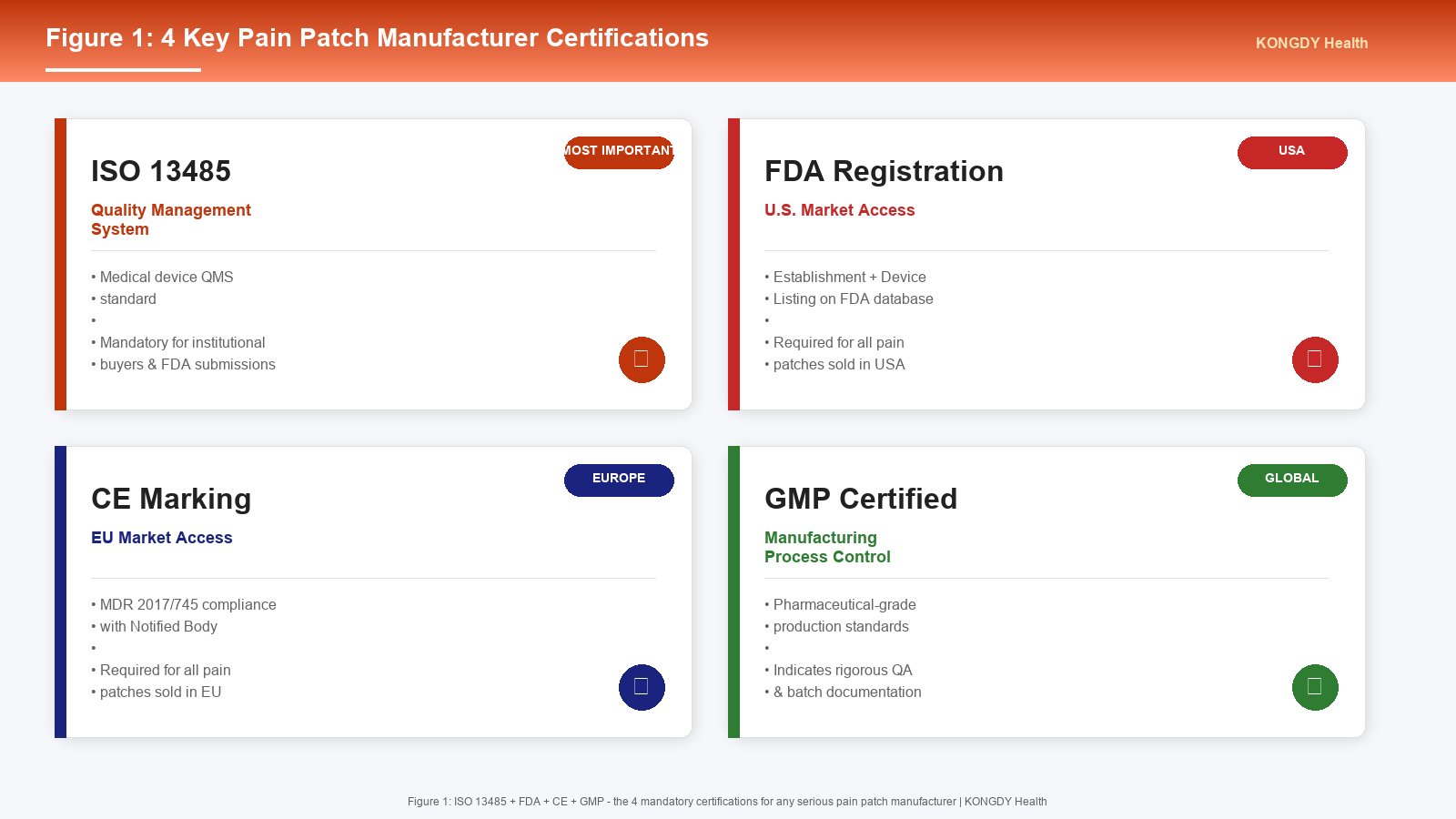
Figure 1: The four mandatory certifications for any serious pain patch manufacturer - ISO 13485, FDA, CE, and GMP.
1. ISO 13485:2016 (QMS - Quality Management System)
What it is: ISO 13485 is the international standard for medical device quality management systems. It specifies requirements for a QMS where an organization needs to demonstrate its ability to provide medical devices and related services that consistently meet customer and applicable regulatory requirements.
Why it matters: ISO 13485 is the foundation of every other pain patch certification. It signals that the manufacturer has documented processes, controlled production, and continuous improvement systems. Most regulatory submissions (FDA 510(k), CE technical file, Health Canada MDL) require ISO 13485 as a prerequisite.
How to verify: Search the certifying body's database (BSI, TUV, SGS, DEKRA) using the certificate number. Verify the certificate is current (not expired) and covers the manufacturer's full address, not just a satellite office.
Red flag: A manufacturer claiming "ISO certified" without specifying ISO 13485 may have a different ISO (e.g., ISO 9001 for general QMS). ISO 9001 is NOT equivalent to ISO 13485 for medical devices.
2. FDA Registration (U.S. Market Access)
What it is: The U.S. Food and Drug Administration (FDA) requires medical device establishments to register with the agency and list their devices. For pain patches, this includes an Establishment Registration and a Device Listing under 21 CFR 807.
Why it matters: Without FDA registration, you cannot legally import or sell pain patches in the United States. U.S. Customs and Border Protection (CBP) checks the FDA Establishment Registration database at the time of import. If your manufacturer is not registered, the shipment is refused entry.
How to verify: Search the FDA Establishment Registration & Device Listing database at accessdata.fda.gov. Look for both Establishment Registration and Device Listing for pain patches (product code is typically "LNJ" for over-the-counter analgesic patches, or specific codes for lidocaine/capsaicin formulations).
Red flag: A manufacturer that claims FDA registration but cannot be found in the database. Some manufacturers list the product as a "cosmetic" or "external use" product to avoid FDA - this is a common regulatory loophole that can backfire when the FDA reclassifies the product.
3. CE Marking (EU Market Access - MDR 2017/745)
What it is: The CE mark indicates that a product complies with EU safety, health, and environmental protection standards. For medical devices, CE marking is governed by the Medical Device Regulation (MDR 2017/745), which replaced the older MDD 93/42/EEC in May 2021.
Why it matters: Without a valid CE certificate, you cannot sell pain patches in any EU member state. The CE certificate must be issued by a Notified Body designated by the European Commission. KONGDY Health's CE certificate covers MDR 2017/745 Class I devices (most OTC pain patches).
How to verify: Search the EUDAMED database (European Database on Medical Devices) or contact the Notified Body directly using the certificate number (typically a 4-digit number, e.g., "0123" for TUV SUD).
Red flag: A CE certificate issued by a non-notified body, or a CE certificate that references the old MDD 93/42/EEC. Post-May 2021, MDD certificates are no longer valid for new product launches.
What it is: GMP is a pharmaceutical-grade manufacturing standard that ensures products are consistently produced and controlled to quality standards appropriate to their intended use. For medical devices, GMP is often aligned with ISO 13485 but goes deeper into process control, batch documentation, and facility requirements.
Why it matters: GMP certification signals that the manufacturer's facility, equipment, personnel, and processes meet the highest standards for medical device production. It is often required for institutional buyers (hospitals, pharmacy chains) and for products sold in highly regulated markets like Japan (PMDA) or South Korea (MFDS).
How to verify: Request the most recent GMP audit report. Verify the issuing authority (national drug regulatory authorities, or accredited certification bodies). GMP certificates typically have 3-5 year validity with annual surveillance audits.
Red flag: A manufacturer that cannot produce a recent GMP audit report, or that produces documentation on demand rather than as a matter of course. GMP is a system; it cannot be created retroactively.
Regional Regulatory Requirements for Pain Patch Manufacturers
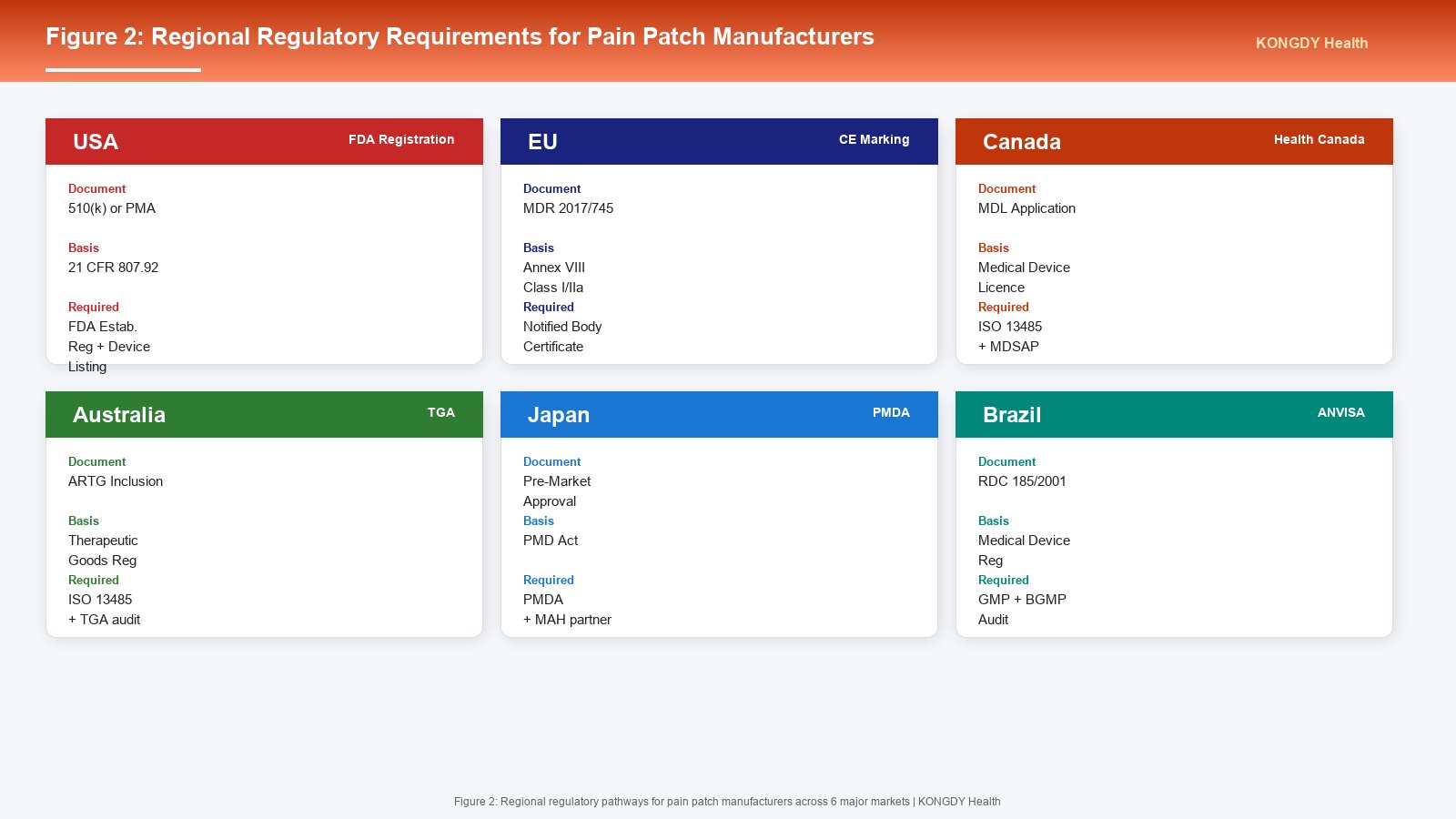
Beyond the four core certifications, pain patch manufacturers must also comply with regional regulations for each target market. Below is an overview of six major markets B2B buyers typically target.
Figure 2: Regional regulatory pathways for pain patch manufacturers across 6 major markets - USA, EU, Canada, Australia, Japan, Brazil.
Market
Regulatory Body
Key Requirement
Documentation
Typical Timeline
USA
FDA
Establishment Registration + Device Listing
21 CFR 807, COA, MSDS
30-60 days
EU
Notified Body + EU Commission
CE Marking under MDR 2017/745
Technical File, Declaration of Conformity
90-180 days
Canada
Health Canada
Medical Device Licence (MDL)
ISO 13485 + MDSAP
60-120 days
Australia
TGA
ARTG Inclusion
ISO 13485 + TGA audit
90-180 days
Japan
PMDA
Pre-Market Approval (PMA)
PMD Act + MAH partner
180-365 days
Brazil
ANVISA
BGMP Audit + Registration
RDC 185/2001 + GMP cert
120-240 days
How to Verify a Pain Patch Manufacturer's Certifications
Verification is non-negotiable. A certificate copy provided by the manufacturer is not proof - it is a starting point. Always cross-check on the issuing body's official database. Here is how:
ISO 13485: Search the certifying body's online database (BSI Group, TUV SUD, SGS, DEKRA, Intertek). Use the certificate number and the manufacturer's legal name. Verify the certificate scope covers medical devices including transdermal patches.
CE Marking: Search the EUDAMED database or contact the Notified Body directly. The 4-digit Notified Body number appears next to the CE mark. Verify it is a designated body under MDR 2017/745 (not just MDD 93/42/EEC).
GMP: Request the most recent GMP audit report. Verify the issuing authority and audit date. GMP certificates are typically valid for 3-5 years with annual surveillance audits.
Common scam patterns to watch for:
Certificate copies that look "too perfect" (no scan artifacts, no Notified Body address)
Certificate numbers that cannot be found in the database
Manufacturers who claim "ISO 9001" instead of "ISO 13485" - they are different
Manufacturers who refuse to provide certificate numbers (e.g., "we have many")
FDA listings that use product codes inconsistent with pain patches (e.g., "cosmetic" or "skin patch" with no active ingredient)
If a manufacturer cannot or will not provide verifiable certificate numbers, walk away. There are dozens of fully certified pain patch manufacturers in China, India, and elsewhere - you do not need to take regulatory risks with unverified suppliers. Browse the KONGDY pain patch catalog for a reference of what a properly certified manufacturer's documentation looks like.
The 6-Stage Compliance Audit Process
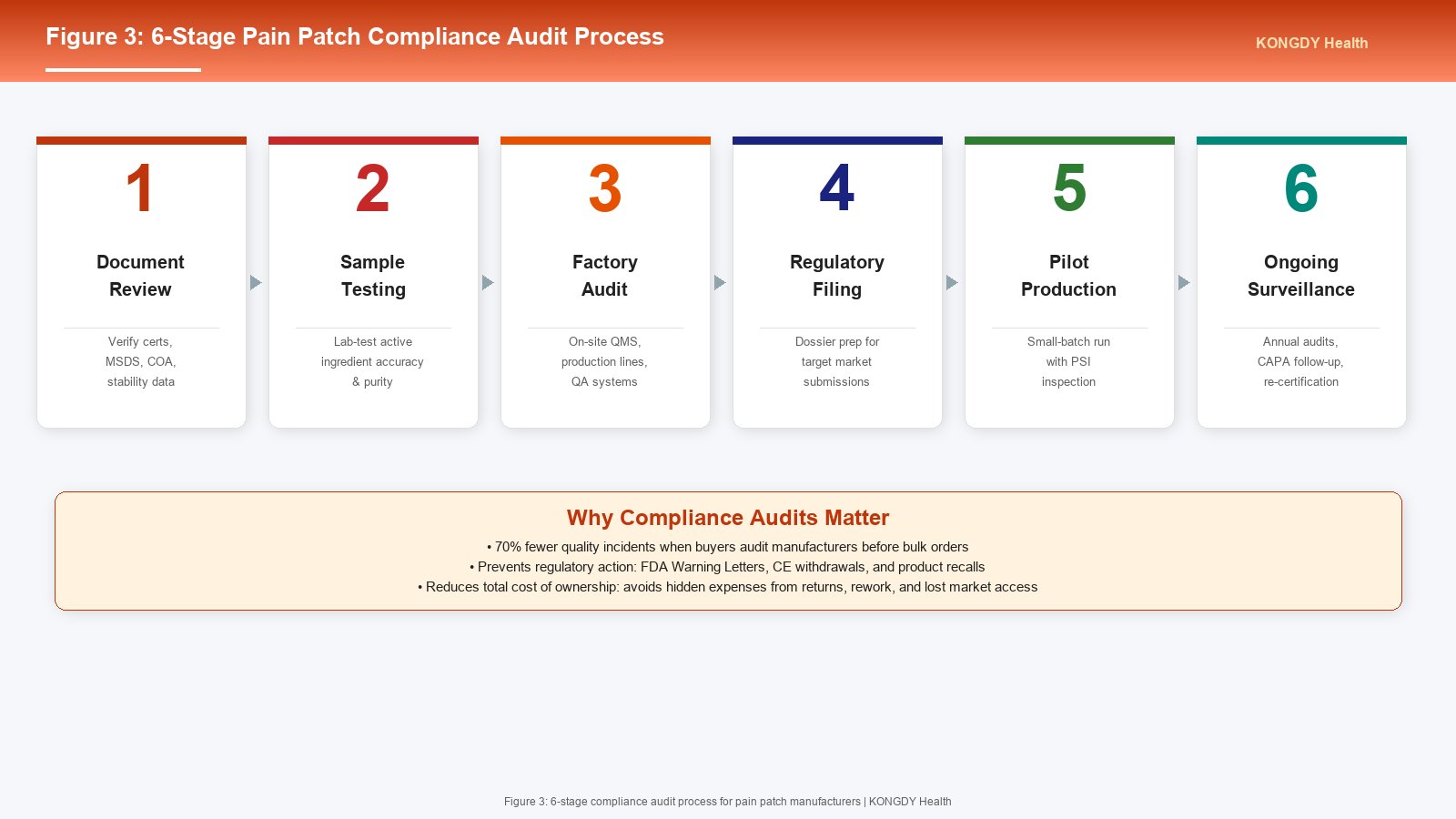
Before placing a bulk order, conduct a structured compliance audit of your prospective pain patch manufacturer. We recommend a 6-stage process that progresses from desktop review to on-site verification:
Figure 3: 6-stage compliance audit process for pain patch manufacturers - from document review through ongoing surveillance.
Stage 1: Document Review (1-2 weeks)
Begin with a desktop review of all manufacturer documentation:
ISO 13485 certificate (verify on issuing body database)
FDA Establishment Registration and Device Listing (verify on FDA database)
CE Certificate and Declaration of Conformity (verify on EUDAMED or Notified Body)
GMP certificate (verify issuing authority)
Product specifications, COAs, MSDS for pain patches
Stability data and shelf life studies
Quality manual and standard operating procedures (SOPs)
Red flag: Documentation that is missing, inconsistent, or cannot be verified on official databases.
Stage 2: Sample Testing (2-3 weeks)
Request 5-10 samples per SKU from the pain patch manufacturer. Send samples to an independent third-party lab for testing:
Active ingredient quantification (HPLC or similar)
Adhesion and wear time testing
Skin irritation and sensitization testing
pH and moisture content
Microbial limits (USP <61> and <62>)
Compare lab results to the manufacturer's claimed specifications. Discrepancies >5% on active ingredient indicate a serious quality control problem.
Stage 3: Factory Audit (1-2 weeks on-site)
Conduct an on-site factory audit - either personally or via a third-party auditor (SGS, TUV, Bureau Veritas). Audit scope should include:
Production line walkthrough (cleanliness, equipment maintenance, operator training)
Quality control laboratory (equipment calibration, testing procedures)
Raw material storage and traceability (COA verification, supplier qualification)
Warehousing and logistics (cold chain if applicable, FIFO/FEFO compliance)
Document control and record-keeping (batch records, deviation reports)
Personnel qualifications and training records
For pain patch manufacturers producing Class I or Class IIa devices, expect a half-day to full-day audit. KONGDY Health welcomes third-party audits at our 20,000 sqm facility.
Stage 4: Regulatory Filing (2-4 weeks)
Work with the manufacturer to prepare regulatory submissions for your target market:
USA: FDA Establishment Registration update, 510(k) if required, labeling compliance review
EU: Technical File, Declaration of Conformity, EUDAMED registration (UDI), labeling per MDR Annex I
Canada: Medical Device Licence application via Health Canada
Australia: TGA ARTG inclusion application
Many pain patch manufacturers provide regulatory support as part of their OEM service. Confirm what is included in your contract before filing.
Stage 5: Pilot Production (4-6 weeks)
Order a small pilot batch (typically 10,000-50,000 pieces) before committing to bulk:
Validate that production scale-up maintains quality
Test packaging and labeling at commercial scale
Conduct Pre-Shipment Inspection (PSI) by independent inspector
Verify COA and batch documentation completeness
A pilot batch is the cheapest insurance policy you can buy. Catching quality issues at 10,000 pieces costs 100x less than discovering them at 1,000,000 pieces.
Stage 6: Ongoing Surveillance (continuous)
Compliance does not end at first delivery. Implement ongoing surveillance:
Annual third-party audits of the manufacturer
Per-batch COA review before shipment release
Customer complaint and adverse event tracking
Regulatory change monitoring (FDA, EU MDR updates)
Certificate renewal tracking (ISO 13485, CE, GMP)
Manufacturers with established QMS - like KONGDY Health - provide ongoing documentation and audit support as part of long-term partnerships.
What Happens When a Pain Patch Manufacturer Fails an Audit
If your audit reveals issues - certificate gaps, documentation problems, or facility concerns - you have three options:
Reject and source elsewhere: If the issues are severe (missing core certifications, falsified documents), walk away. The regulatory risk is not worth the price savings.
Conditional approval with corrective actions: For minor issues (outdated procedure, missing test report), require the manufacturer to fix them within a specified timeframe (e.g., 30-90 days) before placing bulk orders.
Engage a third-party consultant: If you are unsure whether issues are critical or minor, engage a regulatory consultant (e.g., a Notified Body or FDA regulatory affairs firm) for an independent assessment.
The cost of a third-party consultant ($2,000-5,000) is trivial compared to the cost of a regulatory enforcement action ($100,000+ in legal fees, plus shipment losses).
Pain Patch Certification Cost Comparison: Certified vs. Uncertified Manufacturers
Cost Category
Certified Manufacturer (KONGDY)
Uncertified Manufacturer
Per-patch FOB price
$0.10-0.30
$0.05-0.20
Customs clearance
Smooth, no issues
5-15% seizure risk, $5-15K per incident
Regulatory filing support
Included in OEM service
Not available, $10-30K external
FDA Warning Letter risk
Low
High ($50-200K legal)
Product recall exposure
Low (proper COA trail)
High ($100K-1M+)
Retailer audit acceptance
Yes (CVS, Walmart, Amazon)
Often fails
Insurance premiums
Standard
3-10x higher or denied
Time-to-market
30-60 days
90-180+ days (delays from re-documentation)
5-year total cost
Lower (predictable)
Higher (hidden risk)
The price premium for a certified pain patch manufacturer is typically 20-40% higher per patch. But the total cost of ownership over 5 years - factoring in customs risk, regulatory exposure, recall probability, and time-to-market - is consistently lower with a certified partner. Many buyers who initially chose the cheapest manufacturer end up switching after one or two enforcement events.
Common Certification Pitfalls for B2B Buyers
Watch out for these common mistakes when evaluating pain patch manufacturer certifications:
Trusting certificate copies without database verification: Always cross-check on official databases. A copy is not proof.
Confusing ISO 9001 with ISO 13485: ISO 9001 is general QMS. For medical devices, ISO 13485 is required.
Assuming FDA registration is permanent: FDA Establishment Registration must be renewed annually. Verify the registration is currently active.
Accepting MDD certificates post-2021: Old CE certificates under MDD 93/42/EEC are no longer valid for new product launches in the EU.
Not checking product codes in FDA listing: The Device Listing must include the specific product code for pain patches (LNJ or similar), not just "medical device" generically.
Skipping the Notified Body check: The CE mark must come from a Notified Body designated under MDR 2017/745. A self-declared CE (Class I only) is valid for some products but limits market access.
Documentation Checklist for Pain Patch Manufacturers
Before signing a contract, ensure your pain patch manufacturer can provide all of the following documents:
ISO 13485 certificate (current, with scope covering medical devices)
FDA Establishment Registration confirmation
FDA Device Listing for pain patch product codes
CE Certificate (issued by Notified Body under MDR 2017/745)
Declaration of Conformity (EU MDR)
GMP certificate (most recent)
Product COA (Certificate of Analysis) for each batch
MSDS (Material Safety Data Sheet) for each formulation
Stability data (accelerated and real-time)
Recent third-party audit reports (SGS, TUV, Bureau Veritas)
Insurance certificates (product liability)
Quality manual and key SOPs (on request)
A manufacturer that proactively provides all of this documentation - without you having to chase each item - is a strong signal of a mature QMS. Compare this to a manufacturer who is reluctant, slow, or incomplete in their responses.
How KONGDY Health Manages Pain Patch Manufacturer Certifications
As a 36-year veteran pain patch manufacturer, KONGDY Health has built its compliance program around four principles:
Continuous certification maintenance: ISO 13485 surveillance audits every 12 months, full re-certification every 3 years. CE certificate renewal aligned with EU MDR transition timelines. FDA Establishment Registration renewed annually each October.
Per-batch documentation: Every production batch ships with a complete documentation package: COA, batch record, deviation report (if any), and quality release form.
Open audit access: We welcome buyer-initiated and third-party audits at our 20,000 sqm facility. Annual audits are scheduled and ad-hoc audits are accommodated within 30 days.
Regulatory intelligence: Our regulatory affairs team monitors FDA, EU MDR, Health Canada, TGA, and PMDA changes and proactively updates documentation to maintain compliance.
Browse the complete KONGDY pain patch catalog to explore our certified product range. Each product page lists the certifications, target markets, and available documentation.
Frequently Asked Questions
1. What certifications should a pain patch manufacturer have?
A reliable pain patch manufacturer should hold four core certifications: (1) ISO 13485:2016 for quality management, (2) FDA Registration for U.S. market access, (3) CE Marking under MDR 2017/745 for EU market access, and (4) GMP certification for production process control. Additional regional certifications may apply for specific markets (Health Canada, TGA, PMDA, etc.).
2. How do I verify a pain patch manufacturer's ISO 13485 certificate?
Request the certificate number and certifying body (e.g., BSI, TUV SUD, SGS). Search the certifying body's online database using the certificate number to verify the certificate is current, valid, and covers medical devices. Cross-reference the manufacturer's legal name and address with the database entry. Expired, mismatched, or unverifiable certificates are red flags.
3. Is FDA registration the same as FDA approval?
No. FDA Establishment Registration is a notification that a facility exists and what products it makes. FDA approval (510(k) or PMA) is a separate review of the specific product. For most OTC pain patches, only Establishment Registration and Device Listing are required - no premarket approval. However, certain drug-containing patches (e.g., lidocaine 4% patches) may require 510(k) clearance. Confirm with the manufacturer what level of FDA compliance is in place.
4. What is the difference between CE Marking and CE Declaration of Conformity?
The CE Mark is the physical symbol on the product and packaging indicating compliance. The Declaration of Conformity (DoC) is the legal document where the manufacturer declares the product meets all applicable EU directives/regulations. For Class I devices, the manufacturer self-declares; for higher classes, a Notified Body issues the certificate. Both the CE mark AND a valid DoC are required.
5. Why did the EU MDR 2017/745 increase pain patch manufacturer costs?
MDR 2017/745 expanded technical documentation requirements, increased clinical evidence requirements, mandated unique device identification (UDI), and required more rigorous post-market surveillance. The transition from MDD to MDR has increased CE certification costs by 3-5x, eliminated many smaller manufacturers who could not afford the upgrade, and extended certification timelines by 6-12 months. Despite the cost, MDR-compliant pain patch manufacturers have stronger market positioning and access to EU institutional buyers.
6. How often should I audit my pain patch manufacturer?
Best practice is at least annual on-site audits, plus quarterly desktop reviews of certification status, regulatory updates, and quality metrics. For high-volume or new relationships, consider more frequent audits (semi-annual or quarterly). Independent third-party audits by firms like SGS, TUV, or Bureau Veritas add credibility and reduce your team's travel burden.
7. Can a pain patch manufacturer hold GMP certification without ISO 13485?
Technically yes - GMP and ISO 13485 are related but separate certifications. However, in practice, any manufacturer with serious GMP credentials will also have ISO 13485 because the two standards overlap significantly. A GMP-only manufacturer (no ISO 13485) is unusual and should prompt additional questions about their QMS maturity. For B2B buyers, both are essentially required.
8. What is a Notified Body, and why does it matter for pain patch manufacturers?
A Notified Body is an organization designated by an EU member state to assess the conformity of certain products before they are placed on the EU market. For medical devices under MDR 2017/745, the Notified Body issues the CE certificate after reviewing the manufacturer's technical file, QMS, and product testing. The Notified Body's 4-digit number appears next to the CE mark on the product. A CE certificate from a non-designated body is invalid and a major red flag. KONGDY Health's CE certificate is issued by a designated Notified Body under MDR 2017/745.
9. Do I need separate certifications for each country in the EU?
No. The CE mark is valid across all 27 EU member states plus the European Economic Area (Iceland, Liechtenstein, Norway) and Switzerland (under MRA). A single CE certificate issued by a Notified Body grants market access across the entire European Economic Area. This is one of the key advantages of EU compliance - one certification opens 30+ country markets.
10. How do I know if a pain patch manufacturer is being truthful about certifications?
Cross-check every claim on the official database. ISO 13485 - certifying body database (BSI, TUV, SGS). FDA - accessdata.fda.gov. CE - EUDAMED or Notified Body website. GMP - issuing authority verification. Independent third-party audits add another layer of verification. If a manufacturer is consistently verifiable across all four databases and welcomes third-party audits, they are almost certainly legitimate. Inconsistencies, expired certs, or refusal to provide certificate numbers are red flags. KONGDY Health provides verifiable certificate numbers and welcomes buyer-initiated audits.
State-level regulations (e.g., California Prop 65)
Annual FDA compliance review
EU only
ISO 13485 + CE (MDR 2017/745) + GMP
EUDAMED registration, UDI, EU REP
Annual Notified Body surveillance
USA + EU
ISO 13485 + FDA + CE + GMP
EUDAMED + UDI + EU REP + FDA listing
Annual dual-region audit
Canada
ISO 13485 + Health Canada MDL
MDSAP certification
Annual MDSAP audit
Australia
ISO 13485 + TGA ARTG
TGA conformity assessment
Annual TGA audit
Japan
ISO 13485 + PMDA approval
MAH (Marketing Authorization Holder)
PMDA pre-market + annual
Global (multi-region)
ISO 13485 + FDA + CE + GMP
Country-specific add-ons
Annual + region-specific audits
E-commerce (Amazon, Shopify)
ISO 13485 + GMP
Platform-specific labeling, COA on demand
Pre-shipment + annual
Hospital / institutional
ISO 13485 + FDA/CE + GMP
Tender documentation, full audit trail
Pre-tender + annual
About KONGDY Health
KONGDY Health is a fully certified pain patch manufacturer with 36 years of expertise in transdermal patch technology. Headquartered in Zhoukou, Henan, our 20,000 sqm GMP-certified facility produces over 100 million pain patches annually for buyers in 60+ countries. We hold all four core certifications - ISO 13485:2016, FDA Registration, CE Marking under MDR 2017/745, and GMP - plus additional regional approvals for Canada, Australia, Japan, and other markets.
Browse the complete KONGDY pain patch catalog to explore our certified product range. Each SKU ships with full documentation: COA, MSDS, stability data, and regulatory dossiers for your target market. Whether you are a first-time importer or an established brand expanding globally, our compliance team is ready to support your regulatory strategy.