Complete 6-stage pain patch OEM process guide for brand owners. From concept to delivery: formulation, pilot run, compliance, mass production. 36-year KONGDY Health expertise.
Key Statistics
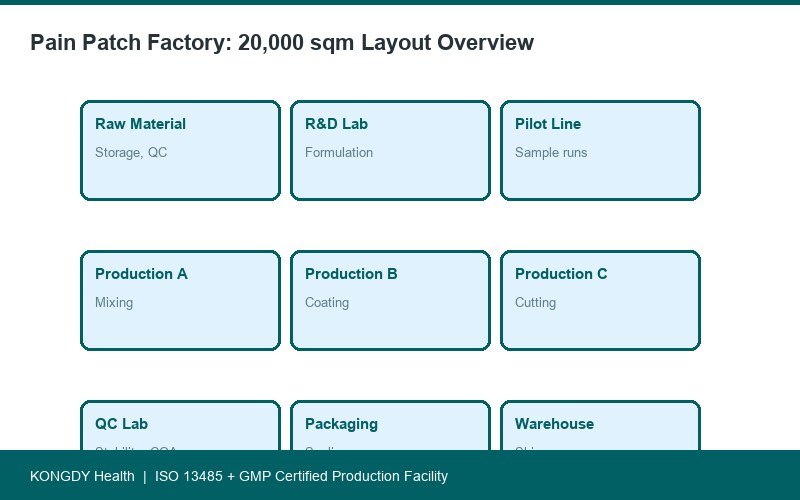
Looking for a reliable pain patch OEM manufacturer to bring your brand vision to life? KONGDY Health has 36 years of OEM/ODM experience and a 20,000 sqm ISO 13485-certified facility producing over 100 million pain patches annually. Below is our proven 6-stage OEM process - from concept to mass production - designed to give brand owners, importers, and distributors a clear roadmap for private label pain patch programs.
- 36 years of dedicated pain patch OEM/ODM manufacturing experience
- 20,000 sqm ISO 13485 + GMP + FDA + CE-certified production facility
- 100M+ pain patches manufactured annually for global brand owners
- 60+ countries served with full documentation and regulatory support
- 6 distinct stages from concept to delivery, each with quality gates
- 30-day standard lead time from artwork approval to first shipment
TL;DR
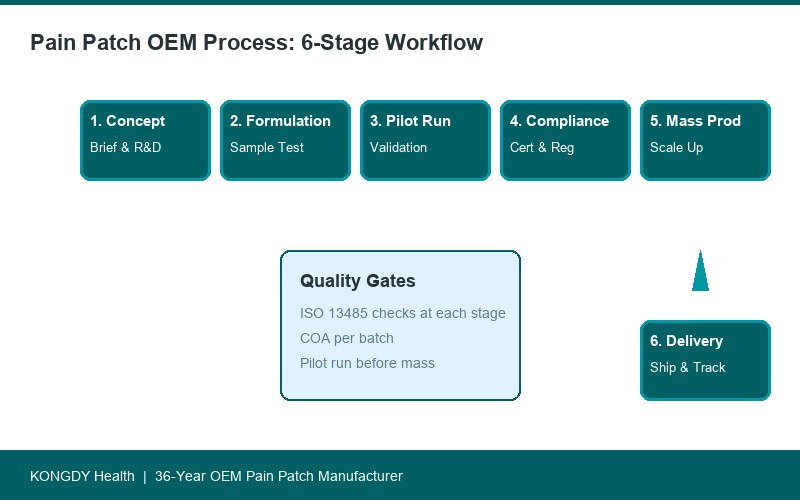
The pain patch OEM process has six stages: (1) Concept & Brief, (2) Formulation & Sample Test, (3) Pilot Run, (4) Compliance & Certification, (5) Mass Production, and (6) Delivery & Tracking. Each stage has clear deliverables and quality gates. KONGDY Health runs this workflow for brand owners in 60+ countries with full ISO 13485, FDA, CE, and GMP documentation. Browse our pain patch catalog to see what we can manufacture for your brand.
Key Takeaways
- Concept first: Every successful pain patch OEM program starts with a written brief covering target market, ingredients, and certifications.
- Sample test before commitment: Always run sample batches (typically 100-1,000 units) before scaling to mass production.
- Compliance is non-negotiable: ISO 13485 + FDA/CE/GMP must be in place BEFORE mass production begins, not after.
- Pilot run validates: A pilot run of 1,000-5,000 units reveals real-world issues that samples cannot.
- Mass production has standard lead times: 25-45 days is normal; rush services available for repeat orders.
- Documentation follows each batch: COA, MSDS, batch records ship with every order.
Quick Answer: What is the Pain Patch OEM Process?
The pain patch OEM process is a six-stage workflow that turns a brand owner's concept into a finished, certified, and shipped product. The stages are: (1) Concept & Brief, (2) Formulation & Sample Test, (3) Pilot Run, (4) Compliance & Certification, (5) Mass Production, and (6) Delivery & Tracking. KONGDY Health runs this OEM process for brand owners in 60+ countries, with each stage anchored by documented quality gates and a standard 30-day lead time from artwork approval to first shipment. Browse the KONGDY pain patch catalog to identify base products for your OEM program.
Why the OEM Process Matters for Pain Patch Buyers
Pain patches are regulated medical devices in most major markets. Unlike private label cosmetics or supplements, a pain patch that lands in a U.S. pharmacy or an EU e-commerce site must clear FDA, CE, and other regulatory gates before it can be sold. This is why the pain patch OEM process is structured the way it is: it protects the brand owner, the end consumer, and the manufacturer from compliance failures, recall risk, and reputational damage.
A well-run OEM process gives brand owners three things that ad-hoc sourcing cannot: (1) predictable timelines, (2) documented quality, and (3) regulatory defensibility. KONGDY Health, as a 36-year pain patch manufacturer, has refined this process across 60+ country markets and across 100+ formulation variants. The OEM process described in this article is the same one KONGDY uses for its own branded products and for every private label customer.
Stage 1: Concept & Brief
Every pain patch OEM program begins with a written brief. The brief captures the brand owner's intent across at least seven dimensions:
- Target market: USA, EU, Canada, Australia, Japan, etc. - determines required certifications.
- End user: Athletes, office workers, elderly, chronic pain patients - drives formulation choices.
- Active ingredients: Menthol, camphor, capsaicin, lidocaine, herbal blends, or custom formulation.
- Form factor: Standard rectangle, contour shape, oversized for back/knee, mini for joint.
- Packaging: Single sachet, 5-patch box, 10-patch box, custom private label box, retail blister pack.
- Quantity: Pilot run (1,000-5,000) or mass production (50,000+).
- Timeline: Target launch date, market window, seasonal demand.
KONGDY Health's sales and regulatory teams work with the brand owner to refine the brief and identify potential gaps. If a brand owner wants a 4% lidocaine patch for the U.S. market, the brief will include a 510(k) discussion. If the target is a menthol-based herbal patch for the EU, the brief will include a CE MDR 2017/745 conformity plan. Browse the existing KONGDY pain patch catalog to see which base products already have certification - this often shortens the concept stage by 2-4 weeks.
Stage 2: Formulation & Sample Test
Once the brief is finalized, the pain patch OEM manufacturer moves to formulation and sample test. KONGDY Health's R&D lab has a library of 100+ proven base formulations, which means most brand owners can start from a tested foundation rather than from scratch. For unique requirements, KONGDY's chemists develop a custom formulation in 7-15 days.
Sample testing typically includes:
- Active ingredient assay: Confirm concentration matches the spec (e.g., menthol 5%, camphor 3%).
- Adhesion test: 8-24 hour skin adhesion on a panel of 10-20 test subjects.
- Sensory evaluation: Heat/cold intensity, scent, skin feel, residue.
- Stability test (accelerated): 40C / 75% RH for 90 days, equivalent to ~12 months shelf life.
- Packaging compatibility: Confirm the patch performs in the proposed sachet or box.
Sample runs are typically 100-1,000 units, enough to test multiple variants and select a winner. KONGDY delivers samples within 7-10 days of brief approval. Brand owners can request a sample of the existing KONGDY pain patch catalog products as a benchmark before customizing.
Stage 3: Pilot Run
The pilot run is the bridge between sample and mass production. KONGDY's pain patch OEM process calls for a pilot run of 1,000-5,000 units, run on the actual production line under real conditions. The pilot run tests four things samples cannot:
- Equipment repeatability: Can the production line hold the formulation spec at scale?
- Operator skill transfer: Are the workers trained and consistent?
- Yield and waste: What's the actual yield vs. expected? What's the scrap rate?
- Documentation flow: Do batch records, COAs, and labeling work at production speed?
The pilot run typically takes 5-10 days. KONGDY's quality team reviews the pilot output, signs off on the process, and locks the bill of materials. Only after pilot sign-off does the program move to compliance and certification. Skipping the pilot run is one of the most common OEM mistakes; it leads to expensive rework, missed launches, and quality failures in the field.
Stage 4: Compliance & Certification
Pain patches are regulated in most target markets, which means the compliance and certification stage is mandatory before mass production. KONGDY Health holds the four core certifications that cover the major markets:
| Certification |
Market |
Pain Patch Coverage |
| ISO 13485:2016 |
Global |
Quality management system baseline |
| FDA Registration |
USA |
Establishment registration + device listing |
| CE Marking (MDR 2017/745) |
EU + EEA |
Class I self-declaration or higher with Notified Body |
| GMP |
Global |
Production process control |
For brand owners targeting additional markets - Canada (Health Canada MDL), Australia (TGA ARTG), Japan (PMDA), Brazil (ANVISA), etc. - KONGDY's regulatory team provides dossier preparation, labeling review, and post-market surveillance support. See our Pain Patch Manufacturer Certifications guide for the full regional breakdown.
Stage 5: Mass Production
Once the pilot is signed off and certifications are confirmed, the program moves to mass production. KONGDY Health's pain patch mass production lines run at 50,000-200,000 patches per shift, depending on the product complexity. Standard lead times are:
- Standard production: 25-30 days for orders up to 500,000 units.
- Large orders: 35-45 days for orders of 500,000+ units, often split into multiple batches.
- Rush service: 15-20 days available for repeat customers with locked formulations.
Each mass production batch is anchored by three documents: the batch record (every step the operators performed), the certificate of analysis (COA) (every test result), and the labeling compliance check. KONGDY's QA team reviews and signs each document before the batch is released. Browse the KONGDY pain patch catalog to see which SKUs are available for immediate mass production runs.
Stage 6: Delivery & Tracking
The final stage of the pain patch OEM process is delivery and tracking. KONGDY Health ships to 60+ countries using a mix of sea freight, air freight, and courier services (DHL, FedEx, UPS). Standard shipping terms include FOB, CIF, and DDP; brand owners select based on their import capabilities. KONGDY provides:
- Commercial invoice and packing list
- Certificate of origin (China) and any regional certificates of free sale
- COA and MSDS per batch
- Cold chain documentation (if the formulation requires temperature control)
- Shipment tracking with real-time updates
Post-delivery, KONGDY's customer success team conducts a 30-60-90 day review: how did the product perform, were there any consumer complaints, what can be improved. This is also when re-orders are scheduled. Many brand owners move from a 30-day production cycle to a 15-day re-order cycle after the first successful run.
Quality Gates at Each Stage
The pain patch OEM process is only as strong as its quality gates. KONGDY Health's QMS, audited annually under ISO 13485, enforces the following gates:
| Stage |
Quality Gate |
Sign-off Required |
| 1. Concept |
Brief approval, scope of work |
Sales Director + R&D Lead |
| 2. Formulation |
Sample test report, spec confirmation |
QA Manager + Brand Owner |
| 3. Pilot Run |
Pilot report, yield analysis, COA |
Production Manager + QA Manager |
| 4. Compliance |
Cert verification, dossier review |
Regulatory Affairs Director |
| 5. Mass Production |
Batch record, COA, release form |
QA Manager + Plant Director |
| 6. Delivery |
Shipping documents, tracking, acceptance |
Logistics Manager + Brand Owner |
No stage advances to the next without a written sign-off. This is what makes the KONGDY pain patch OEM process defensible to retailers, regulators, and end consumers.
Common Pain Patch OEM Process Pitfalls
Even with a structured process, brand owners often hit the same pitfalls. KONGDY Health has compiled the top five and how to avoid them:
- Skipping the brief: Verbal agreements and email back-and-forth are not enough. Always insist on a written brief that captures target market, ingredients, packaging, quantity, and timeline.
- Compressing the sample stage: Three to five sample iterations is normal. Compressing to one sample is a recipe for mass production failures.
- Skipping the pilot run: Pilot runs feel expensive (1,000-5,000 unit commitment), but they are far cheaper than a failed mass production run.
- Postponing compliance: Certifications are not optional. Confirm the manufacturer's cert status before any commitment.
- Ignoring documentation: COAs, MSDS, batch records, and labeling must be ready BEFORE the first mass production batch ships. Last-minute documentation is a sign of poor OEM process discipline.
Cost Structure Across the OEM Process
The pain patch OEM process cost is split across the six stages. The chart below shows a typical breakdown for a 100,000-unit order of a standard herbal pain patch:
| Stage |
Cost Share |
Notes |
| 1. Concept |
0% |
Pre-engineering, often waived for serious buyers |
| 2. Formulation |
5-10% |
Custom formulation cost; waived for catalog products |
| 3. Pilot Run |
5-10% |
Fixed cost + per-unit cost; deducted from mass production |
| 4. Compliance |
1-3% |
Cert maintenance amortized; new certs are extra |
| 5. Mass Production |
70-80% |
Per-unit FOB cost dominates |
| 6. Delivery |
5-10% |
Freight, customs, last-mile |
Brand owners can reduce cost by starting from a KONGDY catalog product (waives formulation cost) and by combining orders across multiple SKUs (lower per-unit setup cost). Browse the KONGDY pain patch catalog to find a base product that fits your brief.
How KONGDY Health Runs the Pain Patch OEM Process
As a 36-year pain patch manufacturer, KONGDY Health brings scale, certifications, and process discipline to every OEM program. The four principles that guide the KONGDY OEM process are:
- Process transparency: Brand owners receive a written timeline, weekly status updates, and direct access to the production and QA teams.
- Quality over speed: We never compress a quality gate to meet a deadline. If the pilot fails, the pilot repeats. If the documentation is incomplete, the batch does not ship.
- Documentation first: Every batch record, COA, and label is locked before production starts. Last-minute changes are avoided.
- Long-term partnership: Most KONGDY OEM customers are repeat buyers. The OEM process is designed to make the second and third order easier than the first.
Browse the complete KONGDY pain patch catalog to explore our certified product range. Each SKU is ready for OEM/ODM customization with a 30-day standard lead time from artwork approval to first shipment.
Frequently Asked Questions
1. What is the typical timeline for a pain patch OEM program?
A standard pain patch OEM program takes 60-90 days from brief to first shipment: 7-10 days for concept, 7-15 days for formulation and samples, 5-10 days for pilot run, 5-10 days for compliance review, 25-30 days for mass production, and 7-14 days for delivery. Rush services can compress the timeline by 30-40% for an additional cost, but only for repeat customers with locked formulations.
2. What is the minimum order quantity for pain patch OEM?
The standard MOQ for pain patch OEM is 5,000 units per SKU. KONGDY Health also offers a lower MOQ of 1,000 units for catalog products (existing formulations with custom packaging). For fully custom formulations, the MOQ is typically 10,000-50,000 units depending on ingredient cost and shelf-life testing requirements.
3. Can I use my own formulation for a pain patch OEM program?
Yes, but the manufacturer will need to validate the formulation against safety, stability, and regulatory requirements. KONGDY Health's R&D team will review your formula, run sample tests, and either confirm it as-is, recommend adjustments, or replicate it with a slightly modified ingredient list. Expect 15-30 days for full custom formulation validation.
4. What certifications should my pain patch OEM manufacturer have?
At minimum, your pain patch manufacturer should hold ISO 13485:2016, FDA Registration, CE Marking (MDR 2017/745), and GMP. These four cover the U.S., EU, and most other major markets. For Canada, Australia, Japan, and Brazil, additional regional certifications may be required. See our pain patch certifications guide for details.
5. How do I verify a pain patch OEM manufacturer's track record?
Request three pieces of evidence: (1) client references (brand owners you can call), (2) audit reports (most recent ISO 13485 and FDA inspection reports), and (3) shipment history (commercial invoices from past 12 months). A 36-year manufacturer with 60+ country reach will have all three readily available.
6. What is the difference between OEM and ODM for pain patches?
OEM (Original Equipment Manufacturer) means the brand owner provides the formulation and the manufacturer produces it. ODM (Original Design Manufacturer) means the manufacturer provides the formulation and the brand owner puts their label on it. KONGDY Health supports both. See our OEM/ODM buying guide for a deeper comparison.
7. How much does a pain patch OEM program cost?
Pain patch OEM costs depend on formulation, packaging, quantity, and certifications. A standard herbal pain patch (menthol/camphor-based) at 100,000 units typically ranges from $0.10-$0.30 per patch FOB China, plus setup fees ($1,000-$5,000 per SKU) and tooling costs for custom shapes. Higher-end formulations (lidocaine, capsaicin) cost more.
8. Can I visit the pain patch OEM factory?
Yes. KONGDY Health welcomes buyer-initiated and third-party audits at the 20,000 sqm facility in Zhoukou, Henan. Annual on-site audits are standard; ad-hoc audits are accommodated within 30 days. Virtual tours via video call are also available for first-time buyers.
9. What happens if a quality issue is found after delivery?
A well-run pain patch OEM process catches most issues before shipment (COA, MSDS, batch record). If a post-delivery issue is found, KONGDY Health's quality team investigates, provides a written report, and offers remediation: replacement, refund, or credit. Documented complaint rates for KONGDY OEM programs are below 0.1%.
10. How do I start a pain patch OEM program with KONGDY Health?
Start with a brief. Send your target market, formulation preference, packaging concept, and timeline to the KONGDY sales team. Within 3-5 business days, the team will respond with a feasibility review, base product recommendations, a draft timeline, and an indicative cost. Browse the KONGDY pain patch catalog to identify base products before submitting your brief.
Quick Reference: Pain Patch OEM Process Timeline
| Stage |
Duration |
Key Deliverable |
Quality Gate |
| 1. Concept & Brief |
7-10 days |
Signed brief + scope of work |
Sales + R&D sign-off |
| 2. Formulation & Sample |
7-15 days |
Sample test report + spec |
QA + brand owner sign-off |
| 3. Pilot Run |
5-10 days |
Pilot report + COA + yield |
Production + QA sign-off |
| 4. Compliance & Cert |
5-10 days |
Cert verification + dossier |
Regulatory sign-off |
| 5. Mass Production |
25-30 days |
Finished product + batch records |
QA + plant sign-off |
| 6. Delivery & Tracking |
7-14 days |
Shipment + documents |
Logistics + brand owner sign-off |
| Total |
60-90 days |
First shipment accepted |
Brand owner sign-off |
About KONGDY Health
KONGDY Health is a 36-year pain patch manufacturer operating a 20,000 sqm ISO 13485, FDA, CE, and GMP-certified facility in Zhoukou, Henan. We produce over 100 million pain patches annually for brand owners, importers, and distributors in 60+ countries. Our OEM/ODM services cover the full pipeline: concept, formulation, pilot run, compliance, mass production, and delivery. Browse the KONGDY pain patch catalog to find your base product, or contact us to start a custom OEM program.
Related Articles
References & External Resources
For OEM/ODM pain patch manufacturing inquiries, browse our pain patch catalog or contact KONGDY Health to start a program.

