How to Choose a Pain Patch Manufacturer: OEM/ODM Buying Guide
A structured 6-pillar framework for evaluating pain patch manufacturers, including certifications, experience, capacity, R&D, compliance, and support. Covers the OEM/ODM process from first inquiry to bulk delivery, red flags to avoid, and a manufacturer comparison checklist.
Jun 23rd,2026440 Views
Key Statistics:
The global pain patch market is projected to reach $5.8 billion by 2028, growing at 6.4% CAGR driven by aging populations and OTC self-care demand.
China-based pain patch manufacturers supply over 60% of private-label pain patches sold in North America and Europe.
Only 35% of new pain patch importers successfully scale past their first container due to manufacturer quality issues.
Buyers who conduct on-site factory audits report 70% fewer quality incidents versus those relying on documentation alone.
The average OEM pain patch lead time is 25-45 days from sample approval to bulk delivery.
Working with a 36-year veteran manufacturer like KONGDY Health typically reduces time-to-market by 30-40% versus newer suppliers.
TL;DR
Choosing a pain patch manufacturer requires evaluating certifications, capacity, R&D, and support-not just price.
The 6-pillar framework (Certifications, Experience, Capacity, R&D, Compliance, Support) gives a structured evaluation approach.
ISO 13485, FDA, CE, and GMP certifications are non-negotiable for any serious OEM pain patch supplier.
Sample evaluation (5-15 days) and small-batch pilot (10,000 pieces MOQ) should precede any bulk commitment.
The full OEM/ODM process takes 45-75 days from first inquiry to first delivery.
KONGDY Health is a 36-year pain patch manufacturer offering all 6 pillars under one roof.
Key Takeaways
Certifications are the foundation: ISO 13485 + FDA/CE/GMP must be verified, not just claimed.
Manufacturer experience matters: 10+ years in transdermal patches beats newer entrants with generic pharma backgrounds.
Capacity must be auditable: Visit the facility or commission third-party audits.
R&D is your competitive moat: Custom formulation and packaging distinguish premium manufacturers.
Documentation prevents disputes: COA, MSDS, stability data, and compliance dossiers must be standard.
After-sales support signals long-term partners: Avoid manufacturers who disappear after delivery.
Medically reviewed by the KONGDY Health B2B Editorial Team. Last updated: 2026-06-23.
Quick Answer
To choose the right pain patch manufacturer, use a 6-pillar evaluation: (1) Certifications (ISO 13485, FDA, CE, GMP), (2) Experience (10+ years in transdermal patches), (3) Capacity (MOQ flexibility + scale-up), (4) R&D (custom formulation + packaging), (5) Compliance (documentation + audit access), (6) Support (logistics + QA + after-sales). Request samples, conduct a small-batch pilot at 10,000 pieces MOQ, and verify certifications on issuing body websites before placing bulk orders. A 36-year veteran like KONGDY Health typically scores 5-6/6 across these pillars and serves buyers in 60+ countries.
Introduction
The pain patch market is booming. Whether you are a brand owner launching a new line, a distributor expanding your portfolio, or a healthcare provider seeking private-label options, choosing the right pain patch manufacturer is the single most important decision you will make. Get it wrong, and you face product recalls, regulatory issues, and damaged customer trust. Get it right, and you have a long-term partner who supports your growth with quality, reliability, and innovation.
This guide draws on 36 years of transdermal patch manufacturing expertise to give B2B buyers a structured framework for evaluating suppliers. We will walk through the 6 pillars that distinguish world-class manufacturers, the red flags that signal risk, and the OEM/ODM process from first inquiry to first delivery. By the end, you will have a clear checklist for selecting a partner who can scale with your business.
Why Choosing the Right Pain Patch Manufacturer Matters
The pain patch is not a commodity product. Unlike generic tablets or capsules, each pain patch involves a complex transdermal delivery system: a backing layer, adhesive matrix, active ingredient, release liner, and packaging. The manufacturer must control ingredient compatibility, drug release kinetics, skin adhesion, stability, and regulatory compliance across multiple jurisdictions.
Regulatory risk: Failure to meet FDA, CE, or local market requirements can block import or trigger recalls.
Supply chain disruption: Late deliveries, stockouts, or production halts that damage your customer relationships.
Brand damage: A single quality incident can permanently tarnish your brand, especially in regulated categories like pain relief.
Conversely, a strong manufacturer gives you:
Predictable quality: Consistent batch-to-batch performance with documented COA for every shipment.
Regulatory peace of mind: Certifications that pass customs and retailer audits in your target markets.
Innovation pipeline: New formulations, packaging options, and trend-driven products.
Operational leverage: The manufacturer handles compliance, stability testing, and documentation so you can focus on marketing and sales.
The 6-Pillar Manufacturer Evaluation Framework
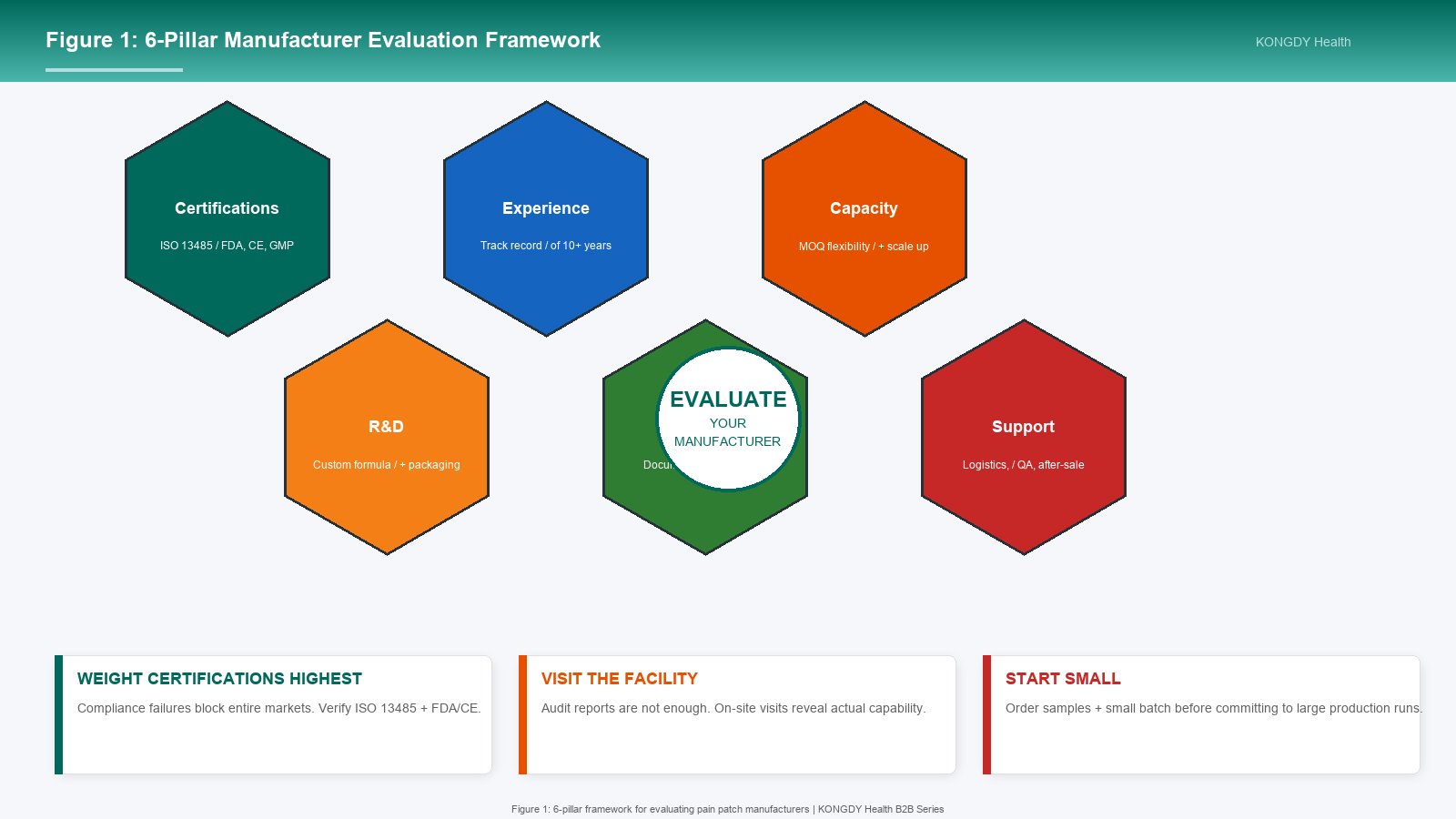
After three decades of working with distributors, brand owners, and retailers across 60+ countries, we have identified six pillars that consistently predict whether a pain patch manufacturer relationship will succeed or fail. Use this framework to score each candidate on a 1-5 scale; the highest-scoring manufacturer is usually your best choice.
Figure 1: 6-pillar framework for evaluating pain patch manufacturers across certifications, experience, capacity, R&D, compliance, and support.
Pillar 1: Certifications (Weight: 25%)
Certifications are the most heavily weighted pillar because they gate access to markets. A pain patch manufacturer without the right certifications cannot legally sell into your target market, no matter how good their product is.
The four certifications that matter most:
ISO 13485:2016: Quality management system specifically for medical devices, including transdermal patches. Mandatory for most institutional buyers and regulatory submissions.
FDA Registration: Required for selling pain patches in the United States. Verify on the FDA establishment registration database, not just on the manufacturer's website.
CE Marking (MDR 2017/745): Required for the European Union. Verify the CE certificate was issued by a notified body and covers your product category.
GMP (Good Manufacturing Practice): Pharmaceutical-grade manufacturing standard. Indicates rigorous process control and batch documentation.
Red flag: A manufacturer who claims certifications but cannot provide certificate numbers verifiable on issuing body websites. Always verify independently.
Pillar 2: Experience (Weight: 20%)
Transdermal patch manufacturing is a specialized skill set that takes years to develop. A manufacturer with 10+ years of dedicated transdermal experience will outperform a newer entrant or a generic pharma manufacturer pivoting from capsules or liquids.
Key experience questions to ask:
How many years have you manufactured pain patches specifically?
How many pain patch SKUs are currently in your production catalog?
How many countries do you actively export to?
Can you provide references from buyers in my target market?
What is your annual production capacity for pain patches (in million pieces)?
A 36-year veteran like KONGDY Health has weathered multiple regulatory shifts, ingredient shortages, and market changes-these learnings are embedded in their processes.
Pillar 3: Capacity (Weight: 15%)
Capacity matters for two reasons: MOQ flexibility at the start, and scale-up ability as your business grows. A manufacturer with rigid MOQs (e.g., 100,000 pieces minimum) may not work for new entrants, while one with too much flexibility may have underutilized capacity and quality drift.
Look for:
MOQ flexibility: 10,000-50,000 pieces for samples and small-batch pilots.
Scale-up runway: Ability to grow with you from 10,000 to 1,000,000+ pieces without quality drift.
Production lines: Multiple lines for different patch formats and active ingredients.
Lead time transparency: Clear published lead times with accountability for delays.
Pillar 4: R&D Capability (Weight: 15%)
R&D capability is what differentiates a true manufacturer from a contract packer. A strong R&D team can develop custom formulations, optimize existing formulas for new markets, and create packaging that stands out on retail shelves.
Key R&D questions to ask:
How many R&D scientists do you have on staff?
Can you develop custom formulations (new active ingredient combinations, dosage strengths, or release profiles)?
Do you have in-house stability testing capabilities?
Can you provide formulation samples within 7-10 days?
What is your process for scaling a lab formula to commercial production?
Manufacturers with strong R&D can also help you navigate regulatory differences across markets-a 4% lidocaine patch in the US requires different documentation than in the EU or Australia.
QA & complaint handling: Responsive investigation of any quality issue with root cause analysis.
Reorder support: Easy reordering with consistent lead times and quality.
Market intelligence: Sharing of trends, regulatory changes, and new product opportunities.
A manufacturer who assigns you a dedicated account manager typically signals a stronger long-term partnership than one who treats you as a ticket number.
Pain Patch Product Portfolio Comparison
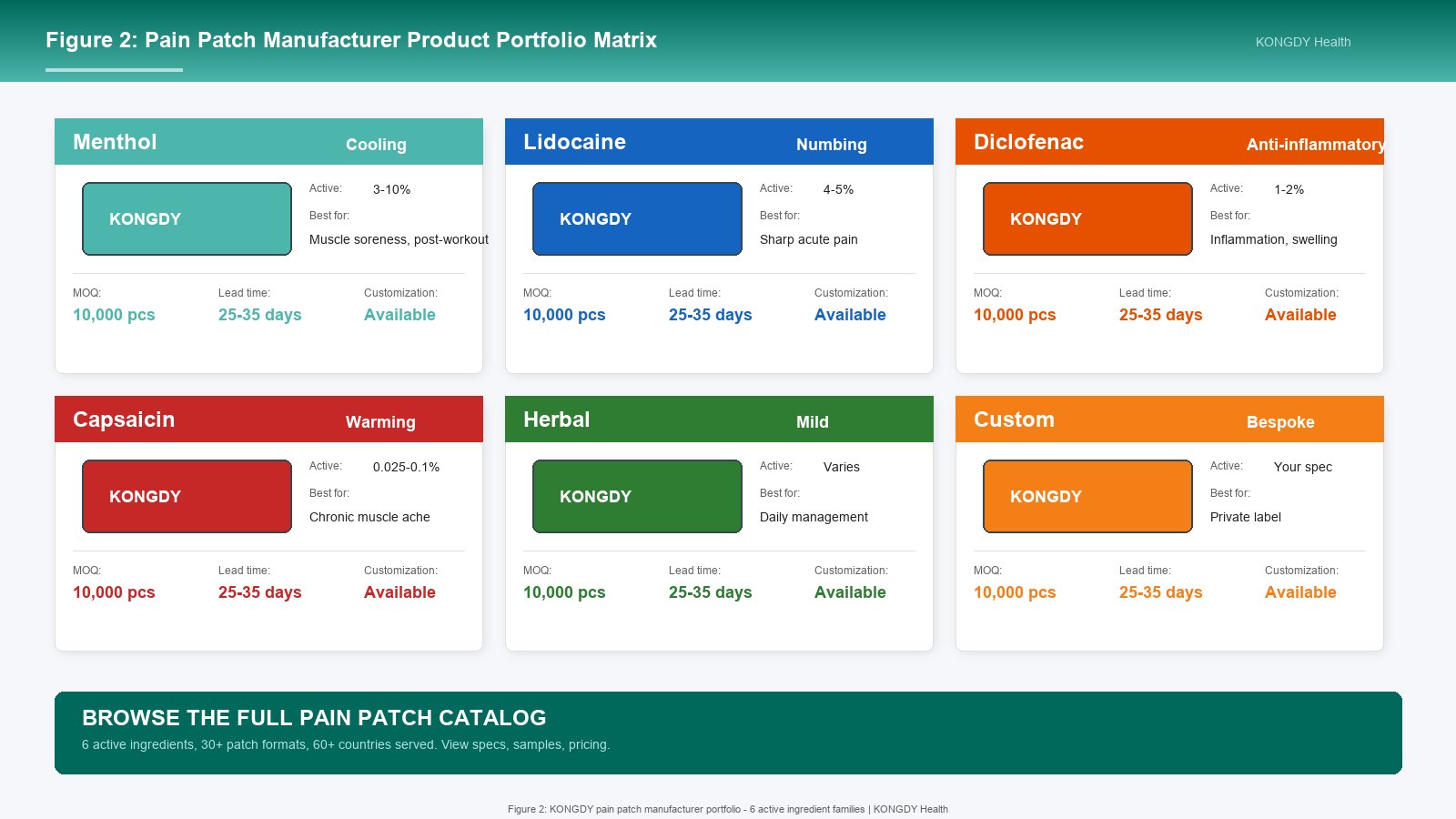
A versatile pain patch manufacturer should offer a broad product portfolio covering different active ingredients, dosage strengths, and patch formats. This allows you to expand your product line without onboarding a new supplier for each new SKU. Browse the complete KONGDY pain patch catalog to see typical manufacturer offerings.
Figure 2: Pain patch manufacturer product portfolio matrix across 6 active ingredient families with MOQ, lead time, and customization options.
Active Ingredient Family
Typical Strength
Best For
Manufacturer Lead Time
Menthol
3-10%
Post-workout soreness, muscle fatigue
25-35 days
Lidocaine
4-5%
Sharp acute pain, neuropathy
30-40 days
Diclofenac
1-2%
Inflammation, swelling, joint pain
35-45 days
Capsaicin
0.025-0.1%
Chronic muscle ache, neuropathic pain
30-40 days
Herbal
Varies
Daily management, sensitive users
25-35 days
Custom formulation
Your spec
Private label, brand differentiation
45-75 days
The OEM/ODM Pain Patch Manufacturing Process
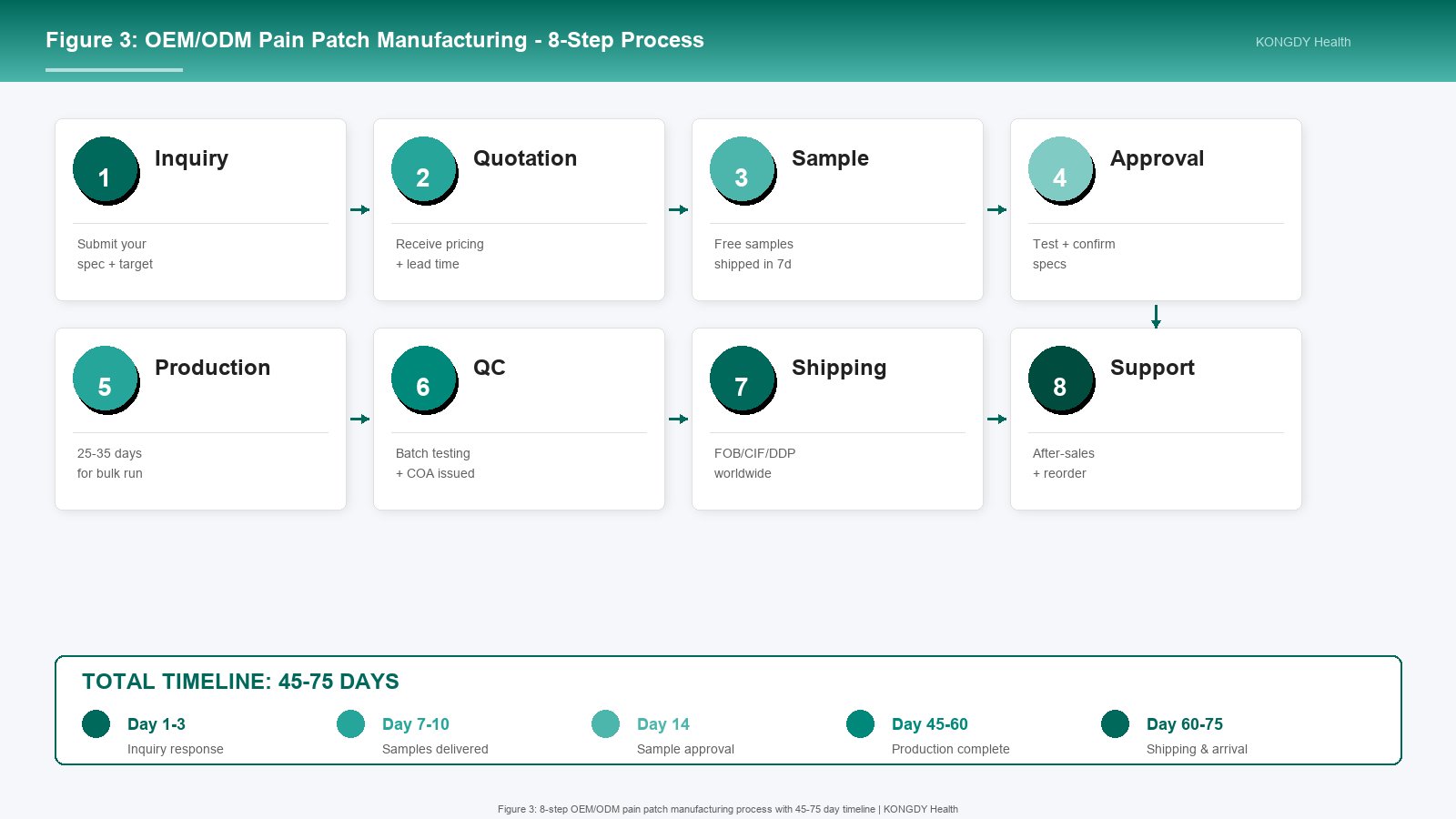
The OEM/ODM process for pain patches typically follows an 8-step sequence, from initial inquiry to bulk delivery. Total timeline: 45-75 days for a standard product, longer for fully custom formulations. Understanding each step helps you plan your inventory and cash flow.
Figure 3: 8-step OEM/ODM pain patch manufacturing process with 45-75 day timeline from first inquiry to delivery.
Step 1: Inquiry Submission
The first step is submitting your product specification to the pain patch manufacturer. A complete inquiry includes:
Top manufacturers respond within 24-48 hours with a feasibility assessment.
Step 2: Quotation & Proposal
The manufacturer provides a detailed quotation including unit price (typically FOB China port), MOQ, lead time, payment terms (usually 30% deposit + 70% before shipment for first orders), and certification scope. Compare quotes across at least 3 manufacturers on a like-for-like basis-price alone is misleading without quality context.
Step 3: Sample Production & Shipping
Reputable pain patch manufacturers provide free samples (5-10 pieces per SKU) for evaluation. Sample delivery typically takes 7-10 days by express courier. Evaluate samples for:
Active ingredient accuracy (lab test the sample)
Adhesion quality (does it stay on during movement?)
Skin feel and comfort
Packaging integrity and label accuracy
Odor and color
Step 4: Sample Approval & Specification Lock
Once you approve samples, both parties sign a specification sheet that locks in formulation, packaging, and quality parameters. This document becomes part of the purchase contract and protects both parties from future disputes.
Step 5: Bulk Production
Production typically takes 25-35 days for standard SKUs, longer for custom formulations. The manufacturer may provide production photos or videos, and most will arrange a pre-shipment inspection (PSI) by your third-party inspector or their internal QC team.
Step 6: Quality Control & COA Issuance
Every batch is tested, and a Certificate of Analysis (COA) is issued showing actual versus specification values for key parameters: active ingredient content, uniformity, adhesion, pH, microbial limits, and stability indicators. Always request and retain COAs for your regulatory records.
Step 7: Shipping & Logistics
Pain patches are typically shipped FOB, CIF, or DDP depending on your preference. FOB is most common for first orders as it gives you control over freight forwarding. Air freight is faster (5-7 days) but more expensive; sea freight is cheaper (25-35 days) for larger volumes.
Step 8: After-Sales Support
Post-delivery, the manufacturer should support you with reorder management, market feedback integration, and any quality investigations. The strongest manufacturers treat the first order as the start of a multi-year relationship, not a transactional sale.
Red Flags When Evaluating Pain Patch Manufacturers
Watch for these warning signs during your evaluation:
No verifiable certifications: Claims of ISO 13485 or FDA registration without certificate numbers verifiable on issuing body websites.
Unrealistic pricing: Quotes 30-50% below market average often signal substandard ingredients or skipped quality steps.
MOQ rigidity: Refusing samples or requiring 100,000+ piece MOQs for first orders.
No factory tour: Refusing on-site visits or hiding the production facility behind "trade secret" claims.
Slow communication: Days-long response times during the sales process predict poor after-sales support.
No references: Refusing to share buyer references or testimonials from existing customers.
Unwilling to sign contracts: Avoiding formal purchase agreements or NDA protection.
Questions to Ask a Pain Patch Manufacturer Before Ordering
Use these questions in your initial conversations to filter candidates quickly:
What is your manufacturing capacity for pain patches annually? (Look for 10M+ pieces/year for serious manufacturers.)
What certifications do you currently hold, and can you provide certificate numbers? (Verify independently.)
What is your MOQ for OEM/ODM orders? (10,000-50,000 pieces is standard; rigid 100,000+ is risky for new buyers.)
What is your standard lead time from sample approval to bulk delivery? (25-45 days is typical.)
Do you provide free samples? (Reputable manufacturers always do.)
Can you handle custom formulations? (Tests R&D depth.)
Do you provide per-batch COAs? (Non-negotiable.)
What packaging options can you offer? (Individual sachets, retail boxes, bulk packaging.)
Can you support my target market's regulatory requirements? (FDA, CE, TGA, etc.)
Do you have buyer references I can contact? (Strong manufacturers always do.)
What are your payment terms? (30/70 is standard; 100% upfront is a red flag.)
Can I visit your factory? (Top manufacturers welcome visits.)
Pain Patch Manufacturer Comparison Checklist
Evaluation Criteria
KONGDY Health
Typical Mid-Tier
Low-Tier
Years in transdermal patches
36 years
10-20 years
<5 years
ISO 13485 certified
Yes
Yes
Often missing
FDA registered
Yes
Sometimes
Often missing
CE certified
Yes
Sometimes
Often missing
Annual capacity
100M+ pieces
10-50M pieces
<10M pieces
MOQ for OEM
10,000 pieces
30,000-50,000
100,000+
Custom formulation
Yes
Limited
No
Free samples
Yes
Sometimes
No
Per-batch COA
Yes
Yes
Often missing
Export experience
60+ countries
10-30 countries
Domestic only
How to Verify a Pain Patch Manufacturer's Certifications
Always verify certifications independently. Here is how:
ISO 13485: Search the certifying body's database (BSI, TUV, SGS) using the certificate number.
FDA Registration: Search the FDA Establishment Registration & Device Listing database at accessdata.fda.gov.
CE Marking: Verify the CE certificate on the notified body's website (TUV, DEKRA, etc.).
GMP: Request the most recent GMP audit report and verify the issuing authority.
If a manufacturer cannot provide verifiable certificate numbers, walk away. False certifications are a major red flag in this industry.
Common Pain Patch OEM/ODM Pitfalls to Avoid
Even with a good manufacturer, mistakes happen. Watch out for these common pitfalls:
Skipping sample testing: Always lab-test samples, don't rely solely on feel or smell.
Ignoring stability data: Request accelerated stability reports to verify shelf life claims.
Not specifying packaging: Lock down packaging details (material, printing, dimensions) in the contract.
Underestimating lead times: Add 2-4 weeks buffer for first orders to handle unexpected delays.
Failing to plan for customs: Confirm HS codes, certificates of origin, and import requirements in advance.
Choosing on price alone: The cheapest quote often hides the largest total cost of ownership.
How to Build a Long-Term Relationship with Your Manufacturer
Once you have selected a pain patch manufacturer, treat the relationship as a partnership, not a transaction. The strongest buyer-manufacturer relationships share these characteristics:
Clear communication: Share forecasts, market feedback, and product roadmap with your manufacturer.
Reasonable growth commitments: Give the manufacturer visibility into your growth so they can plan capacity.
Joint problem-solving: When quality issues arise, work together on root cause analysis rather than blame.
Fair pricing negotiations: Recognize that manufacturers need margin to invest in quality; don't squeeze every cent.
Regular business reviews: Quarterly reviews to discuss performance, opportunities, and challenges.
Manufacturers like KONGDY Health invest in long-term partners by offering priority production slots, better payment terms, and early access to new formulations.
Pain Patch Industry Trends Affecting Manufacturer Selection
The pain patch industry is evolving rapidly. When evaluating manufacturers, consider whether they are positioned for these trends:
Natural and herbal ingredients: Growing consumer demand for plant-based pain relief options.
Extended-release formulations: 24-72 hour wear times versus traditional 8-12 hour patches.
Sustainable packaging: Recyclable materials and reduced plastic in sachets and boxes.
Smarter patches: Integration with wearables, app tracking, and biofeedback sensors.
A future-ready pain patch manufacturer invests in R&D across these trends, not just maintaining legacy products.
When to Switch Pain Patch Manufacturers
Sometimes the right move is to switch. Consider switching if your current manufacturer:
Repeatedly misses quality specifications or lead times
Refuses to invest in new formulations or packaging
Lacks certifications for your growth markets
Becomes unresponsive to communication or support requests
Raises prices dramatically without quality improvement
Cannot scale with your order volume
Switching is expensive (re-tooling, re-certification, lost momentum), so make sure the underlying issues cannot be resolved with your current partner first.
Frequently Asked Questions
1. What is a pain patch manufacturer?
A pain patch manufacturer is a company that designs, formulates, and produces transdermal pain relief patches for B2B buyers (brand owners, distributors, healthcare providers). Top manufacturers offer OEM (your brand, their production) and ODM (their formulation, your brand) services across multiple active ingredients and patch formats.
2. What is the typical MOQ for OEM pain patch orders?
Standard MOQ for OEM pain patch orders is 10,000-50,000 pieces per SKU, depending on the manufacturer and complexity of the formulation. Some manufacturers offer lower MOQs (5,000 pieces) for first-time buyers or sample runs, but expect higher per-unit pricing.
3. How do I verify a pain patch manufacturer's certifications?
Request certificate numbers and verifying body details, then search the certifying body's online database. ISO certifications can be verified through BSI, TUV, or SGS databases. FDA registrations are searchable at accessdata.fda.gov. CE certificates must list the issuing notified body. KONGDY Health provides verifiable certificate numbers for all claims.
4. What is the difference between OEM and ODM in pain patch manufacturing?
OEM (Original Equipment Manufacturer): You provide the formulation spec, and the manufacturer produces to your exact recipe. ODM (Original Design Manufacturer): The manufacturer provides a ready-made formulation that you can brand and sell as your own. OEM suits brands with proprietary formulas; ODM suits buyers wanting faster market entry.
5. How long does OEM pain patch production take?
From sample approval to bulk delivery, OEM pain patch production typically takes 25-45 days for standard formulations, with an additional 7-14 days for shipping depending on your location. Custom formulations may extend this to 45-75 days total. KONGDY Health's standard lead time is 25-35 days for production plus 25-35 days for sea freight.
6. What active ingredients should a pain patch manufacturer offer?
A versatile pain patch manufacturer should offer at minimum: menthol (cooling relief), lidocaine (numbing), diclofenac (anti-inflammatory), capsaicin (warming), and herbal blends (methyl salicylate, camphor, eucalyptus). This covers the major pain relief use cases: post-workout soreness, acute strains, inflammation, chronic ache, and sensitive users.
7. Can a pain patch manufacturer handle custom packaging?
Yes, most established pain patch manufacturers offer custom packaging services including retail boxes, individual sachets, multi-pack configurations, and brand-aligned graphic design. Custom packaging typically adds 1-2 weeks to the production timeline and may have separate MOQ requirements. Explore KONGDY's packaging options as a reference.
8. How much does private label pain patch manufacturing cost?
Private label pain patch costs vary by active ingredient, dosage, patch size, and order quantity. Typical FOB China pricing ranges from $0.05 to $0.50 per patch at 50,000+ piece MOQ, with custom formulations at the higher end. Add 15-25% for packaging customization, and budget for shipping, customs, and import duties in your target market.
9. What questions should I ask a pain patch manufacturer before signing a contract?
Ask: (1) What is your annual production capacity? (2) What certifications do you hold, and can I verify them? (3) What is your MOQ and lead time? (4) Do you provide free samples? (5) What payment terms do you offer? (6) Can you handle my target market's regulatory requirements? (7) Do you have buyer references? (8) What is your after-sales support process?
10. How do I find a reliable pain patch manufacturer in China?
Search industry directories (Made-in-China, Alibaba Verified Suppliers), attend trade shows (Canton Fair, Cosmoprof), and request referrals from industry contacts. Once you have a shortlist, evaluate each candidate against the 6-pillar framework (Certifications, Experience, Capacity, R&D, Compliance, Support). Always visit the factory before placing bulk orders.
Amazon and Shopify require specific label + compliance specs
Hospital or clinic procurement
Manufacturer with hospital contracts + ISO 13485
Institutional buyers require the highest compliance level
Sustainability-focused brand
Manufacturer investing in sustainable packaging
Aligns with brand values and consumer preferences
About KONGDY Health
KONGDY Health is a leading pain patch manufacturer with 36 years of expertise in transdermal patch technology. Headquartered in Zhoukou, Henan, our 20,000 sqm GMP-certified facility produces over 100 million pain patches annually for buyers in 60+ countries. We hold ISO 13485:2016, FDA, CE, and GMP certifications, and offer both OEM and ODM services across menthol, lidocaine, diclofenac, capsaicin, herbal, and custom formulations.
Browse the complete KONGDY pain patch catalog to explore our portfolio, request samples, or discuss custom formulation opportunities. Whether you are a first-time importer or an established brand expanding your line, our team is ready to support your growth with quality, reliability, and innovation.