Private label patch program for pharmacy chains: 5-step launch path covering SKU definition, documentation dossier, artwork and packaging, production slot and pilot validation, and launch cadence with annual reorder schedule. Supports pharmacy chains and distributors across North America, Europe, and Asia with ISO 22716 GMP manufacturing.
1. Why Private Label Patch Programs Work for Pharmacy Chains
Pharmacy chains are the most reliable distribution channel for private label patch programs. The buyer reviews new private label SKUs annually, the shelf turn supports a multi-year supply agreement, and the retail pharmacy customer already buys heat patches, herbal plasters, and topical patches as part of an ongoing self-care routine. For a brand owner or importer, a private label patch program for pharmacy chains combines the margin profile of a private label brand with the scale of a retail pharmacy distribution channel.
The pharmacy chain buyer evaluates a private label program on three fronts: documentation, margin, and shelf differentiation. Documentation covers FDA cosmetic establishment registration, ISO 22716 GMP certification, finished product certificate of analysis, ingredient declaration, and market-specific stability data. Margin covers the unit price, the packaging format, and the reorder cycle. Shelf differentiation covers the artwork, the GTIN registration, and the artwork matrix per destination market. KONGDY has manufactured consumer health patches for 36 years and runs private label programs for pharmacy chains across North America, Europe, and Asia.
This guide walks through the private label patch program for pharmacy chains: the 5-step launch path, the documentation dossier, the packaging and artwork matrix, the launch cadence, the reorder schedule, and the long-term program stability that turns a single SKU launch into a recurring annual revenue stream.
2. Step 1: Define the SKU, the Format, and the Active Profile
The first step in a private label patch program for pharmacy chains is to define the SKU, the patch format, and the active profile. This definition drives the documentation, the manufacturing, and the launch cadence.
2.1 SKU and Format Selection (KONGDY)
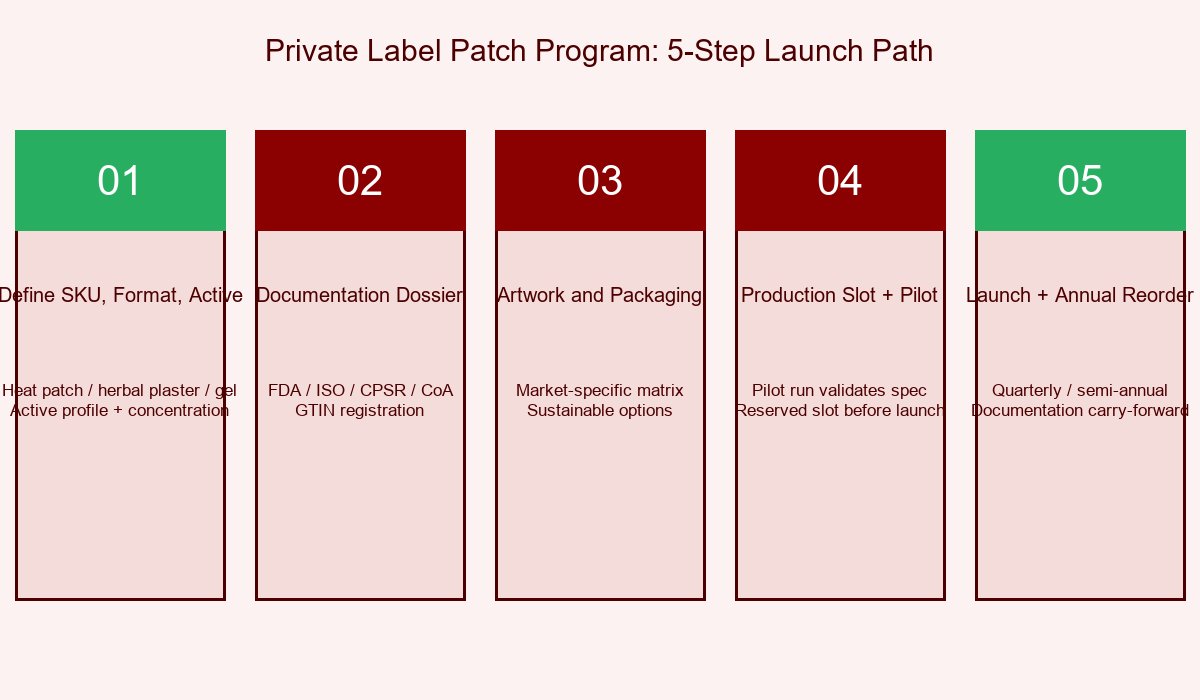
The SKU defines whether the patch is a heat patch, a herbal plaster, a gel patch, or a combination format. The format defines the geometry, the adhesive, and the wear profile. KONGDY maintains a catalogue of validated patch platforms for heat patch, herbal plaster, gel patch, and combination formats, and recommends the format that matches the destination market's retail pharmacy consumer demand.
2.2 Active Profile and Concentration (KONGDY)
The active profile defines the consumer promise and the regulatory classification. Heat patch formats use iron-powder self-heating with optional herbal extracts. Herbal plaster formats use menthol, camphor, eucalyptus, or traditional medicine actives. Gel patch formats use menthol, capsaicin, or cooling/warming combinations. KONGDY documents the active concentration, the stability profile, and the regulatory pathway per active profile.
2.3 Differentiation Strategy for Pharmacy Shelves (KONGDY)
Pharmacy shelves are crowded with self-care patches. The differentiation strategy can be in the active profile (cooling vs warming vs herbal), the wear time (4h vs 8h vs 12h), the packaging format (single-count vs multi-count vs premium gift), or the brand positioning. KONGDY's commercial team reviews the destination market's competitive shelf and recommends the differentiation approach that supports the chain's category positioning.
3. Step 2: Build the Documentation Dossier for Pharmacy Onboarding
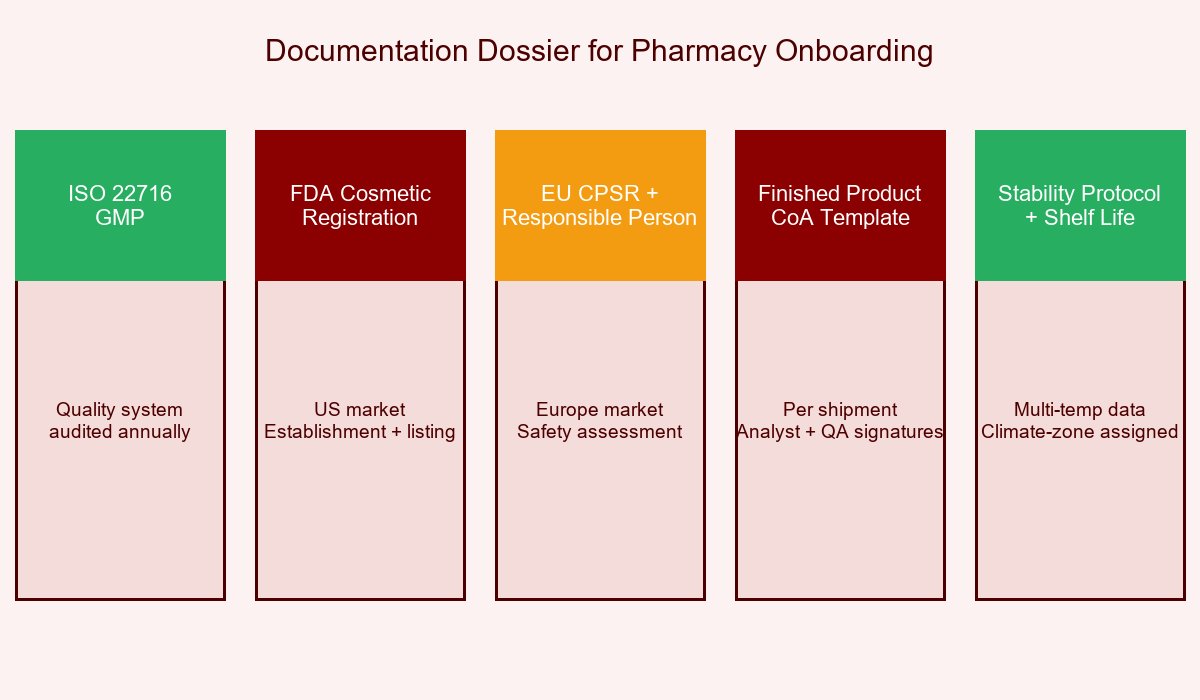
The documentation dossier is the difference between a private label SKU that clears pharmacy onboarding in four weeks and one that holds for three months. The dossier must cover every document the pharmacy chain requires before listing.
3.1 Core Documentation Package (KONGDY)
The core documentation includes the ISO 22716 GMP certificate, the FDA cosmetic establishment registration number and product listing confirmation, the EU CPSR and Responsible Person documentation, the finished product certificate of analysis template, the ingredient declaration, the safety data sheet, and the stability protocol summary. KONGDY prepares each document in the pharmacy chain's preferred format and supports the onboarding call.
3.2 Market-Specific Documentation (KONGDY)
The pharmacy chain buyer reviews the documentation per destination market. North American chains require FDA registration and CPSR summary. European chains require the EU CPSR and the Responsible Person's contact information. Asian chains require market-specific registration documents. KONGDY assembles a market-specific dossier for each private label SKU and updates it annually.
3.3 GTIN Registration and Barcode Compliance (KONGDY)
Pharmacy chains require a GS1 GTIN barcode registered to the destination market's GS1 system. KONGDY supports GTIN assignment and confirms the barcode placement before the production run, so the private label SKU clears pharmacy onboarding without reprints.
4. Step 3: Develop Artwork and Packaging for Retail Pharmacy
The artwork and packaging carry the private label brand through pharmacy onboarding, retail pharmacy shelf presence, and the consumer repeat purchase. Each format must satisfy the pharmacy chain's planogram requirement and the destination market's labelling rules.
4.1 Artwork Matrix Per Destination Market (KONGDY)
KONGDY prepares an artwork matrix per destination market, covering label claims, ingredient declaration, direction for use, warnings, shelf-life statement, and GTIN placement. The artwork is reviewed against the destination market's labelling rules before printing.
4.2 Pharmacy-Friendly Packaging Formats (KONGDY)
Pharmacy-friendly formats include single-count pouches for individual shelf purchase, multi-count sets for value perception, dispenser cartons for clinic dispensary programs, and tamper-evident packaging for child-resistant compliance. KONGDY's packaging matrix matches the pharmacy chain's preferred planogram.
4.3 Sustainable Packaging for Pharmacy Buyers (KONGDY)
Many pharmacy chains require sustainable packaging. KONGDY offers FSC certified cartons, recycled paper inserts, and soy-based inks as standard options, with documentation for the destination market's sustainability claims.
5. Step 4: Lock Production Slots and Validate the Pilot Run
The fourth step in a private label program is to lock the production slot and validate the pilot run. The pilot run tests the specification in actual retail pharmacy conditions and validates the reorder cadence.
5.1 Pilot Run Specification and Production (KONGDY)
The pilot run uses the frozen specification from Step 1 and the validated artwork from Step 3. KONGDY documents the pilot batch yields, the defect rate, the in-process control results, and the finished product certificate of analysis. The pilot run ships to the pharmacy chain for in-store validation before the commercial run is scheduled.
5.2 Production Slot Reservation (KONGDY)
Private label programs require reserved production slots to guarantee the launch window. KONGDY reserves production slots for private label customers in writing before the peak production calendar fills, and the reservation ties the brand to a confirmed ship date.
5.3 First Commercial Run and Retail Onboarding (KONGDY)
The first commercial run ships to the pharmacy chain's distribution centre with a finished product certificate of analysis, a pre-shipment inspection report, and the market-specific documentation dossier. The pharmacy chain's onboarding team reviews the documentation and lists the SKU for the retail launch.
6. Step 5: Launch Cadence, Reorder Schedule, and Long-Term Program Stability
The fifth step in a private label patch program for pharmacy chains is to lock the launch cadence, the reorder schedule, and the long-term program stability. The launch cadence protects the pharmacy shelf window; the reorder schedule protects the working capital.
6.1 Launch Cadence and Pharmacy Window Alignment (KONGDY)
The launch cadence aligns the first commercial run with the pharmacy chain's category review window. Pharmacy chains typically review new private label SKUs quarterly or semi-annually, with the SKU listed within 4 to 6 weeks of the chain's review approval. KONGDY supports the launch cadence with a stage-by-stage lead time schedule and reserved production slots.
6.2 Reorder Schedule and Working Capital (KONGDY)
The reorder schedule depends on the pharmacy chain's sell-through rate. A pilot container of 5,000 to 10,000 pieces funds the launch; a re-order container of 20,000 to 50,000 pieces supports the regional roll-out. KONGDY structures tiered MOQ pricing so the unit cost steps down as reorder volume grows.
6.3 Annual Recurring Program (KONGDY)
A private label program that reorders every quarter produces predictable revenue and stable unit economics. KONGDY structures multi-year supply agreements with reserved capacity, documentation carry-forward, and pricing tier stability. The annual program review covers sell-through, claim substantiation, packaging refresh, and category expansion.
6.4 Multi-SKU Private Label Range (KONGDY)
A single private label SKU launch can expand into a multi-SKU range covering heat patch, herbal plaster, and gel patch formats. KONGDY structures multi-SKU private label programs with shared documentation, shared artwork matrix, and shared production slots, reducing the per-SKU documentation cost.
7. Margin, Pricing, and Pricing Tiers for Pharmacy Chains
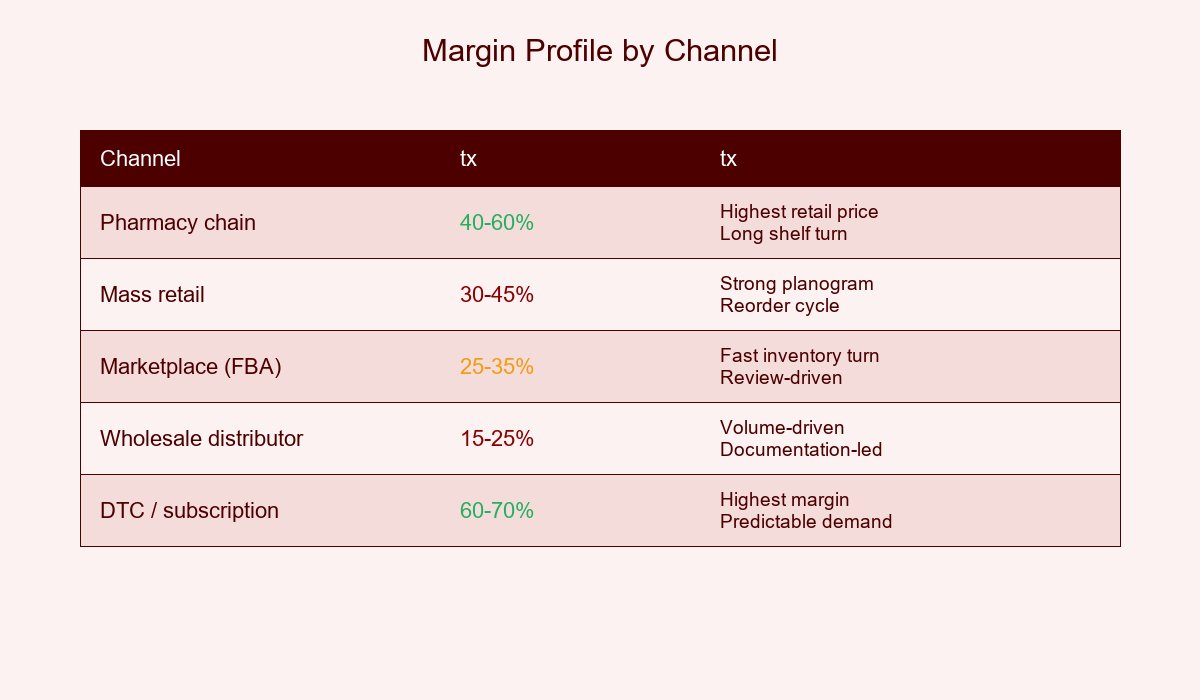
Pharmacy chain margin expectations differ from distributor and marketplace margin. A private label SKU listed in a pharmacy chain carries a higher retail price and a higher margin than the same SKU sold through Amazon FBA.
7.1 Pharmacy Chain Margin Profile (KONGDY)
Pharmacy chains typically expect a 40 to 60 percent retail margin on private label SKUs, which gives the manufacturer a wholesale margin after packaging, certification, and documentation cost. KONGDY's pricing matrix separates the unit price, the packaging cost, the certification cost, and the documentation cost so the wholesale margin is documented before the quotation.
7.2 Tiered MOQ Pricing (KONGDY)
KONGDY structures private label pricing in tiers from a pilot container through a regional roll-out through a multi-year supply agreement. Each tier carries a documented unit price, packaging format, lead time, and documentation scope. The pricing tier is the primary lever for margin optimisation as the program matures.
7.3 Currency, Freight Surcharge, and Pharmacy Pricing (KONGDY)
Currency volatility and freight surcharges affect the wholesale price during peak season. KONGDY offers a quotation validity period, a freight surcharge clause, and a hedging option for multi-year private label programs.
8. Common Pharmacy Chain Onboarding Failures and How to Avoid Them
Pharmacy chain onboarding failures trace back to four predictable issues. The list below covers the most common ones and how KONGDY supports the launch team in avoiding them.
8.1 Missing Documentation Item (KONGDY)
A missing documentation item is the most common cause of onboarding delay. KONGDY prepares the documentation dossier against the pharmacy chain's checklist before the first commercial run, so the launch is not held by a missing item.
8.2 Wrong GTIN Registration (KONGDY)
An unregistered GTIN produces a barcode scanning error at the pharmacy point-of-sale. KONGDY supports GTIN assignment and confirms the GTIN registration with the destination market's GS1 system before printing.
8.3 Incomplete Artwork Against Destination Market Rules (KONGDY)
Artwork that misses the destination market's labelling rules triggers a reprint. KONGDY's artwork review process checks the label against the destination market's labelling requirements before printing, preventing the costly rework cycle.
8.4 No Reorder Cadence Defined (KONGDY)
A private label program without a documented reorder cadence can run out of stock or carry excess inventory. KONGDY structures the reorder cadence based on the pharmacy chain's sell-through rate and supports the program with quarterly inventory snapshots.
9. How KONGDY Supports Long-Term Pharmacy Chain Programs
A private label patch program that ships one launch and then has to be rebuilt is expensive. KONGDY structures long-term programs that carry the documentation, the artwork matrix, and the pricing tier forward year over year, so the pharmacy chain's review team reviews the same compliance file each cycle.
9.1 Documentation Carry-Forward (KONGDY)
KONGDY's compliance dossier carries forward across reorders and across markets. The ISO 22716 certificate, the FDA registration, the CPSR, the stability data, and the packaging compliance statement are not rebuilt each cycle.
9.2 Artwork Refresh Without Tooling Cost (KONGDY)
A pharmacy chain's annual artwork refresh can change 20 to 40 percent of the artwork without changing the printing plates or the dieline. KONGDY supports artwork refresh within the existing tooling, reducing the per-cycle artwork cost.
9.3 Annual Program Review (KONGDY)
KONGDY's annual program review covers sell-through, claim substantiation, packaging refresh, multi-market expansion, and category growth. The review output is a written program brief that feeds the next year's quotation.
9.4 Multi-Market Roll-Out from the Pharmacy Chain's Lead Market (KONGDY)
A pharmacy chain that operates across multiple markets can roll out a single private label SKU from the lead market to the other markets. KONGDY supports multi-market roll-out with a market-specific artwork matrix and a market-specific documentation dossier, so the second market launch is faster than the first.
10. Conclusion: Building a Recurring Annual Pharmacy Chain Program
A private label patch program for pharmacy chains is most valuable when it runs every year on a recurring supply schedule with a single manufacturer who carries the documentation, the artwork matrix, and the certification responsibility. The pharmacy chains that win the category are the ones who work with a manufacturer who structures the documentation carry-forward, the production slot reservation, and the pricing tier stability across the multi-year supply agreement.
KONGDY runs private label patch programs under ISO 22716 GMP certification with FDA registration, EU CPSR preparation, in-house analytical, microbiological, and stability laboratories, and documented change control. The pricing tier structure supports a pilot container through a multi-year supply agreement, and the documentation file carries forward across orders and markets.
Request a private label patch quotation and a free sample within 24 hours — share your target pharmacy chain, the destination market, the SKU format, and the expected annual volume, and the commercial team will return tiered bulk pricing, a stage-by-stage lead time schedule, the documentation dossier for the destination market, and the artwork matrix for the chain's planogram.
Book a factory audit or live video tour at KONGDY's ISO 22716 facility to review the production line, QC laboratory, and stability chamber room, and request the private label program brief for documented re-order cadence, packaging matrix, and multi-market roll-out support. Brand owners planning a launch within one quarter can reserve a pilot container slot while artwork and documentation work run in parallel, so the first container ships on the planned pharmacy listing date.

