FOB vs CIF vs DDP importing patches from China: cost component matrix, risk allocation per Incoterm, documentation responsibilities, payment terms, freight surcharge management, and decision matrix for distributor profile. Covers commercial invoice, packing list, certificate of origin, free sale certificate, HS code classification, and insurance.
1. Why Importing Patches from China Requires a Clear Incoterm Decision
Importing patches from China is a high-frequency decision for distributors, distributors, and pharmacy chains. The patch itself is lightweight, non-hazardous, and shelf-stable, which makes it one of the simpler consumer health categories to import. The complexity is not in the freight; it is in the Incoterm selection, the documentation chain, and the customs preparation. A distributor who picks the wrong Incoterm absorbs costs that the manufacturer would have carried, or worse, accepts responsibility for documentation that the manufacturer should have provided.
The Incoterm choice determines who controls the freight booking, who carries the insurance, who files the customs declaration, and who absorbs the freight surcharge during peak season. Three Incoterms cover most heat patch and gel patch imports: FOB (Free On Board), CIF (Cost, Insurance, Freight), and DDP (Delivered Duty Paid). Each structure has a different cost profile, a different risk allocation, and a different operational requirement.
KONGDY has manufactured consumer health patches for 36 years and supports importing patches from China under all three Incoterms. The facility is ISO 22716 GMP certified, FDA registered, and operates in-house analytical, microbiological, and stability laboratories. This guide explains each Incoterm, the cost components, the documentation responsibilities, the timing of payments and risk transfer, and the decision framework for choosing the right structure for each wholesale program.
2. FOB (Free On Board): Maximum Control, Maximum Responsibility
FOB is the Incoterm for a distributor who wants full control of the freight booking and is willing to accept responsibility for the freight, insurance, and customs clearance. The manufacturer hands the goods over once they are loaded on the vessel at the origin port.
2.1 What FOB Includes and Excludes (KONGDY)
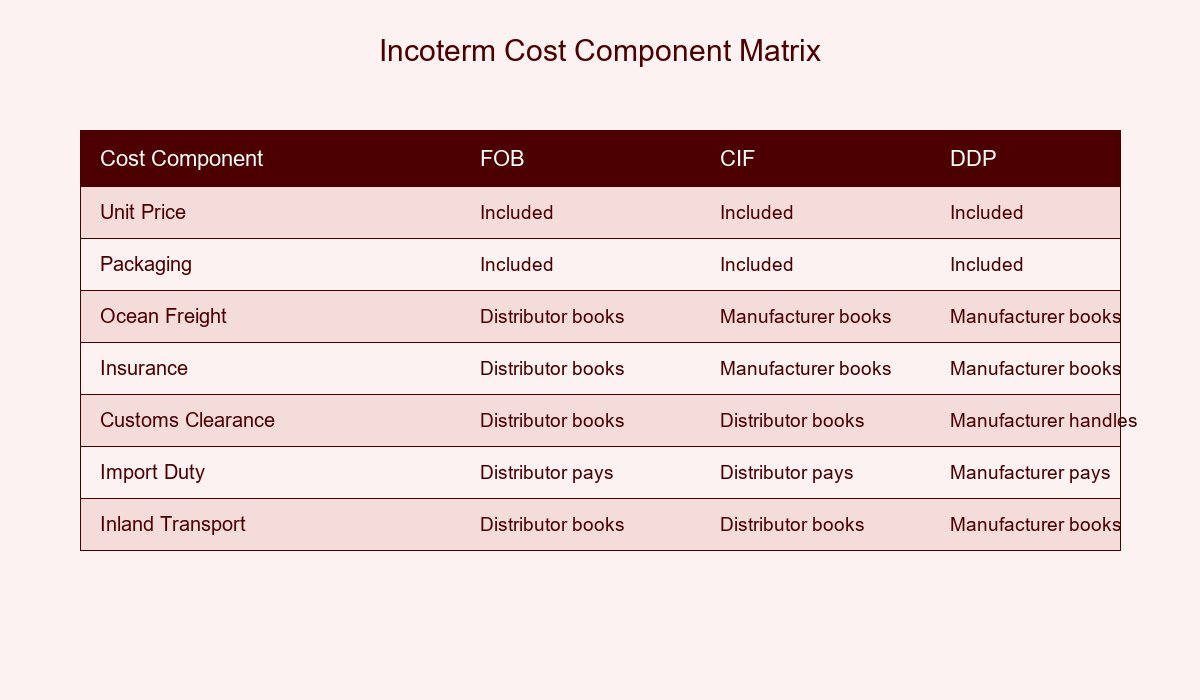
FOB includes the unit price, packaging, and the cost of loading the goods onto the vessel at the origin port. FOB excludes the ocean freight, the insurance, the customs clearance at the destination, and the inland transport to the warehouse. KONGDY quotes FOB with the freight and insurance separated so the distributor can compare the cost structure against the freight quote it secures independently.
2.2 When FOB Is the Right Choice (KONGDY)
FOB suits a distributor who has an in-house logistics team, a freight forwarder relationship, and a customs broker in the destination market. The distributor who takes FOB accepts the freight risk, the freight cost, and the customs documentation, in exchange for control of the freight booking and the ability to consolidate shipments across suppliers.
2.3 Risks and How to Mitigate Them (KONGDY)
FOB carries the highest operational risk because the distributor is exposed to freight delays, peak-season surcharges, and customs clearance problems. KONGDY supports FOB shipments with the commercial invoice, packing list, certificate of origin, and free sale certificate prepared to the distributor's freight forwarder requirement.
3. CIF (Cost, Insurance, Freight): A Balanced Structure
CIF is the Incoterm for a distributor who wants the manufacturer to take responsibility for the freight and insurance but retain responsibility for the customs clearance at the destination. The manufacturer books the ocean freight, secures the insurance, and delivers the goods to the destination port.
3.1 What CIF Includes and Excludes (KONGDY)
CIF includes the unit price, packaging, ocean freight, and insurance to the destination port. CIF excludes the customs clearance, the destination port handling fees, the import duties, and the inland transport to the warehouse. KONGDY quotes CIF with the freight and insurance lines separated so the distributor can compare the total against the alternative of FOB plus an independent freight quote.
3.2 When CIF Is the Right Choice (KONGDY)
CIF suits a distributor who wants predictable freight cost and insurance coverage but still has a customs broker in the destination market to handle the import clearance. CIF is the most common structure for first-time importers who want the manufacturer's freight expertise without giving up customs control.
3.3 Risk Transfer and Insurance Coverage (KONGDY)
CIF transfers the risk from the manufacturer to the distributor at the destination port. The manufacturer secures the minimum insurance coverage required by the Incoterm; the distributor can request additional coverage for higher-value shipments. KONGDY prepares CIF documentation with the commercial invoice, packing list, certificate of origin, and insurance certificate in the format required by the destination customs broker.
4. DDP (Delivered Duty Paid): Maximum Simplicity, Highest Unit Price
DDP is the Incoterm for a distributor who wants the manufacturer to carry the freight, insurance, customs clearance, and import duties, with the goods delivered to the warehouse. The manufacturer absorbs the customs declaration, the import duty, and the inland transport.
4.1 What DDP Includes and Excludes (KONGDY)
DDP includes the unit price, packaging, ocean freight, insurance, customs clearance, import duties, and inland transport to the warehouse. DDP excludes only the destination warehouse unloading and the importer of record registration. KONGDY quotes DDP with the freight, duty, and clearance lines separated so the distributor can compare the landed cost against the alternative of CIF plus an independent customs broker.
4.2 When DDP Is the Right Choice (KONGDY)
DDP suits a distributor who does not have an in-house customs broker, who is importing into a market where the customs process is complex or unfamiliar, or who values the simplicity of a single landed cost per unit. DDP also suits first-time importers who want to test a market without investing in customs infrastructure.
4.3 Risk Transfer and Customs Liability (KONGDY)
DDP transfers the risk from the manufacturer to the distributor only at the destination warehouse. The manufacturer carries the customs declaration risk and the import duty risk until that point. KONGDY prepares the customs declaration with the destination market's HS code classification and pays the import duty on behalf of the distributor.
4.4 DDP Caveats: Import Restrictions and Compliance Hold (KONGDY)
DDP carries a compliance caveat: if the destination market rejects the shipment for a documentation issue, the manufacturer absorbs the loss. KONGDY mitigates this risk by preparing the destination market's compliance dossier before the production run and verifying the HS code classification before the shipment.
5. Cost Comparison: What Each Incoterm Adds to the Unit Price
The three Incoterms differ in the cost components they include. A clear comparison helps the distributor choose the structure that matches its logistics capability and its margin target.
5.1 Cost Component Matrix (KONGDY)
KONGDY's quotation breaks the cost into unit price, packaging, freight, insurance, customs clearance, and import duty. FOB includes the unit price and packaging only. CIF adds freight and insurance. DDP adds customs clearance, import duty, and inland transport. The distributor adds the warehouse handling cost and the inventory holding cost in all three structures.
5.2 Currency and Freight Surcharge Exposure (KONGDY)
Currency volatility and peak-season freight surcharges affect each Incoterm differently. FOB exposes the distributor to the full freight market; CIF shares the freight risk with the manufacturer during transit; DDP shifts the freight risk entirely to the manufacturer. KONGDY offers a freight surcharge clause and a currency hedging option for repeat wholesale programs.
5.3 Total Landed Cost Comparison Example (KONGDY)
A 20,000-piece heat patch container shipped from Shanghai to Los Angeles illustrates the difference: FOB unit cost is the lowest, with the distributor adding freight, insurance, customs, duty, and inland transport. CIF unit cost includes freight and insurance. DDP unit cost includes all components except the importer of record registration. The total landed cost varies by 8 to 15 percent across the three structures depending on the freight market.
5.4 Insurance Coverage and Risk Allocation (KONGDY)
FOB leaves the freight insurance to the distributor. CIF and DDP include the manufacturer's insurance at the Incoterm minimum coverage. The distributor who wants higher coverage can request additional insurance as an optional line. KONGDY prepares insurance certificates with the destination market's insurer of record.
6. Documentation Responsibilities Under Each Incoterm
Documentation is the difference between a shipment that clears customs in five days and one that holds for two weeks. The Incoterm determines who prepares the documentation, but the manufacturer is the source of record for most compliance deliverables.
6.1 Commercial Invoice, Packing List, and Certificate of Origin (KONGDY)
KONGDY prepares the commercial invoice, packing list, and certificate of origin in the format required by the destination market's customs broker. The documents are issued per shipment and matched to the freight booking.
6.2 Free Sale Certificate and Health Certificate (KONGDY)
The free sale certificate confirms that the product is sold freely in the country of manufacture. The health certificate confirms the product's compliance with the destination market's health regulation. KONGDY prepares both documents with the destination market's authority requirement.
6.3 HS Code Classification and Import Duty (KONGDY)
The HS code determines the import duty rate and the customs declaration process. KONGDY supplies the HS code classification per destination market and the import duty rate as part of the quotation, so the distributor can budget the landed cost accurately.
6.4 Insurance Certificate and Risk Allocation Document (KONGDY)
The insurance certificate confirms the coverage during transit. KONGDY prepares the insurance certificate with the destination market's insurer of record, and documents the risk allocation between the manufacturer and the distributor per the selected Incoterm.
7. Payment Terms and Cash Flow Under Each Incoterm
The Incoterm choice changes the timing of payments and the cash flow exposure. A distributor who understands the timing can plan inventory financing, working capital, and the reorder schedule accordingly.
7.1 FOB Payment Terms (KONGDY)
FOB typically runs as a deposit on order confirmation with the balance against the bill of lading. The distributor books the freight, pays the freight forwarder, and carries the working capital during transit. The deposit percentage is documented in the quotation.
7.2 CIF Payment Terms (KONGDY)
CIF runs the same deposit structure as FOB, but the manufacturer bills the freight and insurance separately. The distributor's working capital exposure is lower than FOB because the freight is on the manufacturer's credit line during transit.
7.3 DDP Payment Terms (KONGDY)
DDP typically runs with a higher deposit because the manufacturer carries the customs clearance and the import duty risk during transit. The balance is against the delivery confirmation at the warehouse. KONGDY agrees payment terms in writing with each wholesale program.
7.4 Re-Order Cadence and Working Capital Planning (KONGDY)
Re-order cadence depends on the destination market's sell-through rate and the manufacturer's lead time. KONGDY supports quarterly, monthly, and bi-weekly re-order cadences with pricing tier stability and production slot reservation.
8. Choosing the Right Incoterm for Your Business Model
The right Incoterm depends on the distributor's logistics capability, its working capital position, and its margin target. A decision matrix simplifies the choice.
8.1 Decision Matrix by Distributor Profile (KONGDY)
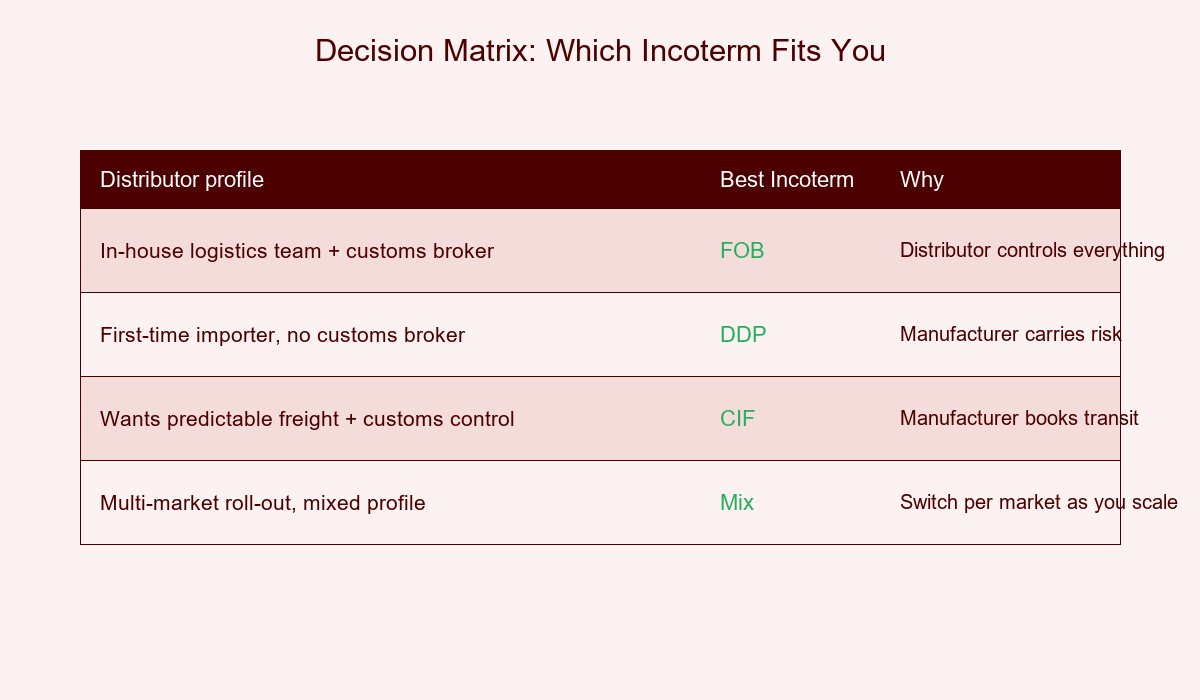
An in-house logistics team with a customs broker: FOB suits. A first-time importer without a customs broker: DDP suits. A distributor who wants predictable freight cost but customs control: CIF suits. KONGDY's commercial team reviews the distributor profile and recommends the Incoterm before the quotation.
8.2 Risk Allocation by Incoterm (KONGDY)
FOB transfers the risk to the distributor at the origin port. CIF transfers the risk at the destination port. DDP transfers the risk at the destination warehouse. The distributor who values risk reduction prefers DDP; the distributor who values cost reduction prefers FOB; the distributor who wants balance chooses CIF.
8.3 Total Cost Comparison by Incoterm (KONGDY)
FOB produces the lowest unit price but the highest operational workload. CIF produces a mid-range unit price with shared freight risk. DDP produces the highest unit price with the lowest operational workload. The total cost of ownership across the three structures varies by 8 to 15 percent depending on the freight market.
8.4 Switching Incoterms Mid-Program (KONGDY)
A wholesale program can switch Incoterms at any reorder, with the manufacturer's commercial team adjusting the quotation and the documentation accordingly. KONGDY supports the switch with a written confirmation and an updated compliance dossier.
9. Common Import Mistakes and How to Avoid Them
First-time importers make four predictable mistakes that affect landed cost, customs clearance, and retail onboarding. The list below covers the most common ones.
9.1 Mismatched HS Code Classification (KONGDY)
An incorrect HS code produces a higher import duty rate or a customs hold. KONGDY supplies the HS code classification per destination market and confirms it with the customs broker before the production run.
9.2 Missing Free Sale Certificate (KONGDY)
Some destination markets require a free sale certificate that is issued by the country of manufacture's health authority. KONGDY prepares the free sale certificate with the destination market's authority requirement.
9.3 Underestimating Peak-Season Freight Surcharge (KONGDY)
Peak-season freight surcharges can compress wholesale margin during Q4. KONGDY offers a freight surcharge clause and a peak-season re-order plan that spaces shipments outside the peak window.
9.4 Documentation Mismatch Between Manufacturer and Distributor (KONGDY)
The manufacturer's documentation and the distributor's customs broker requirement can drift apart over time. KONGDY reviews the documentation pack annually with the wholesale program and updates the market-specific dossier when regulations change.
10. Conclusion: Choosing the Right Incoterm for a Patch Import Program
FOB, CIF, and DDP are not interchangeable. Each suits a different distributor profile, a different logistics capability, and a different margin target. The choice that fits the wholesale program today may not fit the program in two years, and the manufacturer should support a switch without rebuilding the compliance file.
KONGDY supports importing patches from China under all three Incoterms with ISO 22716 GMP certification, FDA registration, in-house analytical, microbiological, and stability laboratories, and documented change control. The commercial team prepares a quotation with each Incoterm so the distributor can compare the cost structure against its logistics capability before committing to a first container.
Request a side-by-side FOB/CIF/DDP quotation for a heat patch or gel patch container within 24 hours — share your target market, expected container volume, retail channel mix, and logistics capability, and the commercial team will return three quotations with the cost components separated, the documentation responsibility matrix, the lead time schedule, and the payment terms for each Incoterm.
Ask about the freight surcharge clause and the peak-season re-order plan if your wholesale program operates on a quarterly cycle, and book a factory audit or live video tour at KONGDY's ISO 22716 facility to review the production line, QC laboratory, and stability chamber room. Distributors planning a first-time import within one quarter can reserve a pilot container slot while artwork and documentation work run in parallel, so the first container ships on the planned retail date.

