Side-by-side comparison of pain relief balm and pain relief cream for B2B buyers: formulation base, application feel, packaging economics, MOQ, lead time, and decision matrix by climate, channel, and use occasion. Covers when balm wins, when cream wins, total cost of ownership, and the procurement checklist importers run before selecting a format.
1. Why B2B Buyers Compare Pain Relief Balm and Pain Relief Cream
Pain relief balm and pain relief cream are both topical analgesics sold to the same consumer segment, but they differ in formulation, application experience, packaging economics, and regulatory pathway. B2B buyers who compare the two with structured criteria avoid portfolio misalignment and returns, because the wrong format for the wrong market creates friction that no amount of marketing fixes.
KONGDY manufactures both pain relief balm and pain relief cream on the same ISO 22716 GMP facility with shared quality systems, so the comparison below is drawn from direct production economics rather than marketing positioning. The facility runs in-house formulation, stability testing, filling for tins/sticks/tubes/jars, and export documentation for FDA cosmetic, EU CPSR, and Asia market pathways.
This guide compares pain relief balm and pain relief cream across formulation base, application feel, packaging cost, shelf life, regulatory pathway, and end-consumer preference, so brand owners, importers, distributors, and Amazon FBA sellers can decide which format fits their channel, climate, and price point. Each section ends with the procurement decision it implies, so the comparison converts into a sourcing action rather than remaining an abstract exercise.
2. Pain Relief Balm vs Pain Relief Cream: Formulation Base
The base is the most fundamental difference between a balm and a cream, because the base defines skin feel, active delivery speed, packaging requirement, and shelf life. The choice cascades into every downstream production and marketing decision.
2.1 Pain Relief Balm: Wax and Butter Base (KONGDY)
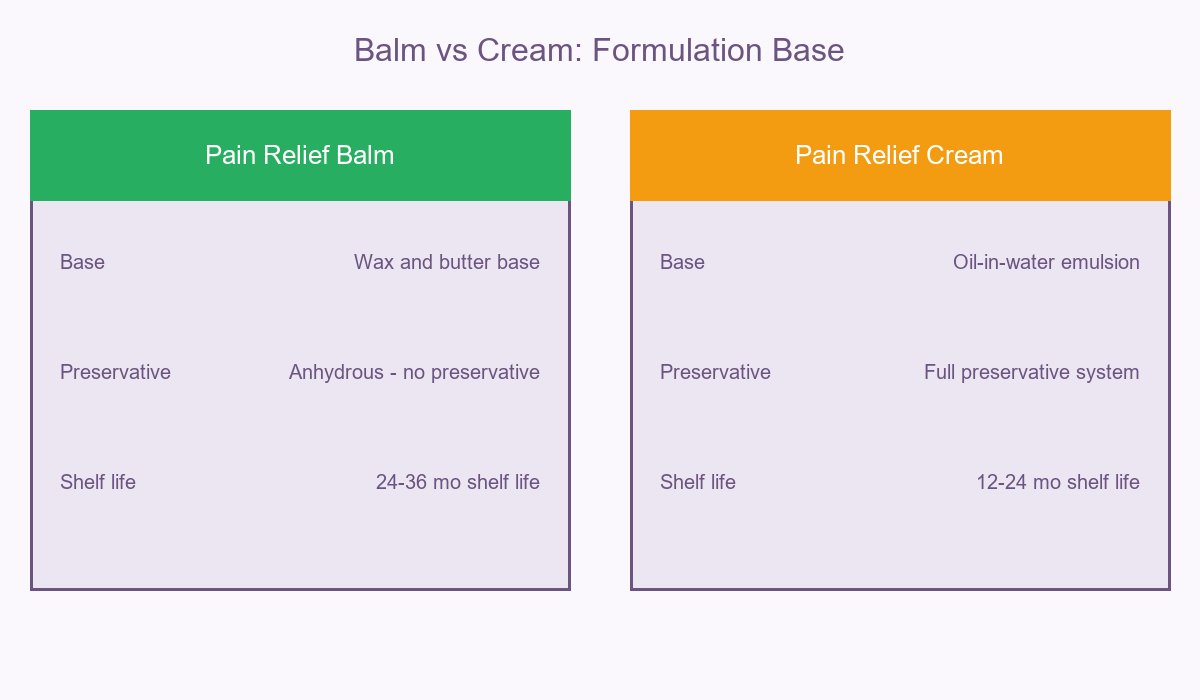
Pain relief balm uses a wax and butter base (typically beeswax, carnauba wax, shea butter, or petrolatum variants) with the active ingredients dissolved or suspended in the lipid phase. The base is anhydrous, which means no preservative system is required and shelf life extends to 24 to 36 months. KONGDY's balm formulations cover menthol, camphor, methyl salicylate, capsaicin, and eucalyptus actives, with 12 qualified base systems ready for private label deployment. Request the balm base system catalog for your market.
2.2 Pain Relief Cream: Oil-in-Water Emulsion Base (KONGDY)
Pain relief cream is an oil-in-water emulsion, which gives a lighter, less greasy skin feel and faster absorption but requires a full preservative system, pH control, and microbial stability testing. The water phase shortens shelf life to 12 to 24 months and adds manufacturing complexity. KONGDY's cream formulations cover the same active ingredients but require emulsification equipment, vacuum deaeration, and water activity control. Request the cream formulation and stability data sheet.
2.3 Implication for B2B Buyers (KONGDY)
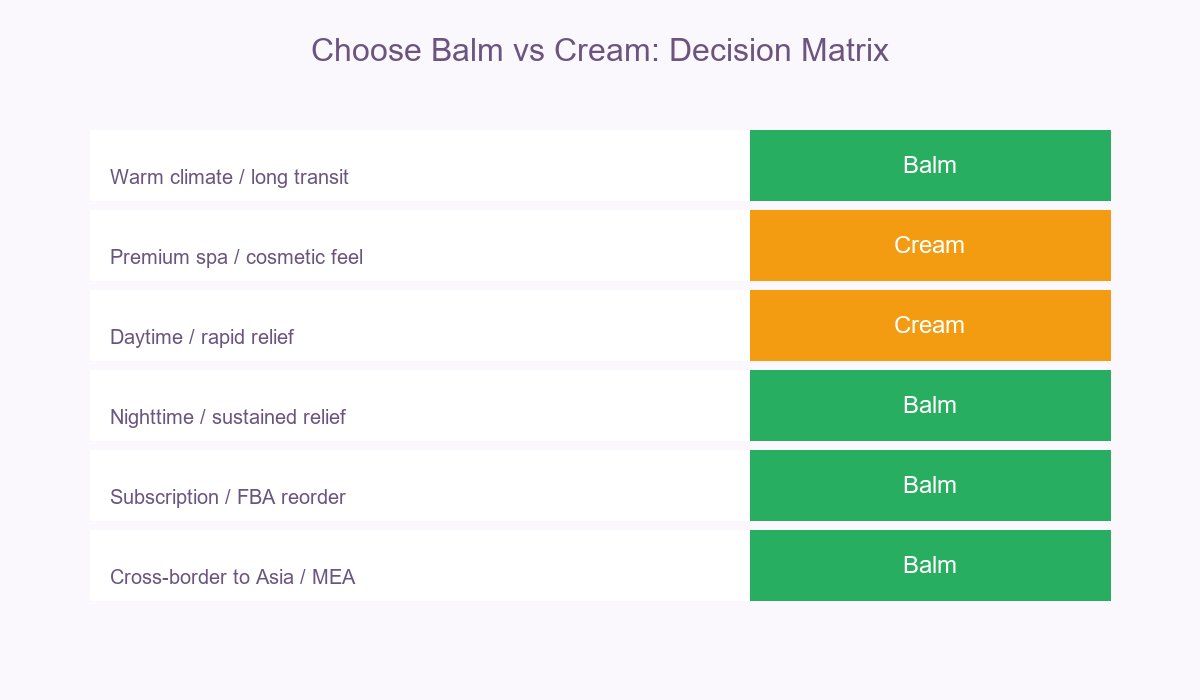
Buyers targeting warm climates, sweat-prone application areas, or markets with long shipping cycles should prefer balm for its stability and packaging simplicity. Buyers targeting daytime office use, premium spa positioning, or fast-absorption claims should prefer cream, accepting the higher testing and shorter shelf life. KONGDY advises format selection against the destination market climate and distribution lead time. Talk to our formulation team about climate-fit format selection.
3. Pain Relief Balm vs Pain Relief Cream: Format and Packaging Economics
Format dictates the primary packaging, filling line setup, tooling cost, and shelf footprint. Comparing formats without comparing packaging understates the real cost difference.
3.1 Balm Packaging: Tin, Stick, Jar (KONGDY)
Balm is typically filled into tins (8g to 50g), twist-up sticks (20g to 75g), or small jars (15g to 50g). Tin and stick packaging has the lowest component cost per gram and the longest shipping durability, but custom tin decoration requires metal stamping tooling that is charged once and amortised across orders. KONGDY supplies balm in tin, stick, and jar formats with both stock and custom decoration options. Get balm packaging format options and tooling cost breakdown.
3.2 Cream Packaging: Tube, Jar, Pump Bottle (KONGDY)
Cream is typically filled into aluminum or laminate tubes (15ml to 100ml), wide-mouth jars (30g to 200g), or airless pump bottles (30ml to 100ml). Tubes carry the lowest unit cost for mass-market retail, while pump bottles carry the highest perceived premium. Custom laminate tubes require printing plates and minimum print runs. KONGDY fills cream formats on the same line set used for balm sticks with format-specific changeover. Request cream packaging format pricing and minimums.
3.3 Tooling Cost Comparison (KONGDY)
Tooling for balm tins typically runs from 800 to 3,000 USD per SKU depending on decoration complexity; tooling for cream tubes runs from 500 to 2,000 USD per SKU. Both are amortised across expected lifetime volume, so the per-unit tooling cost depends on reorder frequency. KONGDY presents tooling charges as separate line items and amortises them across the buyer's expected volume. Get a tooling cost amortisation model for your format choice.
3.4 Shelf Footprint and Retail Planogram (KONGDY)
Balm tins have a smaller shelf footprint per SKU than cream jars and tubes, which favours balm in dense planograms and small retail counters. Cream jars have higher perceived value per unit but require more facings to convey premium positioning. KONGDY advises planogram-fit packaging selection for retail and Amazon FBA channels. Request a planogram-fit packaging recommendation for your channel.
4. Pain Relief Balm vs Pain Relief Cream: Application and Consumer Preference
Application experience drives repeat purchase, which is the metric that matters most for consumer health brands. The two formats deliver very different on-skin performance, and the wrong choice undermines consumer loyalty regardless of active strength.
4.1 Application Feel Comparison (KONGDY)
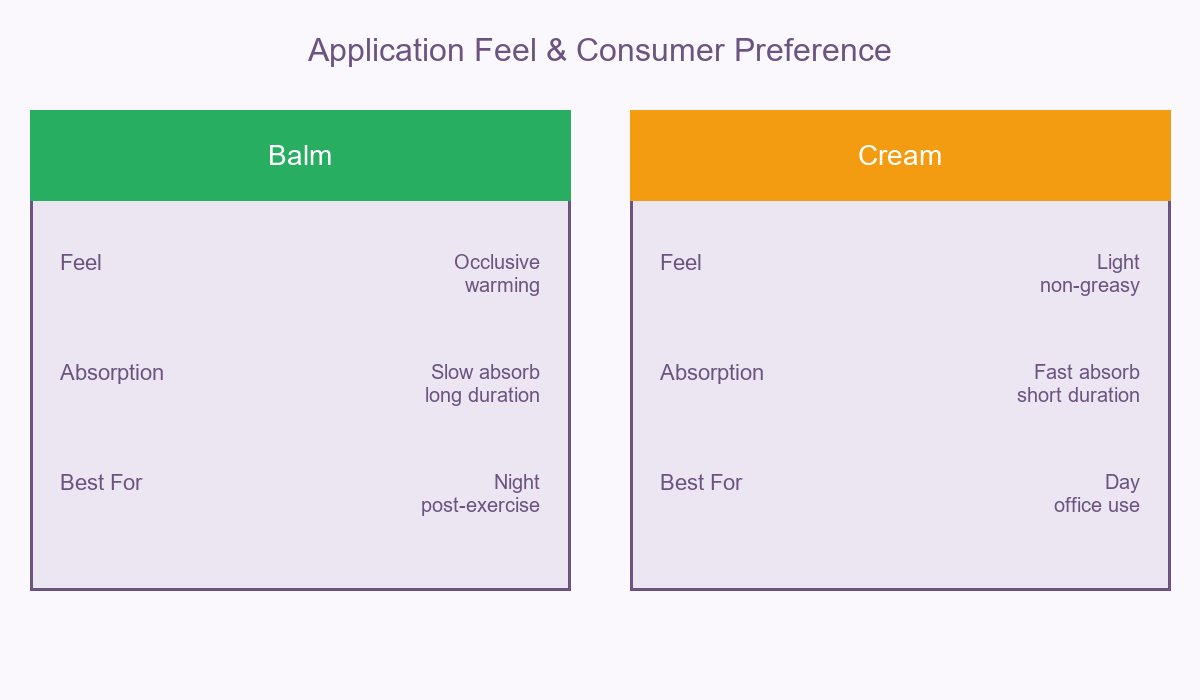
Balm feels occlusive and warming on application, with slower absorption and longer skin contact. The warming sensation reinforces the analgesic perception and supports overnight use for back, neck, and joint pain. Cream feels lighter and absorbs faster, supporting daytime re-application and use under clothing. KONGDY's consumer testing data shows balm wins for nighttime and post-exercise use, cream wins for daytime and office use. Request consumer testing data for your target use occasion.
4.2 Active Ingredient Delivery (KONGDY)
Balm delivers active ingredients through occlusion, which slows release but extends duration, making it suitable for sustained relief over 4 to 8 hours. Cream delivers actives more rapidly, with shorter duration of 2 to 4 hours, but with faster perceived onset. The choice depends on whether the consumer wants sustained relief or rapid relief. KONGDY's formulation team can match active load and release profile to your target claim. Request active delivery profile guidance for your balm or cream project.
4.3 Reorder Cycle and Repeat Purchase (KONGDY)
Balm tins last longer per unit (typical pack covers 30 to 60 applications), which extends the reorder cycle and improves customer lifetime value for subscription and loyalty programs. Cream tubes run out faster, encouraging more frequent reorder but also more frequent churn if the consumer is dissatisfied. KONGDY advises reorder-cycle modelling as part of the format selection. Schedule a reorder-cycle modelling session for your format choice.
4.4 Climate and Seasonality (KONGDY)
Balm softens in warm climates and may partially liquefy above 35 degrees Celsius in transit, while cream remains stable but can separate if temperature cycles are extreme. KONGDY's stability data covers 4 to 40 degree Celsius for both formats and advises transit-tested packaging. Request stability data and transit-tested packaging options for your destination market.
5. Pain Relief Balm vs Pain Relief Cream: When to Choose Which Format
The format decision depends on distribution channel, climate, price point, and consumer occasion. The matrix below gives B2B buyers a structured decision rather than a preference statement.
5.1 Choose Balm When (KONGDY)
Choose balm for warm-climate distribution, long shipping cycles, nighttime and post-exercise positioning, Amazon FBA subscription programs, and price-sensitive mass-market channels where packaging cost per gram matters. Balm also wins for cross-border e-commerce to Asia, Middle East, and Africa where shipping temperatures are high and shelf life is the binding constraint. KONGDY's balm MOQ structure supports entry-tier brand owners with written testing scope and packaging inclusion. Request the balm entry-tier quotation for your market.
5.2 Choose Cream When (KONGDY)
Choose cream for daytime office and professional positioning, premium spa and wellness channels, fast-absorption claims, and markets where the consumer expects a cosmetic-grade skin feel. Cream also wins for first-aid and clinical channel positioning where rapid onset matters more than sustained duration. KONGDY's cream MOQ structure mirrors the balm tiered model with cream-specific testing requirements. Request the cream entry-tier quotation for your market.
5.3 Offer Both Formats in Portfolio (KONGDY)
Mature consumer health brands often run both balm and cream in the same portfolio, with balm positioned for night/sustained relief and cream for day/rapid relief. The shared manufacturing facility at KONGDY allows both formats to run on the same line set with format-specific changeover. Talk to our commercial team about a dual-format portfolio quotation.
5.4 Switch Formats Mid-Cycle (KONGDY)
Some brands launch with cream and add balm later, or vice versa, once consumer feedback clarifies which format drives reorder. The shared ingredient list and active system means reformulation between formats is fast and inexpensive. KONGDY supports mid-cycle format addition with documented change control and parallel stability work. Request the format-switching procedure and timing.
6. Pain Relief Balm vs Pain Relief Cream: Cost-per-Unit Economics
Unit cost comparison without context misleads B2B buyers. A fair comparison accounts for active load, packaging cost, testing cost, freight economics, and amortised tooling.
6.1 Raw Material Cost (KONGDY)
Balm raw materials (waxes, butters, actives) are typically 20 to 40 percent cheaper per kilogram than cream raw materials (emulsifiers, preservatives, water-phase ingredients), but the unit cost per pack depends on pack size. KONGDY discloses raw material cost components separately on every quotation. Request a raw material cost breakdown for balm and cream at your target pack size.
6.2 Packaging Cost Comparison (KONGDY)
Balm tins cost less per gram than cream tubes at equivalent pack size, with tin 50g typically 30 to 50 percent cheaper than tube 50ml after amortised tooling. Cream jars and pump bottles are the most expensive format per gram but offer the highest premium perception. KONGDY quotes packaging cost per unit and per gram on every quotation. Request packaging cost per gram comparison for your format choice.
6.3 Testing Cost Differential (KONGDY)
Cream testing (stability, microbial, preservative efficacy) costs roughly 1.5 to 2 times the equivalent balm testing because of the water phase and preservative system. This testing differential is fixed per formulation, so it weighs heaviest at entry-tier MOQ and is largely irrelevant at scale-tier MOQ. KONGDY specifies the testing component of the unit cost on every quotation. Request a testing cost comparison for balm and cream at your tier.
6.4 Freight and Warehousing Cost (KONGDY)
Balm ships more compactly than cream at equivalent unit count, with tin and stick formats achieving higher density per cubic metre. This favours balm for cross-border e-commerce and long-distance distribution. Cream in jars occupies more space per unit and requires more careful stacking to avoid deformation. KONGDY's logistics team provides per-format container utilisation modelling. Request a container utilisation model for your distribution plan.
7. Pain Relief Balm vs Pain Relief Cream: Regulatory Pathway
Regulatory pathway differs between the two formats because cream's water phase triggers additional preservative and microbial testing requirements in most jurisdictions. B2B buyers should map regulatory pathway before selecting format.
7.1 FDA Cosmetic Pathway (KONGDY)
Both balm and cream qualify for FDA cosmetic monograph pathway when labelled for cosmetic topical use, with the same labeling, GMP, and voluntary registration requirements. Balm's anhydrous base simplifies the safety substantiation file because no preservative system is required. KONGDY prepares FDA cosmetic regulatory documentation for both formats. Request the FDA cosmetic documentation package for your format.
7.2 EU CPSR Pathway (KONGDY)
The EU Cosmetic Product Safety Report (CPSR) requires full ingredient safety assessment, microbiological testing, and stability data for both formats, but cream additionally requires preservative efficacy testing (PET) and a more extensive stability matrix because of the water phase. KONGDY prepares EU CPSR documentation for both formats, with cream requiring roughly 30 percent more testing time. Request the EU CPSR timeline for your format choice.
7.3 Asia Market Pathways (KONGDY)
Asia market pathways (China NMPA, Japan PMDA, Korea KFDA, India CDSCO, ASEAN harmonised) accept both formats but require local testing and registration that varies by jurisdiction. Balm typically completes Asia registration faster because of the simpler stability package. KONGDY supports Asia market registration with documented timelines and local testing partner coordination. Request the Asia market registration timeline for your destination countries.
7.4 OTC Drug versus Cosmetic Classification (KONGDY)
Both formats can be positioned as cosmetic or OTC drug depending on the claims and active ingredients. Active ingredients with recognised analgesic monograph (menthol, methyl salicylate, capsaicin) may qualify for OTC drug pathway in some markets, which adds clinical testing and longer registration. KONGDY advises OTC versus cosmetic positioning based on the destination market and claim structure. Request OTC versus cosmetic positioning advice for your market.
8. Pain Relief Balm vs Pain Relief Cream: MOQ and Lead Time Comparison
MOQ and lead time differ between formats because of testing scope, filling line setup, and packaging minimums. The differences are largest at entry tier and smallest at scale tier.
8.1 Entry-Tier MOQ (KONGDY)
Balm entry-tier MOQ is typically 20 to 30 percent lower than cream entry-tier MOQ because of the simpler testing package and lower packaging minimums. KONGDY's tier 1 balm MOQ starts at 3,000 units, while cream tier 1 starts at 4,000 units. Both include formulation confirmation, basic stability, and entry-tier packaging. Request the entry-tier balm and cream MOQ for your market.
8.2 Growth-Tier MOQ (KONGDY)
Growth-tier MOQ for both formats converges because fixed costs are spread across volume and packaging minimums become the binding constraint. KONGDY's growth-tier balm and cream MOQ both sit at 10,000 to 15,000 units, with format-specific packaging included. Request growth-tier pricing for balm and cream at your target volume.
8.3 Scale-Tier MOQ (KONGDY)
Scale-tier MOQ for both formats is set by production scheduling and raw material procurement economics, which differ only modestly between formats. KONGDY's scale-tier balm and cream MOQ both start at 50,000 units, with priority scheduling and reserved capacity available. Request scale-tier pricing and capacity reservation terms for your annual volume.
8.4 Lead Time Comparison (KONGDY)
Balm lead time is typically 2 to 4 weeks shorter than cream lead time at the same tier because of the simpler stability and preservative efficacy testing scope. KONGDY documents lead time per format and per tier on every quotation. Request the lead time comparison for your format and tier.
9. Pain Relief Balm vs Pain Relief Cream: Procurement Decision Checklist
Use this checklist before selecting a format for your brand. Each item is verifiable in writing and together they define which format fits your channel.
9.1 Define the Use Occasion (KONGDY)
Confirm whether the brand targets nighttime sustained relief (favours balm) or daytime rapid relief (favours cream). The use occasion drives formulation, packaging, and consumer claim structure. KONGDY's commercial team helps buyers define the use occasion and select the matching format. Schedule a use occasion and format selection consultation.
9.2 Map the Distribution Climate (KONGDY)
Identify the climate zones in the distribution footprint, including transit legs. Warm climates (above 30 degree Celsius average) and long transits favour balm's anhydrous stability. KONGDY provides climate-fit stability data and packaging recommendations. Request climate-fit stability data for your distribution plan.
9.3 Compare Testing and Documentation Cost (KONGDY)
Request testing and documentation cost breakdown for both formats at your destination market, because this fixed cost weighs differently at each MOQ tier. KONGDY specifies testing cost per format per market on every quotation. Request the testing cost breakdown for balm and cream at your destination market.
9.4 Verify Regulatory Pathway (KONGDY)
Confirm the regulatory pathway for both formats in your destination market, including registration timeline and testing requirements. KONGDY provides regulatory pathway documentation for FDA, EU CPSR, and Asia markets. Request the regulatory pathway document for your market.
9.5 Model Total Cost of Ownership (KONGDY)
Model total cost of ownership per format over 12 months, including unit cost, packaging, testing, freight, and amortised tooling. Compare on landed cost rather than unit price alone. KONGDY's commercial team provides a TCO modelling worksheet for format comparison. Request the TCO modelling worksheet for balm and cream.
10. Conclusion: Choosing Between Pain Relief Balm and Pain Relief Cream for B2B
Pain relief balm and pain relief cream are not interchangeable formats. The decision is structural, driven by use occasion, climate, regulatory pathway, packaging economics, and consumer expectation. Balm wins for sustained relief, warm climates, long transits, and cost-sensitive channels. Cream wins for rapid relief, premium positioning, daytime use, and cosmetic-grade skin feel.
KONGDY's manufacturing capability covers both formats on the same ISO 22716 GMP facility with shared quality systems, 12 qualified active and base systems, and dedicated filling equipment for tin, stick, tube, jar, and pump bottle formats. The company supplies both formats to B2B brand owners, importers, distributors, and Amazon FBA sellers across FDA cosmetic, EU CPSR, and Asia market pathways with documented MOQ tiers, testing scope, and packaging inclusion.
Request a side-by-side pain relief balm and pain relief cream quotation within 48 hours — KONGDY's commercial team will return format-specific MOQ tiers, raw material cost breakdown, packaging cost per gram, testing cost comparison, regulatory pathway timeline, and lead time so you can decide on landed cost rather than unit price alone.
Next steps for B2B buyers: submit your product brief including target markets, distribution climate, use occasion, annual volume forecast, and channel mix through the contact form. You will receive a written format recommendation, side-by-side quotation, regulatory pathway timeline, climate-fit stability data, and total cost of ownership model. Brand owners planning a launch within two quarters can additionally reserve an entry-tier pilot batch slot at KONGDY's ISO 22716 certified facility while format selection and stability work are completed in parallel.

