Pain relief balm MOQ explained as a three-tier structure for B2B brand owners: entry pilot volume for validation, growth volume with printed packaging, and scale volume with reserved capacity. Covers what drives the minimum order quantity, tooling and testing cost allocation, negotiation levers for first orders, and the checklist to verify before signing.
1. Why Pain Relief Balm MOQ Matters for B2B Brand Owners
Pain relief balm MOQ is the minimum order quantity a contract manufacturer will produce in a single run, and it is the number that decides whether a new balm line is commercially viable or quietly abandoned. Balm production carries fixed costs per batch: vessel cleaning and changeover, filling line setup, label plate charges, and quality testing. Those costs must be spread across unit volume, so the MOQ is simply the batch size at which the manufacturer can amortise setup without losing money.
KONGDY has manufactured consumer health products for 36 years and structures pain relief balm MOQ around three tiers rather than a single flat number, so brand owners can enter at pilot scale and grow into commercial volume. The facility runs ISO 22716 GMP certified balm production with in-house formulation, stability testing, filling, and export documentation. Tiered MOQ means a first-order brand is not forced to buy a full container before it has market data, while a scaling brand still receives the unit economics of volume production.
This guide explains the tiered pain relief balm MOQ structure, what drives each tier's quantity, which cost components change between tiers, and the negotiation levers B2B brand owners can use on a first order without damaging long-term supply relationships.
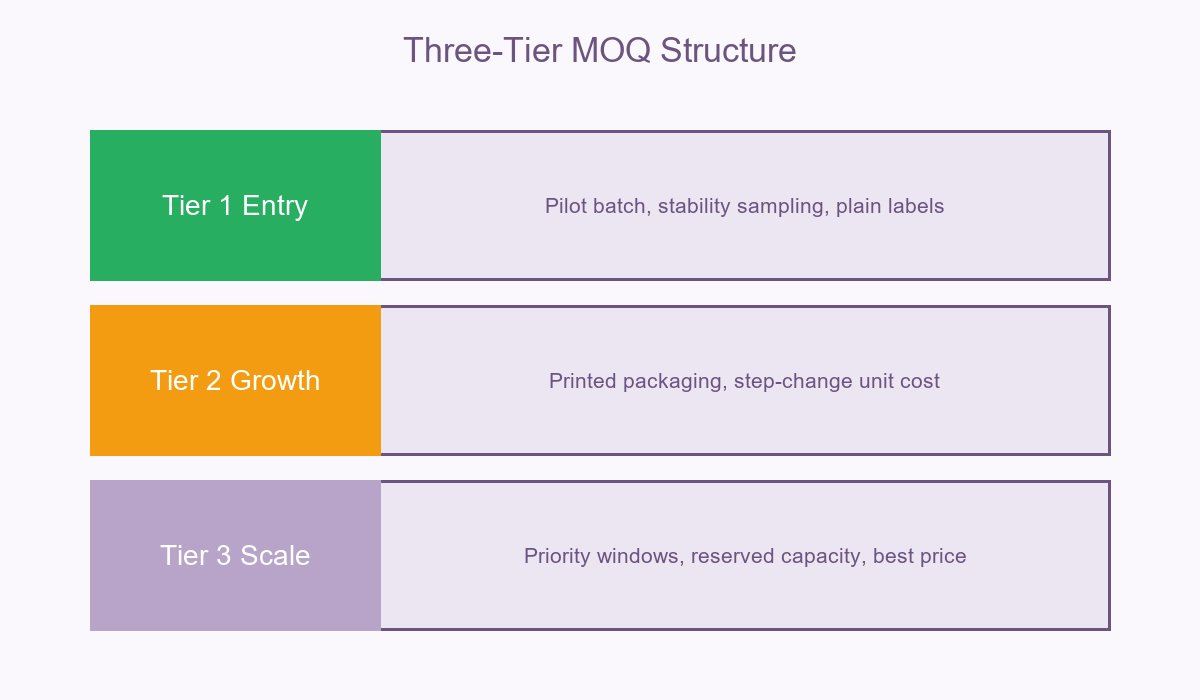
2. Pain Relief Balm MOQ: Tiered Structure Overview
A tiered pain relief balm MOQ structure links order quantity to unit price, tooling treatment, lead time, and production scheduling priority. Instead of quoting one number that either excludes new brands or destroys margin, the manufacturer publishes a ladder of quantities with defined commercial terms at each step.
2.1 Tier 1: Pilot and Validation Volume (KONGDY)
Tier 1 covers the smallest run that still allows full validation: stability sampling, microbiological testing, fill-weight verification, and labelling accuracy checks. It exists so a brand can confirm the formula and packaging before committing capital. KONGDY quotes Tier 1 with the testing scope stated so buyers can see exactly what they are paying for. Request Tier 1 pain relief balm MOQ pricing with the testing scope included.
2.2 Tier 2: Growth Volume (KONGDY)
Tier 2 is the first commercially efficient run, where setup cost per unit drops sharply and printed packaging becomes economic. Buyers usually enter Tier 2 once the first market test confirms reorder intent. KONGDY prices Tier 2 to include printed cartons and labels without separate plate amortisation pressure. Get Tier 2 balm pricing with printed packaging included.
2.3 Tier 3: Scale Volume (KONGDY)
Tier 3 delivers the lowest unit cost, priority scheduling, and dedicated production windows. It suits brands with confirmed distribution, repeat order history, or multi-market launches. KONGDY reserves Tier 3 capacity slots in advance for repeat customers. Confirm Tier 3 capacity availability for your launch window.
2.4 How the Tiers Interlock (KONGDY)
The tiers are designed to be climbed, not chosen once. Each tier's testing and documentation carry forward, so a brand moving from Tier 1 to Tier 2 does not repeat stability work or re-qualify packaging. KONGDY carries validation data forward across tiers automatically. Ask for a tier progression plan covering your first three orders.
3. Pain Relief Balm MOQ: Entry Tier Explained
The entry tier is where most B2B brand owners start, and it is the tier most often misunderstood, because a low quantity does not always mean a low total cost. Buyers should understand which cost elements are fixed at entry level and which scale away later.
3.1 What Is Included at Entry Level (KONGDY)
Entry-level pain relief balm MOQ typically includes formulation confirmation, a defined number of filling units, primary packaging, plain or minimally printed labels, stability sampling, microbiological testing, and a certificate of analysis. It answers the question of whether the product works and sells. KONGDY lists the exact inclusion list on the Tier 1 quotation so nothing is assumed. Request the Tier 1 inclusion list and sample quantity.
3.2 Tooling and Plate Charges (KONGDY)
Printed cartons, labels, and decorated tins require printing plates or dies that are charged once regardless of run size. At entry level these charges can dominate the landed cost per unit. KONGDY separates tooling charges from unit price on every quotation so buyers can see the one-time versus recurring cost split. Get a tooling cost breakdown for your balm packaging format.
3.3 Testing Cost Allocation (KONGDY)
Stability, microbiological, and analytical testing are largely fixed per formulation, not per unit, so they weigh heaviest at the smallest run. This is why entry-tier unit prices look high compared with Tier 3. KONGDY discloses the testing component of the quotation so buyers understand where the money goes. Schedule a testing cost review before approving a first order.
3.4 Lead Time at Entry Level (KONGDY)
Entry-level runs are scheduled around larger production campaigns, which can lengthen lead time compared with dedicated Tier 3 windows. Buyers planning a fixed launch date should confirm the schedule slot before ordering. KONGDY provides written lead time commitments including testing duration and packing. Confirm lead time for your target launch date.
4. Pain Relief Balm MOQ: Growth Tier Explained
The growth tier is where a balm line starts to behave like a real business. Setup costs are diluted, printed packaging becomes affordable, and the manufacturer can begin holding inventory safety stock for repeat supply.
4.1 Quantity Thresholds and Rationale (KONGDY)
Growth-tier quantities are set at the point where filling runs long enough to justify cleaning, changeover, and packaging setup without idle line time. That threshold varies with pack format, since stick filling and tin filling have different cycle times. KONGDY sets growth-tier thresholds per packaging format rather than applying one blanket number. Ask for growth-tier thresholds by packaging format.
4.2 Unit Economics Improvement (KONGDY)
Moving from entry to growth tier typically produces the largest single reduction in unit cost across the whole ladder, because fixed costs are divided across several times the unit count. The improvement is usually step-change rather than gradual. KONGDY publishes the expected unit cost reduction between tiers before the buyer orders. Request a cross-tier unit cost comparison for your balm.
4.3 Packaging Customisation at Growth Volume (KONGDY)
At growth volume, printed cartons, branded labels, custom tin decoration, and custom applicator colours become commercially sensible. This is where private label differentiation becomes visible on shelf. KONGDY coordinates custom packaging sourcing and artwork compliance for growth-tier runs. Get custom packaging feasibility and cost for your growth-tier order.
4.4 Replenishment Planning (KONGDY)
Growth-tier buyers should plan replenishment against sales velocity and shelf life rather than reordering reactively after stock-out. Manufacturing lead time plus shipping transit defines the reorder point. KONGDY provides reorder point guidance based on shelf life and transit time for each destination. Request a replenishment planning template for your market.
5. Pain Relief Balm MOQ: Scale Tier Explained
The scale tier is built for brands with predictable demand, distribution agreements, or multi-market rollouts. It trades flexibility for the best unit economics and the strongest supply security.
5.1 Quantity Thresholds and Volume Discounts (KONGDY)
Scale-tier quantities support continuous or near-continuous production, which removes repeated setup cost and enables raw material purchasing at better supplier terms. Volume discounts at this tier reflect both manufacturing and procurement savings. KONGDY passes procurement savings into scale-tier pricing. Get scale-tier volume pricing for annual demand of your balm line.
5.2 Priority Scheduling and Capacity Reservation (KONGDY)
Scale-tier customers receive priority production windows and reserved capacity, which protects launch dates during peak season when filling lines are congested. Capacity reservation is agreed in writing against annual volume commitments. KONGDY offers written capacity reservation agreements for scale-tier partners. Confirm capacity reservation terms for your annual volume.
5.3 Raw Material Security (KONGDY)
At scale, actives such as menthol, camphor, and capsaicin are sourced against forecast rather than per batch, with safety stock held for critical inputs. This insulates the brand from spot price volatility and supply interruptions. KONGDY maintains qualified dual sourcing for critical balm actives. Talk to our procurement team about actives sourcing security at scale.
5.4 Long-Term Partnership Terms (KONGDY)
Scale-tier relationships typically include annual pricing review, quality agreement, change control notification windows, and continuous improvement targets. These terms protect both sides against unilateral changes. KONGDY negotiates long-term supply agreements with defined review points. Request a long-term balm supply agreement template.
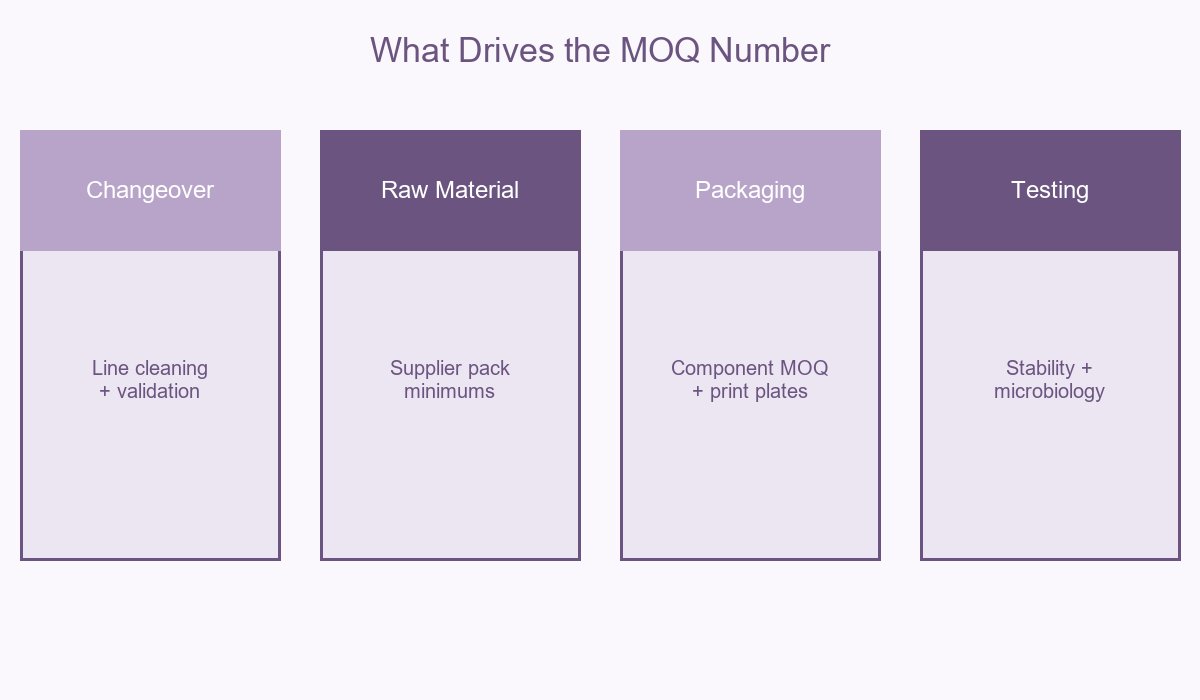
6. Pain Relief Balm MOQ: What Drives the Numbers
Buyers who understand what actually drives MOQ can negotiate with evidence instead of pressure. Every MOQ number decomposes into a small set of physical and commercial constraints, and each of them can be discussed on its merits.
6.1 Filling Line Changeover and Cleaning (KONGDY)
Changing between products requires dismantling, cleaning, and re-qualifying filling equipment, plus documented cleaning validation for the previous formulation. This time is consumed regardless of run length. KONGDY's changeover documentation supports both food-grade and cosmetic cleaning validation standards. Ask how changeover time is calculated for your balm format.
6.2 Raw Material Minimum Pack Sizes (KONGDY)
Actives, speciality butters, and essential oils are purchased in supplier minimum pack sizes, so a small finished-goods run can still require a full drum or sack of each input. Excess material is either carried as inventory or written off. KONGDY maps raw material minimum pack sizes against your formula to show the true material-driven floor. Request a raw material pack size analysis for your formula.
6.3 Packaging Component Minimums (KONGDY)
Tins, sticks, tubes, and applicators carry their own supplier minimums, and custom-decorated components carry substantially higher ones because of printing setup. Packaging minimums frequently exceed formulation minimums in practice. KONGDY checks packaging supplier minimums before quoting so the quoted MOQ is achievable. Get a packaging component minimum assessment for your format.
6.4 Quality Testing Requirements (KONGDY)
Stability, microbiological, and analytical testing requirements are set by regulation and by the destination market, not by order size. Testing therefore cannot be waived to reduce MOQ, only reallocated to the appropriate tier. KONGDY specifies the mandatory testing package for each destination market. Confirm the testing package required for your destination market.
7. Pain Relief Balm MOQ: Negotiation Levers for First Orders
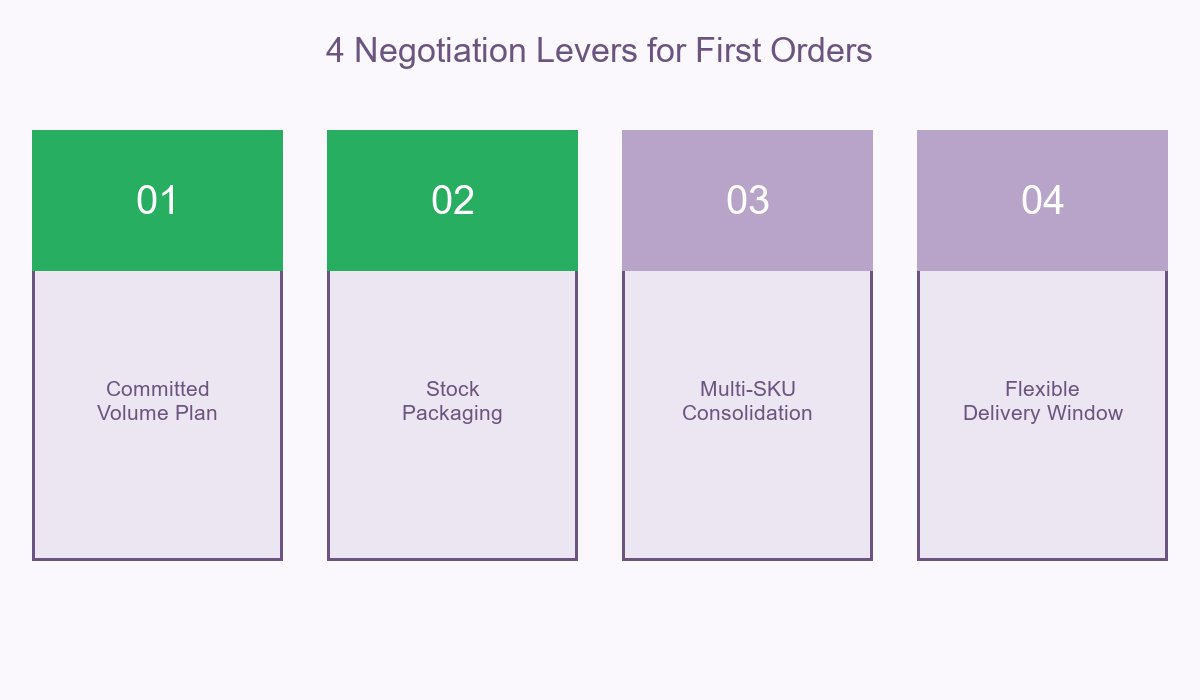
Negotiation on a first balm order works best when the buyer offers something the manufacturer values in return for volume flexibility. The levers below are the ones experienced B2B buyers use most often.
7.1 Committed Future Volume (KONGDY)
A documented plan for follow-on orders is the strongest lever available, because it lets the manufacturer plan raw material and line capacity with confidence. A forecast with a stated reorder trigger is far more persuasive than an open-ended promise. KONGDY accepts committed volume plans as a basis for entry-tier pricing. Submit your 12-month balm volume plan for a revised quotation.
7.2 Standard Packaging Instead of Custom (KONGDY)
Choosing a stock container with a printed label instead of a fully custom-moulded pack removes tooling and component minimums from the calculation entirely. Many brands adopt stock primary packaging for launch and switch to custom at growth volume. KONGDY offers stock balm packaging options with low minimums for first orders. Request stock packaging options for your launch.
7.3 Multi-Format Consolidation (KONGDY)
Ordering two or three balm formats or SKUs in one production campaign spreads changeover and setup across a larger combined batch. Consolidation works especially well when formats share the same base. KONGDY consolidates multi-SKU balm orders into single campaigns to reduce per-SKU minimums. Talk to our production planning team about multi-SKU consolidation.
7.4 Flexible Delivery Windows (KONGDY)
Buyers who accept flexible production scheduling let the manufacturer slot their run into a gap rather than reserving dedicated capacity, which reduces the effective minimum. This trades planning certainty for a lower entry quantity. KONGDY offers flexible-window scheduling for buyers who can accept a wider delivery range. Ask about flexible-window balm production scheduling and pricing.
8. Pain Relief Balm MOQ: Cost-per-Unit Economics Across Tiers
Comparing tiers only on quoted unit price hides the total cost of ownership. A structured comparison covers every cost element from tooling through freight, so the decision is made on landed cost.
8.1 One-Time Versus Recurring Costs (KONGDY)
Tooling, plates, artwork revision, and formulation development are one-time costs that should be amortised over expected lifetime volume, not charged entirely to the first order. KONGDY presents quotations with one-time and recurring costs separated. Request a quotation with amortisation view for your balm project.
8.2 Freight and Incoterms Impact (KONGDY)
Unit economics change materially between EXW, FOB, CIF, and DDP because freight, insurance, and duty sit with different parties. Comparing quotes on different Incoterms produces misleading conclusions. KONGDY quotes balm orders on the Incoterm the buyer requests and documents what is included. Get balm quotations on FOB, CIF, and DDP terms for direct comparison.
8.3 Inventory Carrying Cost (KONGDY)
Larger orders lower unit price but increase inventory carrying cost, storage, and obsolescence risk against a defined shelf life. The optimum order quantity balances both sides rather than minimising price alone. KONGDY helps buyers model carrying cost against shelf life for each tier. Schedule an order quantity and carrying cost modelling session.
8.4 Quality Risk Cost (KONGDY)
Cheaper suppliers with weak testing shift risk onto the buyer in the form of recalls, relabelling, and returns, which typically dwarf the price difference. Quality cost should be assessed explicitly rather than assumed equal. KONGDY documents testing scope and certification on every quotation so risk is comparable. Request a quality scope comparison against alternative balm suppliers.
9. Pain Relief Balm MOQ: B2B Buyer Negotiation Checklist
Use this checklist before signing a first balm supply agreement. Each item is verifiable in writing, and together they define whether the agreed MOQ is genuinely workable.
9.1 Confirm Tier Definitions in Writing (KONGDY)
Ask for the quantity, unit price, testing scope, packaging inclusion, tooling charges, and lead time for each tier on a single document. Verbal tier descriptions change; written ones do not. KONGDY issues a one-page tier schedule with every balm quotation. Request the written balm tier schedule.
9.2 Verify Testing Scope Cannot Be Reduced (KONGDY)
Confirm which tests are regulatory minimums for your destination market and which are optional, so you never negotiate away a compliance requirement. KONGDY identifies mandatory versus optional testing for each market. Request a mandatory testing list for your destination market.
9.3 Check Tooling Ownership and Reuse (KONGDY)
Clarify who owns plates and tooling, whether they can be reused for reorders, and whether they transfer if you change supplier. Ownership disputes are a common cause of reorder cost shocks. KONGDY states tooling ownership and reuse terms in the supply agreement. Confirm tooling ownership and reuse terms in writing.
9.4 Agree Change Control and Price Review (KONGDY)
Define how formulation changes, raw material price movements, and annual price reviews are handled, including the notification window before changes take effect. KONGDY operates a documented change control process with advance customer notification. Request the change control and price review procedure.
10. Conclusion: Pain Relief Balm MOQ Planning for B2B Brand Owners
Pain relief balm MOQ is not a single number to negotiate down, it is a structure to plan against. Tiers exist because balm production carries fixed setup, testing, and tooling costs that must be spread across volume, and the right entry point depends on whether a brand is validating a formula, scaling a proven product, or securing long-term supply. Buyers who understand filling changeover, raw material pack sizes, packaging minimums, and mandatory testing negotiate with evidence rather than pressure.
KONGDY's pain relief balm MOQ structure covers three tiers with written quantities, testing scope, packaging inclusion, tooling treatment, and lead time at each step, backed by ISO 22716 GMP certified production, in-house stability and microbiological testing, custom and stock packaging options, and export documentation for FDA cosmetic, EU CPSR, and Asia market pathways. With 36 years of consumer health manufacturing experience and 12 qualified active and base systems, the facility supports both first validation runs and reserved capacity for established brands.
Get a custom pain relief balm quotation for your MOQ tier within 48 hours — KONGDY's commercial team will return Tier 1, Tier 2, and Tier 3 quantities with unit pricing, tooling cost breakdown, mandatory testing scope for your destination market, and written lead time so you can model landed cost before committing.
Next steps for B2B buyers: submit your balm product brief, target markets, annual volume forecast, and packaging preference through the contact form. You will receive a written tier schedule, a raw material pack size analysis, a packaging component minimum assessment, and a tier progression plan for your first three orders. Brand owners planning a launch within two quarters can additionally reserve a pilot batch slot at KONGDY's ISO 22716 certified facility while formulation and stability work are completed in parallel.

