Documentation-first pain relief balm quality control for first-time importers: ISO 22716 GMP, FDA cosmetic, EU CPSR, and Asia market pathways. Covers finished product CoA, stability data, microbiological testing, packaging compliance, customs documentation, and the 5 most common first-shipment documentation failures B2B buyers must catch before signing the supply agreement.
1. Why Pain Relief Balm Quality Control Matters for First-Time Importers
Pain relief balm quality control is the discipline that prevents an importer's first shipment from being stopped at customs, recalled from retail, or rejected by consumers. Topical analgesics travel across regulatory regimes, climate zones, and consumer expectations, and every leg of that journey exposes the product to failure modes that proactive QC prevents. Importers who build a documentation audit habit on day one avoid the most common causes of first-shipment failure: missing Certificates of Analysis, mismatched ingredient declarations, stability data that does not match the destination market's storage conditions, and packaging claims that overstate the formulation's documented performance.
KONGDY has manufactured consumer health products for 36 years and operates a documentation-first QC system covering formulation, raw material qualification, in-process control, finished product testing, stability, and export documentation. The facility runs ISO 22716 GMP certified balm production with in-house analytical chemistry, microbiology, and stability chambers. Every balm shipment leaves the facility with a written QC dossier that the importer's regulatory team can present at destination without rebuilding the file.
This guide covers the QC documentation framework that first-time pain relief balm importers should demand from their manufacturer before signing a supply agreement, the verification steps to perform on each shipment, and the records to retain for traceability through customs, retail onboarding, and any post-market surveillance event. Each documentation item is verifiable in writing and together they define whether the QC system is genuinely auditable.
2. Pain Relief Balm QC: What Is a Documentation-First Quality System
A documentation-first QC system records every decision, test, and result in writing before the product moves to the next step. It is the opposite of relying on the manufacturer's reputation, a sales promise, or a sample's appearance. B2B importers who require documentation-first systems catch problems months before they reach the consumer.
2.1 Raw Material Qualification Records (KONGDY)
Raw material qualification records include Certificate of Analysis (CoA) for each input, supplier audit reports, allergen statements, and traceability from the supplier batch to the finished goods batch. KONGDY retains raw material CoAs for every input lot for a minimum of 7 years, with supplier audit reports refreshed annually. Request raw material qualification records for your balm supplier's last three batches.
2.2 In-Process Control Records (KONGDY)
In-process control records document the production steps, including filling line setup, cleaning validation, fill weight verification, torque or seal checks (for tubes and jars), and line clearance documentation between batches. KONGDY retains batch records for every production run for a minimum of 7 years. Request a sample in-process control record for your balm SKU.
2.3 Finished Product Testing Records (KONGDY)
Finished product testing records document the analytical, microbiological, and stability results for each finished batch. The records include the test method reference, specification, result, and analyst signature. KONGDY issues a finished product CoA with every shipment. Request a sample finished product CoA for your balm format.
2.4 Retention and Audit Trail (KONGDY)
A retention policy specifies how long each record is kept, where it is stored, who can access it, and how it is presented to regulatory authorities on request. KONGDY retains QC records for 7 years minimum, with electronic batch records indexed by batch number and accessible to authorised regulatory staff on request. Request the QC retention policy and audit trail procedure.
3. Pain Relief Balm QC: Quality System Standards and Certifications
The quality system standards the manufacturer holds define the baseline of documentation discipline. Importers should require evidence of certification, the scope of certification, and the most recent audit cycle, because "certified" without scope is not auditable.
3.1 ISO 22716 GMP Certification (KONGDY)
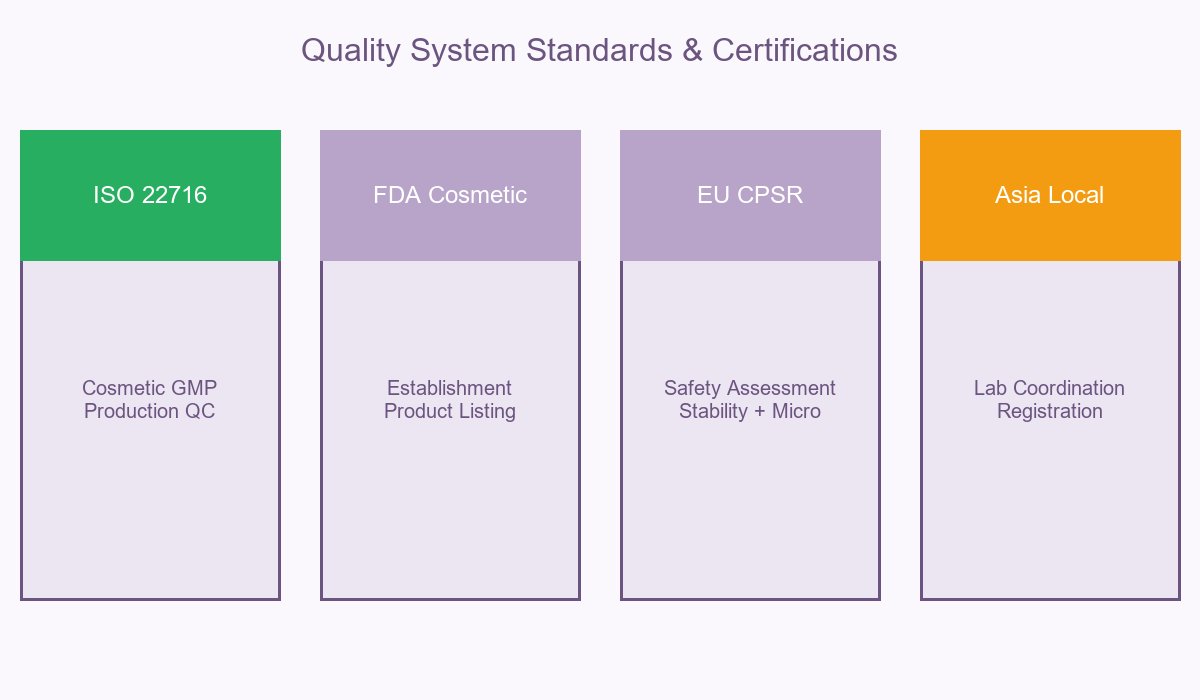
ISO 22716 is the cosmetic GMP standard covering production, quality control, equipment, premises, materials, and personnel. KONGDY's facility is ISO 22716 certified by an accredited body, and the certificate scope covers balm, cream, gel, and patch formats. The most recent surveillance audit is documented and available on request. Request the ISO 22716 certificate and most recent surveillance audit report.
3.2 FDA Cosmetic Registration (KONGDY)
FDA cosmetic registration is voluntary for cosmetic topical products but signals that the manufacturer has filed the establishment, product listing, and ingredient declaration with the FDA database. KONGDY maintains FDA cosmetic establishment registration and product listing for all balm SKUs sold into the US market. Request the FDA establishment registration number and product listing confirmation.
3.3 EU CPSR Preparation Support (KONGDY)
EU Cosmetic Product Safety Report (CPSR) is mandatory for cosmetic products placed on the EU market. KONGDY prepares the CPSR with a qualified safety assessor and provides the document as part of the regulatory dossier for EU importers. The CPSR covers ingredient safety, microbiological quality, stability, and product information. Request the CPSR preparation timeline for your destination EU country.
3.4 Asia Market Testing Coordination (KONGDY)
Asia market registration typically requires sample shipment to a local accredited lab for destination-market-specific testing. KONGDY coordinates local testing with partner labs in China, Japan, Korea, India, and ASEAN markets, with documented timelines and test method alignment to local requirements. Request the Asia testing partner list and timeline for your destination markets.
4. Pain Relief Balm QC: Documentation Framework by Document Type
The framework below organises QC documentation into categories that any first-time importer can verify before signing a supply agreement. Each category has a defined purpose, owner, and retention rule.
4.1 Certificate of Analysis (CoA) Framework (KONGDY)
The finished product CoA documents the test results for each batch against the agreed specification. Required entries include batch number, manufacturing date, expiry date, analytical test results, microbiological test results, fill weight verification, and the analyst and QA release signatures. KONGDY issues a finished product CoA with every shipment. Request a sample finished product CoA and specification document for your balm format.
4.2 Certificate of Conformity (CoC) (KONGDY)
The CoC is a one-page declaration that the finished product conforms to the agreed specification, formula, and regulatory requirements of the destination market. KONGDY issues a CoC with each shipment covering the destination market's specific requirements. Request a sample CoC for your destination market.
4.3 Safety Data Sheet (SDS) for Topical Products (KONGDY)
The SDS documents the hazard, handling, storage, and first-aid information for the product. For topical cosmetics, the SDS is often simplified but still required for transport classification and customs clearance. KONGDY provides SDS for every balm SKU formatted to the destination market's requirement. Request a sample SDS for your balm SKU.
4.4 Ingredient Declaration and Allergen Statement (KONGDY)
The ingredient declaration lists every ingredient in INCI nomenclature, in descending order of concentration, with allergens explicitly called out where applicable. KONGDY provides the INCI declaration for every balm SKU, including the regulatory allergens required by EU, US, and Asia markets. Request the INCI declaration and allergen statement for your balm SKU.
5. Pain Relief Balm QC: Pre-Shipment Documentation Checklist
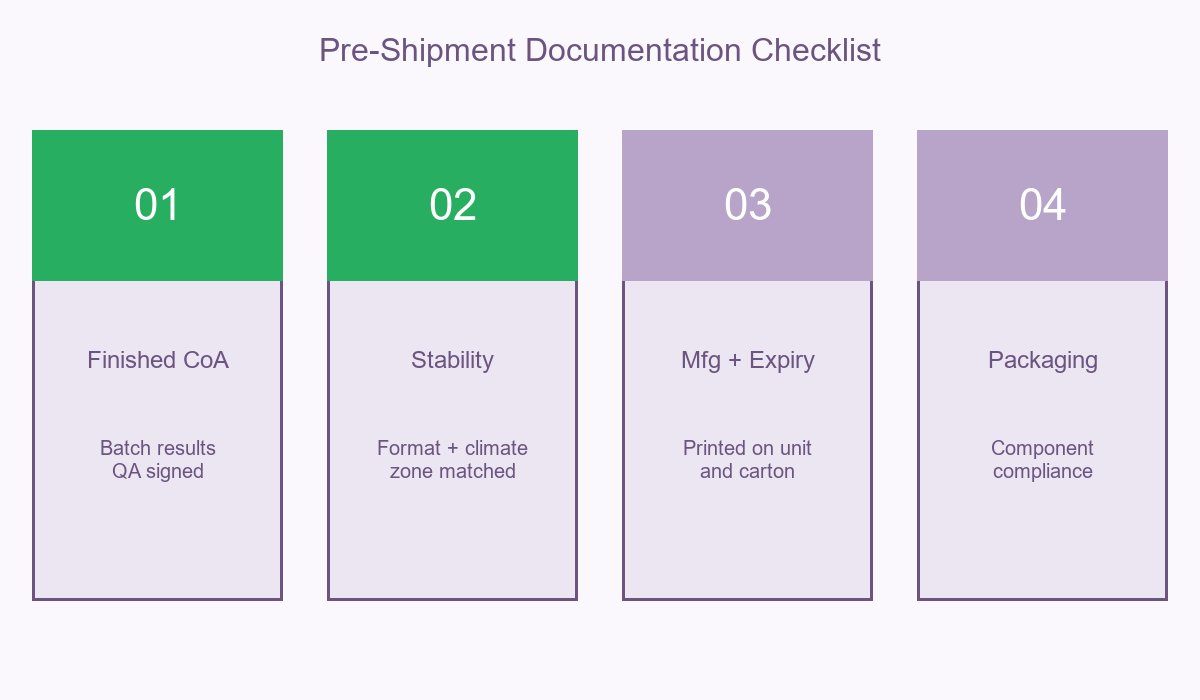
This checklist covers the documentation that should be in the importer's hands before the shipment leaves the manufacturer's facility. Each item is verifiable in writing.
5.1 Finished Product Certificate of Analysis (KONGDY)
Confirm the finished product CoA is issued by the manufacturer's QA department, signed by an authorised analyst, and covers every test in the agreed specification. The CoA must reference the batch number and manufacturing date. KONGDY's QA department signs and issues every finished product CoA. Request the CoA for the current production batch before shipment.
5.2 Stability Data Summary for the Shipment's Format (KONGDY)
Confirm the stability data covers the exact balm formula and packaging format being shipped, with shelf life assignment against the destination market's climate zone. KONGDY issues a stability data summary referencing the formula code, packaging code, and storage condition. Request the stability summary for your specific balm format and climate zone.
5.3 Manufacturing Date and Expiry Date (KONGDY)
Confirm the manufacturing date and expiry date are printed on each unit and on the outer carton, and that the expiry date matches the shelf life assigned in the stability data. KONGDY prints manufacturing date and expiry date on each unit and outer carton in the destination market's preferred format. Confirm date format and printing method for your destination market.
5.4 Packaging Component Compliance (KONGDY)
Confirm every packaging component (tin, lid, label, outer carton) complies with food-contact or cosmetic-contact material regulations in the destination market. KONGDY maintains packaging component compliance statements for every component in use. Request packaging component compliance statements for your balm SKU.
6. Pain Relief Balm QC: Microbiological and Stability Testing Records
Microbiological and stability testing are the most-cited causes of import failure for topical analgesics. Both require documented test methods, specifications, and trend data that the importer's regulatory team can present on demand.
6.1 Microbiological Testing Records (KONGDY)
Microbiological testing records document the total aerobic microbial count, yeast and mould count, and absence of specified pathogens (Pseudomonas aeruginosa, Staphylococcus aureus, Candida albicans, E. coli) for each finished batch. KONGDY runs microbiological testing on every batch with accredited methods and retains the records for 7 years. Request microbiological testing records for your supplier's last three balm batches.
6.2 Preservative Efficacy Testing (PET) (KONGDY)
PET is required for cream formats with a water phase but not for anhydrous balm formats. For balm, the equivalent discipline is microbial challenge testing on the production environment and raw material water activity verification. KONGDY documents microbial control across the production environment and verifies raw material water activity on every input batch. Request PET documentation for your cream SKU or microbial control data for your balm SKU.
6.3 Stability Testing Records (KONGDY)
Stability testing records document the analytical, microbiological, and sensory results at 0, 3, 6, 12, 18, 24, and 36 months under defined storage conditions. KONGDY maintains stability chambers at 4 degree Celsius, 25 degree Celsius / 60 percent RH, 30 degree Celsius / 65 percent RH, and 40 degree Celsius / 75 percent RH with documented chamber qualification and calibration records. Request the stability protocol and most recent stability summary for your balm SKU.
6.4 Stability Data Interpretation and Shelf Life Assignment (KONGDY)
Stability data interpretation assigns the shelf life based on the time point at which the first attribute falls outside the specification. KONGDY's stability summary states the assigned shelf life, the storage condition, and the supporting data. Request the stability interpretation document and the assigned shelf life for your destination market.
7. Pain Relief Balm QC: Import Clearance and Customs Documentation
Customs clearance requires a specific set of documents that align the shipment with the destination market's regulatory and tariff classification. Missing documents are the most common cause of customs hold.
7.1 Commercial Invoice and Packing List (KONGDY)
The commercial invoice and packing list document the unit count, unit value, total value, HS code, country of origin, and manufacturer details required for customs declaration. KONGDY issues the commercial invoice and packing list with each shipment, formatted to the destination market's customs requirement. Request a sample commercial invoice and packing list template for your destination market.
7.2 Certificate of Origin (KONGDY)
The Certificate of Origin documents the country of manufacture, which determines the tariff rate applied by the destination market. KONGDY issues Certificates of Origin through the relevant chamber of commerce for each shipment. Request the Certificate of Origin procedure and chamber of commerce details.
7.3 Health Certificate (Where Required) (KONGDY)
Some destination markets require a health certificate issued by the country of origin's health authority or by an accredited body confirming the product is manufactured under recognised GMP. KONGDY supports health certificate issuance through accredited bodies for destinations that require it. Confirm whether your destination market requires a health certificate.
7.4 Free Sale Certificate (KONGDY)
The Free Sale Certificate documents that the product is freely sold in the country of manufacture, which some destination markets require for cosmetic import approval. KONGDY provides Free Sale Certificates through the relevant authority for shipments requiring it. Request the Free Sale Certificate procedure and timeline for your destination market.
7.5 Tariff Classification and HS Code Verification (KONGDY)
The HS code determines the tariff rate and the regulatory pathway at customs. Balm is typically classified under HS 3004 or HS 3304 depending on the destination market's interpretation. KONGDY's commercial team advises the correct HS code and documents it on the commercial invoice. Confirm the correct HS code for your destination market before shipment.
8. Pain Relief Balm QC: Documentation Audit Checklist for First-Time Importers
This checklist covers the documentation the importer should verify before signing the supply agreement. Each item is verifiable in writing and together they define whether the QC system is auditable on first shipment.
8.1 Request the QC Manual (KONGDY)
The QC manual documents the manufacturer's quality system at a procedural level, covering every QC step from raw material receipt to shipment release. KONGDY provides the QC manual under NDA to qualified importers. Request the QC manual under NDA before signing the supply agreement.
8.2 Verify the Most Recent Audit Reports (KONGDY)
Audit reports from the most recent ISO 22716 surveillance audit, FDA inspection (where applicable), and customer audits document the quality system's current state. KONGDY shares redacted audit reports with qualified importers. Request redacted audit reports for the last two audit cycles.
8.3 Confirm Recall and Complaint Procedures (KONGDY)
A documented recall procedure and complaint handling process is required for any market with post-market surveillance obligations. KONGDY maintains a written recall procedure, complaint handling log, and mock recall records refreshed annually. Request the recall procedure and complaint handling process.
8.4 Check the Document Retention Policy (KONGDY)
Document retention must align with the destination market's record-keeping requirements, typically 5 to 7 years after the last shipment. KONGDY retains QC records for 7 years minimum with electronic indexing. Request the document retention policy in writing.
8.5 Verify Change Control Procedure (KONGDY)
A change control procedure documents how formulation, raw material, packaging, or process changes are handled, including customer notification windows. KONGDY operates a documented change control system with written customer notification before any change takes effect. Request the change control procedure and notification timeline.
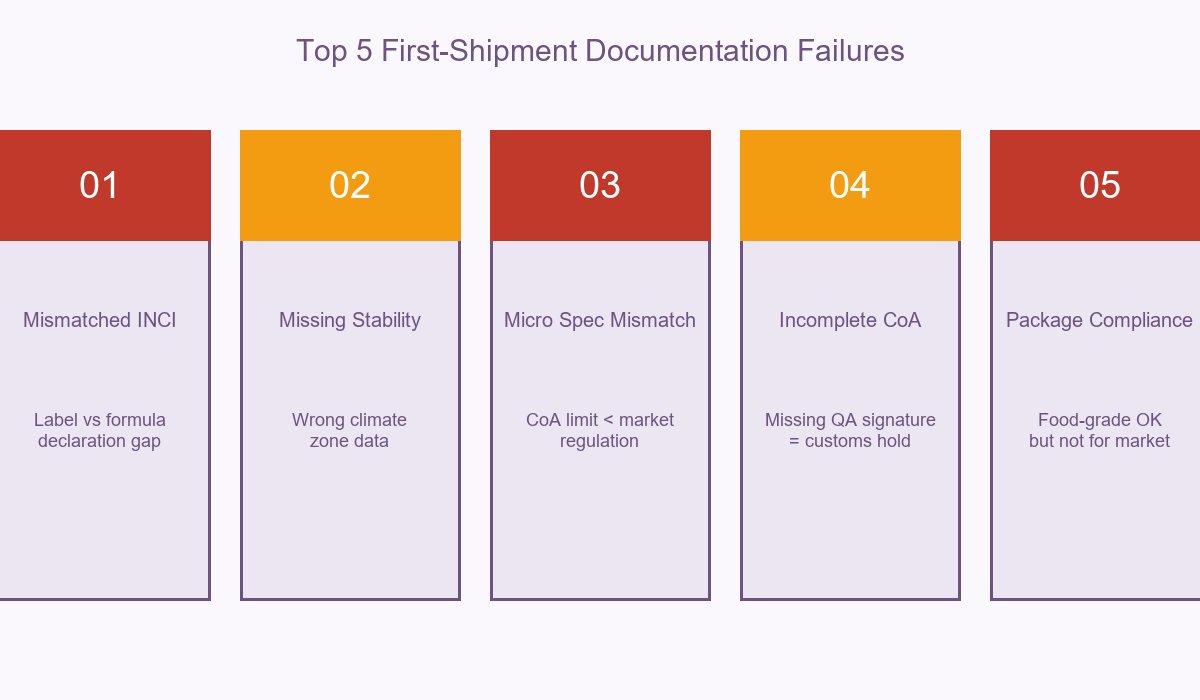
9. Pain Relief Balm QC: Common Documentation Failures and How to Avoid Them
First-time importers commonly fail customs, retail onboarding, or post-market surveillance because of documentation issues that could have been prevented with a pre-shipment audit. The failures below are the most frequent.
9.1 Mismatched INCI Declaration (KONGDY)
The INCI declaration on the label does not match the formulation in the QC records. The mismatch is often a minor naming difference (for example, "Vitamin E" vs "Tocopherol") but customs authorities treat it as misdeclaration. KONGDY's QC team verifies that the label INCI declaration matches the formula record before shipment release. Request INCI declaration cross-check before label printing.
9.2 Stability Data Missing for the Destination Climate Zone (KONGDY)
Stability data exists but only covers temperate storage, while the shipment is destined for tropical climate where storage temperature exceeds 30 degree Celsius. KONGDY generates stability data at multiple storage conditions including 30 degree Celsius / 65 percent RH and 40 degree Celsius / 75 percent RH for tropical market shipments. Request stability data for your destination climate zone.
9.3 Microbiological Specification Mismatch (KONGDY)
The microbiological specification in the finished product CoA is more lenient than the destination market's regulatory limit. KONGDY specifies microbiological limits against the destination market's regulation, not against a generic cosmetic limit. Confirm microbiological specification against your destination market's regulation.
9.4 Missing or Incomplete CoA Signatures (KONGDY)
The finished product CoA is missing the QA release signature or the analyst signature, which means customs cannot verify release and may hold the shipment. KONGDY's QC system requires both analyst and QA release signatures before a CoA is issued. Confirm signature completeness on every shipment's CoA.
9.5 Packaging Component Compliance Gap (KONGDY)
Packaging components meet food-contact regulations in one market but not the destination market. KONGDY maintains packaging component compliance statements per destination market. Request packaging compliance statement for your destination market before label printing.
10. Conclusion: Pain Relief Balm QC Documentation as a Sourcing Criterion
Pain relief balm QC documentation is not a post-shipment formality. It is the primary criterion for selecting a manufacturer, because no amount of marketing fixes a first-shipment customs hold, a retail onboarding rejection, or a consumer complaint that cannot be traced back to a documented batch. Documentation-first QC is the difference between an importer whose first shipment clears customs in 5 days and one whose shipment sits at the port for 3 weeks while missing paperwork is reconstructed.
KONGDY's documentation-first QC system covers raw material qualification, in-process control, finished product testing, stability, microbiological, packaging compliance, customs, and post-market documentation for FDA cosmetic, EU CPSR, and Asia market pathways. The system is ISO 22716 GMP certified, FDA registered, and audited annually by accredited bodies, with 7-year document retention and electronic batch record indexing.
Request KONGDY's pain relief balm QC documentation pack within 48 hours — the commercial team will return the QC manual summary, redacted ISO 22716 audit report, finished product CoA template, stability protocol summary, packaging compliance statement, and the destination market's HS code and tariff classification for your shipment.
Next steps for first-time importers: submit your destination market, expected annual volume, format preference, and current QC documentation baseline through the contact form. You will receive a written QC documentation gap analysis, the manufacturer's documentation pack, a sample finished product CoA, the stability summary for your destination climate zone, and a customs clearance timeline for your first shipment. Brand owners planning a launch within two quarters can additionally reserve a pilot batch slot at KONGDY's ISO 22716 certified facility while QC documentation and stability work are completed in parallel.

