Complete OEM/ODM guide to massage patch manufacturing for wellness brands, importers, and Amazon FBA sellers. Covers mechanism selection, formulation, customization, sampling, certifications, MOQ tiers, lead time, payment terms, and how to vet a contract manufacturer before you commit to a first bulk order.
1. Why Massage Patch OEM Matters for Wellness Brands in 2026
Massage patch OEM has become the fastest route for wellness brands to enter the wearable recovery category without building a factory, a formulation team, or a regulatory department. A massage patch is a self-contained wearable that delivers heat, vibration, magnetic, or transdermal stimulation to a targeted muscle group, and it sells into the same customer who already buys massage guns, foam rollers, and recovery devices. For a brand owner, importer, or Amazon FBA seller, the appeal is straightforward: the device category is crowded with electronics that carry battery shipping restrictions, warranty returns, and high per-unit cost, while a massage patch ships as a lightweight consumer health product with a long shelf life and a low return rate.
The OEM/ODM model lets a wellness brand put its own name on a finished, tested, certified product. Instead of sourcing a generic item from a trading company and hoping the quality holds, a brand owner who works with a contract manufacturer controls the formulation, the adhesive, the heating curve, the packaging, and the certification file. That control is what converts a commodity purchase into a defensible brand asset, and it is the difference between a product that survives its first retail season and one that gets delisted after a wave of complaints.
KONGDY has manufactured consumer health patches for 36 years and runs OEM, ODM, and private label programs for wellness brands, sports recovery labels, pharmacy chains, and e-commerce sellers across North America, Europe, and Asia. The facility holds ISO 22716 GMP certification, maintains FDA cosmetic establishment registration, and operates in-house analytical, microbiological, and stability laboratories. This guide covers the complete OEM/ODM pathway: technology selection, formulation, customization, sampling, compliance, pricing, MOQ, lead time, supplier vetting, and launch sequencing.
2. What a Massage Patch OEM Program Actually Includes
A massage patch OEM program is more than a purchase order. It is a defined set of engineering, compliance, and commercial deliverables that a contract manufacturer provides so the brand owner can sell the product in a target market without rebuilding the supply chain.
2.1 Product Engineering and Technology Selection (KONGDY)
Product engineering starts with the mechanism: self-heating, vibration, magnetic, far-infrared, or transdermal gel. The manufacturer documents how the mechanism performs across the product's shelf life, what the consumer feels, and how the effect can be substantiated in marketing copy. KONGDY provides technology selection matrices that compare heat output, wear time, adhesion, and cost per unit for each mechanism.
2.2 Formulation and Adhesive Development (KONGDY)
Formulation development defines the active and functional ingredients, the adhesive matrix, the backing film, and the release liner. Adhesive selection drives consumer complaints more than any other variable, because a patch that lifts at the edge during exercise is returned regardless of how well the mechanism works. KONGDY tests adhesion at multiple temperatures and humidity levels before a formula is approved for production.
2.3 Compliance and Certification File (KONGDY)
The compliance file covers the certification pathway for each destination market: FDA cosmetic registration and product listing for the United States, CE marking and CPSR documentation for the European Union, and local registration support for Asia and the Middle East. KONGDY assembles a market-specific compliance dossier for every OEM project and keeps it current as regulations change.
2.4 Packaging, Artwork, and Retail Readiness (KONGDY)
Packaging covers primary (pouch, tin, box), secondary (display carton, shipper), and artwork (label claims, directions, warnings, barcodes). Retail-ready packaging requires barcode registration, claim review, and often a shelf-life statement. KONGDY prepares artwork dielines, verifies barcode placement, and reviews claims against the destination market's advertising rules before printing.
2.5 Commercial Terms and Logistics (KONGDY)
Commercial terms define price tiers, MOQ, lead time, payment terms, Incoterms (FOB, CIF, DDP), packaging cost, and tooling or artwork setup fees. KONGDY issues written quotations with tiered pricing so a brand owner can model unit economics at 5,000, 20,000, 50,000, and 100,000 pieces before committing to a first order.
3. Massage Patch Technologies and How to Choose One
The mechanism determines the consumer promise, the regulatory pathway, the unit cost, and the shipping profile. Choosing a mechanism is therefore the first commercial decision in an OEM project, not a technical afterthought.
3.1 Self-Heating Massage Patches (KONGDY)
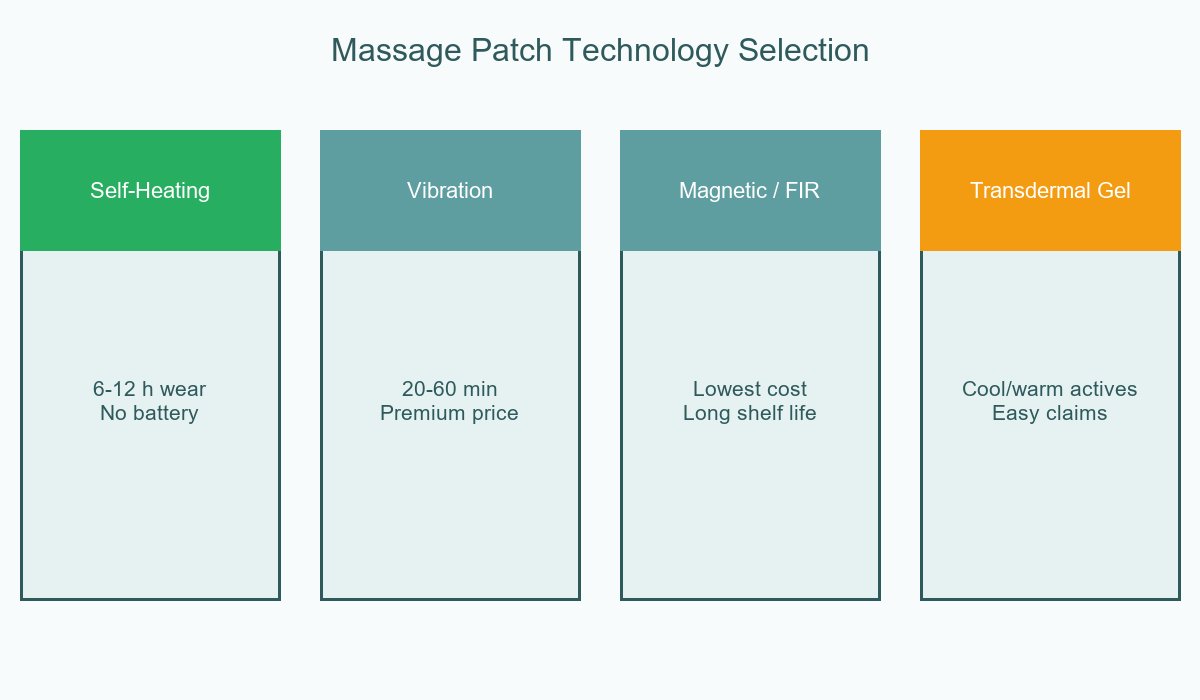
Self-heating patches use an iron-powder oxidation reaction to deliver 40 to 50 degrees Celsius of consistent heat for 6 to 12 hours. They require no battery, carry no lithium shipping restrictions, and cost less per unit than electronic alternatives. Self-heating patches fit muscle soreness, menstrual comfort, and winter outdoor use. KONGDY produces self-heating patches with controlled temperature curves documented by lot.
3.2 Vibration Massage Patches (KONGDY)
Vibration patches embed a thin micro-motor and a coin cell to deliver pulsed vibration for 20 to 60 minutes. They create a strong demonstration effect in video advertising and command premium pricing, but they add electronics compliance, battery transport documentation, and higher return rates. KONGDY manufactures vibration formats with UN38.3 transport documentation and drop-tested housings.
3.3 Magnetic and Far-Infrared Patches (KONGDY)
Magnetic and far-infrared patches rely on passive materials: embedded magnets or ceramic powder that reflects body heat. They are the lowest-cost wearable in the category, with a long shelf life and no battery or heat reaction to manage. They suit pharmacy chains and value-tier private label programs where price per unit drives the listing decision.
3.4 Transdermal Gel Massage Patches (KONGDY)
Transdermal gel patches combine a hydrogel matrix with functional actives such as menthol, camphor, arnica, or magnesium. They deliver a cooling or warming sensation, adhere tightly to contoured areas, and are the easiest format to substantiate with standard cosmetic claims. KONGDY formulates gel patches with documented active concentrations and in-house stability data.
3.5 Hybrid Formats (KONGDY)
Hybrid patches combine a self-heating layer with a transdermal gel, or a magnetic layer with a cooling gel, to create a differentiated consumer promise. Hybrids raise formulation complexity and cost, but they support a premium price point and are difficult for competitors to copy quickly. KONGDY develops hybrid formats on a project basis with staged sample approvals.
4. OEM vs ODM vs Private Label: Which Model Fits Your Brand
The three sourcing models differ in who owns the design, how much customization is available, and how long the project takes. Picking the wrong model is the most expensive mistake a first-time brand owner makes.
4.1 OEM (Original Equipment Manufacturer) (KONGDY)
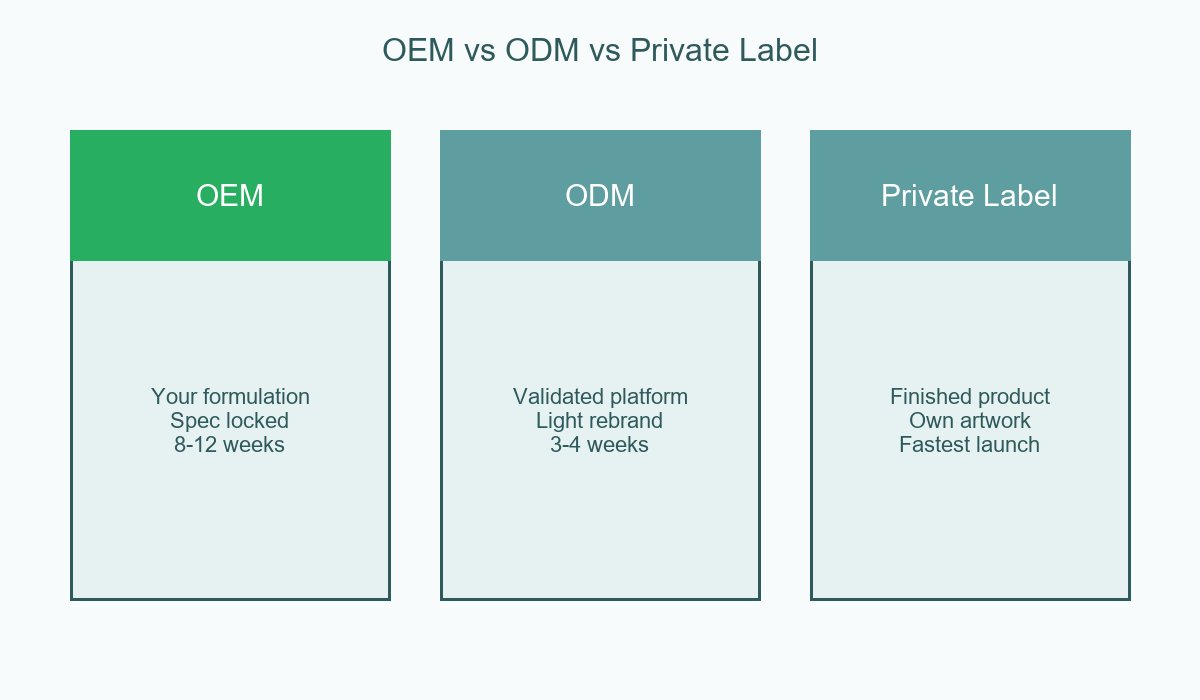
In a true OEM program the brand owner specifies the formulation, mechanism, dimensions, packaging, and claims, and the manufacturer builds to that specification. OEM delivers the strongest differentiation and the best long-term margin, and it requires the longest development timeline because formulation, stability, and artwork all run as new work. KONGDY runs OEM projects with a written specification signed by both parties before sampling begins.
4.2 ODM (Original Design Manufacturer) (KONGDY)
In an ODM program the manufacturer supplies an existing, validated design that the brand owner rebrands with limited changes to color, scent, packaging, and claims. ODM compresses lead time to as little as 3 to 4 weeks for a repeat design, and the certification file already exists. KONGDY maintains a catalogue of validated ODM patch platforms that brands can launch under their own label.
4.3 Private Label and White Label (KONGDY)
Private label and white label use a finished product with the brand owner's label applied. The difference is usually scope: private label typically includes custom packaging and artwork, while white label ships in generic packaging. Both are the fastest route to market and the weakest form of differentiation. KONGDY offers private label programs for pharmacy chains, distributors, and e-commerce sellers that need volume quickly.
4.4 Hybrid Roadmap: ODM First, OEM Second (KONGDY)
Most successful wellness brands start with ODM or private label to validate demand, then move to OEM once reorder volume justifies the development cost. This sequence reduces first-order risk while preserving the option to build a defensible formula later. KONGDY structures multi-phase agreements that credit part of the ODM development work toward a later OEM project.
5. Customization Options in a Massage Patch OEM Project
Customization is where a brand owner converts a generic patch into a product that a retailer and a consumer recognize. Each customization adds cost and lead time, so the commercial decision is which items to customize first.
5.1 Shape, Dimension, and Anatomy Fit (KONGDY)
Patch geometry determines comfort and coverage. Neck patches need a curved contour, shoulder patches need a large surface with high flexibility, and lower-back patches need length. KONGDY maintains tooling for standard geometries and produces custom dies for brand-specific shapes within 10 to 15 working days.
5.2 Heating Curve and Wear Time (KONGDY)
Heating curve customization sets the peak temperature, ramp-up time, plateau duration, and total wear time. A sports recovery brand may specify a fast ramp and 6-hour plateau, while a comfort brand may specify a slower ramp and 12-hour plateau. KONGDY documents the heating curve for each SKU and verifies it on every production lot.
5.3 Scent, Active Concentration, and Sensation Profile (KONGDY)
Scent and sensation customization covers menthol intensity, camphor level, herbal notes, and the balance between cooling and warming. Concentration changes affect stability and regulatory classification, so KONGDY runs an accelerated stability check on every new concentration before production approval.
5.4 Adhesive Strength Tuning (KONGDY)
Adhesive strength must match the wear scenario: a patch worn under clothing during a commute needs different tack than one worn during gym training. KONGDY tunes adhesive systems across a documented peel-strength range and records the selected value in the finished product specification.
5.5 Packaging Format and Retail Presentation (KONGDY)
Packaging customization covers pouch material, barrier film, resealable zippers, tin or tube format, dispenser cartons, and gift or subscription configurations. Barrier film selection determines shelf life, so KONGDY links each packaging format to a stability-tested shelf life before artwork is finalized. Request the packaging format guide and the shelf life data that applies to your chosen configuration.
6. Sampling and Validation: From Prototype to Production Approval
Sampling is the stage where a brand owner discovers whether the manufacturer can hit the specification repeatedly. A disciplined sample plan turns a first order from a gamble into a measured decision.
6.1 Prototype Round and Specification Lock (KONGDY)
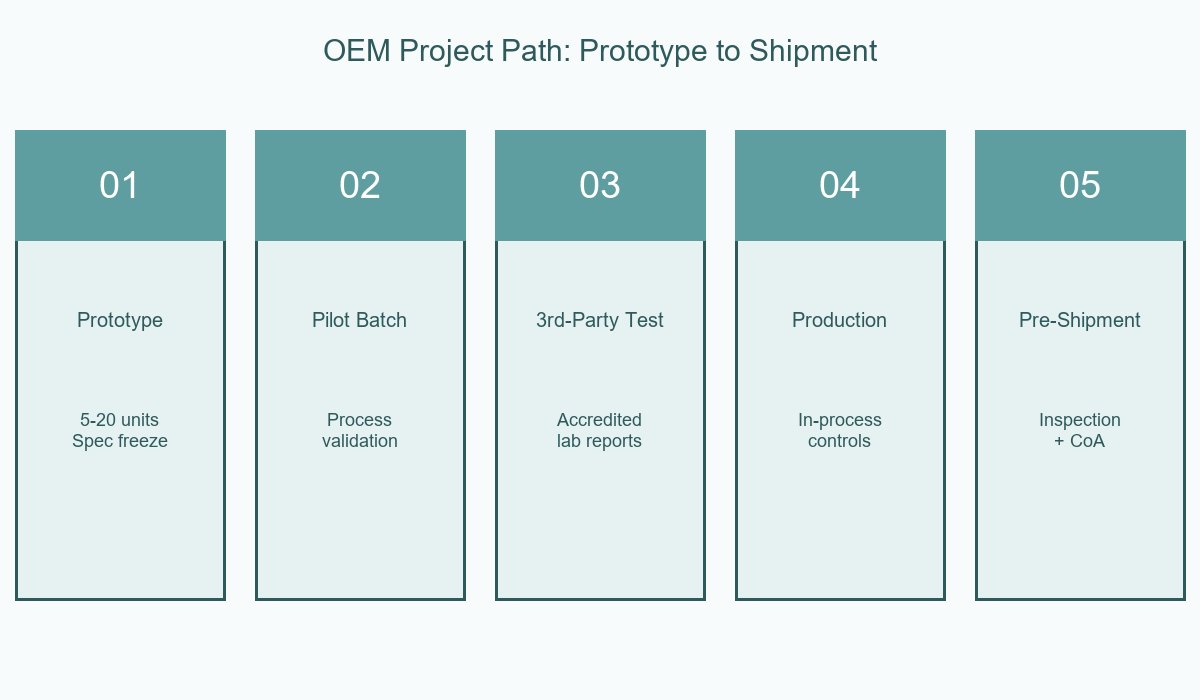
The prototype round produces 5 to 20 hand-built units so the brand owner can evaluate feel, adhesion, heat curve, and packaging fit. Once the prototype is approved, KONGDY freezes the specification document: formula code, materials, dimensions, adhesive value, heating curve, and packaging components. No change moves forward without a written change notification.
6.2 Pilot Batch and Process Validation (KONGDY)
The pilot batch runs the production line at reduced volume to validate equipment settings, fill or assembly tolerances, and line clearance before full-scale production. KONGDY documents pilot batch yields, defect rates, and in-process control results, and shares them with the brand owner for approval before the commercial run.
6.3 Third-Party Testing and Verification (KONGDY)
Third-party testing confirms the product against destination market requirements using an accredited laboratory. Typical tests cover heavy metals, microbial limits, skin irritation, stability, and for electronic formats, battery transport documentation. KONGDY coordinates third-party testing with accredited partners and includes the reports in the compliance dossier.
6.4 Production Run and Pre-Shipment Inspection (KONGDY)
The production run executes against the frozen specification with in-process controls at defined intervals. Pre-shipment inspection verifies unit count, fill or assembly integrity, label accuracy, carton condition, and the finished product certificate of analysis before the container is sealed. KONGDY issues a pre-shipment inspection report with photographs for every order.
7. Certifications, Quality Control, and Documentation for OEM Buyers
A wellness brand inherits the manufacturer's quality system the moment its name goes on the label. Verifying that system before signing a supply agreement is cheaper than fixing it after a recall or a customs hold.
7.1 ISO 22716 GMP Certification (KONGDY)
ISO 22716 is the cosmetic good manufacturing practice standard covering premises, equipment, raw materials, production, quality control, and documentation. KONGDY holds ISO 22716 certification with a scope covering patch, gel, balm, and cream formats, audited by an accredited certification body with annual surveillance. Request the certificate and the most recent surveillance audit report.
7.2 FDA Registration and Product Listing (KONGDY)
FDA cosmetic establishment registration and product listing place the facility and the SKU in the FDA database, which US retailers and Amazon increasingly request during onboarding. KONGDY maintains establishment registration and product listing for every SKU manufactured for the United States market. Request the establishment registration number and the product listing confirmation for your SKU.
7.3 EU CE and CPSR Pathway (KONGDY)
European market access requires a Cosmetic Product Safety Report prepared by a qualified safety assessor, plus a Responsible Person established in the EU. KONGDY prepares the CPSR, supplies the ingredient and stability data behind it, and coordinates with the brand's nominated Responsible Person. Request the CPSR timeline for your destination country.
7.4 Batch Records, Certificates, and Retention (KONGDY)
Batch records, certificates of analysis, certificates of conformity, safety data sheets, and stability summaries form the traceability chain that customs authorities and retailers audit. KONGDY retains QC records for a minimum of 7 years with electronic indexing by batch number and issues a complete document pack with every shipment.
7.5 Factory Audit Access and Change Control (KONGDY)
Audit access lets a brand owner or its third-party auditor inspect the line, the laboratories, and the records before and after the first order. KONGDY hosts scheduled factory audits for qualified buyers and operates a documented change control procedure with written customer notification before any formulation, material, or process change takes effect.
8. Pricing, MOQ, Lead Time, and Payment Terms for Massage Patch OEM
Unit economics decide whether a wellness brand can sustain paid acquisition. Understanding cost drivers before requesting a quotation prevents the two most common negotiating errors: assuming price is linear with volume and assuming lead time starts at order signature.
8.1 What Drives Unit Cost (KONGDY)
Unit cost is driven by mechanism type, patch dimension, active concentration, adhesive grade, packaging format, artwork complexity, print method, and order quantity. Self-heating and magnetic formats sit at the low end, transdermal gel in the middle, and vibration formats at the high end because of the motor, battery, and electronics documentation. KONGDY breaks each quotation into material, conversion, packaging, testing, and certification lines so the brand owner can see where cost originates.
8.2 MOQ Tiers and How to Negotiate Them (KONGDY)
MOQ exists because each production run consumes line time, tooling setup, and a minimum material purchase. Common tiers run from 5,000 pieces for a stock platform to 50,000 pieces for a fully custom formulation with dedicated tooling. KONGDY structures tiered MOQ pricing so a brand can enter at a pilot volume and step down unit cost as reorder volume grows, and offers starting MOQ options for first-time buyers launching a single SKU.
8.3 Lead Time Components (KONGDY)
Lead time includes sample development, specification approval, artwork proofing, material procurement, production, third-party testing, and shipment preparation. Stock ODM platforms ship in 3 to 4 weeks after artwork approval, while a custom OEM formulation typically requires 8 to 12 weeks including stability work. KONGDY publishes a stage-by-stage lead time schedule with the quotation so the brand can plan launch dates against confirmed milestones.
8.4 Payment Terms and Incoterms (KONGDY)
Payment terms typically run as a deposit on order confirmation with the balance against the bill of lading, with negotiated terms available for repeat buyers. Incoterms determine who controls freight, insurance, and import clearance, and the choice materially changes landed cost. KONGDY quotes FOB, CIF, and DDP so a brand owner can compare landed cost per unit before choosing a structure.
9. How to Vet a Massage Patch Manufacturer Before You Commit
Supplier selection determines the ceiling on product quality, margin, and growth speed. A structured vetting process replaces brochure claims with verifiable evidence in five steps.
9.1 Verify Legal Entity and Manufacturing Status (KONGDY)
Confirm the legal entity, business licence, registered address, and whether the supplier manufactures or trades. A trading company that outsources production cannot control batch records or audit outcomes. KONGDY manufactures in its own ISO 22716 certified facility and welcomes buyer verification of entity and site.
9.2 Request Certificates and Audit Reports (KONGDY)
Request ISO 22716 certification, FDA registration documents, third-party test reports, and the most recent customer audit summary. Verify certificate numbers against the issuing body's public registry rather than accepting a PDF at face value. KONGDY provides certificate numbers for independent verification and shares redacted audit reports with qualified buyers.
9.3 Run a Sample Test in Your Actual Channel (KONGDY)
Test the sample the way your customer will use it: wear it during exercise, in humidity, over a workday, and after shelf storage. Track adhesion, heat duration, irritation, and packaging integrity. KONGDY supports structured sample evaluation with a scoring sheet and adjusts the specification based on documented feedback.
9.4 Schedule a Factory Audit or Live Video Tour (KONGDY)
A factory audit or a live video walkthrough of the production floor, warehouse, and laboratory confirms that the operation behind the quotation exists at the claimed scale. KONGDY hosts factory audits and scheduled video tours covering the production line, QC laboratory, stability chamber room, and finished goods warehouse.
9.5 Test Responsiveness on Technical Questions (KONGDY)
Ask two or three technical questions with quantitative answers expected, such as the peak temperature tolerance of the heating layer or the peel strength specification of the adhesive. Fast, specific answers indicate an engineering team; vague answers indicate a sales intermediary. KONGDY answers technical questions in writing with specification values and test method references.
10. Conclusion: Launching a Massage Patch Brand with KONGDY OEM
Massage patch OEM gives wellness brands a wearable recovery product with the unit economics, shipping profile, and regulatory simplicity that electronics cannot match. The brands that win the category are the ones that treat sourcing as product development: they lock a specification, validate adhesion and heating performance, build a compliance file for each destination market, and negotiate MOQ tiers against a realistic reorder curve rather than a first-order price.
KONGDY supports that process end to end with 36 years of patch manufacturing, ISO 22716 GMP certification, FDA registration, in-house analytical, microbiological, and stability laboratories, tooling for standard and custom geometries, and documented change control. OEM, ODM, and private label programs are available for brand owners, importers, pharmacy chains, distributors, and e-commerce sellers, with tiered MOQ structures that let a new brand enter at pilot volume.
Request a free massage patch sample and OEM quotation within 24 hours — send your target market, mechanism preference, expected annual volume, and packaging direction, and the commercial team will return a specification proposal, tiered bulk pricing, a stage-by-stage lead time schedule, and the certification roadmap for your destination market.
Book a factory audit or live video tour at KONGDY's ISO 22716 facility to review the production line, QC laboratory, and stability chamber room, and download the massage patch OEM catalogue for validated platforms, packaging formats, and custom formulation options. Brand owners planning a launch within two quarters can reserve a pilot batch slot while formulation and stability work run in parallel, so sample approval and compliance preparation finish on the same timeline.

