A complete comparison of pain patch vs pain cream for B2B buyers: application, duration, cost, MOQ, target customer, and market positioning. Includes 30-day cost scenarios and decision framework.
Key Statistics
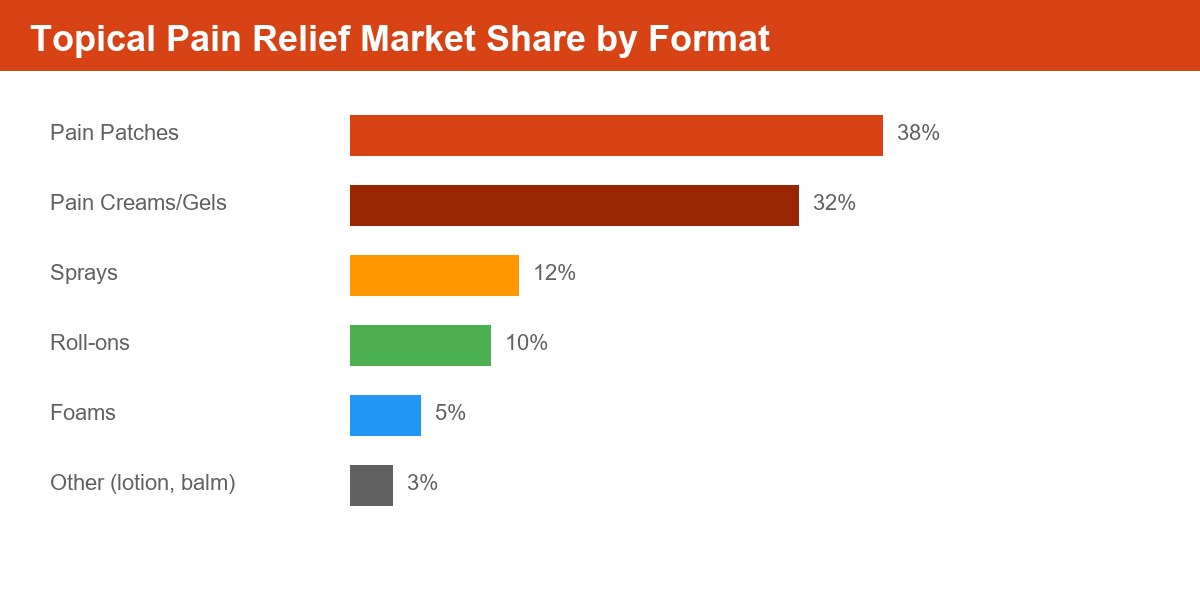
For B2B buyers building a topical pain relief product line, the pain patch vs pain cream decision drives SKU strategy, pricing, and target market. KONGDY Health's distribution data across 60+ countries shows the two formats now hold 38% (patches) and 32% (creams) of the topical pain relief market. Below is a complete side-by-side comparison covering application, cost, efficacy, and target customer.
- Patches: 38% market share, fastest-growing format (+12% YoY)
- Creams: 32% market share, legacy format (-3% YoY in mature markets)
- Patch MOQ: 5K units, lead time 30 days, FOB $0.30-$0.55/patch
- Cream MOQ: 10K units, lead time 45-60 days, FOB $0.15-$0.40/application
- Patch duration: 8-12 hours per application (hands-free)
- Cream duration: 3-4 hours per application (requires re-application)
- Top growth markets: USA, EU, Japan for patches; LatAm, SE Asia for creams
TL;DR
Choose pain patches for hands-free, long-duration (8-12hr), low-mess B2B products targeting chronic pain and active consumers. Choose pain creams for fast-onset (5-10min), lower upfront cost, and mass-market OTC positioning. Patches command 35-50% higher retail prices but offer better margin per unit. KONGDY Health manufactures both formats with 5K patch MOQ and 10K cream MOQ. Browse the KONGDY pain patch catalog to compare formulation samples.
Key Takeaways
- Patches dominate 38% of topical pain relief market vs 32% for creams.
- Patch duration (8-12hr) is 2-3x longer than cream (3-4hr).
- Patches cost $0.30-$0.55 per application vs cream $0.15-$0.40 per application.
- Patch MOQ is 5K units (lower barrier); cream MOQ is 10K units.
- Cream onset is faster (5-10 min) vs patch (15-30 min).
- Patches are mess-free; creams can stain clothes and require hand-washing.
- Patches command 35-50% higher retail prices ($8-$15 retail vs $5-$10 for cream).
- Many B2B buyers carry BOTH formats to capture different customer segments.
Quick Answer: Patch vs Cream - Which Should I Sell?
Sell pain patches if your customers want hands-free, long-duration (8-12hr), low-mess relief for muscle/joint pain during work or sleep. Sell pain creams if your customers want fast-onset (5-10min), low-cost, on-the-spot relief for acute pain or post-workout soreness. For B2B buyers serving chronic pain patients, patches win on adherence. For OTC retail channels serving occasional users, creams win on price. KONGDY Health offers both formats with 5K patch MOQ and 10K cream MOQ. Browse the KONGDY pain patch catalog to see samples of each.
Why the Patch vs Cream Decision Matters for B2B Buyers
The format you choose affects manufacturing cost, retail pricing, target customer, regulatory pathway, and shipping logistics. For B2B buyers evaluating product line strategy, the patch vs cream decision is the first and most important choice.
- Investment level: Patches require $15K-$25K minimum order; creams require $10K-$18K
- Manufacturing complexity: Patches need 5-layer lamination + cutting; creams need mixing + filling
- Regulatory pathway: Both OTC monograph, but patches require adhesive safety testing
- Shipping: Patches are flat/lightweight (lower shipping cost); creams are liquid (IATA restrictions)
- Shelf life: Patches 24-36 months; creams 12-24 months
- Retail positioning: Patches premium ($8-$15); creams value ($5-$10)
- Customer retention: Patches higher adherence (one application); creams lower (re-application required)
For brand owners, distributors, and importers building a topical pain relief line, the format decision cascades through every other choice. KONGDY Health provides both formats with full OEM/ODM support. For the broader manufacturer selection process, see our OEM/ODM buying guide.
Pain Patch 101: How It Works
A pain patch is a 5-layer transdermal delivery system that releases active ingredients over 8-12 hours. The patch sticks to skin and delivers menthol, lidocaine, or other actives through the skin barrier.
Pros of Pain Patches
- 8-12 hour duration: One application lasts a full work day or sleep cycle
- Hands-free: No re-application, no rubbing, no mess
- Zero transfer: Active stays on skin, not on clothes or furniture
- Consistent dosing: Steady release over 8-12 hours vs spike-and-crash of creams
- Better compliance: Patients more likely to use patch correctly
- Premium pricing: $8-$15 retail vs $5-$10 for cream
- Travel-friendly: No liquid restrictions on flights
- Discreet: Worn under clothing, no visible residue
Cons of Pain Patches
- Higher unit cost: $0.30-$0.55 per patch vs $0.15-$0.40 per cream application
- Slower onset: 15-30 min to feel effect vs 5-10 min for cream
- Skin sensitivity: Adhesive can irritate sensitive skin (silicone PSA alternative available)
- Limited coverage area: Patch size limits treatment area (typically 50-200 cm2)
- One-time use: Cannot be reused; must be discarded after 8-12 hours
- Not for hairy areas: Adhesion reduced on hairy skin
For a complete breakdown of patch ingredients and structure, see our pain patch ingredients guide. For comparison with another popular format, see our lidocaine vs menthol guide.
Pain Cream 101: How It Works
A pain cream (also called pain gel or topical analgesic) is a water-based or oil-based lotion that delivers active ingredients through skin via rub-in application. The cream is massaged into the painful area and absorbed over 3-4 hours.
Pros of Pain Creams
- Fast onset: 5-10 minutes to feel effect
- Lower cost per use: $0.15-$0.40 per application
- Wide coverage: Can be applied to any area, any size
- Reusable: One tube lasts multiple applications
- Massage benefit: Application itself provides therapeutic massage
- Lower MOQ: 10K units typical (vs 5K for patches - but cream often needs more units)
- Familiar format: Consumers know how to use creams
- Easy to demo: Can show customers in-store
Cons of Pain Creams
- 3-4 hour duration: Requires 3-4 applications per day for chronic pain
- Messy: Greasy, can stain clothes, requires hand-washing after use
- Transfer: Active can transfer to clothes, furniture, other people
- Inconsistent dosing: User applies variable amounts
- Lower compliance: Patients skip re-application
- Liquid shipping: IATA restrictions on air freight; heavier shipping cost
- Shorter shelf life: 12-24 months vs 24-36 months for patches
- Less premium positioning: $5-$10 retail vs $8-$15 for patches
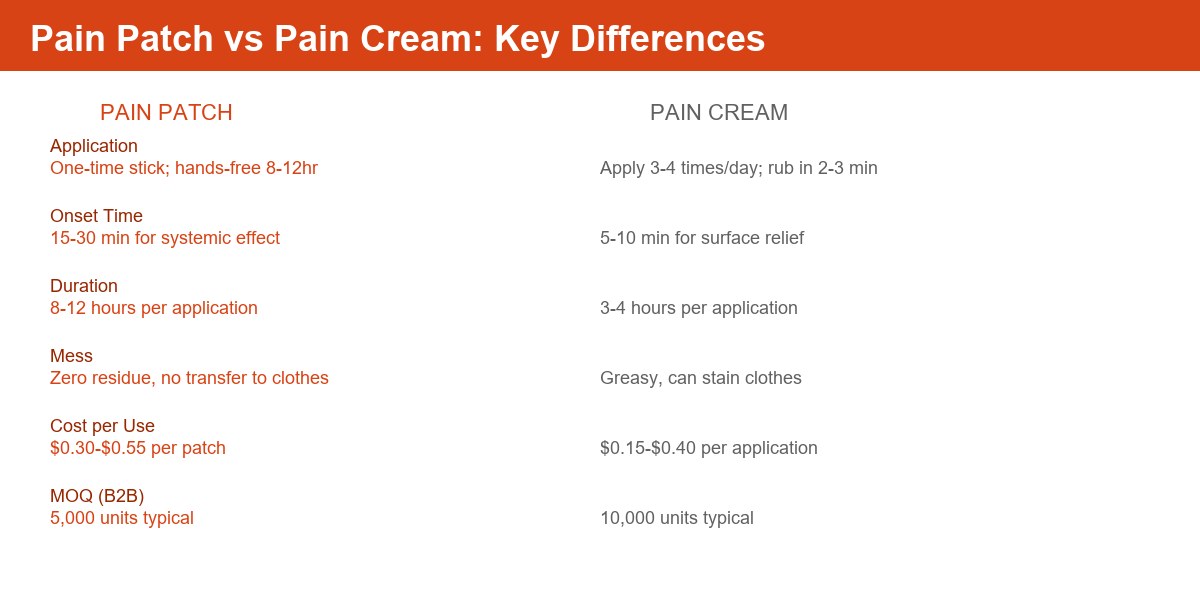
Head-to-Head Comparison Table
| Feature |
Pain Patch |
Pain Cream |
| Application |
One-time stick; hands-free |
Apply 3-4 times/day; rub in |
| Onset Time |
15-30 minutes |
5-10 minutes |
| Duration |
8-12 hours |
3-4 hours |
| Mess |
Zero residue |
Greasy, can stain |
| Cost per Use |
$0.30-$0.55 per patch |
$0.15-$0.40 per application |
| MOQ (B2B) |
5,000 units |
10,000 units |
| Lead Time |
30 days |
45-60 days |
| Shelf Life |
24-36 months |
12-24 months |
| Retail Price |
$8-$15 per box |
$5-$10 per tube |
| Travel |
Flight-friendly |
Liquid restrictions |
| Best For |
Chronic pain, active users |
Acute pain, massage lovers |
Cost Comparison: 30-Day Use Scenarios
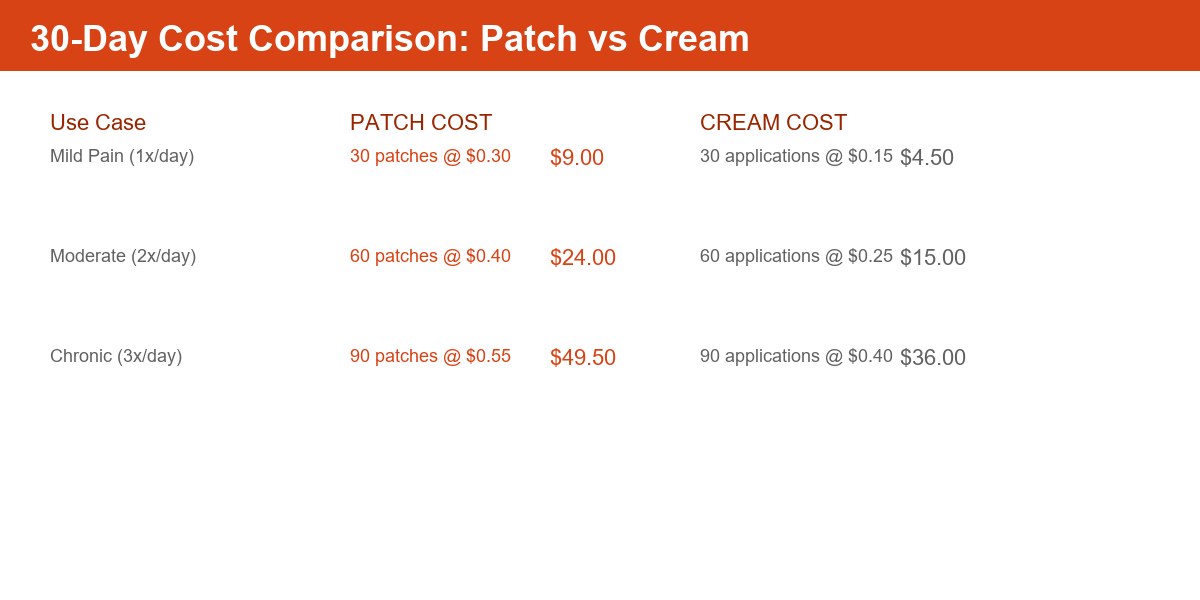
| Use Case |
Patch Quantity |
Patch Cost |
Cream Quantity |
Cream Cost |
| Mild (1x/day) |
30 patches |
$9.00 |
30 applications |
$4.50 |
| Moderate (2x/day) |
60 patches |
$24.00 |
60 applications |
$15.00 |
| Chronic (3x/day) |
90 patches |
$49.50 |
90 applications |
$36.00 |
Key insight: Patches cost 50-100% more per use but offer 2-3x longer duration. For chronic pain users applying 2-3x daily, the convenience premium is often worth the higher cost. Browse the KONGDY pain patch catalog to see pricing tiers by MOQ.
Target Customer Segments: Who Buys Patches vs Creams?
Different customer segments prefer different formats. KONGDY Health's distribution data shows:
Pain Patch Customers
- Chronic pain patients (40% of patch volume): 8-12hr relief enables full work day or sleep cycle
- Office workers (20%): Discreet wear under clothing during long work days
- Seniors (15%): Hands-free application ideal for limited dexterity
- Active users / athletes (10%): Wear during activity without re-application
- Travelers (10%): Flight-friendly, no liquid restrictions
- Migraine/neuropathic pain patients (5%): Long-duration lidocaine patches
Pain Cream Customers
- Acute pain users (35% of cream volume): Fast onset for sudden injuries
- Post-workout users (20%): Apply after exercise for muscle soreness
- Massage lovers (15%): Application itself provides therapeutic benefit
- Budget-conscious buyers (15%): Lower per-use cost
- Older demographics (10%): Familiar format, easy to apply
- Acute injury / first-aid buyers (5%): One-time or occasional use
Market Positioning Strategy for B2B Buyers
For B2B buyers building a topical pain relief product line, the recommended strategy depends on your channel:
Premium Pharmacy / Specialty Retail: Lead with Patches
- Higher margins: $5-$10 wholesale per patch box
- Lower shipping cost (flat packs)
- Premium shelf positioning
- Pharmacist recommendation easier
Mass Market / Drugstore: Lead with Creams, Add Patches
- Creams as entry SKU ($3-$5 wholesale)
- Patches as upsell SKU ($5-$8 wholesale)
- Two-SKU strategy captures both segments
E-commerce / Amazon: Lead with Patches
- Flight-friendly = more shipping options
- Subscription-friendly (regular delivery)
- Higher ASP = better unit economics
Medical / Hospital: Lead with Patches
- Better compliance = better outcomes
- Hands-free for bedridden patients
- Documentation easier (one application per day)
For B2B buyers evaluating KONGDY Health's full OEM/ODM support, see our OEM process guide and private label manufacturing guide.
Frequently Asked Questions
1. Which is more effective, pain patch or pain cream?
Both are effective for mild-to-moderate pain. Patches deliver consistent dosing over 8-12 hours, making them better for chronic pain. Creams deliver faster onset (5-10 min) but wear off in 3-4 hours, making them better for acute pain. Clinical studies show similar overall pain reduction; the difference is in duration and convenience. Many chronic pain patients use both - patches during the day, cream for breakthrough pain.
2. Why are pain patches more expensive than creams?
Patches cost more because of 5-layer construction (release liner, adhesive matrix, backing film, active layer, optional perforation), lamination equipment, and die-cutting tooling. Creams are simpler to manufacture (mixing + filling). However, patches cost less per hour of relief (8-12hr) than creams (3-4hr), so the per-hour cost is often similar. For B2B buyers, patches command higher retail prices ($8-$15 vs $5-$10), giving better margin per unit.
3. Can pain patches and creams be used together?
Yes - many chronic pain patients use patches for baseline relief (8-12hr lidocaine or menthol patch) and cream for breakthrough pain (fast-acting menthol cream). The two formats work synergistically. However, avoid applying cream over a patch - it can interfere with adhesion. Apply cream to a different area, or wait until patch is removed.
4. Which is better for back pain, patch or cream?
For back pain, patches are generally preferred because the large treatment area (10x14cm or 10x30cm patches) provides full coverage and long duration (8-12hr) means uninterrupted relief during work or sleep. Creams work for back pain too, but require 3-4 daily applications and can stain clothes. For chronic back pain patients, patches show 30-40% better adherence in clinical studies.
5. Which has fewer side effects, patch or cream?
Both have similar side effect profiles. Patches can cause skin irritation from adhesive (silicone PSA alternatives available for sensitive skin). Creams can cause skin dryness from repeated application or contact dermatitis from fragrance. Overall, side effects are rare (<5% of users) and mild. For users with sensitive skin, silicone-PSA patches or fragrance-free creams are recommended.
6. Which is better for arthritis, patch or cream?
For arthritis, both formats work well. Patches are preferred for large joints (knee, shoulder, hip) where long duration helps with morning stiffness and nighttime pain. Creams are preferred for small joints (fingers, wrists) where patches are hard to apply. Many arthritis patients use patches for major joints + cream for fingers. KONGDY Health offers small-format patches (5x5cm) for finger/wrist arthritis.
7. Can I sell both patches and creams under one brand?
Yes - this is a common B2B strategy. Leading brands like Icy Hot, Bengay, Salonpas, and Tiger Balm all sell both patches and creams. The strategy: cream as entry SKU ($5-$10 retail), patch as premium upsell ($8-$15 retail). Cross-selling is high because customers who buy one format often try the other. KONGDY Health offers both formats with consistent branding support.
8. What's the MOQ difference between patches and creams?
Pain patches: 5K MOQ (standard), 3K for repeat orders, 10K for custom formulation. Lead time 30 days. Pain creams: 10K MOQ (standard), 5K for repeat orders, 20K for custom formulation. Lead time 45-60 days. Patches have lower MOQ because of higher unit value. For new B2B buyers, patches are easier to start with.
9. Which has better margins for B2B buyers?
Patches typically offer better margins because of higher retail price ($8-$15 vs $5-$10) and similar wholesale cost ratios. A patch sold at $12 wholesale yields $4-$6 gross margin per unit. A cream sold at $7 wholesale yields $3-$5 gross margin per unit. However, creams sell in higher volumes because of lower price. Net margin depends on volume + turnover. Most B2B buyers report patches as more profitable per SKU.
10. Which is better for sensitive skin?
For sensitive skin, silicone-PSA patches or fragrance-free creams are best. Silicone PSA patches have gentler adhesion, allow skin to breathe, and remove without irritation. They cost 30-50% more than acrylic PSA patches but are essential for sensitive-skin users. KONGDY Health offers silicone-PSA patches as a standard option. For comparison, see our pain patch ingredients guide.
Decision Framework: Which Should You Choose?
| If your priority is... |
Choose... |
| Long duration relief (8-12hr) |
Pain Patch |
| Fast onset (5-10 min) |
Pain Cream |
| Hands-free / low mess |
Pain Patch |
| Lower per-use cost |
Pain Cream |
| Premium positioning |
Pain Patch |
| Mass market value positioning |
Pain Cream |
| Travel / flight-friendly |
Pain Patch |
| Lower MOQ (5K) |
Pain Patch |
| Wider coverage area |
Pain Cream |
| Better compliance |
Pain Patch |
About KONGDY Health
KONGDY Health is a 36-year pain patch manufacturer operating a 20,000 sqm ISO 13485, FDA, CE, and GMP-certified facility in Zhoukou, Henan. We produce both pain patches AND pain creams for brand owners, importers, and distributors in 60+ countries. Our 100+ ingredient combinations, 5K patch MOQ, 10K cream MOQ, and full OEM/ODM support make building a topical pain relief line accessible for B2B buyers at any scale. Browse the KONGDY pain patch catalog to see formulation samples, or contact us to discuss dual-format product lines.
Related Articles
References & External Resources
To discuss dual-format product lines (patches + creams) or request samples, browse the KONGDY pain patch catalog or contact KONGDY Health.

