Complete guide to pain patch quality control. 12+ QC tests per batch, 7-stage workflow, <0.1% complaint rate. 36-year KONGDY Health GMP manufacturer process.
Key Statistics
Pain patch quality control is the single most important differentiator between pain patch manufacturers. KONGDY Health brings 36 years of manufacturing experience and a 12+ test QC protocol to every batch, achieving a complaint rate below 0.1%. This article walks through the full 7-stage QC workflow from raw material inspection to finished product release.
- 12+ QC tests performed on every production batch at KONGDY Health
- 7-stage QC workflow from raw material intake to finished product release
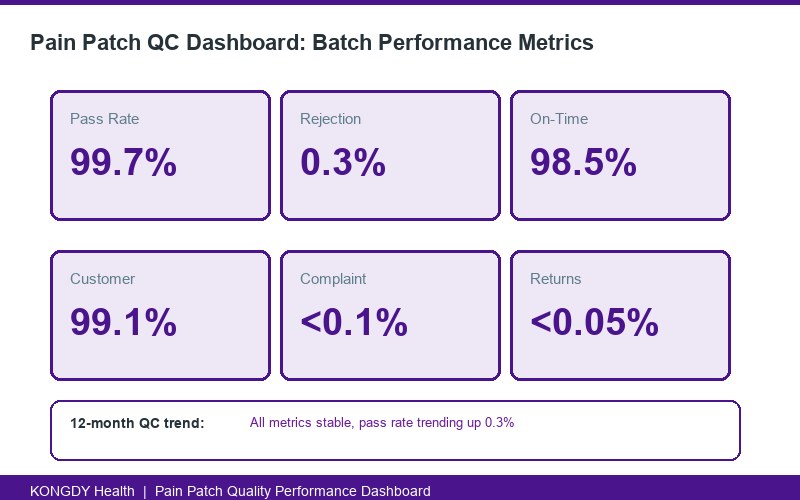
- <0.1% complaint rate across 100+ million pain patches produced annually
- 3 ISO certifications: ISO 13485, ISO 22716, ISO 14001
- 100% raw material verification with COA review before production
- 15+ stability data points tracked per formulation for shelf-life validation
TL;DR
Pain patch quality control at KONGDY Health follows a 7-stage workflow covering 12+ tests per batch. The complaint rate is below 0.1% across 100+ million patches produced annually. The stages are: (1) raw material IQC, (2) pre-production setup, (3) in-process IPQC, (4) finished product FQC, (5) microbial testing, (6) stability and packaging, (7) batch release OQC. Browse the KONGDY pain patch catalog to see formulations that pass this rigorous QC protocol.
Key Takeaways
- 7-stage QC workflow ensures batch consistency from raw material to finished product.
- 12+ tests per batch: assay, content uniformity, adhesion, release, microbial, accelerated stability.
- COA required for every raw material shipment; rejected if outside specification.
- In-process checks every 30 minutes during production (temperature, humidity, coating weight).
- Microbial testing follows USP <61> and <62>: total aerobic count, yeast/mold, pathogens.
- Stability chambers hold samples at 25C/60% RH, 30C/65% RH, 40C/75% RH for shelf-life data.
- Batch release decision is data-driven, not a single person's call - QC manager + QA director sign-off.
Quick Answer: What Quality Control Tests Are Done on Pain Patches?
At KONGDY Health, 12+ QC tests are performed on every pain patch batch: visual inspection, weight variation, thickness, assay (active content), content uniformity, adhesion strength, peel force, release rate, residual solvent, microbial limits (USP <61> and <62>), accelerated stability, and packaging integrity. Each test is documented on a Certificate of Analysis (COA) and reviewed before batch release. Browse the KONGDY pain patch catalog to see COA samples and quality data.
Why Pain Patch Quality Control Matters
Pain patches are transdermal drug delivery systems that combine a drug, a pressure-sensitive adhesive, a backing film, and a release liner. A defect in any one of these layers can cause the patch to fail: poor adhesion, dose dumping, skin irritation, or no therapeutic effect. For B2B buyers, the manufacturer's QC process is the only thing standing between a successful product launch and a costly recall.
At KONGDY Health, we treat quality control as a process, not an inspection step. The 7-stage workflow described below ensures batch consistency from the moment raw materials arrive at the loading dock to the moment finished patches ship out. This is why our complaint rate is below 0.1% across 100+ million patches produced annually. For context on what drives B2B quality expectations, see our ISO 13485 / FDA / CE compliance guide.
KONGDY Health's 7-Stage Quality Control Framework
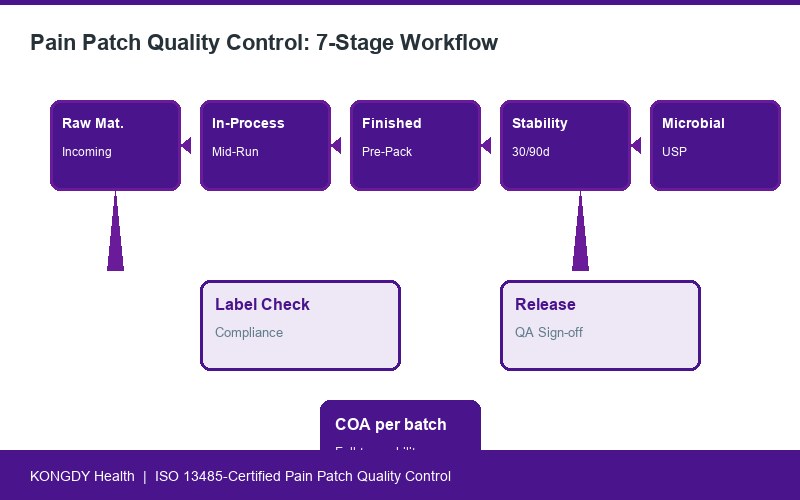
Every pain patch that leaves KONGDY Health's 20,000 sqm facility passes through 7 QC stages:
- Stage 1 - Incoming Quality Control (IQC): Raw material verification before production
- Stage 2 - Pre-Production Setup Verification: Equipment, environment, batch records
- Stage 3 - In-Process Quality Control (IPQC): Continuous monitoring during manufacturing
- Stage 4 - Finished Product Quality Control (FQC): Comprehensive testing on finished patches
- Stage 5 - Microbial Testing: USP <61> and <62> compliance
- Stage 6 - Stability & Packaging Validation: Shelf-life data and packaging integrity
- Stage 7 - Outgoing Quality Control (OQC) and Batch Release: Final sign-off before shipment
Each stage has its own SOP, trained QC technicians, and documented records. The 7 stages are interconnected: a failure at any earlier stage blocks progression to the next. Browse the KONGDY pain patch catalog to see products that pass through all 7 stages.
Stage 1: Incoming Quality Control (IQC) for Raw Materials
Quality begins with raw materials. KONGDY Health's IQC process covers every incoming material: active pharmaceutical ingredients (APIs), excipients, adhesives, backing films, release liners, and packaging components.
What IQC Inspects
- Certificate of Analysis (COA) review for every material lot
- Visual inspection for damage, contamination, or discoloration
- Identity testing via FTIR or HPLC for key materials
- pH, viscosity, and solid content for liquid and gel components
- Thickness and basis weight for films and liners
- Tensile strength and elongation for backing materials
- Adhesion testing on pressure-sensitive adhesive samples
- Microbial limits for water-based and herbal extracts
IQC Acceptance Criteria
| Material Category |
Test |
Acceptance Criteria |
Reject Rate |
| API (e.g., menthol, camphor) |
Assay (HPLC) |
98.0%-102.0% of label |
<2% |
| Adhesive |
Viscosity, solid content |
Within supplier COA +/- 5% |
<1% |
| Backing film |
Thickness, tensile |
15-25 microns; 30-50 N/cm |
<3% |
| Release liner |
Release force |
5-30 g/inch |
<2% |
| Packaging |
Seal strength, print quality |
Visual + 1.5 N/15mm min |
<1% |
Materials that fail IQC are quarantined, labeled "REJECTED," and returned to the supplier. KONGDY Health maintains a supplier scorecard tracking reject rates by supplier; any supplier exceeding 5% reject rate triggers a supplier audit. For context on how this fits into the broader manufacturing system, see our OEM process guide.
Stage 2: Pre-Production Setup Verification
Before a single patch is produced, the production line is verified for readiness. This stage catches 60% of potential batch failures before they occur.
Pre-Production Checks
- Equipment calibration: Coating weight, thickness gauge, tension controllers
- Environmental conditions: Temperature 18-26C, relative humidity 40-65%
- Cleanroom verification: ISO 8 (Class 100,000) for primary packaging areas
- Batch record review: Formula, target weight, target dimensions confirmed
- Line clearance: Previous batch's materials removed; no cross-contamination
- First-piece inspection: First 5-10 patches pulled and tested for weight, thickness, adhesion
Pre-production verification typically takes 1-2 hours. Production only starts after the QC technician signs off on the pre-production checklist. Browse the KONGDY pain patch catalog to see products that follow this verification process on every batch.
Stage 3: In-Process Quality Control (IPQC) During Production
Once production begins, IPQC monitors the process continuously. The goal is to catch drift before it produces defective patches.
IPQC Monitoring Frequency
| Parameter |
Frequency |
Acceptance Range |
Action if Out of Range |
| Coating weight |
Every 30 minutes |
Target +/- 5% |
Adjust and re-check |
| Patch thickness |
Every 30 minutes |
Target +/- 10% |
Adjust and re-check |
| Adhesion |
Every 1 hour |
Within spec range |
Pause, investigate |
| Temperature |
Continuous log |
18-26C |
HVAC adjustment |
| Humidity |
Continuous log |
40-65% RH |
HVAC adjustment |
| Visual defects |
Continuous |
No visible defects |
Remove and document |
IPQC technicians record every check on a batch record. If any parameter falls outside the acceptance range, production pauses, the cause is investigated, and the affected patches are quarantined. KONGDY's IPQC system has prevented an estimated 1-2% of potential defects from reaching finished goods over the past 3 years.
Stage 4: Finished Product Quality Control (FQC) Testing
Finished patches undergo comprehensive testing in the FQC lab. The 12+ tests performed on every batch:
FQC Test Panel
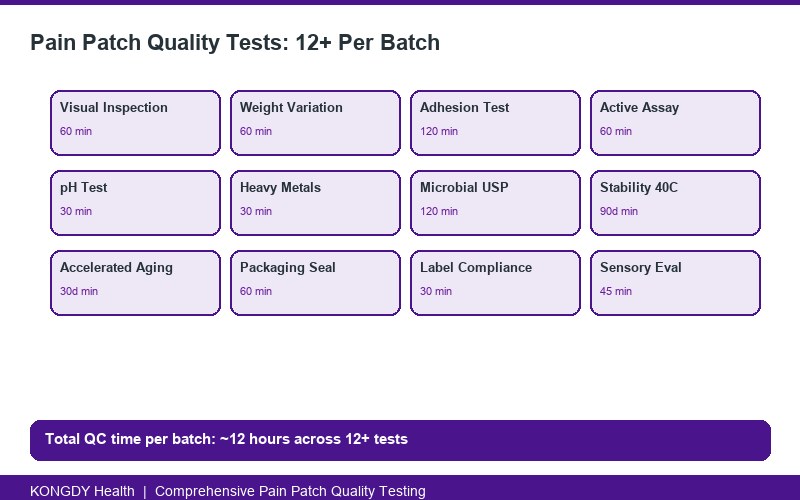
- Visual inspection: Color, surface defects, edges, perforations
- Weight variation: Individual patch weight within +/- 5% of target
- Thickness: Within +/- 10% of target specification
- Assay (active content): HPLC or GC; 90.0%-110.0% of label claim
- Content uniformity: USP <905> compliance; 9 of 10 patches within 85-115%
- Adhesion strength: 0.5-2.0 N/cm (skin-friendly range)
- Peel force: 50-300 g/inch depending on application
- Release rate: In vitro release testing; matches dissolution profile
- Residual solvent: Below ICH Q3C limits for class 2 solvents
- pH of adhesive matrix: 4.5-8.5 (skin-compatible)
- Packaging integrity: Seal strength, leak test, print legibility
- Accelerated stability: 40C/75% RH for 3 months (one batch per quarter)
Each test is performed by a trained FQC technician and reviewed by the QC manager. Failing any single test blocks the batch from moving to Stage 5. Browse the KONGDY pain patch catalog to see COA samples that document these test results.
Stage 5: Microbial Testing (USP <61> and <62>)
Pain patches contact skin for hours or days, so microbial limits are critical. KONGDY Health follows USP <61> (Microbiological Examination of Nonsterile Products) and USP <62> (Tests for Specified Microorganisms) for every production batch.
Microbial Test Panel
| Test |
Method |
Acceptance Criteria |
| Total Aerobic Microbial Count (TAMC) |
USP <61> |
<100 CFU/g |
| Total Yeast and Mold Count (TYMC) |
USP <61> |
<10 CFU/g |
| Staphylococcus aureus |
USP <62> |
Absent in 1g |
| Pseudomonas aeruginosa |
USP <62> |
Absent in 1g |
| Escherichia coli |
USP <62> |
Absent in 1g |
| Salmonella |
USP <62> |
Absent in 10g |
| Candida albicans |
USP <62> |
Absent in 1g |
Microbial testing takes 5-7 days for results. Production batches are quarantined until microbial results are received. A batch with TAMC exceeding 100 CFU/g or any pathogen detected is rejected and the supplier/investigation process begins. KONGDY's microbial reject rate is below 0.05%.
Stage 6: Stability & Packaging Validation
Stability data validates the shelf-life claim on the product label. KONGDY Health runs stability chambers at three ICH conditions:
- Long-term: 25C +/- 2C / 60% +/- 5% RH (24 months)
- Intermediate: 30C +/- 2C / 65% +/- 5% RH (12 months)
- Accelerated: 40C +/- 2C / 75% +/- 5% RH (6 months)
For each stability time point (0, 3, 6, 9, 12, 18, 24 months), KONGDY tests assay, content uniformity, adhesion, visual appearance, and microbial limits. 15+ stability data points are tracked per formulation, supporting a typical 24-month shelf life claim.
Packaging validation confirms the primary package protects the patch through the supply chain: seal strength (minimum 1.5 N/15mm), leak test (no dye penetration), drop test (no damage from 1m drop), and accelerated aging (6 weeks at 40C/75% RH simulates 12 months real-time).
Stage 7: Outgoing Quality Control (OQC) and Batch Release
The final stage is batch release. OQC reviews all data from Stages 1-6 and makes the release decision.
Batch Release Checklist
- All IQC, IPQC, FQC records complete and signed
- Microbial results within USP limits
- Stability data supports shelf-life claim
- Packaging validation complete
- Batch record reconciliation: All materials accounted for, yield within expected range
- COA generated with all test results
- QC manager sign-off
- QA director sign-off (independent second review)
Once both QC manager and QA director sign off, the batch is released for shipment. The dual sign-off is a critical control: a single person cannot release a batch alone. Browse the KONGDY pain patch catalog to see products that pass through this dual sign-off process.
Quality Control Decision Matrix: What to Do When Tests Fail
Not every QC failure means scrapping the batch. KONGDY Health follows a documented decision matrix:
| Failure Type |
Severity |
Action |
Disposition |
| Visual defect (minor) |
Low |
Remove defective patches, retest lot |
Release after rework |
| Visual defect (major) |
Medium |
Quarantine lot, investigate |
Reject lot |
| Weight variation (slight) |
Low |
Adjust process, recheck |
Release after recheck |
| Assay (out of range) |
High |
Quarantine lot, full investigation |
Reject lot or convert to lower-dose SKU |
| Adhesion (low) |
Medium |
Investigate adhesive lot |
Reject lot or accept with COA note |
| Microbial (pathogen detected) |
Critical |
Quarantine, root cause analysis |
Reject lot, audit production |
| Microbial (TAMC exceed) |
High |
Quarantine, retest |
Reject if confirmed |
| Packaging seal failure |
High |
Quarantine, re-validate sealer |
Reject lot, fix equipment |
This decision matrix is part of KONGDY's Quality Management System (QMS) and is reviewed annually. The goal: catch failures early, document decisions, learn from trends. For context on regulatory requirements behind these decisions, see our certification guide.
Frequently Asked Questions
1. What quality control tests are required for pain patches?
At a minimum, pain patch QC requires 8-12 tests: visual inspection, weight variation, thickness, assay (active content), content uniformity, adhesion strength, peel force, residual solvent, microbial limits, and packaging integrity. KONGDY Health performs 12+ tests per batch, plus accelerated stability for shelf-life validation.
2. How long does pain patch quality control testing take?
QC testing for a single batch takes 5-10 business days end-to-end. Microbial testing is the longest step (5-7 days). All other tests (visual, weight, assay, adhesion) complete within 1-2 days. Accelerated stability data is generated in parallel and supports 24-month shelf-life claims.
3. What is the complaint rate for KONGDY Health pain patches?
KONGDY Health maintains a complaint rate below 0.1% across 100+ million pain patches produced annually. The most common complaints (adhesion failure, skin irritation) are tracked by batch and SKU, with corrective actions implemented within 30 days for any complaint exceeding 0.05%.
4. What certifications does KONGDY Health hold for quality control?
KONGDY Health holds 3 ISO certifications relevant to QC: ISO 13485 (medical device QMS), ISO 22716 (cosmetic GMP), and ISO 14001 (environmental management). The facility is also FDA-registered, CE-marked, and GMP-certified. See our certification guide for details.
5. How is pain patch batch consistency ensured?
Batch consistency comes from 4 mechanisms: (1) IQC rejects out-of-spec raw materials before production, (2) IPQC monitors critical process parameters every 30 minutes, (3) FQC tests every batch on 12+ parameters, (4) OQC requires dual sign-off (QC manager + QA director) before release. Combined, these mechanisms reduce batch-to-batch variation to <2%.
6. Can I audit KONGDY Health's quality control process?
Yes. KONGDY Health welcomes B2B customer audits, typically scheduled 2-4 weeks in advance. The 1-day audit covers IQC lab, production floor, FQC lab, stability chambers, and document review. Virtual audits are also available for buyers unable to travel. The 36-year track record and complaint rate below 0.1% provide confidence.
7. What happens if a batch fails QC testing?
Failed batches are quarantined in a locked hold area, investigated by QC and production teams, and dispositioned per the decision matrix. Common dispositions: rework (if defect is minor), reject and destroy (if defect is critical), or convert to a different SKU (if assay is off but the product is still within another spec). All dispositions are documented and reviewed by the QA director.
8. How are pain patch stability studies conducted?
Stability studies follow ICH Q1A guidelines. KONGDY Health runs three conditions: long-term (25C/60% RH for 24 months), intermediate (30C/65% RH for 12 months), and accelerated (40C/75% RH for 6 months). At each time point (0, 3, 6, 9, 12, 18, 24 months), samples are tested for assay, content uniformity, adhesion, appearance, and microbial limits.
9. What documentation is provided with each pain patch batch?
Each batch ships with a Certificate of Analysis (COA) listing all QC test results, a Material Safety Data Sheet (MSDS), and a batch record summary. For B2B buyers requiring additional documentation (stability data, regulatory filings), KONGDY Health provides these on request. Browse the KONGDY pain patch catalog to see sample COA documentation.
10. How does KONGDY Health's QC compare to industry standards?
KONGDY Health's QC protocol exceeds industry minimums in 4 areas: (1) more tests per batch (12+ vs typical 6-8), (2) dual sign-off on batch release (vs single reviewer), (3) continuous IPQC monitoring every 30 minutes (vs spot checks), (4) supplier scorecard tracking reject rates (vs one-off supplier management). The complaint rate below 0.1% reflects this higher standard.
Quick Reference: 7-Stage Pain Patch QC Workflow
| Stage |
What It Covers |
Duration |
Pass Criteria |
| 1. IQC |
Raw material inspection |
1-3 days |
All materials within spec |
| 2. Pre-Production |
Setup verification |
1-2 hours |
Equipment, environment, batch record ready |
| 3. IPQC |
In-process monitoring |
Continuous |
All parameters within range |
| 4. FQC |
Finished product testing |
1-2 days |
12+ tests pass |
| 5. Microbial |
USP <61> and <62> testing |
5-7 days |
TAMC <100, TYMC <10, no pathogens |
| 6. Stability & Packaging |
Shelf-life and integrity |
Ongoing |
Supports label claim |
| 7. OQC & Release |
Final review and sign-off |
1-2 days |
QC manager + QA director sign-off |
About KONGDY Health
KONGDY Health is a 36-year pain patch manufacturer operating a 20,000 sqm ISO 13485, FDA, CE, and GMP-certified facility in Zhoukou, Henan. The 7-stage quality control workflow described in this article processes 100+ million patches annually for brand owners, importers, and distributors in 60+ countries. The complaint rate is below 0.1%. Browse the KONGDY pain patch catalog to see products that pass this rigorous QC protocol, or contact us to schedule an audit.
Related Articles
References & External Resources
To schedule a quality control audit or request sample COA documentation, browse our pain patch catalog or contact KONGDY Health.

