In the transdermal patch industry, the OEM vs private label decision determines everything downstream: formulation control, IP ownership, per-unit cost, time-to-market, and exit value. According to 2025 industry surveys, 64% of B2B buyers initially launch with OEM and migrate to private label within 3 years, while 28% start with private label from day one. The remaining 8% use a hybrid model.
This article provides a complete 6-dimension comparison framework, 4 buyer-scenario decision maps, pricing benchmarks for both models, and a 9-step private label launch path. By the end, you will know exactly which model fits your brand's stage, capital, and ambition.
The choice matters because the two models have fundamentally different economics. With OEM, you buy a pre-existing formulation, change only the label and packaging, and ship in 4-8 weeks. With private label, you develop a custom formulation, file your own regulatory dossier, and ship in 4-9 months. The cost per unit is 30-50% higher for OEM initially, but private label catches up after 18-24 months due to lower marginal cost and stronger brand differentiation.
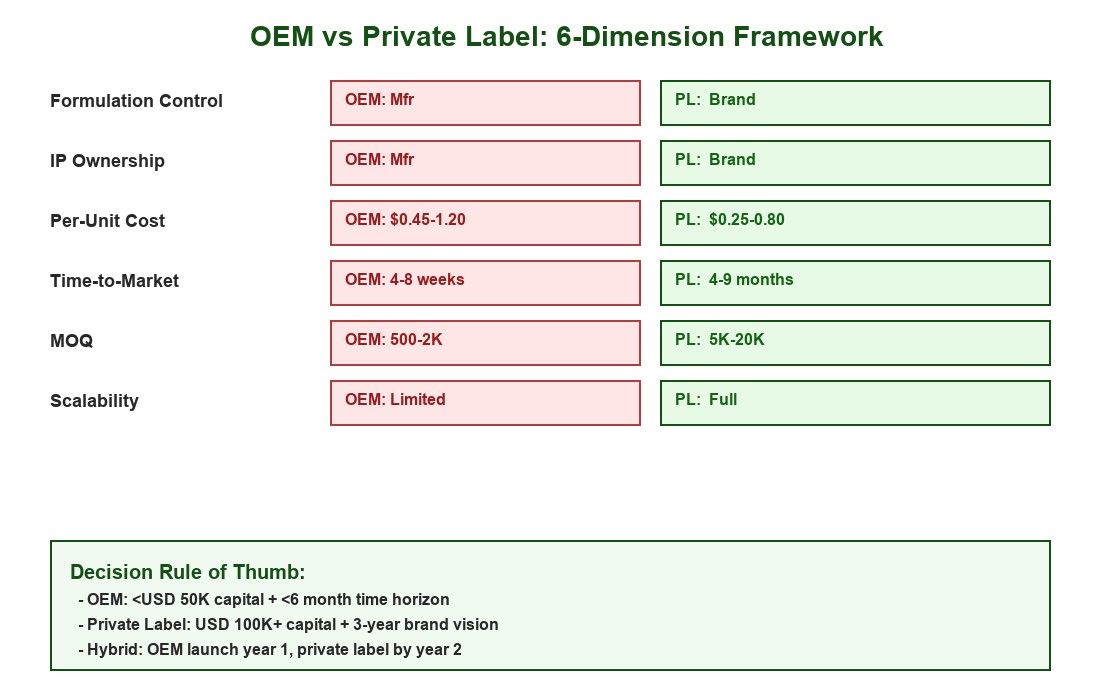
Use these 6 dimensions to compare OEM and private label across the full product lifecycle. Each dimension has a different weight depending on your brand stage, capital position, and target market.
| Dimension | OEM | Private Label | Weight |
|---|---|---|---|
| Formulation Control | Manufacturer's | Brand's | Critical |
| IP Ownership | Manufacturer owns | Brand owns | Critical |
| Per-Unit Cost | USD 0.45-1.20 | USD 0.25-0.80 | High |
| Time-to-Market | 4-8 weeks | 4-9 months | High |
| MOQ | 500-2,000 units | 5,000-20,000 units | High |
| Scalability | Limited (others use same) | Full | Critical |
OEM means the manufacturer owns the formulation. You specify active ingredients, intensity, and patch size from a menu of 10-40 existing formulas. Private label means you develop a unique formulation with proprietary ingredient ratios, possibly a novel active, and custom release kinetics.
Why this matters: With OEM, your patch is chemically identical to competitors using the same manufacturer. With private label, you have a defensible differentiator that competitors cannot replicate.
Under OEM, the manufacturer retains all intellectual property in the formulation. You own only the trademark, brand assets, and marketing collateral. Under private label, you own the formulation IP, the technical file, and (if applicable) the patent.
Why this matters: Brand value at exit (M&A or licensing) is 4-7x higher when you own the formulation IP. OEM-only brands typically exit at 1-2x annual revenue. Private-label brands exit at 3-5x.
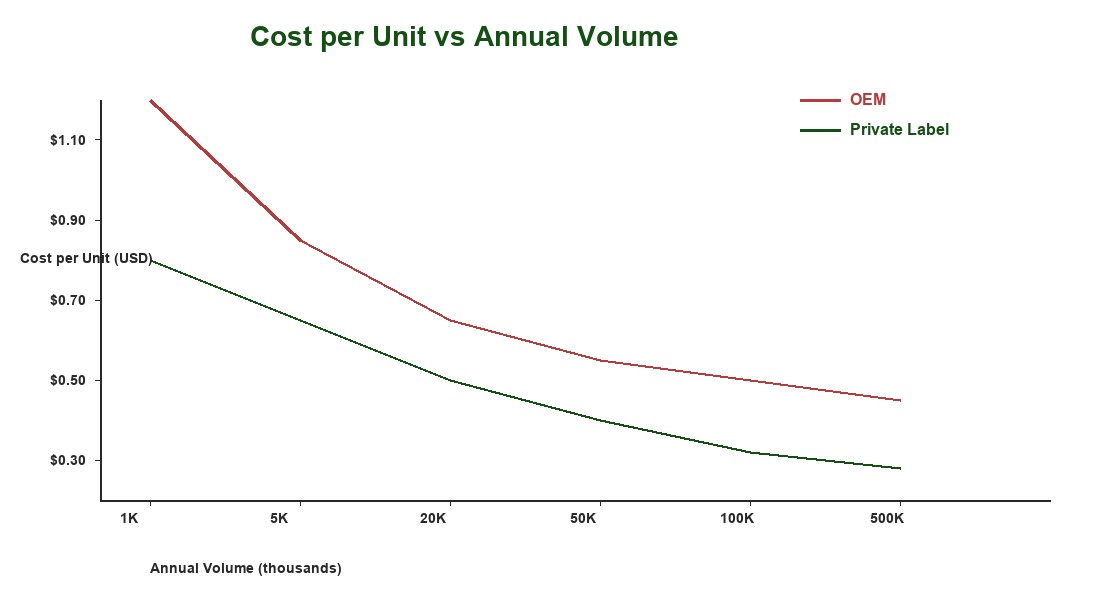
OEM per-unit cost typically runs USD 0.45-1.20 for a standard 9x13 cm heat patch with 8-hour duration. Private label drops to USD 0.25-0.80 for the same spec, with additional savings from raw material bulk purchasing and process optimization. Over 500,000 units, the difference is USD 100,000-200,000.
OEM from existing catalog: 4-8 weeks including sampling, label design, regulatory review, and first shipment. Private label from scratch: 4-9 months including formulation development, stability testing, regulatory filing, and pilot production.
OEM MOQs start at 500-2,000 units per SKU, allowing you to test 3-5 product variants at low risk. Private label MOQs start at 5,000-20,000 units per SKU, reflecting the fixed costs of custom production setup and regulatory filing.
OEM caps your differentiation at packaging and marketing. Your patch will look and feel like every other brand using the same manufacturer. Private label allows you to scale formulation innovation across multiple SKUs (muscle, joint, menstrual, sleep) and develop a defensible product family.
OEM is the right choice under 4 specific conditions.
If you have under USD 50,000 in launch capital and want to test 3-5 product-market combinations in 2-3 months, OEM is the only viable path. The 4-8 week lead time allows you to launch, gather data, and pivot before capital runs out.
If your competitive position is price + distribution, not formulation innovation, OEM is sufficient. Examples: regional pharmacy chains, private label pharmacy chains, basic e-commerce SKUs.
If you sell exclusively into one region with mature regulatory framework (e.g., USA OTC monograph), and you don't intend to expand, OEM + Drug Facts label is sufficient.
If you are responding to a competitor's launch or chasing a seasonal window (winter for warming patches, summer for cooling), the 4-8 week OEM lead time is the only way to make the window.
OEM is the wrong choice if you intend to: (1) build a defensible brand worth more than USD 5M at exit, (2) sell into 3+ regulatory regions, (3) develop unique actives (e.g., proprietary herbal blends), or (4) license your formula to other brands.
Private label is the right choice under 4 specific conditions.
If your goal is to build a brand that can be sold for 4-7x annual revenue, private label is mandatory. Buyers and investors pay for IP, not packaging.
If you plan to sell into 3+ regions (USA + EU + Canada, for example), the cost of OEM customization for each region's regulatory framework exceeds the cost of one private label that complies with all of them.
If your brand thesis includes a unique ingredient (e.g., a specific herbal extract, a proprietary capsaicin analog, a slow-release matrix), private label is the only way to legally own and protect that IP.
Private label unit economics improve dramatically above 100,000 units/year. Below that, OEM is more cost-effective. KONGDY's analysis of 200+ clients shows the breakeven typically occurs at 80,000-120,000 units/year for a standard heat patch.
Private label is the wrong choice if you: (1) have under USD 100,000 launch capital, (2) need to ship within 3 months, (3) lack internal regulatory expertise, or (4) have not validated product-market fit.
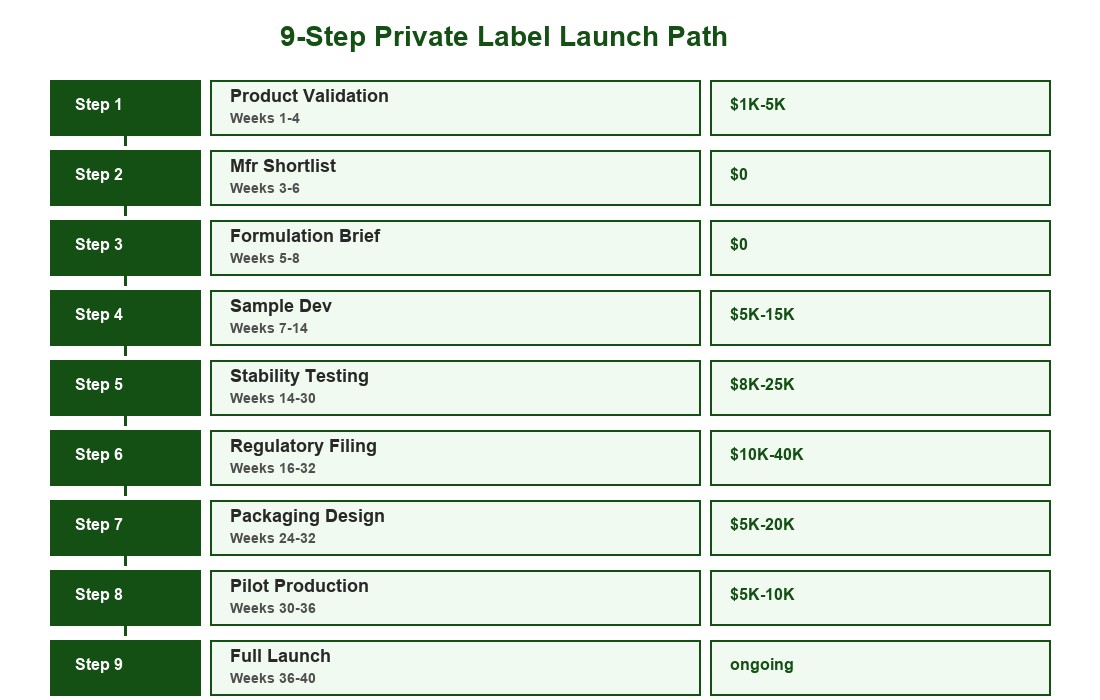
If you have decided on private label, follow this 9-step path. Each step builds on the previous one, with realistic time and cost estimates.
Validate demand before spending on formulation. Run 5-10 customer interviews, test pricing with a landing page, and identify 2-3 competitor gaps your product will fill. Cost: USD 1,000-5,000.
Identify 5-8 candidate manufacturers. Request: ISO 13485 certificate, FDA registration confirmation, CE Marking, facility audit availability, and 3 reference customers. KONGDY participates in this shortlist phase with full documentation support.
Draft a formulation brief: active ingredients, intensity profile, duration target, skin feel, scent, and any contraindications. Send to 2-3 manufacturers for feasibility and quote.
Manufacturers develop 2-3 sample variations. Test for active concentration, duration, dissolution, and skin comfort. Iterate 1-2 rounds to lock final formula. Cost: USD 5,000-15,000.
Submit final formula for accelerated and real-time stability testing. This runs 6 months for full shelf-life data, but accelerated data (3 months at 40°C) is acceptable for initial launch in most markets. Cost: USD 8,000-25,000.
File in your target market: FDA Drug Listing (USA), CE Marking under MDR (EU), Health Canada MDL, etc. Run in parallel with stability testing where possible. Cost: USD 10,000-40,000 per region.
Design primary packaging (sachet, carton), secondary packaging (display box), and regulatory labeling. Allow 4-6 weeks for design + print + delivery. Cost: USD 5,000-20,000.
Run a 5,000-10,000 unit pilot production to validate manufacturing scale, packaging line performance, and quality consistency. This is your dress rehearsal before full launch.
Receive first production run of 20,000-50,000 units, launch marketing, and begin sales. Total elapsed time from kickoff to first shipment: 36-40 weeks (9-10 months).
OEM pricing depends on size, duration, active ingredients, and order volume. The following benchmarks are for a 9x13 cm heat patch with 8-hour duration and capsaicin or menthol active.
| Volume | Per-Unit Cost | MOQ | Lead Time |
|---|---|---|---|
| 500-2,000 units | USD 1.00-1.20 | 500 | 4 weeks |
| 2,000-10,000 units | USD 0.70-0.90 | 2,000 | 4-6 weeks |
| 10,000-50,000 units | USD 0.55-0.75 | 10,000 | 6-8 weeks |
| 50,000+ units | USD 0.45-0.60 | 50,000 | 8-10 weeks |
OEM total cost for a 10,000 unit launch: USD 7,000-9,000 in production + USD 2,000-4,000 in label design + USD 1,000-2,000 in shipping = USD 10,000-15,000 total. This is the minimum viable OEM entry point.
Private label pricing follows a different curve. The development cost is higher but the per-unit cost is lower. Below are benchmarks for the same 9x13 cm heat patch with 8-hour duration and a custom capsaicin-menthol blend.
| Volume | Per-Unit Cost | MOQ | Lead Time |
|---|---|---|---|
| 5,000-20,000 units | USD 0.65-0.80 | 5,000 | 6-9 months |
| 20,000-100,000 units | USD 0.40-0.60 | 20,000 | 4-6 weeks |
| 100,000-500,000 units | USD 0.30-0.45 | 100,000 | 6-8 weeks |
| 500,000+ units | USD 0.25-0.35 | 500,000 | 8-12 weeks |
Private label total cost for a 10,000 unit launch: USD 15,000-25,000 in formulation + USD 8,000-25,000 in stability + USD 10,000-40,000 in regulatory + USD 5,000-20,000 in packaging + USD 6,500-8,000 in production = USD 44,500-118,000 total. This is 4-10x the OEM entry cost, reflecting the IP development investment.
Use these 4 decision maps to match your brand profile to the correct manufacturing model.
Recommendation: OEM. Launch with 3 SKUs from existing catalog, test market response over 6 months, raise additional capital, then migrate to private label. Timeline: 6 months to validate, 12 months to migrate. KONGDY supports both phases.
Recommendation: Private Label. Develop a unique formulation, file in 2-3 regions, and launch with full IP ownership. Timeline: 9-12 months. KONGDY provides end-to-end private label support from brief to shipment.
Recommendation: OEM with Private Label Transition. Launch OEM in 3-5 store-brand SKUs, transition to private label for the top 2 sellers. Timeline: 18 months. KONGDY offers both modes in a single supply contract.
Recommendation: Private Label with Hybrid Compliance. One private label formulation that complies with all target regions. File in parallel across regions. Timeline: 12-18 months. KONGDY coordinates FDA + CE + Health Canada + TGA filings.
Through KONGDY's work with 500+ clients, we have identified 7 common mistakes that cost B2B buyers significant time and money.
Mistake 1: Choosing OEM because it's faster, without considering long-term IP value. Many buyers undervalue the 4-7x exit multiple that comes with private label ownership.
Mistake 2: Choosing private label because it sounds prestigious, without sufficient capital. Private label projects that run out of money at month 6 are extremely common.
Mistake 3: Underestimating stability testing time. Real-time stability testing takes 24 months. Accelerated data takes 3 months but is not accepted in all markets.
Mistake 4: Assuming OEM means no regulatory work. Even OEM requires FDA Drug Listing, Drug Facts labeling, and EUDAMED registration in the EU. Plan 4-8 weeks for OEM compliance alone.
Mistake 5: Treating MOQ as fixed. Most manufacturers negotiate MOQ for committed volume contracts or multi-SKU orders. KONGDY's standard MOQ is 500 for OEM and 5,000 for private label, but we negotiate based on total annual commitment.
Mistake 6: Not budgeting for label design. A professional label that meets regulatory requirements costs USD 2,000-8,000 in design + print setup. This is true for both OEM and private label.
Mistake 7: Confusing OEM with white label. OEM is custom manufacturing using existing manufacturer formulas. White label is unbranded generic product anyone can rebrand. The two are often confused but have different pricing and IP implications.
For buyers who start with OEM and plan to migrate to private label, follow this 3-stage migration path.
Launch with OEM from existing manufacturer catalog. Sell in 2-3 markets. Gather customer feedback on formulation, packaging, and pricing. Build brand awareness.
Based on customer feedback, develop a unique formulation. Run stability testing and regulatory filing in parallel. Do not interrupt OEM sales during this phase.
Launch private label SKU alongside OEM SKU. Position private label as premium tier. Gradually shift customers to private label via pricing incentives and marketing. Discontinue OEM SKU after 18-24 months.
The migration path allows you to build cash flow from OEM while developing the higher-margin private label business. KONGDY supports both phases under a single supply contract.
OEM means you buy a manufacturer's existing formulation and customize only the label and packaging. Private label means you develop a unique formulation and own the IP. OEM ships in 4-8 weeks; private label takes 4-9 months.
Yes. OEM per-unit cost is USD 0.45-1.20 vs private label USD 0.25-0.80 for similar volume. But private label becomes cheaper above 80,000-120,000 units/year due to lower marginal cost.
Yes. Many B2B brands launch with OEM and migrate to private label within 12-24 months once they have validated product-market fit and built capital for the larger private label investment.
Yes, but OEM filing is typically faster (4-8 weeks) because you cite the manufacturer's existing dossier. Private label filing is a new dossier (4-9 months) because you are filing your own data.
Minimum total investment is USD 44,500-118,000 for a 10,000 unit launch, covering formulation, stability, regulatory, packaging, and production. The breakeven on private label vs OEM typically occurs at 80,000-120,000 units/year.
Yes. KONGDY provides both services. Many buyers start with OEM under one contract and migrate to private label under an expanded contract. This allows continuity of supply throughout the transition.
OEM is typically non-exclusive: the same formula may be sold to multiple brands. Private label is exclusive to your brand, with the formulation registered in your name. Some manufacturers offer exclusive OEM at a premium (typically 30-50% higher per-unit cost).
You are ready for private label if you have: (1) validated product-market fit with OEM, (2) USD 50,000+ capital remaining after operating costs, (3) at least 12 months of cash runway, and (4) regulatory expertise in-house or via a consulting partner.
KONGDY is a leading heat patch manufacturer based in Henan, China, with 36 years of transdermal patch manufacturing experience. Our 36,000 m² facility provides both OEM and private label services under one supply contract, allowing B2B clients to launch with OEM and migrate to private label seamlessly. KONGDY holds ISO 13485:2016 certification, FDA Drug Establishment Registration, and CE Marking under MDR 2017/745, with full regulatory support for 60+ countries.
Our heat patch product portfolio includes warming patches, capsaicin heat patches, herbal warming blends, and menthol-based warming formats, all available in OEM catalog or as fully customized private label. KONGDY's product development team supports formulation, stability testing, regulatory filing, and packaging design. Contact us at KONGDY Heat Patch Collection to request OEM samples or schedule a private label development consultation.
Heat patch OEM vs private label is not a binary choice for most B2B brands. It is a 12-24 month journey that begins with OEM validation and matures into private label ownership. The 6-dimension framework, 4 buyer scenarios, and 9-step private label launch path covered in this article give you the tools to navigate that journey.
The single most important variable is not the model you choose today, but the clarity of your 3-year brand vision. A brand that knows it will exit for USD 50M+ should start private label from day one. A brand that is testing product-market fit should start OEM. A brand that is somewhere in between should plan a 12-month OEM-to-private-label migration.
If you are evaluating KONGDY for either OEM or private label, request both our OEM catalog and our private label development package at our heat patch collection page. We respond to all serious inquiries within 24 hours and can typically ship OEM samples within 1 week and private label quotes within 2-3 weeks.

