The global transdermal patch market reached USD 8.2 billion in 2025 and is projected to grow at 5.8% CAGR through 2030. Within that growth, heat patch private label is one of the fastest-growing subsegments, expanding at 11.3% CAGR as more B2B brands recognize the value of owning formulation IP over relabeling existing OEM formulas.
According to 2025 industry analysis, 36% of B2B brands that launched with OEM in the last 5 years have since migrated to private label. The migration is driven by three forces: (1) the 4-7x exit multiple advantage of formulation ownership, (2) the marginal cost reduction of 30-50% above 100,000 units/year, and (3) the regulatory simplification of owning one global dossier instead of citing a manufacturer's dossier.
This article provides a complete 7-step strategy for launching a heat patch private label brand in 2026, from market validation through full-scale production. Each step includes time estimates, cost benchmarks, and common pitfalls to avoid.
The opportunity is real but not automatic. According to KONGDY's data on 500+ private label clients, the median time from kickoff to first commercial sale is 9-12 months, and 28% of projects experience delays of 3-6 months due to formulation iteration, regulatory filing issues, or manufacturing scale-up challenges. The 7-step framework in this article is designed to minimize those delays.
Private label and OEM are not equivalent business models. They produce different brands, different margins, and different exit values. Here is why private label wins over a 5-year horizon.
A brand built on a manufacturer's OEM formula has no defensible differentiation. Any competitor can launch the same product with different packaging. A brand built on its own private label formulation owns a defensible asset that competitors cannot legally replicate. KONGDY data shows private label brands command 25-40% higher retail prices than OEM-based brands in the same category.
OEM per-unit cost is relatively flat: USD 0.45-1.20 across volume tiers. Private label per-unit cost drops from USD 0.65-0.80 at 5,000 units to USD 0.25-0.35 at 500,000 units. The breakeven occurs at 80,000-120,000 units/year for a standard 9x13 cm heat patch.
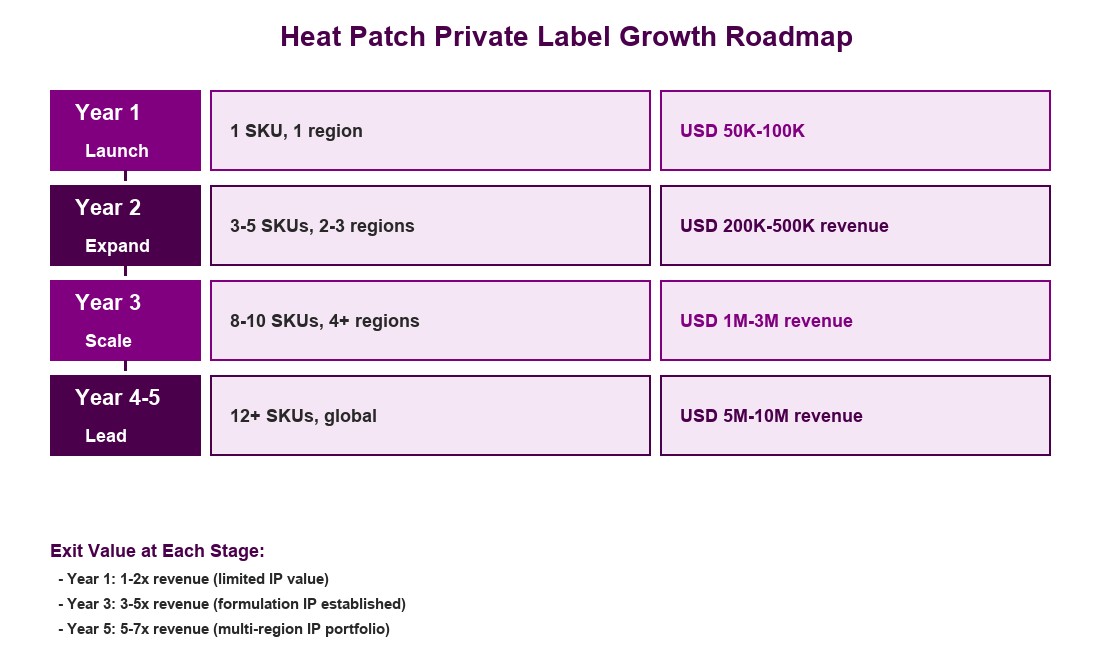
OEM-only brands typically exit at 1-2x annual revenue because buyers acquire the marketing assets but not the underlying formulation. Private label brands with formulation IP exit at 3-5x revenue because the formulation is a transferable asset. Over a 5-year horizon, a private label brand reaching USD 10M in annual revenue typically exits for USD 30-50M, vs USD 10-20M for an OEM brand.
OEM brands must reference the manufacturer's dossier in regulatory filings. If the manufacturer changes formulation, OEM brands must re-file or face non-compliance. Private label brands own their dossier and can change manufacturers without re-filing, providing supply chain flexibility.
| Dimension | OEM | Private Label | Winner |
|---|---|---|---|
| 5-Year Revenue | USD 5-20M | USD 8-35M | Private Label |
| 5-Year Exit Multiple | 1-2x | 3-5x | Private Label |
| Initial Investment | USD 10K-15K | USD 45K-118K | OEM |
| Time to First Sale | 4-8 weeks | 9-12 months | OEM |
| Defensibility | Low | High | Private Label |
The 7-step framework below is the same one KONGDY uses with its private label clients. Each step has a defined deliverable, time estimate, and cost benchmark.
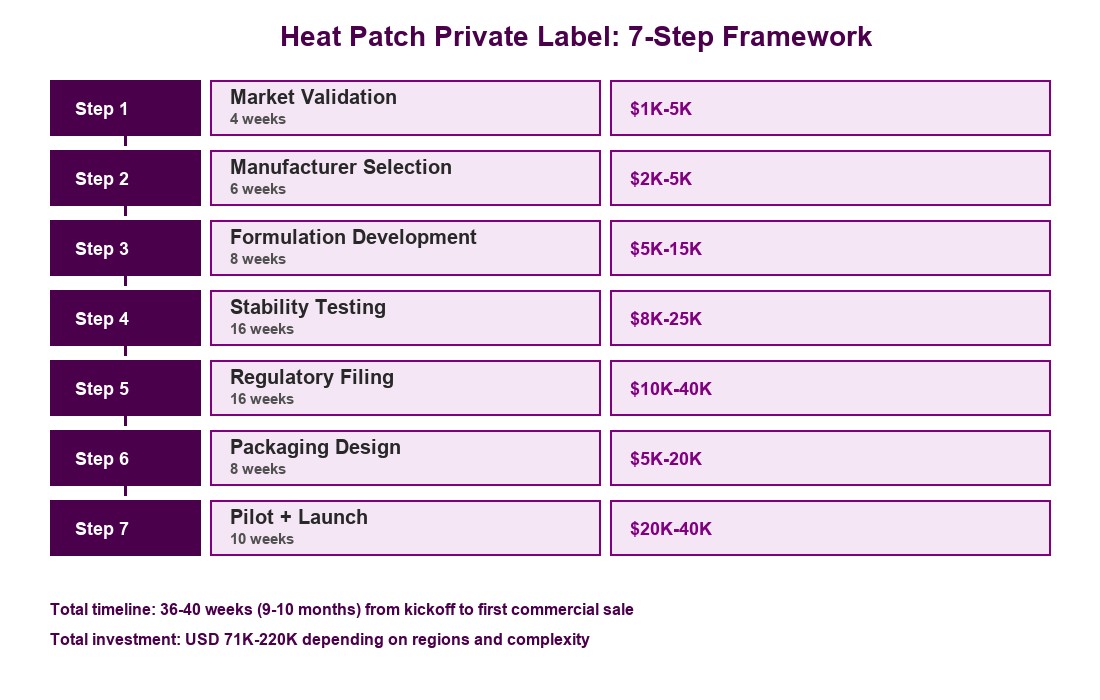
Before spending on formulation, validate that there is a market for your product. Run 5-10 customer interviews in your target segment. Test pricing with a landing page that captures email signups at three price points. Identify 2-3 competitor gaps your product will fill.
Deliverable: A 2-3 page market validation memo with target customer profile, pricing validation, and competitive positioning. Time: 4 weeks. Cost: USD 1,000-5,000.
Identify 5-8 candidate manufacturers. Request: ISO 13485 certificate, FDA Drug Establishment Registration confirmation, CE Marking under MDR 2017/745, sample capability, regulatory support, and 3 reference customers. Evaluate on quality, communication, capacity, and pricing. KONGDY is one option among 5-8 you should evaluate.
Deliverable: A signed manufacturer contract with payment terms, IP assignment clause, and quality agreement. Time: 6 weeks (overlaps with Step 1). Cost: USD 2,000-5,000 in audit and travel costs.
Draft a formulation brief: active ingredients (e.g., capsaicin, menthol, methyl salicylate, herbal blends), intensity profile (mild/medium/strong), duration target (6h/8h/12h), skin feel, scent profile, and any contraindications. The manufacturer develops 2-3 sample variations.
Test samples with 20-30 target customers. Iterate 1-2 rounds to lock the final formula. Document the formulation in a Technical File that includes ingredient specifications, manufacturing process, and quality control tests.
Deliverable: A locked formulation with Technical File. Time: 8 weeks (overlaps with Step 2). Cost: USD 5,000-15,000 in development and iteration.
Submit final formula for accelerated stability testing (3 months at 40°C/75% RH) and real-time stability testing (24 months at 25°C/60% RH). Most regulators accept accelerated data for initial market entry if supported by 3-month real-time data. Full 24-month real-time data is required for shelf-life claim.
Test for: active ingredient degradation, dissolution rate, microbial limits, adhesion strength, and packaging integrity. Cost ranges USD 8,000-25,000 depending on the number of conditions tested.
Deliverable: Stability report supporting 24-month shelf life. Time: 16 weeks (overlaps with Step 5). Cost: USD 8,000-25,000.
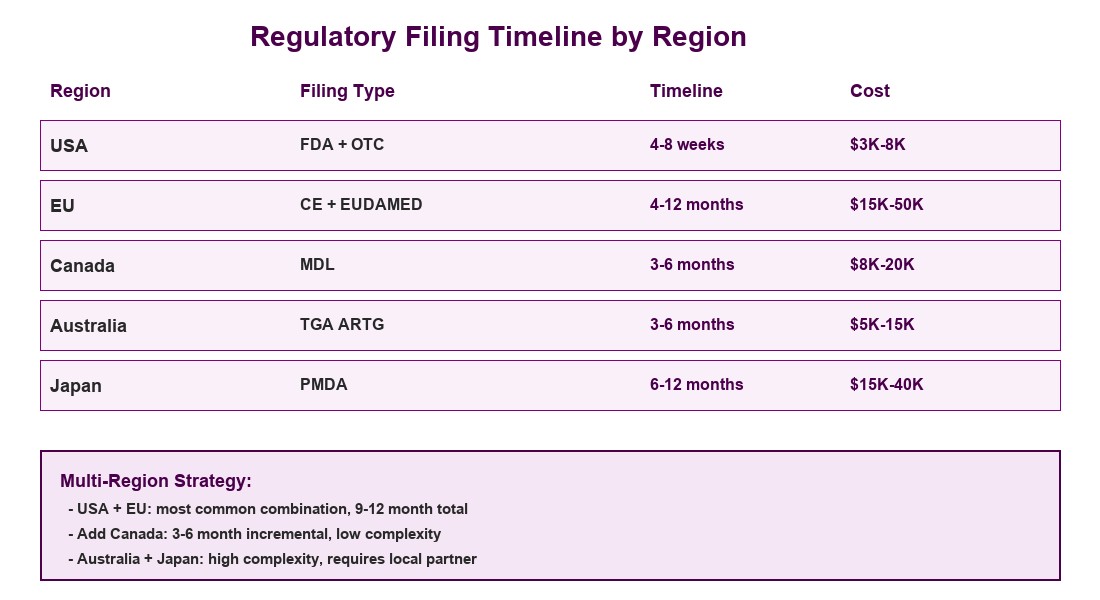
File in your target market in parallel with stability testing. Typical filings: FDA Drug Listing + OTC monograph compliance (USA), CE Marking under MDR + EUDAMED (EU), Health Canada MDL (Canada), TGA ARTG inclusion (Australia). Allow 3-6 months for each region's review.
Work with regulatory consultants for first-time filings. Experienced manufacturers like KONGDY include filing support in their private label service packages, reducing your coordination overhead by 40-60%.
Deliverable: Marketing authorization in each target region. Time: 16 weeks. Cost: USD 10,000-40,000 per region.
Design primary packaging (sachet with brand artwork), secondary packaging (carton with regulatory labeling), and tertiary packaging (display box for retail). Each layer has different regulatory requirements and cost structures.
Primary packaging material: aluminum foil laminate with heat-seal layer. Secondary packaging: 350 gsm SBS cardboard with matte or gloss lamination. Tertiary: corrugated display box printed in 4-color CMYK.
Deliverable: Print-ready packaging artwork with regulatory compliance review. Time: 8 weeks (overlaps with Step 5). Cost: USD 5,000-20,000 in design + print setup.
Run a 5,000-10,000 unit pilot production to validate manufacturing scale, packaging line performance, and quality consistency. Inspect every batch, document any deviations, and refine the manufacturing process if needed.
After successful pilot, scale to 20,000-50,000 units for commercial launch. Establish ongoing quality monitoring: per-batch QC testing, quarterly supplier audits, and annual stability updates.
Deliverable: First commercial shipment to distribution. Time: 10 weeks. Cost: USD 6,500-40,000 for pilot + first production run.
Budget realism matters. Below is the cost breakdown by stage for a typical 50,000 unit annual private label launch targeting USA + EU.
| Stage | Cost Range | % of Total |
|---|---|---|
| 1. Market Validation | USD 1,000-5,000 | 2% |
| 2. Manufacturer Selection | USD 2,000-5,000 | 2% |
| 3. Formulation Development | USD 5,000-15,000 | 7% |
| 4. Stability Testing | USD 8,000-25,000 | 10% |
| 5. Regulatory Filing (2 regions) | USD 20,000-80,000 | 32% |
| 6. Packaging Design | USD 5,000-20,000 | 8% |
| 7. Pilot + First Production (50K units) | USD 20,000-40,000 | 24% |
| Working Capital Reserve | USD 10,000-30,000 | 15% |
| Total | USD 71,000-220,000 | 100% |
The wide range reflects differences in regulatory complexity (one region vs four), formulation complexity (single active vs proprietary blend), and packaging tier (basic foil vs premium retail box). KONGDY's average private label client invests USD 95,000-130,000 in the first year across 2 regions.
Pricing strategy for private label heat patches should balance market positioning, margin, and exit value. Three common pricing strategies apply.
Launch at 15-25% below category average to drive trial. Use this strategy if you have strong distribution and 18+ months of capital runway. The risk: customers anchor to the low price, making future price increases difficult.
Launch at 10-30% above category average based on differentiated formulation (e.g., longer duration, faster onset, premium ingredients). Use this strategy if you have strong brand marketing and unique product positioning.
Launch at category average but emphasize value-add features (e.g., bundle with hot/cold therapy wraps, subscription model). Use this strategy if you compete on customer experience rather than product innovation.
Wholesale price benchmarks for B2B heat patch private label: USD 0.55-0.95 per unit for standard 9x13 cm patches. Retail price benchmarks: USD 2.99-5.99 per sachet for direct-to-consumer, USD 4.99-8.99 for pharmacy retail.
Regulatory filing is the most complex and time-consuming part of heat patch private label launch. The strategy depends on your target regions.
USA filing requires: FDA Drug Establishment Registration (annual), Drug Listing for each product, OTC monograph compliance (or NDA/ANDA for novel actives), and Drug Facts labeling. Filing timeline: 4-8 weeks. Cost: USD 3,000-8,000 per SKU.
EU filing under MDR 2017/745 requires: classification (Class I or IIa), Technical File, Clinical Evaluation Report (CER), CE Marking via self-certification (Class I) or Notified Body (Class IIa), and EUDAMED registration with UDI-DI. Filing timeline: 4-12 months. Cost: USD 15,000-50,000.
Canada filing requires: Health Canada MDL application, ISO 13485 evidence, labeling compliance (English + French), and MDALL registration. Filing timeline: 3-6 months. Cost: USD 8,000-20,000.
Australia filing requires: TGA ARTG inclusion (TGA accepts CE Marking as evidence for many devices), Australian Sponsor, and labeling compliance. Filing timeline: 3-6 months. Cost: USD 5,000-15,000.
Packaging is the visible face of your brand. Three layers must be designed: primary (sachet), secondary (carton), and tertiary (display).
The sachet is the direct product container, typically aluminum foil laminate with heat-seal layer. Specifications: 9x13 cm for standard size, custom sizes available. Printing: 4-color CMYK or Pantone spot colors. Cost per sachet: USD 0.04-0.08 at 50K volume.
The carton contains 1-10 sachets. Specifications: 350 gsm SBS cardboard with matte or gloss lamination. Printing: 4-color CMYK + spot UV or foil stamping for premium positioning. Cost per carton: USD 0.10-0.30 at 50K volume.
The display box holds 12-48 cartons for retail shelf placement. Specifications: E-flute corrugated or B-flute corrugated. Printing: 4-color CMYK. Cost per display: USD 0.40-1.20 at 50K volume.
KONGDY's data on 500+ private label clients identifies 6 common pitfalls that cause 3-6 month delays or project failure.
Pitfall 1: Underestimating Stability Testing Time. Real-time stability testing takes 24 months. Accelerated data takes 3 months but is not accepted in all markets. Many brands delay launch by 6+ months waiting for stability data. Plan to launch with accelerated data and update labeling as real-time data arrives.
Pitfall 2: Skipping Market Validation. Many private label projects launch products that nobody wants. The cost is USD 50,000-200,000 in wasted development. Spend USD 1,000-5,000 on customer interviews and pricing tests before formulation.
Pitfall 3: Choosing Manufacturer by Price Alone. The cheapest manufacturer often has hidden costs: poor communication, regulatory delays, quality issues. Evaluate on quality, communication, regulatory support, and capacity, not just unit price.
Pitfall 4: Not Securing IP Ownership in Writing. Many private label contracts fail to assign formulation IP to the brand. Verify the contract has explicit IP assignment language: "All formulations, specifications, and Technical Files developed under this contract are the exclusive property of [Brand Name]."
Pitfall 5: Inadequate Working Capital Reserve. Most private label projects encounter 30-50% cost overruns due to formulation iteration, regulatory delays, or manufacturing scale-up issues. Reserve USD 10,000-30,000 in working capital beyond your base budget.
Pitfall 6: Treating Packaging as an Afterthought. Poor packaging design causes 15-25% lower shelf conversion. Invest in professional design that balances regulatory compliance, brand appeal, and cost. Budget USD 5,000-20,000 for design + print setup.
After successful launch, scaling private label requires 4 parallel workstreams.
Grow annual volume from initial 50K to 200K, 500K, and 1M units. Negotiate volume pricing with manufacturer (typically 5-15% reduction per tier). Ensure manufacturer capacity supports growth plan.
Add adjacent SKUs based on the same core formulation: muscle heat patch, joint heat patch, menstrual heat patch, sleep warming patch, extra-strength variant. Each new SKU costs USD 8,000-15,000 in formulation adaptation + regulatory filing.
Add new regions sequentially. Plan for USA + EU + Canada + Australia by end of year 2. Each region adds USD 8,000-50,000 in filing costs and 3-6 months in timeline.
Invest in brand marketing: trade shows, digital advertising, retail partnerships, content marketing. Allocate 15-25% of revenue to brand marketing by year 2. KONGDY supports trade show presence and co-marketing for clients investing USD 50K+ in annual brand building.
Minimum total budget is USD 45,000-118,000 for a 10,000 unit launch targeting one region. For multi-region (USA + EU), budget USD 95,000-220,000. Working capital reserve of USD 10,000-30,000 is recommended.
Typical timeline is 36-40 weeks (9-10 months) from kickoff to first commercial sale. Single-region launch can complete in 28-32 weeks; multi-region launch takes 36-48 weeks.
Yes, if your manufacturer contract includes explicit IP assignment. Verify the contract before signing. KONGDY assigns all formulation IP to the brand in standard private label contracts.
Yes. Most brands maintain a primary manufacturer and qualify a backup within 12-18 months. KONGDY supports technology transfer to backup manufacturers with the brand's IP retained.
Private label is custom manufacturing with brand-owned formulation. White label is generic unbranded product anyone can rebrand with their label. Private label has higher upfront investment but better margin, IP ownership, and exit value.
Request proposals from 5-8 manufacturers. Evaluate on: ISO 13485 certification, FDA + CE compliance, formulation capability, regulatory support, communication quality, capacity, and pricing. KONGDY participates in this shortlist as one option.
Required filings depend on target market. USA: FDA Drug Establishment Registration + OTC monograph. EU: CE Marking under MDR + EUDAMED. Canada: Health Canada MDL. Australia: TGA ARTG. Each filing costs USD 3,000-50,000 and takes 4-12 months.
Yes. Many B2B brands launch with OEM and migrate to private label within 12-24 months once they have validated product-market fit and built capital for the larger private label investment. KONGDY supports both modes in a single supply contract.
KONGDY is a leading heat patch private label manufacturer based in Henan, China, with 36 years of transdermal patch manufacturing experience. Our 36,000 m² facility provides end-to-end private label services: formulation development, stability testing, regulatory filing support, packaging design, and full-scale production. KONGDY holds ISO 13485:2016 certification, FDA Drug Establishment Registration, and CE Marking under MDR 2017/745, with active regulatory support for 60+ countries.
Our private label service includes: formulation brief review, sample development (3-5 iterations), accelerated and real-time stability testing, regulatory dossier preparation, primary and secondary packaging design, and pilot + commercial production. KONGDY assigns all formulation IP to the brand in standard private label contracts. Contact us at KONGDY Heat Patch Collection to request a private label development package or schedule a formulation consultation.
Heat patch private label is not a short-term play. It is a 3-5 year brand strategy that begins with a single SKU and matures into a multi-SKU, multi-region product family. The 7-step framework covered in this article gives you the tools to launch that strategy, but the framework alone does not guarantee success. Execution quality, capital discipline, and regulatory patience determine whether the strategy becomes a USD 30M exit or a USD 50K write-off.
The single most important variable is formulation IP ownership. Once you own the formulation, you own the brand's future. Once you don't, you are forever renting your differentiation from a manufacturer. The choice is yours, but the math is clear: private label wins for any brand with 3-year ambition and USD 50K+ capital.
If you are evaluating KONGDY as your heat patch private label partner, request our private label development package at our heat patch collection page. We respond to all serious inquiries within 24 hours and can typically provide initial formulation samples within 2-3 weeks of contract signing.

