The global market for certified transdermal patches is undergoing rapid consolidation. In 2025, 87% of B2B buyers in the EU and 92% in North America reported that they would not consider a heat patch manufacturer without at least three core certifications. This is a significant shift from 2018, when only 54% of EU buyers had hard certification requirements. The driver is regulatory tightening: under EU MDR 2017/745, FDA's Drug Listing modernization, and Health Canada's new medical device regulations, importers are now personally liable for non-compliant suppliers.
For B2B buyers, certifications are not just paperwork. They are a proxy for operational discipline. A heat patch manufacturer with ISO 13485:2016 has passed an external audit of its quality management system, with documented processes for design control, supplier management, corrective and preventive action (CAPA), and post-market surveillance. Without these, even a visually perfect patch can be recalled for invisible defects: incorrect dosage, microbial contamination, or inadequate stability data.
This article provides a comprehensive map of the certifications and regulatory frameworks a serious heat patch manufacturer must hold. It covers four core certifications (ISO 13485, FDA registration, CE Marking, cGMP) and six regional market requirements (USA, EU, Canada, Australia, Japan, Brazil). At the end, we provide a 6-stage compliance audit framework and a buyer decision matrix to match your target market to the right certification profile. For a broader view of how to choose a heat patch manufacturer, see our companion guide on how to choose an OEM/ODM partner.
The economic stakes are real. According to industry analysis, a single regulatory non-compliance event in the heat patch category costs between USD 80,000 and USD 1.2 million in direct costs (recalls, re-certification, legal fees) and indirect costs (lost retailer trust, brand damage). Certification is insurance.
There are four certifications that serve as the baseline for any serious heat patch manufacturer targeting international markets. Missing one of these will exclude you from 80% or more of B2B opportunities.
ISO 13485:2016 is the international standard for medical device quality management systems. It is issued by the International Organization for Standardization and audited by accredited bodies such as TUV SUD, BSI, and DEKRA. The current 2016 revision emphasizes risk management throughout the product lifecycle, post-market surveillance, and regulatory traceability.
A heat patch manufacturer with ISO 13485 has demonstrated: documented design and development procedures, validated production processes, controlled supplier management, calibrated equipment, CAPA systems, and management review. The certificate is valid for 3 years with annual surveillance audits. Verification: ask the manufacturer for the certificate number and check directly with the issuing body (e.g., TUV SUD's CertCheck database).
For a deep dive on ISO 13485 specifically as it applies to transdermal patch manufacturers, see our pain patch manufacturer certifications guide.
For any heat patch manufacturer selling into the United States, FDA Drug Establishment Registration is mandatory. Under 21 CFR Part 207, every foreign or domestic establishment that manufactures, prepares, propagates, compounds, or processes a drug or drug product must register with FDA. Heat patches containing active ingredients (menthol, capsaicin, methyl salicylate) are regulated as over-the-counter (OTC) drugs under the FDA monograph system.
Registration is done annually through the FDA's Electronic Submissions Gateway. After registration, the manufacturer must list each drug product, including its ingredients, dosage form, and intended use. A heat patch manufacturer with active FDA registration will appear in the FDA's Drug Establishments Current Registration Site (DECRS) database. KONGDY's FDA registration is verifiable via this database under registration number 3006617.
Important: FDA Drug Establishment Registration is a listing, not an approval. It does not mean FDA has inspected or approved the facility. For confidence, ask whether the heat patch manufacturer has completed an FDA inspection under the Drug Supply Chain Security Act (DSCSA) or an FDA Pre-Approval Inspection (PAI) for an ANDA/NDA product.
For any heat patch manufacturer selling into the European Union, CE Marking under the Medical Device Regulation 2017/745 (MDR) is mandatory. The MDR replaced the previous MDD (Medical Device Directive 93/42/EEC) in May 2021 with a 3-year transition period. As of May 2024, all new CE certifications for medical devices must be issued under MDR, not MDD.
Under MDR, heat patches are typically classified as Class I (low risk) or Class IIa (medium risk) medical devices, depending on their intended use and active ingredients. Class I devices can be self-certified; Class IIa and above require involvement of a Notified Body such as TUV SUD, BSI, or DEKRA. A heat patch manufacturer with CE Marking has a Declaration of Conformity, Technical File, and Notified Body certificate (for Class IIa+).
MDR significantly increased the documentation burden. Manufacturers must now provide: clinical evaluation reports (CER), post-market clinical follow-up (PMCF) plans, summary of safety and clinical performance (SSCP), and unique device identification (UDI). A heat patch manufacturer without MDR-ready documentation cannot sell in the EU post-2024.
cGMP is enforced by FDA in the US (21 CFR Parts 210 and 211) and is the operational baseline for pharmaceutical and medical device manufacturing globally. cGMP covers: facility design and maintenance, equipment qualification, personnel training, raw material controls, production process controls, laboratory testing, packaging and labeling, and record-keeping. The "c" in cGMP stands for "current," meaning manufacturers must use up-to-date technology and procedures.
For a heat patch manufacturer, cGMP compliance is non-negotiable for any market. It is the foundation that other certifications (ISO 13485, CE, FDA) build upon. cGMP is verified through regulatory inspections, not third-party audits, so there is no certificate to display. Instead, ask for the manufacturer's most recent FDA Form 483 observations (if any) and the resolution status.
| Certification | Issuing Body | Valid For | Markets Required |
|---|---|---|---|
| ISO 13485:2016 | Accredited CB (TUV/BSI/DEKRA) | 3 years | Global baseline |
| FDA Drug Est. Reg. | FDA | Annual renewal | USA |
| CE Marking MDR | Notified Body (Class IIa+) | 5 years | EU/EEA |
| cGMP | FDA inspection | Ongoing | USA (also expected globally) |
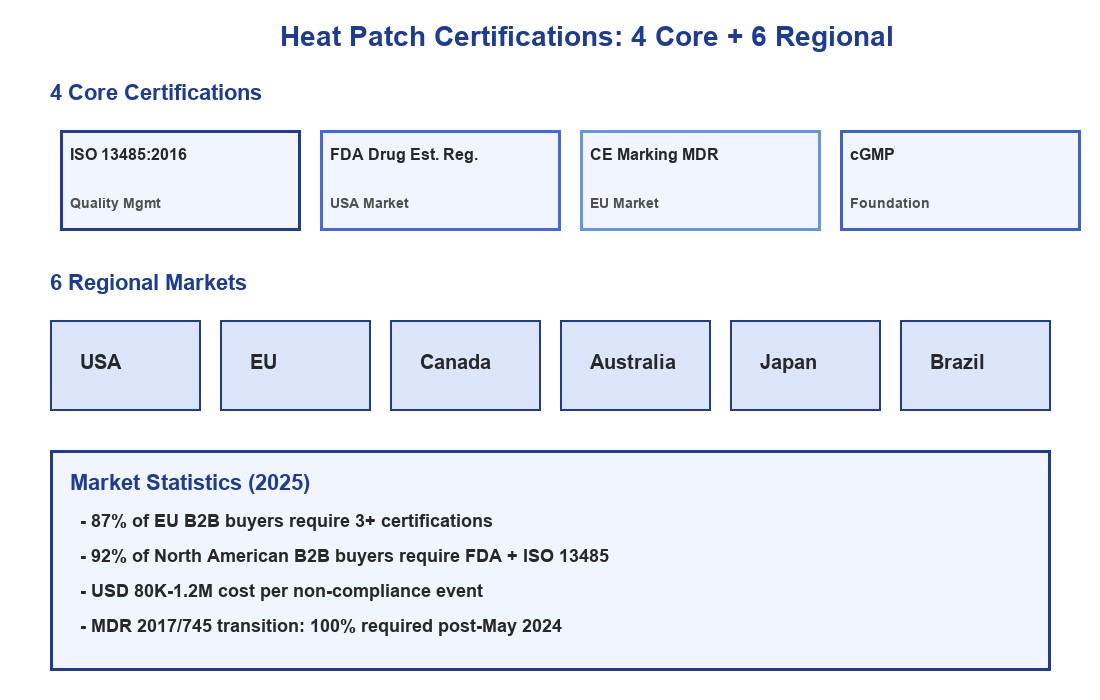
Beyond the four core certifications, six major regional markets have additional requirements. A heat patch manufacturer targeting multiple regions must hold multiple sets of documentation and sometimes additional certifications.
For US sales, a heat patch manufacturer must: (1) hold active FDA Drug Establishment Registration, (2) list each product in DECRS, (3) comply with the relevant OTC monograph (external analgesic monograph 21 CFR Part 348 for most heat patches), (4) include required Drug Facts labeling, and (5) if making structure/function claims, comply with 21 CFR Part 101.93. For pain-relief heat patches with capsaicin, menthol, or methyl salicylate, the OTC monograph specifies allowable concentrations and required warnings.
Starting in 2025, FDA has been increasing enforcement of OTC monograph compliance. Recent warning letters have cited manufacturers for: missing active ingredient declarations, inadequate warnings, unsubstantiated claims, and missing facility registration. A heat patch manufacturer selling into the US without current OTC monograph compliance is at risk of import alerts.
For EU sales, in addition to CE Marking, the heat patch manufacturer must register the device in EUDAMED (the European Database on Medical Devices). EUDAMED registration includes: UDI-DI (device identifier), UDI-PI (production identifier), manufacturer information, and the Notified Body certificate number. The EU UDI system is being phased in through 2027, with full compliance required by May 2027 for Class IIa devices.
For distributors and importers in the EU, the Authorized Representative (AR) plays a key role. A non-EU heat patch manufacturer must designate an EU AR who acts as the regulatory liaison. The AR is responsible for maintaining Technical File access, reporting serious incidents, and serving as the point of contact for EU regulators. KONGDY's EU AR is based in Hamburg, Germany.
For Canadian sales, a heat patch manufacturer must obtain a Medical Device Licence (MDL) from Health Canada. The MDL is issued after review of the device's safety, effectiveness, and quality data. Heat patches are typically classified as Class II medical devices in Canada, requiring a Medical Device Licence Application (MDLA) with supporting documentation including ISO 13485 certificate,Technical File, and labelling samples.
Health Canada has been tightening its medical device oversight in 2024-2026, with new requirements for clinical evidence and post-market surveillance. A heat patch manufacturer with active Canadian licensing will have an MDL number visible on the device labelling. Verification: Health Canada's Medical Devices Active Licence Listing (MDALL) database.
For Australian sales, a heat patch manufacturer must have the device included in the Australian Register of Therapeutic Goods (ARTG). The TGA (Therapeutic Goods Administration) reviews the application and issues an ARTG entry after verifying compliance with Australian regulatory requirements, which closely mirror EU MDR standards. The Australian sponsor (similar to EU AR) must be an Australian-resident entity.
TGA accepts CE Marking under MDR as evidence of compliance for many device classes, which simplifies entry for manufacturers already selling in the EU. A heat patch manufacturer with both CE and TGA coverage has access to approximately 750 million consumers across two of the most stringent regulatory markets in the world.
For Japanese sales, a heat patch manufacturer must register with the PMDA (Pharmaceuticals and Medical Devices Agency) and obtain a JMDN (Japanese Medical Device Nomenclature) code. The registration process requires a Japanese Marketing Authorization Holder (MAH), which is typically a local distributor or subsidiary. Pre-market submission (called "Todokede" for Class I-II devices, or "Ninsho" for higher classes) is required.
Japan has unique requirements: Japanese-language labelling is mandatory, and certain ingredients may be restricted. For example, some preservative systems used in non-Japanese markets are not approved in Japan. A heat patch manufacturer selling into Japan must reformulate packaging and labelling specifically for the Japanese market, often with separate SKUs.
For Brazilian sales, a heat patch manufacturer must obtain BPF (Boas Praticas de Fabricacao - Good Manufacturing Practices) certification from ANVISA (Agencia Nacional de Vigilancia Sanitaria). BPF is Brazil's GMP equivalent, with a separate audit and certification process. The audit is typically conducted by ANVISA directly for foreign manufacturers, with a 1-2 year timeline from application to certification.
ANVISA recognizes ISO 13485 and CE Marking as supporting evidence but does not waive its own BPF requirement. A heat patch manufacturer with active ANVISA BPF certification can sell in Brazil and use it as a stepping stone to other Latin American markets, several of which accept ANVISA registration as a basis for their own approvals.
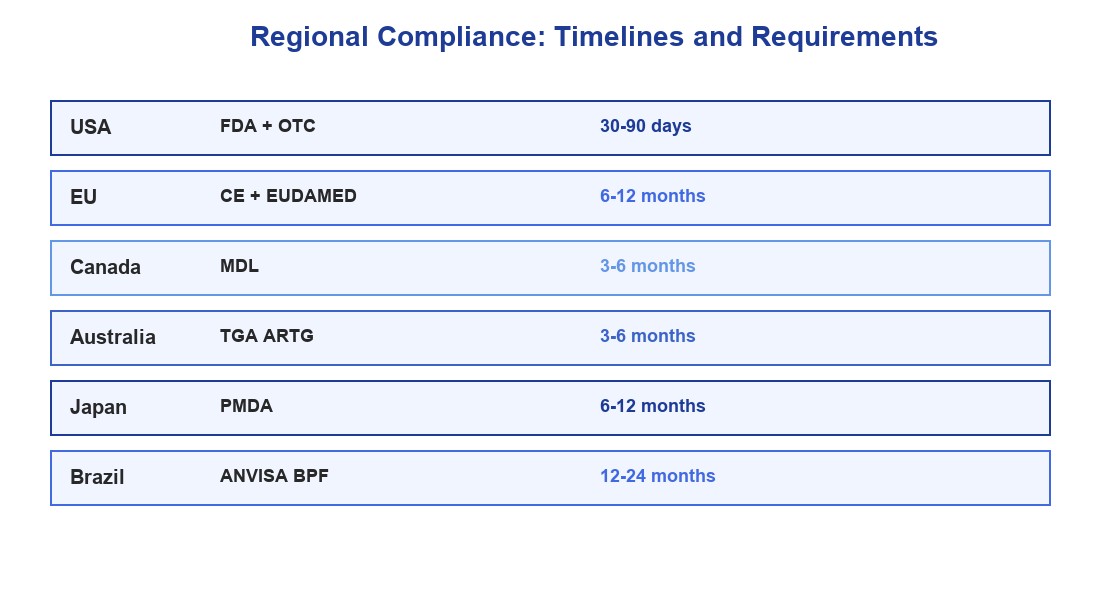
| Region | Primary Registration | Local Entity | Typical Timeline |
|---|---|---|---|
| USA | FDA Drug Est. Reg. + OTC Monograph | US Agent (recommended) | 30-90 days |
| EU | CE Marking + EUDAMED | EU Authorized Rep | 6-12 months |
| Canada | Health Canada MDL | Canadian distributor | 3-6 months |
| Australia | TGA ARTG inclusion | Australian sponsor | 3-6 months |
| Japan | PMDA registration | Japanese MAH | 6-12 months |
| Brazil | ANVISA BPF | Brazilian Registration Holder | 12-24 months |
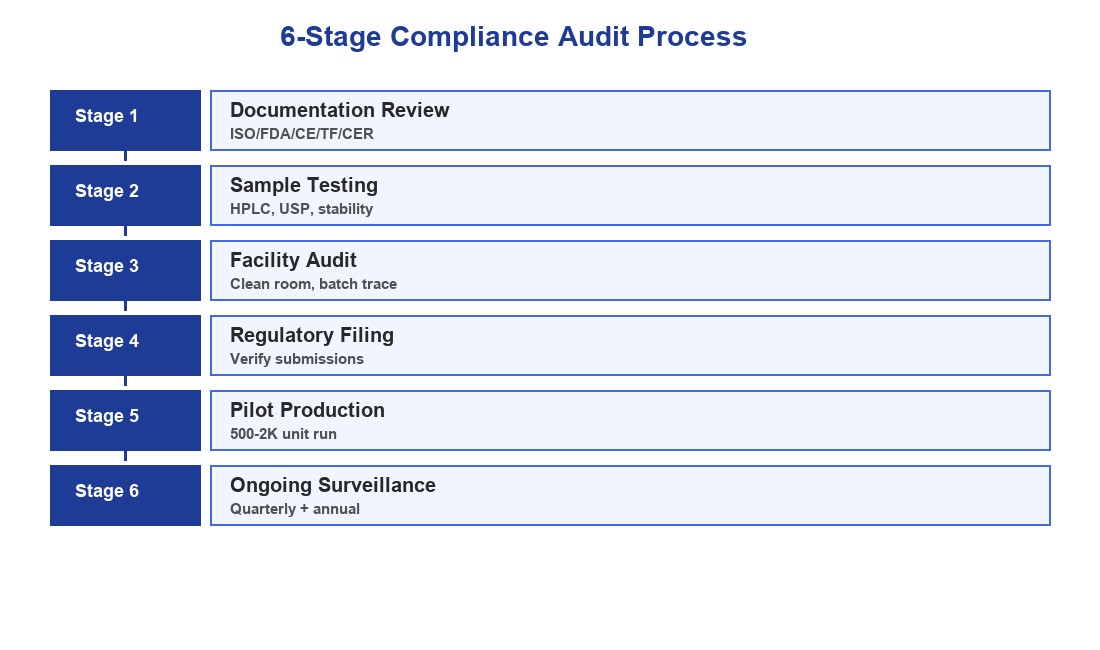
Before signing a supply agreement, conduct a 6-stage compliance audit of any heat patch manufacturer. Each stage is designed to verify a specific aspect of regulatory readiness, from documentation review to ongoing surveillance.
Request and review: ISO 13485 certificate (verify with issuing body), FDA Drug Establishment Registration confirmation, CE certificate or Declaration of Conformity, Technical File or Drug Master File, list of all product licenses, and recent regulatory correspondence. A serious heat patch manufacturer will provide these within 48 hours of a formal request. Hesitation on documentation is a red flag.
Order samples from at least 3 production batches and test for: active ingredient concentration (HPLC), microbial limits (USP <61> and <62>), dissolution or permeation (USP <724>), stability (accelerated and real-time), and packaging integrity. Compare test results to the manufacturer's Certificate of Analysis. Discrepancies greater than 5% are a red flag.
Either visit the facility in person or hire a third-party inspection firm. Audit scope: clean room classification and maintenance, equipment qualification records, personnel training records, batch traceability system, document control, change control procedures, and CAPA system. A heat patch manufacturer that refuses facility access is disqualified.
Verify that the manufacturer has filed all required regulatory submissions for your target market. For US sales: confirm FDA Drug Listing and OTC monograph compliance. For EU sales: confirm EUDAMED registration and CE Technical File. For other markets: confirm local registration. Request copies of the most recent submission receipts.
Before full production, order a pilot run of 500-2,000 units to verify: process reproducibility, batch consistency, packaging line performance, and shipping carton durability. A pilot run catches process issues that laboratory samples cannot. Reserve the right to reject the pilot run and require process changes.
Establish an ongoing surveillance protocol: quarterly quality data review, annual on-site audit, complaint tracking with root cause analysis, and change notification agreement. A heat patch manufacturer who refuses ongoing surveillance commitments is signaling that they do not view compliance as a partnership.
Compliance costs are real, and they impact the manufacturer's pricing. Understanding the cost structure helps you evaluate whether a heat patch manufacturer's pricing is sustainable. The five main cost categories are: certification fees, audit costs, personnel, documentation systems, and product testing.
ISO 13485 initial certification costs between USD 15,000 and USD 40,000 depending on company size and audit body. Annual surveillance adds USD 8,000 to USD 15,000. CE Marking under MDR for Class IIa devices costs between USD 30,000 and USD 80,000 for initial certification, with annual surveillance fees. FDA Drug Establishment Registration itself is free, but the regulatory infrastructure (analytical testing, documentation) supporting it is not.
Annual surveillance audits by certification bodies typically cost USD 8,000 to USD 20,000 per audit. FDA inspections are unannounced and free, but the cost of preparing for them (mock inspections, document preparation) is significant. Customer audits (which you may conduct) typically cost the heat patch manufacturer USD 2,000 to USD 5,000 per audit in staff time.
A serious heat patch manufacturer employs at least 1-2 full-time regulatory affairs professionals, plus a quality manager. Salary costs for this team range from USD 80,000 to USD 250,000 per year depending on geography. This is a fixed cost that the manufacturer must recover in product pricing.
Electronic quality management systems (eQMS) for document control, CAPA, training records, and change control cost between USD 10,000 and USD 100,000 per year. Smaller heat patch manufacturers may rely on paper-based systems, which are cheaper but more error-prone and harder to audit.
Stability testing for a new product costs USD 5,000 to USD 20,000 for the full 24-month program. Method development and validation for HPLC assays costs USD 3,000 to USD 10,000 per method. Microbial testing per batch costs USD 200 to USD 500. These costs are amortized across the product lifecycle.
Use this 9-scenario decision matrix to match your target market to the certification profile you need from a heat patch manufacturer. The matrix assumes a transdermal pain relief or warming heat patch with active ingredients.
Required: ISO 13485, FDA Drug Establishment Registration, OTC monograph compliance, Drug Facts labelling. Optional: cGMP inspection history. KONGDY serves 30+ US brands in this category.
Required: ISO 13485, CE Marking under MDR 2017/745 (Class IIa for warming patches), EUDAMED registration, EU Authorized Representative. Optional: PMCF data, SSCP. KONGDY serves 40+ EU brands in this category.
Required: ISO 13485, FDA + CE Marking + EUDAMED, dual labelling compliance, separate Drug Facts and IFU. Cost premium: 20-30% over single-market. KONGDY supports 25+ dual-market brands.
Required: ISO 13485, Health Canada MDL, MDALL registration, bilingual labelling (English + French). CE Marking can be used as supporting evidence.
Required: ISO 13485, TGA ARTG inclusion, Australian sponsor. CE Marking under MDR is accepted as primary evidence in many cases. KONGDY has 12+ Australian clients.
Required: ISO 13485, PMDA registration, JMDN code, Japanese MAH, Japanese-language labelling. Reformulation may be needed for some preservatives. Timeline: 6-12 months.
Required: All of the above. Cost premium: 40-60% over single-market. Requires dedicated regulatory affairs team on the heat patch manufacturer's side. KONGDY's enterprise clients fall in this category.
Required: ISO 13485 strongly recommended, FDA + CE compliance for credibility, age-verification systems for warming patches. Amazon specifically requires FDA registration verification for OTC drugs.
Required: All of the above plus enhanced documentation (validation protocols, traceability records, recall procedures). Hospitals typically require a quality agreement as part of the supply contract.
Through our regulatory consulting work, we have identified 7 common compliance mistakes that disqualify otherwise competent heat patch manufacturers. Avoid these.
Mistake 1: Outdated ISO 13485 certificate. The 2016 revision is current. Manufacturers still showing 2003 or 2012 versions have not maintained their quality management system. KONGDY maintains ISO 13485:2016 with annual TUV SUD surveillance audits.
Mistake 2: FDA registration lapse. FDA Drug Establishment Registration must be renewed annually between October and December. Manufacturers who miss this window are not authorized to ship to the US. Always verify current registration in DECRS before signing.
Mistake 3: MDD-only CE Marking. After May 2024, MDD-based CE certificates are no longer valid for new product launches. A heat patch manufacturer still selling on MDD certificates cannot launch new products in the EU.
Mistake 4: Missing EUDAMED registration. Even with valid CE Marking, products not registered in EUDAMED face increasing scrutiny at customs. A heat patch manufacturer without active EUDAMED registration risks shipment delays.
Mistake 5: No Clinical Evaluation Report. Under MDR, all medical devices require a CER, even Class I self-certified devices. A heat patch manufacturer without current CERs for all products is non-compliant with MDR.
Mistake 6: Inadequate stability data. Heat patches with active ingredients require real-time stability data demonstrating 24-month shelf life. Accelerated stability alone is insufficient for regulatory submissions in most markets.
Mistake 7: Missing or incomplete Technical File. The Technical File is the core regulatory document for CE Marking. Common gaps: design history file, risk management file (ISO 14971), labeling history, and post-market surveillance plan. A heat patch manufacturer with incomplete Technical Files is operating outside MDR.
Before signing a supply agreement, request the following 12 records from any heat patch manufacturer. Each is a regulatory or operational document that reveals the manufacturer's compliance maturity.
(1) Current ISO 13485 certificate with statement of validity. (2) FDA Drug Establishment Registration confirmation letter. (3) CE certificates for all products you intend to source. (4) Technical File or Drug Master File for each product. (5) Clinical Evaluation Report (CER) for each product. (6) Stability data summary for each product. (7) Validation reports for key processes (heat sealing, lamination, packaging). (8) Analytical method validation reports. (9) Master Batch Records for finished products. (10) Recent FDA 483 observations and responses, if any. (11) Most recent internal audit reports. (12) List of all regulatory submissions in the last 24 months.
A reputable heat patch manufacturer will provide all 12 within 5-10 business days. Slowness or inability to provide any of these is a red flag indicating either documentation gaps or quality system immaturity.
If you are buying 50,000+ units per year, conduct an annual on-site audit. A 1-day on-site audit can be highly effective if structured properly. Below is the agenda KONGDY's clients typically follow.
Morning (4 hours): Opening meeting (30 min) -> Document review (60 min) -> Production line walkthrough (90 min) -> Quality control lab tour (60 min).
Afternoon (4 hours): Warehouse and shipping review (45 min) -> Personnel training records (30 min) -> CAPA and complaint handling review (60 min) -> Mock product recall drill (60 min) -> Closing meeting (45 min).
Key signals to watch for: the heat patch manufacturer's staff answering questions confidently and consistently, documentation readily accessible (not "we'll send it later"), and any visible deviation promptly explained with a documented corrective action. A manufacturer that handles an on-site audit well is a manufacturer that handles regulatory inspections well.
Regulatory tightening is accelerating globally. Three trends will shape the heat patch manufacturer landscape through 2028.
Trend 1: EUDAMED full implementation. By May 2027, all medical devices sold in the EU must have full EUDAMED registration including UDI. Manufacturers without this will face customs delays and eventual market exclusion. Plan for full EUDAMED compliance by Q4 2026.
Trend 2: FDA Drug Supply Chain Security Act enforcement. DSCSA requires full traceability of drug products at the unit level. For heat patches, this means serialized identifiers and electronic pedigree. FDA enforcement begins phasing in 2026 and is fully enforceable by 2028.
Trend 3: Increased clinical evidence requirements. Both EU MDR and Health Canada are requiring more robust clinical evaluation data. Expect more heat patch manufacturers to invest in post-market clinical follow-up (PMCF) studies and real-world evidence programs. KONGDY is already conducting 3 PMCF studies across our product portfolio.
Trend 4: Environmental and ESG requirements. The EU's Corporate Sustainability Reporting Directive (CSRD) and similar regulations in other jurisdictions will require heat patch manufacturers to disclose ESG performance, including carbon footprint, packaging sustainability, and supply chain ethics. Expect supplier ESG questionnaires to become standard in B2B RFQs by 2027.
Use these 10 compliance questions in your RFQ process. A heat patch manufacturer that cannot answer all 10 confidently should be removed from consideration.
1. What is your current ISO 13485 certificate number and issuing body? 2. Is your FDA Drug Establishment Registration current and active? 3. Which Notified Body issued your CE certificates and what is the certificate number? 4. Are all your products registered in EUDAMED with valid UDI-DI? 5. Do you have current Clinical Evaluation Reports for all products? 6. What real-time stability data do you have for each product? 7. Have you had any FDA 483 observations in the last 3 years, and what was the resolution? 8. What is your process change notification protocol with customers? 9. Do you have a mock recall procedure and when was it last tested? 10. What post-market surveillance data do you collect and share with customers?
ISO 13485 is a quality management system standard, audited and certified by accredited bodies. CE Marking is a regulatory declaration that a product meets EU safety, health, and environmental requirements. ISO 13485 supports CE Marking but does not replace it. A heat patch manufacturer can have ISO 13485 without CE Marking, but cannot have CE Marking without quality system documentation that meets ISO 13485 standards.
For Class IIa devices like most heat patches, expect 6-12 months from initial Notified Body engagement to certificate issuance. This includes: gap analysis (1-2 months), documentation preparation (2-4 months), Notified Body review (2-4 months), and certificate issuance (1-2 months). For Class I self-certified devices, the timeline is 1-3 months.
Yes. Under 21 CFR Part 207, the importer of record must ensure the foreign manufacturer is registered. If you are a US-based importer, you are responsible for verifying your heat patch manufacturer's active FDA registration before importing. Failure to do so can result in FDA import alerts and seizure of products.
Initial ISO 13485 certification costs between USD 15,000 and USD 40,000 depending on company size, scope, and audit body. Annual surveillance audits add USD 8,000 to USD 15,000. Recertification every 3 years is included in some packages or adds an additional USD 10,000 to USD 25,000.
ISO 13485 is a strong baseline but is not a substitute for country-specific registrations. To sell globally, a heat patch manufacturer must combine ISO 13485 with: FDA registration (USA), CE Marking (EU), MDL (Canada), ARTG (Australia), PMDA (Japan), and ANVISA BPF (Brazil). Each requires its own application and ongoing compliance.
Verify directly with the issuing body: TUV SUD's CertCheck (ISO 13485, CE), FDA DECRS (Drug Establishment Registration), Health Canada MDALL (Medical Device Licence), TGA ARTG search, EUDAMED public search. Never accept a manufacturer's self-declaration without independent verification.
FDA 483 remediation costs vary widely. Minor observations may require USD 5,000 to USD 20,000 in consulting and process changes. Major observations can trigger warning letters, import alerts, or consent decrees, with costs ranging from USD 100,000 to USD 5 million. The most cost-effective strategy is preventing 483s through robust quality systems.
An EU Authorized Representative (AR) acts as the regulatory liaison between a non-EU heat patch manufacturer and EU regulatory authorities. The AR maintains the Technical File, registers the device in EUDAMED, reports serious incidents, and serves as the EU contact point. The AR does not have quality or production responsibilities, but is personally liable for regulatory compliance failures.
KONGDY is a leading heat patch manufacturer based in Henan, China, with 36 years of transdermal patch manufacturing experience. Our 36,000 m² facility holds ISO 13485:2016 certification, FDA Drug Establishment Registration, and CE Marking under MDR 2017/745. We are registered in EUDAMED, TGA ARTG (Australia), and Health Canada MDALL, with active applications pending for ANVISA BPF and PMDA Japan.
Our heat patch product portfolio includes warming patches, capsaicin heat patches, herbal warming blends, and menthol-based warming formats, all manufactured under cGMP and ISO 13485 quality systems. KONGDY's regulatory team supports B2B clients in 60+ countries with documentation, filing, and post-market surveillance. Contact us at KONGDY Heat Patch Collection to request certification documentation or schedule a facility audit.
Heat patch manufacturer certifications are not a checkbox. They are a foundation upon which a sustainable B2B partnership is built. The four core certifications (ISO 13485, FDA, CE, cGMP) and six regional registrations covered in this article represent the minimum baseline for any serious manufacturer targeting international markets.
The single most important variable is not the count of certifications, but the maturity of the underlying quality system. A heat patch manufacturer with five certifications but a weak CAPA system is more dangerous than a manufacturer with three certifications and a strong CAPA. Ask about processes, not just paperwork.
If you are ready to evaluate KONGDY as your certified heat patch manufacturer, request our certification dossier at our heat patch collection page. We respond to all serious inquiries within 24 hours and can typically schedule a facility audit within 2-3 weeks.

