MOQ negotiation tactics for first-time patch buyers: re-order cadence, stock platform with custom artwork, itemised tooling and artwork, multi-SKU production run, Incoterm matching, and documentation cost anchoring. Covers tier pricing matrix, multi-phase agreements, and total cost framework for distributors, brand owners, and importers.
1. Why MOQ Negotiation Is the Most Important First Purchase Decision
MOQ negotiation sets the working capital commitment, the unit cost trajectory, and the supplier relationship for every order that follows. First-time buyers who negotiate MOQ without a framework typically end up with one of two outcomes: they over-commit to inventory they cannot sell, or they under-commit and never reach the unit cost the supplier was prepared to offer. The negotiation is the lever that determines which outcome applies.
The six tactics in this guide are what KONGDY's commercial team has used with first-time brand owners, importers, distributors, and pharmacy chains across North America, Europe, and Asia. The facility is ISO 22716 GMP certified, FDA registered, and operates in-house analytical, microbiological, and stability laboratories. This guide covers the tactics a first-time buyer should bring to the negotiation, the levers that suppliers accept, and the questions that reveal the supplier's true cost structure.
A note on ethics: the tactics below assume an honest supplier. They do not include any practice that a reputable supplier would refuse. The objective is to find a fair working capital outcome, not to extract concessions that the supplier cannot afford without cutting quality or documentation.
2. Tactic 1: Lead with the Re-Order Schedule, Not the First Order Volume
The most powerful lever in a MOQ negotiation is the reorder schedule, because it reduces the supplier's risk on the second and third orders. A supplier who sees a documented reorder cadence is willing to lower the first-order MOQ.
2.1 Why Re-Order Cadence Reduces Supplier Risk (KONGDY)
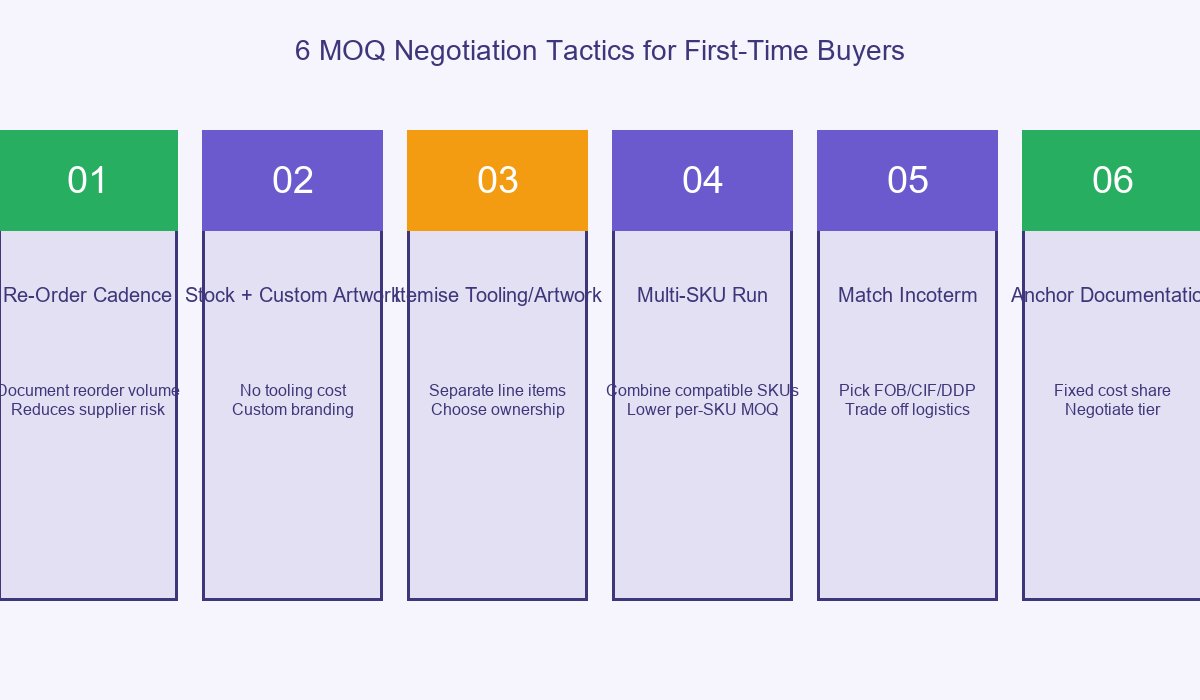
The first order is a validation step. The second and third orders are the supplier's actual revenue. KONGDY's commercial team reviews the reorder cadence before pricing the first order, and a documented cadence reduces the supplier's working capital exposure on the validation step.
2.2 How to Present a Re-Order Cadence (KONGDY)
The cadence should include the expected volume, the timing, and the channel mix. KONGDY accepts a written cadence as part of the multi-phase agreement structure, with the cadence commitment tied to the tier pricing stability.
2.3 What the First-Order MOQ Becomes (KONGDY)
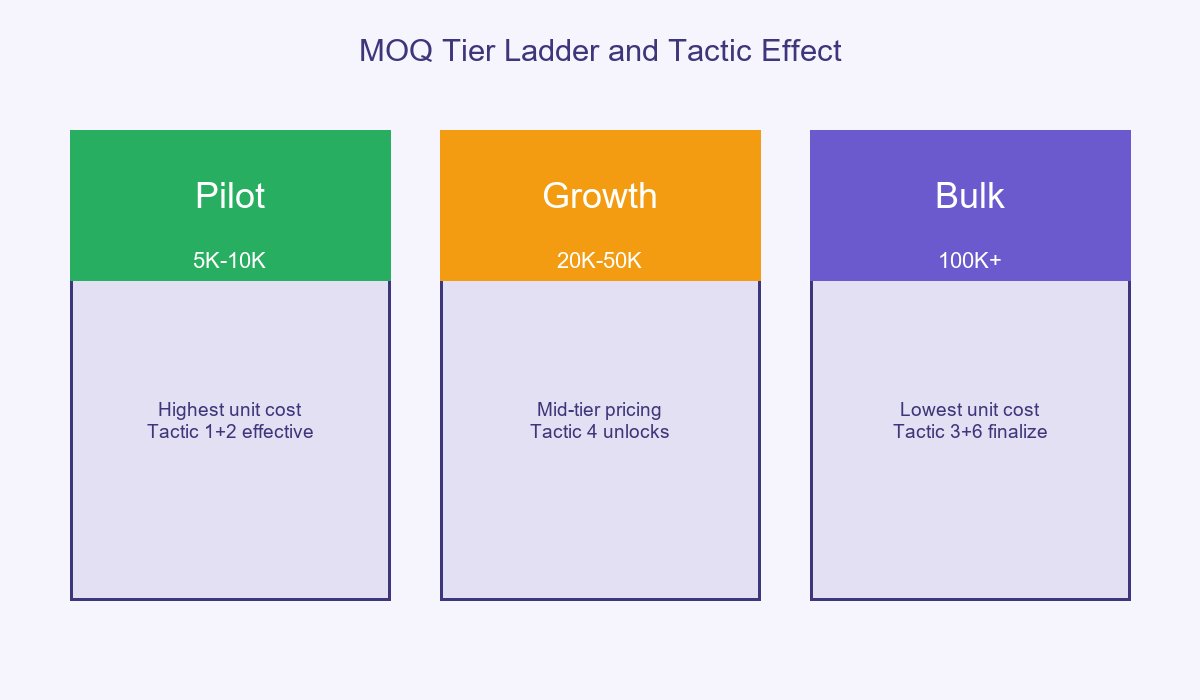
A documented cadence can move the first-order MOQ down by one tier (for example, from 20,000 to 10,000 pieces) without changing the supplier's economics. KONGDY's pilot container tier is designed for exactly this scenario.
3. Tactic 2: Specify the Standard Platform with Custom Artwork
A first-time buyer can preserve the pilot MOQ while still launching under the buyer's own brand by specifying a stock platform with custom artwork. This tactic saves the tooling cost without sacrificing the brand identity.
3.1 What a Stock Platform with Custom Artwork Looks Like (KONGDY)
The buyer chooses a validated platform from the supplier's catalogue and applies its own artwork, ingredient declaration, and GTIN. The supplier produces the run on standard lines and with standard packaging materials. KONGDY maintains a catalogue of validated patch platforms with documented actives, stability, and lab reports.
3.2 The MOQ Effect (KONGDY)
A stock platform with custom artwork removes the tooling setup from the cost structure, which lowers the minimum order quantity. KONGDY's stock platform tier supports 5,000 to 10,000 pieces with a 3 to 4 week lead time.
3.3 The OEM Pathway Forward (KONGDY)
Once the sell-through validates the format, the buyer can move to a custom formulation under the OEM program, using the validation data to support the development cost. KONGDY structures multi-phase agreements that credit part of the earlier development work toward the OEM project.
4. Tactic 3: Negotiate Tooling and Artwork as Separate Lines
When tooling is bundled into the unit price, the buyer pays for tooling amortization on every unit forever. When tooling is itemized as a separate line, the buyer can choose to own it, amortise it, or use the supplier's existing tooling.
4.1 Tooling Itemisation (KONGDY)
KONGDY lists tooling as a separate line in the quotation, with the option to own the dies, amortise the cost over a documented run, or use existing tooling. The itemised cost structure lets the buyer compare the total cost across formats and order volumes.
4.2 Artwork Setup as Separate Line (KONGDY)
Artwork setup is a one-time cost that supports the brand's artwork files, market-specific claims, and GTIN placement. KONGDY itemises the artwork setup separately so the buyer can budget for it as a setup expense rather than as a per-unit cost.
4.3 Documentation Setup as Separate Line (KONGDY)
Documentation setup covers the FDA registration, the EU CPSR preparation, the stability protocol, and the market-specific dossier. KONGDY itemises this separately so the buyer can compare the documentation cost across destinations.
5. Tactic 4: Combine Multiple SKUs in One Production Run
The single most effective way to lower the per-SKU MOQ is to combine multiple SKUs in one production run. A buyer with two or three related SKUs can reach the bulk production tier with minimum running volume.
5.1 Multi-SKU Production Run Mechanics (KONGDY)
KONGDY groups compatible SKUs into a single production run when the actives, the matrix, and the packaging are compatible. The buyer pays one tooling setup and one production run, but receives multiple SKUs at the bulk tier unit price.
5.2 Compatible SKU Criteria (KONGDY)
Compatible SKUs share the active profile, the matrix, the packaging format, and the destination market. KONGDY's commercial team reviews the SKU list before quotation to confirm the compatibility.
5.3 The MOQ Effect (KONGDY)
A multi-SKU run can lower the per-SKU MOQ by 50 percent or more, while keeping the unit cost at the bulk tier. KONGDY structures multi-SKU private label programs with shared documentation and artwork matrix.
6. Tactic 5: Match the Incoterm to the Buyer's Logistics Capability
The Incoterm choice changes the unit price, the working capital exposure, and the supplier's documentation responsibility. A first-time buyer who picks the wrong Incoterm absorbs costs that the manufacturer would have carried.
6.1 FOB, CIF, and DDP Comparison (KONGDY)
FOB is the lowest unit price but the highest brand-side logistics workload. CIF is a balanced structure with shared freight and customs responsibility. DDP is the highest unit price with the lowest operational workload. KONGDY quotes all three structures so the buyer can compare landed cost.
6.2 When to Choose Each Incoterm (KONGDY)
Choose FOB when the buyer has an in-house logistics team and a customs broker. Choose CIF when the buyer wants predictable freight cost but customs control. Choose DDP when the buyer does not have a customs broker or wants a single landed cost per unit. KONGDY's commercial team supports the choice with a written comparison.
6.3 Incoterm as a Negotiation Lever (KONGDY)
The Incoterm can be a negotiation lever when the buyer is willing to take more logistics responsibility. A buyer who accepts FOB can often negotiate a lower unit price than a buyer who requires DDP. KONGDY itemises the freight, insurance, and customs clearance lines separately so the lever is visible.
7. Tactic 6: Anchor on Documentation Cost, Not Unit Price
The MOQ negotiation usually anchors on the unit price. The better anchor is the total cost, which includes documentation, certification, and compliance cost. A buyer who anchors on documentation cost captures a hidden lever.
7.1 Why Documentation Cost Is a Hidden Lever (KONGDY)
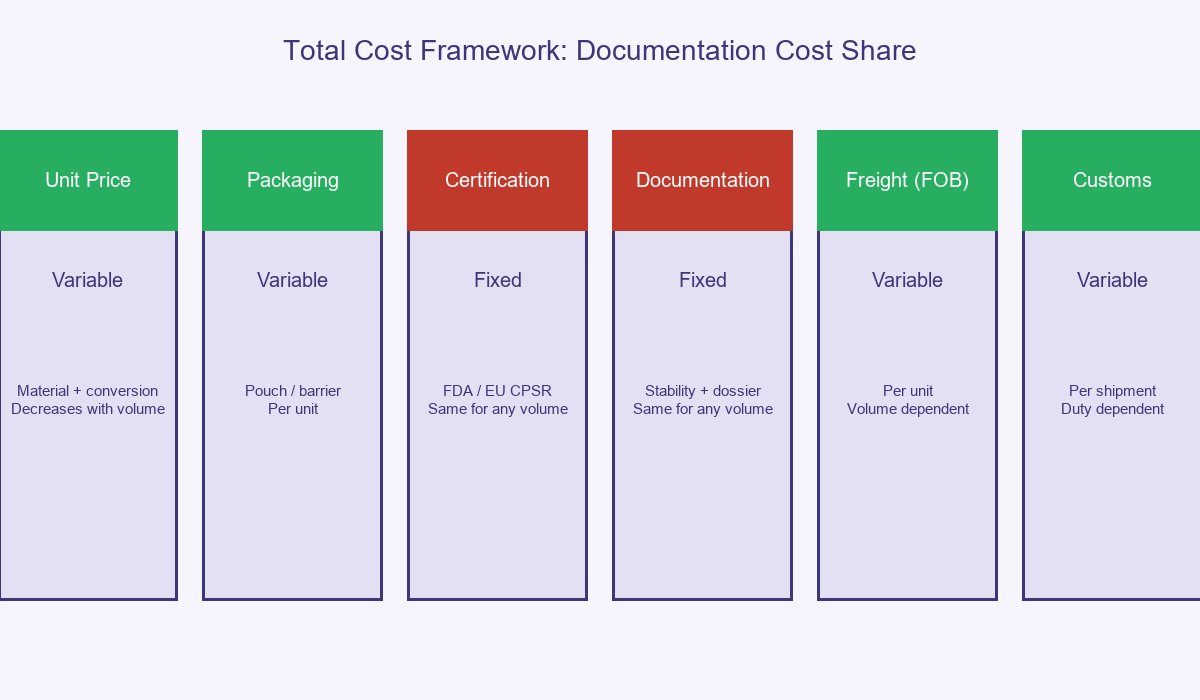
Documentation cost is the same for every unit in the order. A buyer who orders 5,000 units pays the same documentation cost as a buyer who orders 50,000 units. KONGDY's quotation separates the documentation cost from the unit price so the buyer can see the fixed cost share and negotiate accordingly.
7.2 Negotiating the Documentation Tier (KONGDY)
A buyer can ask the supplier to amortise the documentation cost across the first three orders, or to credit part of the documentation cost against the second order. KONGDY accepts both structures as part of the multi-phase agreement.
7.3 The Total Cost Framework (KONGDY)
The total cost framework includes unit price, packaging, documentation, certification, freight, and customs. KONGDY's commercial team supports the buyer with a written total cost comparison across MOQ tiers.
8. The Negotiation Sequence: Putting the Six Tactics Together
The six tactics above are most effective when they are deployed in sequence. A first-time buyer who leads with all six at once overwhelms the conversation. A buyer who leads with the reorder cadence, then specifies the stock platform, then itemises tooling, then multi-SKUs the run, then matches the Incoterm, then anchors on documentation cost, builds a defensible negotiation framework.
8.1 The First Email (KONGDY)
KONGDY's commercial team receives first-time buyer briefs in a standard format. The brief includes the destination market, the expected annual volume, the channel mix, the launch window, and the buyer's reorder cadence assumption. The first email sets the negotiation stage.
8.2 The Quotation Round (KONGDY)
KONGDY's quotation includes the unit price, the packaging cost, the documentation cost, the certification cost, the freight (FOB), and the tier pricing matrix. The quotation supports the negotiation with the data behind every line.
8.3 The Multi-Phase Agreement (KONGDY)
The multi-phase agreement structure supports the negotiation by tying the first-order MOQ to the reorder cadence, the documentation carry-forward, and the tier pricing stability. KONGDY writes the multi-phase agreement so the first-time buyer has a clear path from validation to commercial scale.
9. Common MOQ Negotiation Mistakes and How to Avoid Them
First-time buyers make four predictable mistakes in MOQ negotiation. The list below covers the most common ones and how KONGDY supports the buyer in avoiding them.
9.1 Anchoring on Unit Price Without Documentation Cost (KONGDY)
Anchoring on unit price without seeing the documentation cost is the most common mistake. KONGDY's quotation separates the documentation cost from the unit price so the buyer can see the total cost.
9.2 Failing to Specify the Re-Order Cadence (KONGDY)
Failing to specify the reorder cadence forfeits the most powerful lever. KONGDY's commercial team accepts a written cadence as part of the multi-phase agreement.
9.3 Buying at the Pilot Tier and Pricing as the Bulk Tier (KONGDY)
Setting the retail price against the bulk-tier margin when the order is at the pilot tier produces margin compression in the first quarter. KONGDY's tier pricing matrix ties the unit price to the actual tier.
9.4 Negotiating MOQ Without a Reorder Plan (KONGDY)
A lower minimum without a documented reorder plan is a one-time concession that will not repeat. KONGDY structures the multi-phase agreement so the concession is tied to the reorder commitment.
10. Conclusion: Locking the Right MOQ with KONGDY
MOQ negotiation is a working capital decision, not a bargaining exercise. The right outcome is a MOQ that funds demand validation at the lowest total cost, keeps unit economics acceptable after the reorder, and preserves enough cash to market the product. The six tactics above give a first-time buyer the framework to reach that outcome.
KONGDY supports first-time buyer negotiations with a documented multi-phase agreement structure, tier pricing matrix, itemised tooling and artwork lines, multi-SKU program capability, and Incoterm flexibility. The facility is ISO 22716 GMP certified, FDA registered, and operates in-house analytical, microbiological, and stability laboratories.
Request a tiered MOQ quotation and a multi-phase agreement draft within 24 hours — share your target market, expected annual volume, channel mix, and the six tactics you intend to use, and the commercial team will return a quotation structured around your reorder commitment, the multi-SKU program, and the documentation carry-forward across markets.
Book a factory audit or live video tour at KONGDY's ISO 22716 facility to review the production line, QC laboratory, and stability chamber room, and request the multi-phase agreement template for your first-order brief. Brand owners planning a launch within two quarters can reserve a pilot batch slot while documentation and artwork work run in parallel, so the first container ships on the planned retail date.

