Side-by-side comparison of cooling gel patches and heat patches for B2B brand owners, importers, and distributors. Quantifies sensory mechanism, unit economics, supply chain structure, regulatory pathway, and channel fit so buyers can choose the right format for their audience, working capital cycle, and destination market.
1. Why B2B Buyers Compare Cooling Gel Patch and Heat Patch
Cooling gel patch vs heat patch is now a standard line item in the patch sourcing brief because both formats serve the same consumer base while operating on opposite sensory mechanisms. A cooling gel patch delivers a cooling sensation through menthol or eucalyptus actives in a gel matrix that adheres to contoured body areas. A heat patch delivers warming through iron-powder self-heating with optional herbal extracts. The two formats overlap in their audience and retail placement, but they diverge on positioning, regulatory pathway, and wholesale margin.
For a brand owner, importer, distributor, or pharmacy chain buyer, the format choice changes unit cost, packaging cost, certification scope, return rate, and the marketing story that supports the product. A cooling gel patch brand carries a sports-recovery, post-exercise, or active-lifestyle positioning. A heat patch brand carries a chronic-pain, winter-warmth, or everyday-comfort positioning. KONGDY has manufactured consumer health patches for 36 years and supplies both formats under the same ISO 22716 GMP certified facility, FDA registration, and in-house analytical, microbiological, and stability laboratories.
This comparison sets out five differences that B2B buyers should quantify before allocating budget, together with a procurement decision framework, the questions to put to a contract manufacturer that offers both formats, and a wholesale margin comparison.
2. Difference 1: Sensory Mechanism and Consumer Promise
The sensory mechanism is the root cause of every other difference in this comparison. It determines what the consumer feels, how the product is positioned, and what claims the brand can substantiate.
2.1 Cooling Gel Patch Mechanism (KONGDY)
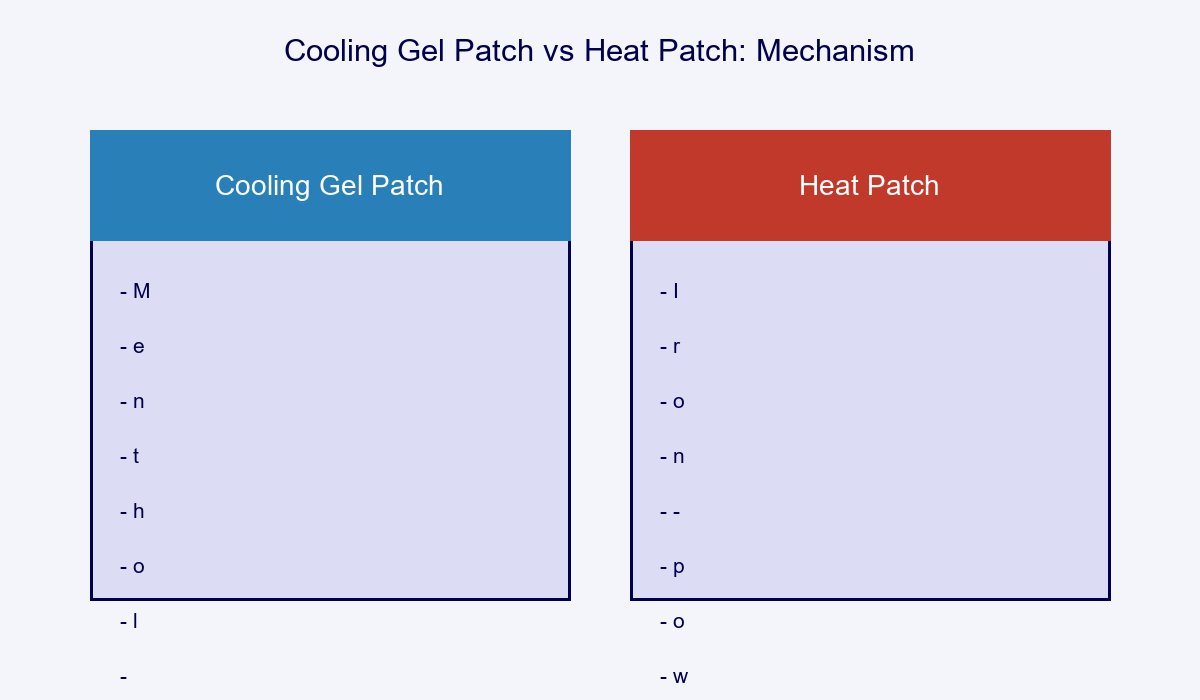
A cooling gel patch uses menthol or eucalyptus active in a hydrogel matrix that adheres to the skin. The cooling sensation activates within minutes and sustains 4 to 8 hours depending on the active load, the gel matrix, and the wear scenario. KONGDY documents the active concentration, the gel integrity, the cooling onset, and the wear time for every cooling gel SKU.
2.2 Heat Patch Mechanism (KONGDY)
A heat patch uses iron-powder self-heating oxidation to deliver 40 to 50 degrees Celsius of consistent heat for 6 to 12 hours without any electronics. KONGDY supplies heat patches with documented heating curves, peel strength, and wear time, plus optional herbal extracts that add traditional medicine positioning.
2.3 Sensation Onset and Daypart Positioning (KONGDY)
Cooling gel patches deliver a fast sensation onset and a moderate wear time, which suits active-lifestyle positioning, daytime wear, and post-exercise recovery. Heat patches deliver a slower onset and a longer wear time, which suits chronic-pain positioning, evening wear, and overnight use. KONGDY's commercial team supports the brand with format-specific positioning guides and claim substantiation documentation.
2.4 Claim Substantiation Requirements (KONGDY)
Cooling gel patch claims rely on documented menthol or eucalyptus concentration and skin sensitivity testing. Heat patch claims rely on documented heating curve, stability under shipping conditions, and skin sensitivity testing. KONGDY prepares the substantiation package for each format and supports the destination market's claim review with the underlying data.
3. Difference 2: Unit Economics and Total Cost of Ownership
Comparing sticker price between formats is misleading. Total cost of ownership includes landed cost, packaging, returns, and the working capital tied up in inventory.
3.1 Active and Material Cost (KONGDY)
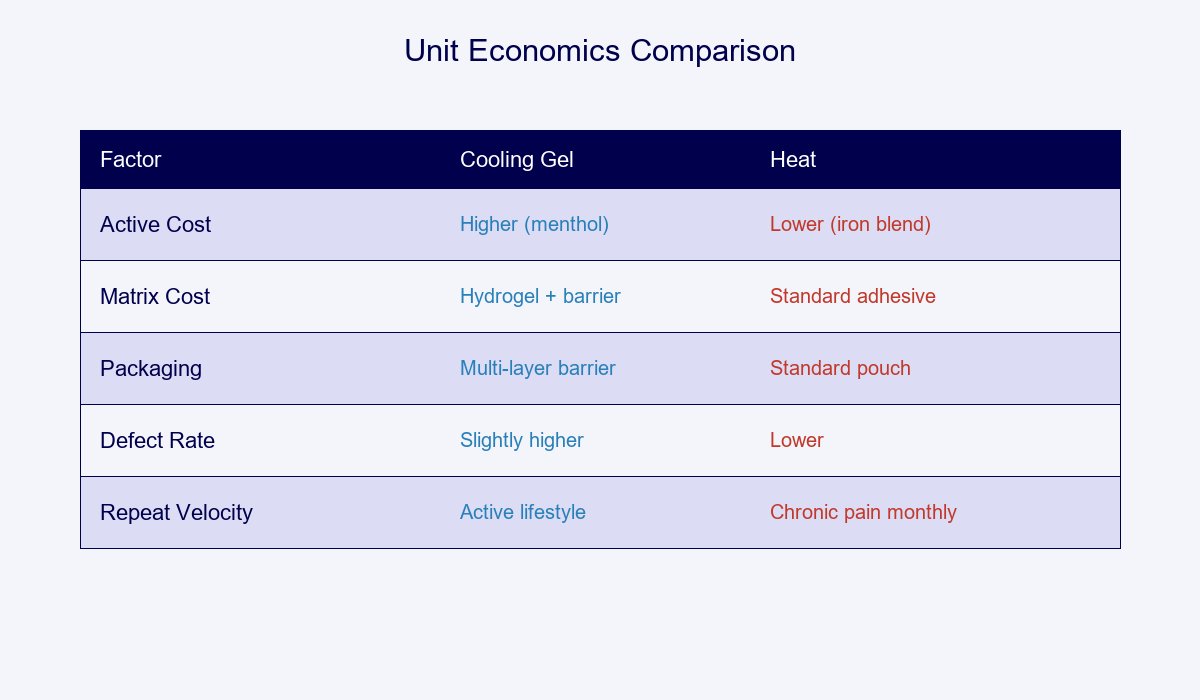
Menthol and eucalyptus actives for cooling gel patches cost more than the iron-powder blend for heat patches, because the gel matrix adds barrier packaging and analytical specification cost. KONGDY breaks each quotation into active cost, matrix cost, packaging cost, and testing cost so the buyer can see exactly where the unit cost difference originates.
3.2 Packaging Cost Difference (KONGDY)
Cooling gel patches require barrier packaging that prevents gel migration and moisture loss during shelf storage, which adds a multi-layer barrier film and a foil seal. Heat patches use standard pouch packaging without the gel-specific barrier requirement. KONGDY's packaging matrix matches the format to the destination market's storage conditions.
3.3 Returns and Warranty (KONGDY)
Both formats are consumable, so the return channel is limited to defect claims rather than warranty repair. Cooling gel patches carry a slightly higher defect exposure because the gel matrix is sensitive to temperature. KONGDY resolves defect claims with batch-level traceability for both formats.
3.4 Repeat Purchase and Customer Lifetime Value (KONGDY)
Both formats support subscription commerce and repeat purchase. Cooling gel patches align with the sports-recovery consumer who reorders after a workout cycle; heat patches align with the chronic-pain consumer who reorders on a monthly cycle. KONGDY supports both channels with re-order cadence documentation and inventory turn modeling.
4. Difference 3: Manufacturing and Supply Chain Structure
The supply chain behind each format determines how easily a brand can customize, how fast it can scale, and how exposed it is to a single component.
4.1 Component Sourcing (KONGDY)
Cooling gel patches require hydrogel matrix sourcing, menthol or eucalyptus active sourcing, and barrier film sourcing. Heat patches require iron-powder blend sourcing, adhesive backing sourcing, and standard pouch sourcing. KONGDY maintains multiple qualified sources for each component and validates each source against the documented specification.
4.2 Customization Depth (KONGDY)
Cooling gel patch customization extends to active concentration, gel matrix selection, patch geometry, and packaging. Heat patch customization extends to heating curve, herbal extract addition, patch geometry, and packaging. KONGDY develops both formats with custom geometry in 10 to 15 working days and validates any new active concentration with an accelerated stability check.
4.3 Scalability and Lead Time (KONGDY)
Both formats scale through converting and filling capacity, which is linear and predictable. Cooling gel patches require additional analytical work because the gel matrix is sensitive to storage conditions. KONGDY publishes a stage-by-stage lead time schedule for each format, with stock platforms shipping in 3 to 4 weeks and custom formulations requiring 8 to 12 weeks including stability work.
4.4 Quality Control Points (KONGDY)
Both formats require QC at raw material qualification, in-process control, finished product testing, stability, and packaging integrity. KONGDY runs the same QC chain for both formats and retains QC records for 7 years minimum with electronic indexing.
5. Difference 4: Regulatory Pathway and Compliance Burden
Regulatory scope affects launch timeline, documentation cost, and the number of markets a brand can enter with one product file.
5.1 Cosmetic Classification for Both Formats (KONGDY)
Both cooling gel and heat patches are typically classified as cosmetic or general consumer health products in most destination markets. The difference lies in the supporting analytical documentation: gel-specific stability data versus heat-specific temperature stability data.
5.2 Microbiological Specification (KONGDY)
The gel matrix in cooling patches requires additional microbiological screening at stability pull-points because the gel can support microbial growth if contaminated. Heat patches have a lower microbiological exposure because the dry matrix does not support microbial growth. KONGDY specifies microbiological limits against the destination market's regulation for both formats.
5.3 Multi-Market Launch Efficiency (KONGDY)
Both dossiers carry across markets with market-specific additions. The cooling gel dossier adds gel-specific stability data per climate zone; the heat patch dossier adds heating curve data per climate zone. KONGDY supports multi-market launch with format-specific documentation templates.
5.4 Stability Testing at Multiple Storage Conditions (KONGDY)
Gel matrices are sensitive to temperature and humidity. KONGDY generates cooling gel stability data at 25, 30, and 40 degrees Celsius to support tropical, subtropical, and temperate destination markets. Heat patches follow the same protocol with heating curve verification at each pull-point.
6. Difference 5: Channel Fit and Wholesale Margin
The two formats behave differently on retail placement and wholesale margin. A format that fits one channel well may require adaptation in another.
6.1 Pharmacy and Mass Retail Channel Fit (KONGDY)
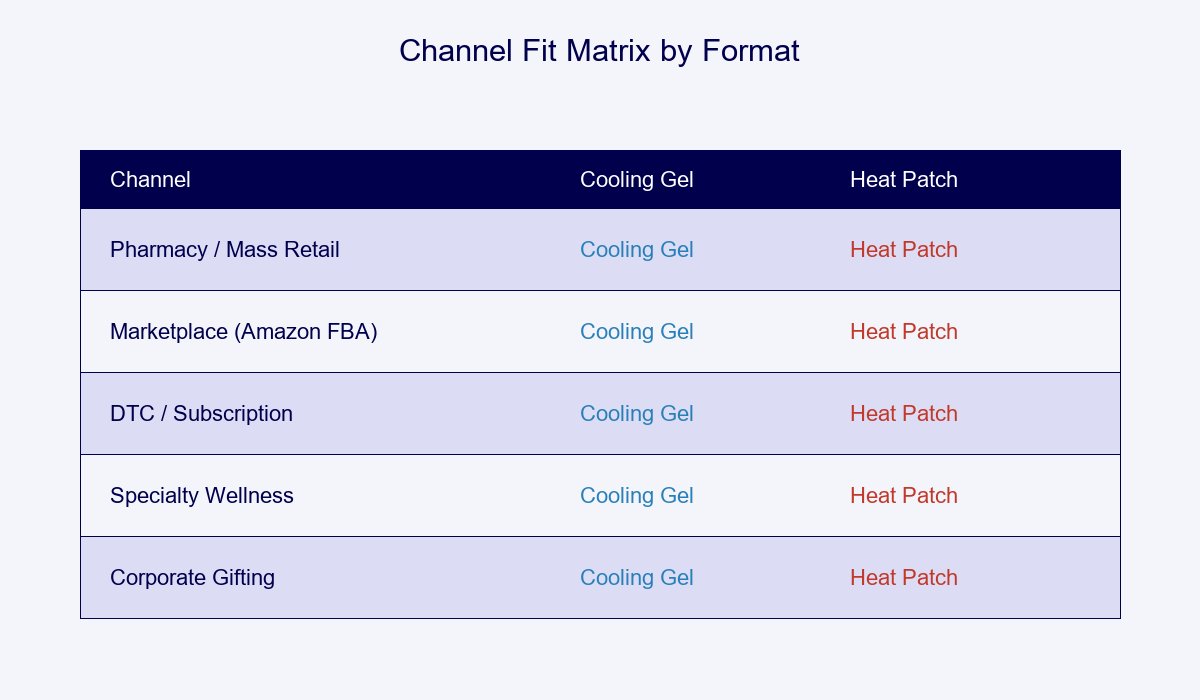
Pharmacy chains and mass retail buyers accept both formats. Cooling gel patches align with sports-recovery and wellness aisle placement; heat patches align with pain-relief and winter-care placement. KONGDY supports both formats with retail-ready packaging configurations and GTIN registration.
6.2 Marketplace and DTC Channel Fit (KONGDY)
Marketplace listings and DTC e-commerce channels carry both without restriction, but the marketing story differs: cooling gel patches sell with workout imagery and athlete recommendations; heat patches sell with winter imagery and chronic-pain testimonials. KONGDY's artwork review process supports both formats against the destination market's labelling rules.
6.3 Specialty Wellness and Corporate Gifting (KONGDY)
Specialty wellness retailers and corporate gifting programs carry both formats. Cooling gel patches support active-lifestyle corporate wellness programs; heat patches support winter-care and seasonal gifting programs. KONGDY supplies multi-format private label programs with shared documentation and artwork matrix.
6.4 Wholesale Margin Comparison (KONGDY)
Cooling gel patches typically command a 10 to 20 percent higher unit price than heat patches because of the gel matrix and the active load. Heat patches support a higher volume per container at a lower unit price. KONGDY's quotation breaks the unit price, packaging cost, certification cost, and documentation cost separately so the distributor can compare the wholesale margin profile.
7. Procurement Decision Framework: Cooling Gel Patch vs Heat Patch
The comparison collapses into a short set of questions. Answering them with numbers rather than impressions produces a defensible sourcing decision.
7.1 Define the Consumer Use Case First (KONGDY)
If the consumer needs fast sensation onset for active-lifestyle positioning, the cooling gel patch fits. If the consumer needs sustained warming for chronic-pain positioning, the heat patch fits. KONGDY's commercial team reviews the consumer profile and recommends the format that matches the destination market's retail demand.
7.2 Model Landed Cost and Repeat Velocity (KONGDY)
Build a simple model with landed cost per unit, retail price, expected monthly consumption per customer, return rate, and inventory turns. The cooling gel patch usually commands a higher retail price but carries a higher defect exposure; the heat patch supports a faster inventory turn at a lower unit price. KONGDY provides both formats in the quotation so the model uses real numbers.
7.3 Audit the Compliance Burden per Market (KONGDY)
List the certification documents each format requires for every market you intend to enter within 24 months, then compare documentation cost and timeline. Both formats share most of the dossier scope; the gel matrix adds microbiological stability data at climate-zone pull-points. KONGDY prepares market-specific dossiers for both formats.
7.4 Test at Low Volume Before Committing (KONGDY)
Validate demand with a pilot order rather than a first-order forecast. KONGDY offers starting MOQ options and stock platforms that let a brand validate sensation, adhesion, and packaging acceptance before funding a custom formulation.
7.5 Interview the Manufacturer on Both Formats (KONGDY)
A manufacturer that produces only one format will recommend only that format. Ask about tooling, in-house converting capability, laboratory scope, stability chambers, change control, and audit access, then verify the answers against certificates and a factory tour. KONGDY manufactures cooling gel and heat patches in the same ISO 22716 GMP certified facility with in-house laboratories.
8. Common Sourcing Mistakes and How to Avoid Them
Most format selection mistakes trace back to four decisions made too early. The list below covers the most common ones and how KONGDY supports the brand in avoiding them.
8.1 Choosing Format Without Validating the Channel (KONGDY)
Choosing a format before validating the retail channel produces a working capital investment in the wrong format. KONGDY supports the brand with format-specific market intelligence and a pilot container that lets the brand validate the format before committing to a commercial run.
8.2 Underestimating Stability Documentation Cost (KONGDY)
Gel matrix stability data is a meaningful share of the ICPC documentation cost, not a courtesy deliverable. KONGDY separates the questionnaire into platform-level and market-specific lines so the brand can budget accurately.
8.3 Specifying Custom Before Validating the Market (KONGDY)
Custom formulation and bespoke geometry are wasted if the SKU does not match the channel's best-selling configuration. KONGDY recommends launching on a stock platform and switching to custom after sell-through validates the format.
8.4 Re-Order Trigger Without a Sell-Through Threshold (KONGDY)
A reorder decision triggered by calendar rather than sell-through data can produce oversupply or stockout. KONGDY supports the brand with weekly inventory snapshots and re-order recommendations based on the velocity trend.
9. Cost Comparison: What Each Format Actually Costs
The cost comparison is the final gate between sourcing decisions. A clear breakdown lets the brand compare the formats against the target working capital.
9.1 Unit Price Component (KONGDY)
KONGDY's quotation breaks the unit price into active cost, matrix cost, packaging cost, and testing cost. The cooling gel format carries a higher active cost and matrix cost; the heat format carries a lower active cost and standard packaging.
9.2 Certification and Documentation Cost (KONGDY)
Both formats share the ISO 22716 GMP cost share, the FDA registration cost share, and the EU CPSR preparation cost. The gel format adds gel-specific stability testing cost; the heat format adds heating curve verification cost.
9.3 Freight and Inland Transport Cost (KONGDY)
Freight and customs depend on the Incoterm. KONGDY quotes FOB, CIF, and DDP for both formats so the brand can compare landed cost structures.
9.4 Inventory Carrying Cost (KONGDY)
Inventory carrying cost depends on the working capital cycle. KONGDY's commercial team supports the brand with a working capital model that projects the inventory carrying cost by month for each format.
10. Conclusion: Choosing Between Cooling Gel Patch and Heat Patch for Your Brand
Cooling gel patch vs heat patch is not a question of which product is better; it is a question of which positioning matches the brand's channel, capital, and growth plan. Cooling gel patches win on fast sensation onset, active-lifestyle positioning, and a premium retail price. Heat patches win on longer wear time, chronic-pain positioning, and a faster inventory turn. A brand can run both formats, using the cooling gel patch as the flagship SKU and the heat patch as the seasonal SKU, provided the supply chain supports each format's compliance and inventory profile.
KONGDY has manufactured consumer health patches for 36 years and operates ISO 22716 GMP certified production with FDA registration, EU CPSR preparation, in-house analytical, microbiological, and stability laboratories, multi-format capability, and documented change control. OEM, ODM, and private label programs are available for traditional medicine brands, sports recovery labels, cross-border e-commerce sellers, distributors, and pharmacy chains.
Request a side-by-side quotation and a free sample within 24 hours — share your target market, channel mix, expected annual volume, and product format preference, and the commercial team will return a landed cost comparison for both formats, tiered bulk pricing, a lead time schedule, and the certification roadmap for each market you plan to enter.
Book a factory audit or live video tour at KONGDY's ISO 22716 facility to review converting lines, the QC laboratory, and the stability chamber room, and download the cooling gel and heat patch comparison catalogue to see validated platforms, packaging configurations, and custom formulation options. Brand owners planning a launch this quarter can reserve a pilot batch slot while artwork and stability work run in parallel, so the first order ships on the planned retail date.

