Seven red flags B2B buyers should look for when vetting massage patch manufacturers. Covers auditable quality systems, sample-versus-production variability, stability data for the destination climate, complete certificates of analysis, microbiological specification, packaging compliance, and documented change control, with a pre-shipment checklist for first-time importers.
1. Why Massage Patch QC Red Flags Decide a New Brand's First Shipment
The first shipment of a massage patch line sets the trajectory of a wellness brand. If the shipment clears customs, lands in the channel, and performs for consumers, the brand wins the right to invest in marketing, expand the SKU range, and negotiate repeat orders at better pricing. If it is held at customs, rejected on retail onboarding, or returned by consumers, the brand burns its working capital and credibility before it has a chance to learn what sells. QC red flags are the early signals that warn a buyer that the first shipment is at risk.
KONGDY has manufactured consumer health patches for 36 years under ISO 22716 GMP certification and supplies OEM, ODM, and private label programs to wellness brands, sports recovery labels, pharmacy chains, and e-commerce sellers. The facility runs FDA cosmetic establishment registration, in-house analytical, microbiological, and stability laboratories, and documents every batch with a finished product certificate of analysis. The seven red flags below are the ones KONGDY sees most often in supplier evaluations, and they apply whether the patch is self-heating, magnetic, transdermal gel, or vibration.
This guide walks through the red flags a B2B buyer should look for, the questions that expose each one, the documentation that resolves it, and the procurement actions that prevent a first shipment from failing on a quality issue the brand could have caught earlier.
2. Red Flag 1: No Auditable Quality System
A supplier that cannot produce a written quality manual, an ISO certificate, or a recent audit report is signalling that the QC system is informal, undocumented, and inconsistent across batches. Documentation is what makes a quality system auditable; without it the buyer has no way to verify that the next shipment will match the sample.
2.1 What "Auditable" Means at KONGDY (KONGDY)
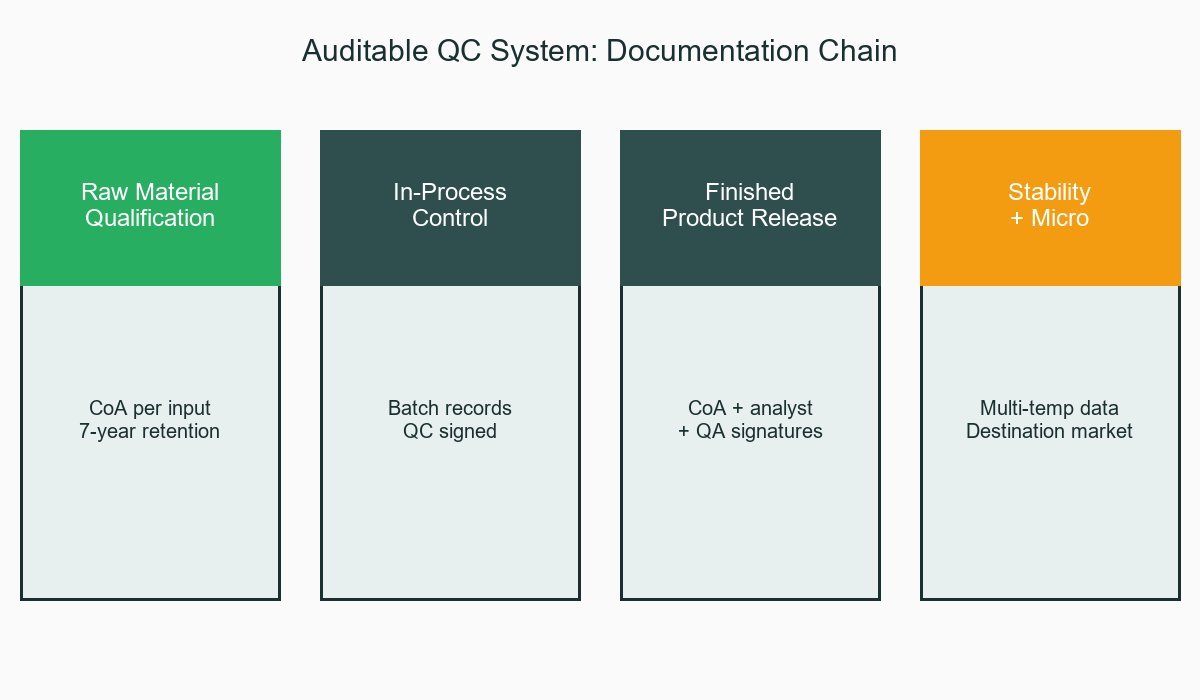
An auditable QC system documents every decision, test, and result in writing. KONGDY issues a QC manual summary under NDA, retains raw material qualification records for a minimum of 7 years, and shares redacted ISO 22716 surveillance audit reports with qualified buyers. The auditable chain runs from raw material qualification to in-process control to finished product release.
2.2 Question to Put to the Supplier (KONGDY)
Ask for the QC manual structure, the ISO 22716 certificate number, and the date of the most recent surveillance audit. Verify the certificate number against the issuing body's public registry rather than accepting a PDF at face value. KONGDY provides verifiable numbers and accepts reverse checks by qualified buyers.
2.3 Procurement Action (KONGDY)
If the supplier cannot answer the question in writing within 48 hours, treat it as an early red flag and broaden the search. A clear documentation gap today usually widens into a customs documentation gap during the first shipment.
3. Red Flag 2: Batch Variability Across Samples and Production Runs
If two consecutive samples differ in adhesion, scent, colour, heat output, or feel, the production line is not under statistical control. Sample-stage variation is the most reliable predictor of shipment-stage failure.
3.1 What to Test Between Sample and Production Run (KONGDY)
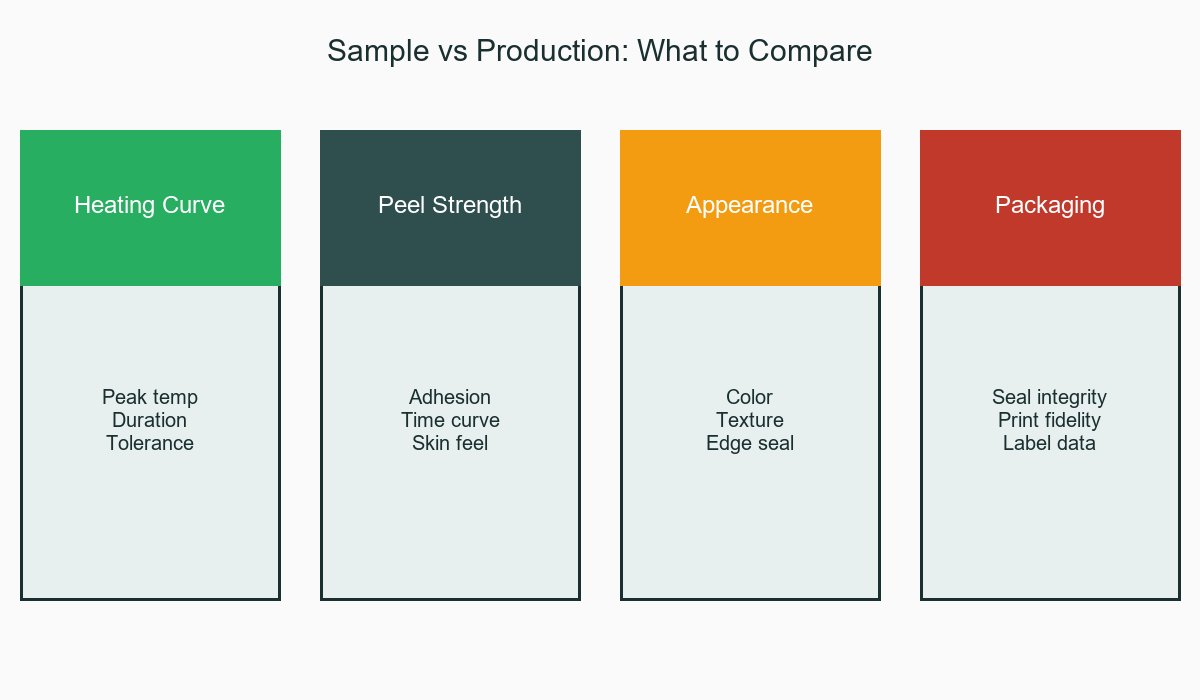
Request at least two production samples taken from separate batches rather than two samples from the same pilot run. Compare heating curve, peel strength, appearance, and packaging integrity between the samples. KONGDY documents the production samples with batch number, manufacturing date, and finished product certificate of analysis for the audit trail.
3.2 Question to Put to the Supplier (KONGDY)
Ask whether the supplier tracks process capability indices (Cpk) on heating output, adhesive peel strength, and packaging seal integrity. KONGDY records in-process control results and shares Cpk summaries for the buyer's reference SKU.
3.3 Procurement Action (KONGDY)
Specify a sample acceptance protocol in the quotation: three production samples from different batches, each with its own finished product CoA, and a documented comparison report signed by the buyer's QA team.
4. Red Flag 3: Missing or Incomplete Stability Data for the Destination Climate
Stability data generated at one temperature and humidity does not predict behaviour in a different climate. A supplier who cannot produce stability data for the destination market is implicitly asking the buyer to validate the product in the field.
4.1 What Adequate Stability Data Looks Like (KONGDY)
Adequate stability data covers the exact formula and packaging format, runs at multiple storage conditions including 30 degrees Celsius / 65 percent RH and 40 degrees Celsius / 75 percent RH for tropical destinations, and assigns a shelf life against the chosen storage condition. KONGDY maintains stability chambers qualified and calibrated to ICH conditions and assigns shelf life from the supporting data.
4.2 Question to Put to the Supplier (KONGDY)
Ask for the stability protocol, the storage conditions tested, and the assigned shelf life for the destination market. If the supplier only has ambient storage data, ask whether they can generate accelerated data before shipment or commit to a shorter shelf life claim.
4.3 Procurement Action (KONGDY)
Match the stability data scope to the destination market's storage reality, not to the supplier's convenience. KONGDY assigns shelf life from the climate condition the shipment will actually experience.
5. Red Flag 4: Inconsistent or Missing Certificates of Analysis
A finished product CoA that does not list every test in the agreed specification, or that omits the analyst and QA release signatures, is unusable at customs and at retail onboarding. A signature gap is the single most common cause of customs hold on a first shipment.
5.1 What a Complete CoA Looks Like (KONGDY)
A complete finished product CoA covers batch number, manufacturing date, expiry date, analytical test results against the specification, microbiological test results, fill weight verification, and signatures from the analyst and the QA release authority. KONGDY signs and issues a CoA for every finished batch and includes the documents in the pre-shipment inspection report.
5.2 Question to Put to the Supplier (KONGDY)
Ask for a sample CoA from a recent batch and confirm whether the analyst signature, the QA release signature, and the destination market's specification are all present. If any element is missing in the sample, it will be missing in the shipment.
5.3 Procurement Action (KONGDY)
Write the CoA content requirements into the supply agreement as a deliverable, not as a courtesy. KONGDY confirms the CoA format before the first production run and locks the format for the duration of the program.
6. Red Flags 5-7: Microbiological, Documentation, and Change Control Gaps
Three more red flags surface during the documentation audit. Each is fixable before the first shipment but expensive to fix after.
6.1 Red Flag 5: Microbiological Specification Mismatch with Destination Regulation (KONGDY)
The microbiological specification in the CoA is more lenient than the destination market's regulatory limit, or the supplier is using a generic cosmetic limit rather than the destination's specific one. KONGDY specifies microbiological limits against the destination market's regulation for every shipment, and the finished product CoA records the test method, the result, and the analyst signature.
6.2 Red Flag 6: Packaging Component Compliance Gap (KONGDY)
Packaging components meet food-contact regulation in one market but not the destination market, or the supplier does not have a written compliance statement per component. KONGDY maintains packaging component compliance statements for every component in use and provides the statement for the destination market before printing.
6.3 Red Flag 7: No Documented Change Control or Notification Window (KONGDY)
The supplier changes formulation, raw material, or process without written customer notification, or has no change control procedure at all. KONGDY operates a documented change control system with a written customer notification window before any change takes effect, so the brand can plan artwork updates and customs re-filing in advance.
7. How to Vet a Massage Patch Supplier Before You Commit
Red flags are easier to prevent than to recover from. A structured vetting process replaces brochure claims with verifiable evidence in five steps.
7.1 Step 1: Verify Legal Entity and Manufacturing Status (KONGDY)
Confirm the legal entity, business licence, registered address, and whether the supplier manufactures or trades. A trading company that outsources production cannot control batch records or audit outcomes. KONGDY manufactures in its own ISO 22716 certified facility and welcomes buyer verification of entity and site.
7.2 Step 2: Request Certificates and Audit Reports (KONGDY)
Request ISO 22716 certification, FDA registration documents, third-party test reports, and the most recent customer audit summary. Verify certificate numbers against the issuing body's public registry rather than accepting a PDF at face value. KONGDY provides certificate numbers for independent verification and shares redacted audit reports with qualified buyers.
7.3 Step 3: Run a Sample Test in the Actual Channel (KONGDY)
Test the sample the way the customer will use it: wear it during exercise, in humidity, over a workday, and after shelf storage. Track adhesion, heat duration, irritation, and packaging integrity. KONGDY supports structured sample evaluation with a scoring sheet and adjusts the specification based on documented feedback.
7.4 Step 4: Schedule a Factory Audit or Live Video Tour (KONGDY)
A factory audit or a live video walkthrough of the production floor, warehouse, and laboratory confirms that the operation behind the quotation exists at the claimed scale. KONGDY hosts factory audits and scheduled video tours covering the production line, QC laboratory, stability chamber room, and finished goods warehouse.
7.5 Step 5: Test Responsiveness on Technical Questions (KONGDY)
Ask two or three technical questions with quantitative answers expected, such as the peak temperature tolerance of the heating layer or the peel strength specification of the adhesive. Fast, specific answers indicate an engineering team; vague answers indicate a sales intermediary. KONGDY answers technical questions in writing with specification values and test method references.
8. Pre-Shipment Documentation Checklist for First-Time Importers
The list below covers the documentation the importer should verify before signing the supply agreement. Each item is verifiable in writing and together they define whether the QC system is auditable on the first shipment.
8.1 Request the QC Manual (KONGDY)
The QC manual documents the manufacturer's quality system at a procedural level, covering every QC step from raw material receipt to shipment release. KONGDY provides the QC manual under NDA to qualified importers.
8.2 Verify the Most Recent Audit Reports (KONGDY)
Audit reports from the most recent ISO 22716 surveillance audit, FDA inspection (where applicable), and customer audits document the quality system's current state. KONGDY shares redacted audit reports with qualified importers.
8.3 Confirm Recall and Complaint Procedures (KONGDY)
A documented recall procedure and complaint handling process is required for any market with post-market surveillance obligations. KONGDY maintains a written recall procedure, complaint handling log, and mock recall records refreshed annually.
8.4 Check the Document Retention Policy (KONGDY)
Document retention must align with the destination market's record-keeping requirements, typically 5 to 7 years after the last shipment. KONGDY retains QC records for 7 years minimum with electronic indexing.
8.5 Verify Change Control Procedure (KONGDY)
A change control procedure documents how formulation, raw material, packaging, or process changes are handled, including customer notification windows. KONGDY operates a documented change control system with written customer notification before any change takes effect.
9. Common Documentation Failures and How to Avoid Them
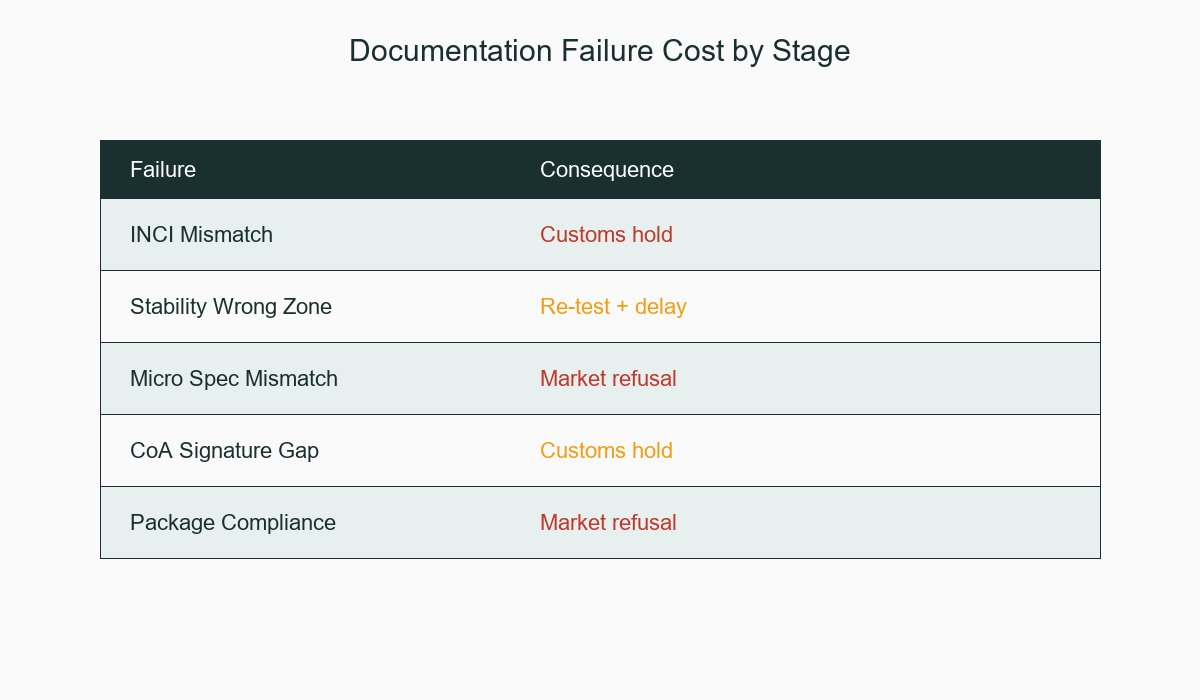
First-time importers commonly fail customs, retail onboarding, or post-market surveillance because of documentation issues that could have been prevented with a pre-shipment audit. The failures below are the most frequent.
9.1 Mismatched INCI Declaration (KONGDY)
The INCI declaration on the label does not match the formulation in the QC records. The mismatch is often a minor naming difference but customs authorities treat it as misdeclaration. KONGDY's QC team verifies that the label INCI declaration matches the formula record before shipment release.
9.2 Stability Data Missing for the Destination Climate Zone (KONGDY)
Stability data exists but only covers temperate storage, while the shipment is destined for tropical climate where storage temperature exceeds 30 degrees Celsius. KONGDY generates stability data at multiple storage conditions including 30 degrees Celsius / 65 percent RH and 40 degrees Celsius / 75 percent RH for tropical market shipments.
9.3 Microbiological Specification Mismatch (KONGDY)
The microbiological specification in the finished product CoA is more lenient than the destination market's regulatory limit. KONGDY specifies microbiological limits against the destination market's regulation, not against a generic cosmetic limit.
9.4 Missing or Incomplete CoA Signatures (KONGDY)
The finished product CoA is missing the QA release signature or the analyst signature, which means customs cannot verify release and may hold the shipment. KONGDY's QC system requires both analyst and QA release signatures before a CoA is issued.
9.5 Packaging Component Compliance Gap (KONGDY)
Packaging components meet food-contact regulations in one market but not the destination market. KONGDY maintains packaging component compliance statements per destination market.
10. Conclusion: Treat QC Red Flags as a Sourcing Filter, Not a Risk
Red flags in a massage patch supplier are a filtering tool, not a future risk to manage. Each red flag that the brand catches before the first order is one less customs hold, one less retail onboarding rejection, and one less consumer complaint in the first six months of operation. The brands that win the category are the ones that treat QC documentation as a sourcing filter and reject suppliers whose systems fail the verification.
KONGDY's documentation-first QC system covers raw material qualification, in-process control, finished product testing, stability, microbiological, packaging compliance, customs, and post-market documentation for FDA cosmetic, EU CPSR, and Asia market pathways. The system is ISO 22716 GMP certified, FDA registered, and audited annually by accredited bodies, with 7-year document retention and electronic batch record indexing.
Request KONGDY's massage patch QC documentation pack within 48 hours — the commercial team will return the QC manual summary, redacted ISO 22716 audit report, finished product CoA template, stability protocol summary, packaging compliance statement, and the destination market's HS code and tariff classification for your shipment.
Schedule a factory audit or live video tour at KONGDY's ISO 22716 facility to review the production line, QC laboratory, and stability chamber room, and request a free sample to validate adhesion, heat duration, and packaging acceptance in your channel. Brand owners planning a launch within two quarters can additionally reserve a pilot batch slot while QC documentation and stability work are completed in parallel, so sample approval and customs preparation finish on the same timeline.

