Tiered massage patch MOQ guide for new OEM brands, importers, and Amazon FBA sellers. Explains pilot, growth, and bulk minimums, what drives the quote, how to negotiate MOQ without buying unsellable volume, and how to plan lead time against cash flow and reorder data.
1. Why Massage Patch MOQ Decides Whether a New OEM Brand Can Launch
The massage patch MOQ conversation is where most first-time brand owners discover whether their launch plan is realistic. A supplier that quotes a low price at an impossible minimum order quantity, or a premium price at a volume the brand cannot fund, is not a commercial partner. The minimum order quantity is the single number that determines how much working capital sits in inventory before a single unit sells, and it sets the floor on unit cost that the brand has to recover through either paid acquisition or margin.
Massage patch manufacturing is a converting and filling process, so MOQ exists for a physical reason. Every production run consumes line time, tooling setup, adhesive batch preparation, functional material procurement, and a quality control release cycle. The cost of setting up a run does not shrink with order size, which is why unit price falls as volume rises and why a manufacturer cannot profitably run 500 pieces of a custom formulation.
KONGDY has manufactured consumer health patches for 36 years and structures massage patch MOQ in tiers, so a new brand can start at a pilot quantity, validate demand in its actual channel, and step down unit cost as reorder volume grows. The facility is ISO 22716 GMP certified with in-house analytical, microbiological, and stability laboratories. This guide explains how tiered MOQ structures work, what drives the quote, what each tier delivers, how to negotiate MOQ without buying volume you cannot sell, and how to plan the reorder cycle against cash flow.
2. How Tiered MOQ Structures Work in Patch Manufacturing
A tiered structure replaces a single minimum with a ladder of minimums, each paired with a price and a set of inclusions. The ladder is what makes a category accessible to new brands without giving away margin to large ones.
2.1 Why a Single Flat MOQ Fails Both Sides (KONGDY)
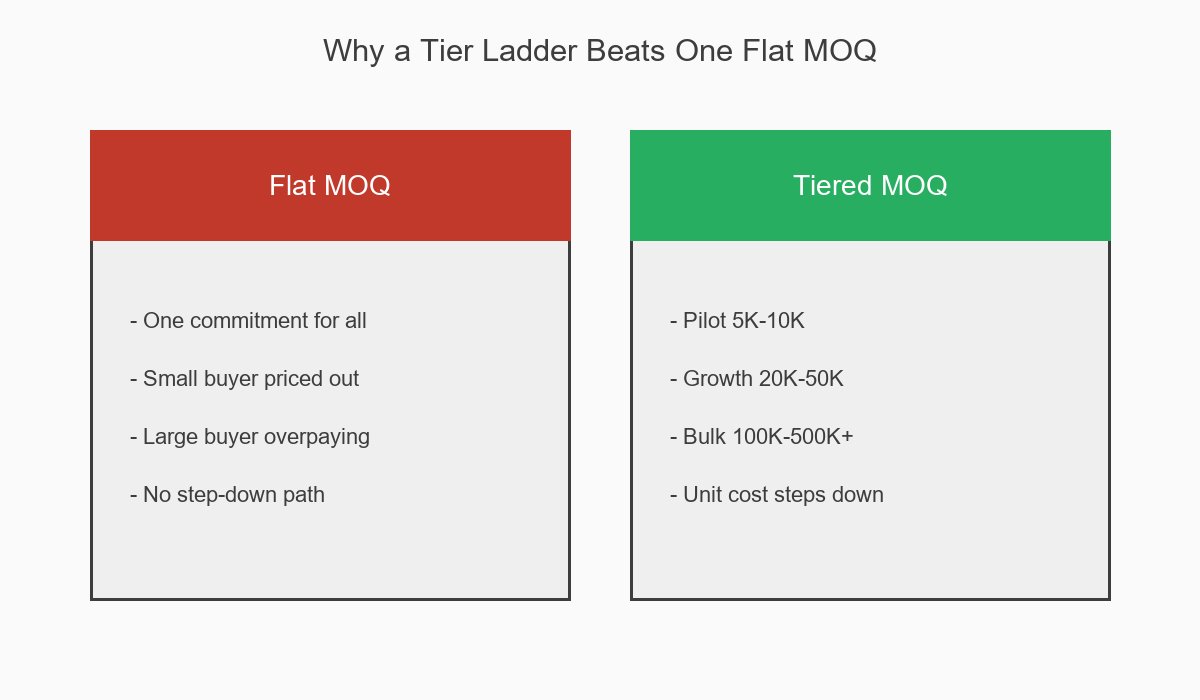
A flat minimum forces every buyer into the same commitment regardless of channel maturity. A brand owner launching on Amazon needs enough units to test listings and run initial advertising; a distributor with an established pharmacy network needs container volume. One number cannot serve both, so the supplier either loses the small buyer or overprices the large one. KONGDY quotes tiered minimums instead of a single figure so each buyer commits only to the volume its channel can absorb.
2.2 Tier Ladder: Pilot, Growth, Bulk (KONGDY)
The ladder typically runs from a pilot tier of 5,000 to 10,000 pieces, through a growth tier of 20,000 to 50,000 pieces, to a bulk tier of 100,000 pieces and beyond. Each step down in unit cost is tied to a step up in tooling commitment, material purchase, and line scheduling priority. KONGDY publishes the ladder in the quotation so a brand owner can model unit economics at each level before choosing an entry point.
2.3 What Changes Between Tiers (KONGDY)
Moving up a tier changes four things: unit price, tooling ownership, packaging print method, and scheduling priority. The pilot tier usually uses existing tooling and standard print; the growth tier unlocks dedicated artwork plates; the bulk tier allows custom dies, premium barrier packaging, and reserved line time. KONGDY documents these differences line by line in the quotation.
2.4 Where Certification and Testing Cost Sits (KONGDY)
Testing and certification are volume independent, so their cost per unit falls as the order grows. A pilot order absorbs the same third-party testing, stability verification, and documentation work as a bulk order across fewer units. KONGDY separates testing and compliance lines from material and conversion lines in every quotation so the buyer can see exactly which costs economy of scale reduces.
3. What Actually Drives a Massage Patch MOQ Quote
Understanding cost drivers before the negotiation prevents the two most common errors: assuming price falls linearly with volume, and assuming the quoted minimum is negotiable in isolation from the specification.
3.1 Mechanism, Dimension, and Material (KONGDY)
Self-heating patches, magnetic patches, transdermal gel patches, and vibration patches have different material costs, so their minimums differ. Patch area drives raw material consumption directly, and a neck patch consumes less material than a lower-back patch at the same thickness. KONGDY quotes MOQ by mechanism and dimension rather than publishing one generic minimum for the whole category.
3.2 Adhesive System and Backing Film (KONGDY)
Adhesive grade and backing film selection change both cost and minimum, because specialty adhesives are purchased in larger roll quantities. A high-flexibility backing for shoulder placement costs more per square metre and carries a higher material minimum than a standard film. KONGDY specifies the adhesive system in the quotation so the buyer can trade performance against minimum if needed.
3.3 Packaging Format and Print Method (KONGDY)
Pouch versus carton, foil versus coated film, label versus direct print, and standard plate versus digital print all change the tooling component of the minimum. Digital print supports low minimums with modest unit penalty; gravure print requires a high minimum but a much lower unit cost. KONGDY quotes both options so the brand can choose the crossover point that matches its launch plan.
3.4 Tooling and Artwork Setup (KONGDY)
Die cutting, fill or assembly fixtures, and print plates are one-time costs amortised across the order. At a pilot volume the amortised share is significant; at bulk volume it becomes negligible. KONGDY lists tooling as a separate line and states whether the brand owns the tooling and can transfer it.
3.5 Testing, Certification, and Documentation (KONGDY)
Third-party testing, safety documentation, and market-specific compliance preparation are driven by the destination market, not by order size, so they form a fixed cost block. KONGDY prepares FDA registration data, EU CPSR documentation, and Asia market testing coordination as a defined deliverable, which lets the brand compare total landed cost rather than unit price alone.
4. Tier 1: Pilot Order (5,000 to 10,000 Pieces)
The pilot tier exists to answer one question with real market data: does this product sell in my channel at my price? Everything in the tier is designed to keep the answer affordable.
4.1 What the Pilot Tier Includes (KONGDY)
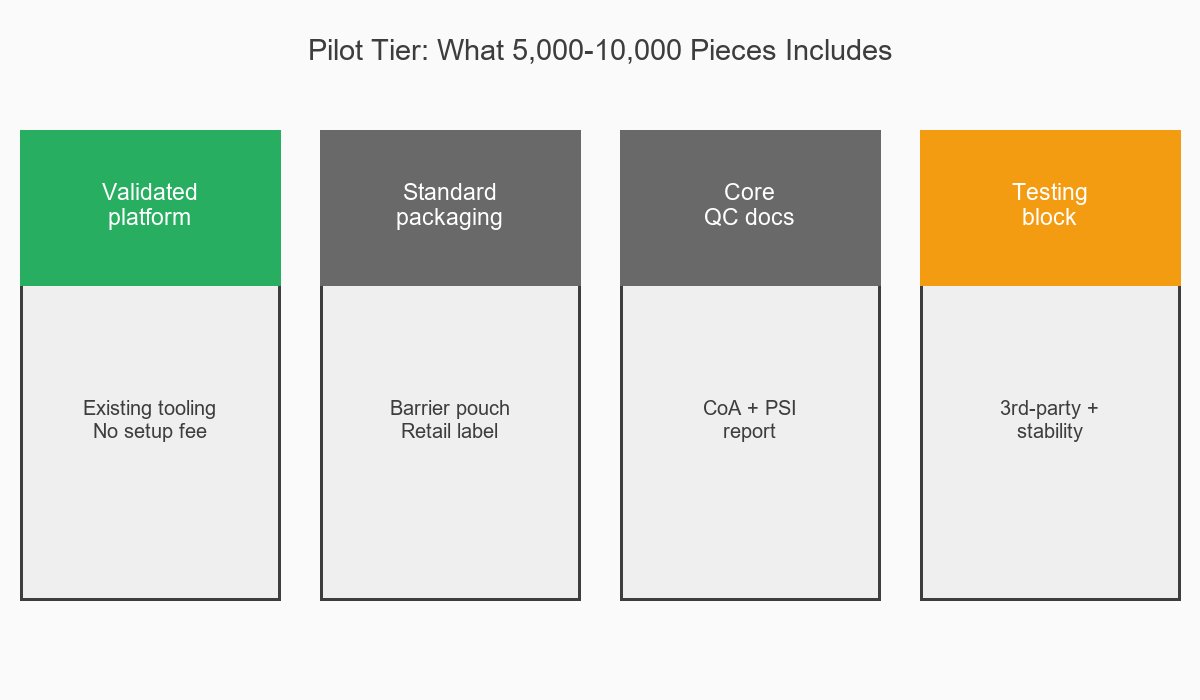
The pilot tier uses validated platforms and existing tooling, standard barrier packaging, core documentation, and a single production run with standard QC release. KONGDY ships pilot orders with a finished product certificate of analysis and a pre-shipment inspection report so the brand can onboard retail or marketplace channels without waiting for a second run.
4.2 Why Pilot Volume Is the Right First Order (KONGDY)
Pilot volume funds the launch without locking up cash in inventory that may not match the channel's best-selling configuration. It produces enough units for a listing test, a sample program, and the first reorder decision, which is the information the brand actually needs. A first order sized to demand data rather than to a discount target keeps working capital available for advertising.
4.3 What the Pilot Tier Does Not Include (KONGDY)
Custom formulation development, bespoke dies, premium print, and reserved line capacity sit above the pilot tier, because each requires a commitment the supplier cannot recover at launch volume. KONGDY states this explicitly in the quotation instead of quietly pricing the pilot at a level that subsidises features the buyer never receives.
4.4 Cost Structure at Pilot Volume (KONGDY)
At pilot volume the amortised tooling and fixed testing share dominate the unit cost, so the buyer should evaluate the tier as a validation expense rather than a production price. KONGDY shows the same quotation at pilot, growth, and bulk volume side by side, so the expected unit cost after the reorder is visible before the first order is signed.
5. Tier 2: Growth Order (20,000 to 50,000 Pieces)
The growth tier is where the economics of the category start working. Unit cost steps down, tooling is largely amortised, and packaging options open up.
5.1 Unit Cost Step-Down Mechanics (KONGDY)
At growth volume the fixed block is spread across enough units that material and conversion become the dominant cost lines, which is where supplier efficiency actually shows. KONGDY applies the growth tier price to the whole quantity, not only to units above the threshold, so the buyer receives the benefit on the entire order.
5.2 Packaging and Print Upgrade Options (KONGDY)
The growth tier supports dedicated print plates, higher barrier film, multi-count configurations, display cartons, and market-specific labelling. These upgrades raise the per-unit cost but improve shelf presence and shelf life, which usually matters more than a few cents of unit price in pharmacy and mass retail. KONGDY proofs artwork and confirms barcode placement before printing at this tier.
5.3 Custom Formulation and Geometry (KONGDY)
Custom dies, custom geometries, and adjusted active concentrations become commercially sensible at growth volume because development cost is amortised across a larger run. KONGDY develops custom geometries in 10 to 15 working days and validates any new concentration with an accelerated stability check before production approval.
5.4 Planning the Growth Order Timing (KONGDY)
The growth order should be placed against sell-through data, not against a calendar target, and it should be sized to cover lead time plus a safety stock. KONGDY issues a stage-by-stage lead time schedule with the quotation, so the brand can back-calculate the order date from the retail or marketplace commitment.
6. Tier 3: Bulk Program (100,000 to 500,000+ Pieces)
The bulk tier is a supply agreement rather than a purchase order. It converts a transactional relationship into scheduling certainty for both sides.
6.1 Dedicated Tooling and Reserved Capacity (KONGDY)
At bulk volume the brand can own dedicated dies, dedicated artwork plates, and reserved production capacity on defined dates. Reserved capacity matters because it protects the reorder schedule during peak seasons when converting lines are booked months ahead. KONGDY confirms reserved slots in writing and records them in the production plan.
6.2 Best Unit Cost and Incoterms Flexibility (KONGDY)
Bulk pricing reflects the lowest per-unit material and conversion cost, and it is the only tier where Incoterm flexibility materially changes landed cost. KONGDY quotes FOB, CIF, and DDP at bulk volume so the buyer can compare landed cost structures against its own freight and clearance capability.
6.3 Private Label and Multi-SKU Programs (KONGDY)
Bulk buying supports several SKUs within one program, which is how pharmacy chains and distributors build a patch range rather than a single item. Multi-SKU programs share testing and documentation across the range, so the fixed cost block spreads further. KONGDY structures multi-SKU private label programs with shared artwork templates and consistent labelling conventions.
6.4 Payment Terms at Bulk Volume (KONGDY)
Payment structures typically move from deposit-heavy at pilot to balanced terms at bulk, with negotiated terms available for repeat buyers and established relationships. KONGDY agrees payment structure in writing with the tier pricing so the cash flow profile is known before production is scheduled.
7. MOQ Negotiation: What Buyers Can Trade Instead of Volume
Volume is not the only currency in a MOQ negotiation. Suppliers accept other forms of commitment because they reduce the risk of idle line time and uncertain material procurement.
7.1 Commit to a Reorder Schedule (KONGDY)
A written reorder schedule with defined quantities and dates lets the supplier plan material purchase and line allocation, which is worth more than a single larger order. KONGDY offers entry MOQ reductions when a buyer commits to a documented reorder cadence, because the second and third orders cost the supplier less to secure.
7.2 Accept Standard Platform or Standard Packaging (KONGDY)
Choosing a validated platform with existing tooling and standard packaging removes setup cost from the equation, which is the largest single reason a minimum is high. KONGDY keeps a catalogue of validated platforms that carry a lower starting minimum than a fully custom specification.
7.3 Combine SKUs in One Run (KONGDY)
Several small SKUs with the same base materials and packaging family can be produced in one run, reaching the minimum in aggregate rather than per SKU. This is the standard technique for launching a range on a limited budget. KONGDY groups compatible SKUs into a single production run and quotes the combined minimum.
7.4 Pay Tooling Separately (KONGDY)
Removing tooling from the per-unit calculation and paying it as a separate line lowers the entry minimum while keeping the tooling in the buyer's ownership. KONGDY itemises tooling separately so the buyer can decide whether to own it, amortise it, or use existing tooling to reach a lower minimum.
7.5 Share Demand Data and Channel Plans (KONGDY)
Suppliers price risk, and a buyer who shares sell-through data, channel mix, and forecast logic is demonstrably lower risk than one who asks for a discount without evidence. KONGDY reviews channel plans with buyers and matches the entry tier to the demonstrated demand profile instead of applying a blanket rule.
8. MOQ, Lead Time, and Cash Flow: Building a Reorder Plan
MOQ is only half of the working capital equation. The other half is lead time, because inventory must cover demand from order placement to delivery.
8.1 Lead Time by Tier (KONGDY)
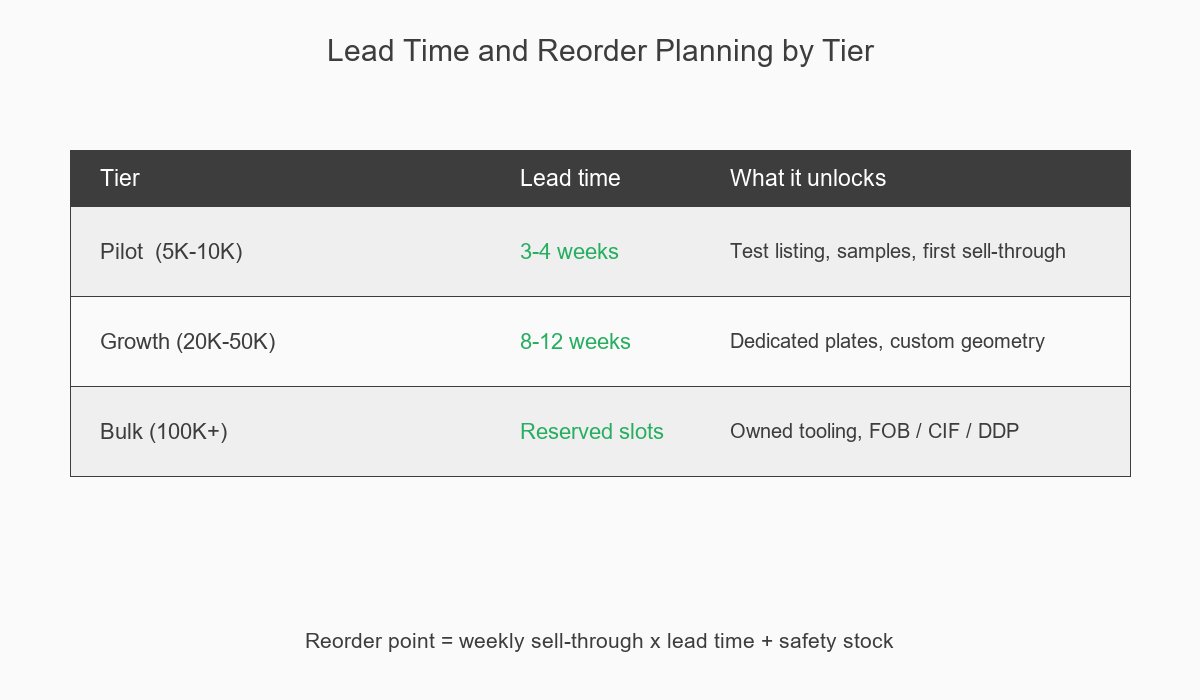
Stock platforms at pilot volume typically ship 3 to 4 weeks after artwork approval, while custom formulations at growth and bulk volume require 8 to 12 weeks including stability work. KONGDY publishes the stage-by-stage schedule with every quotation so the buyer can plan the retail or marketplace commitment around a confirmed delivery window.
8.2 Safety Stock and Reorder Point (KONGDY)
The reorder point should be calculated from average weekly sell-through, lead time in weeks, and a safety margin for demand variance and inspection delays. A pilot order funds the first test; the reorder decision should be triggered by data, not by the calendar. KONGDY supports buyers with a reorder planning worksheet that converts sell-through into an order date.
8.3 Cash Conversion and Tier Selection (KONGDY)
Paying more per unit at pilot volume can still produce a better cash conversion cycle than paying less per unit on inventory that takes two quarters to sell. KONGDY quotes three tiers side by side precisely so the buyer can compare unit cost against inventory turn rather than optimising price alone.
8.4 Scaling Without Over-Commitment (KONGDY)
The healthy pattern is pilot, then growth, then bulk, with each step justified by sell-through. Skipping a tier means funding inventory that demand has not yet validated, which is the most common cause of failure among first-time brand owners. KONGDY structures agreements that allow the tier to be stepped up on the next order without renegotiating the specification.
9. Common Massage Patch MOQ Mistakes and How to Avoid Them
Most MOQ problems are avoidable and originate in three decisions: choosing the wrong entry tier, quoting the wrong specification, and forgetting the fixed cost block.
9.1 Buying Volume to Chase Unit Price (KONGDY)
Ordering a full container to reach the bulk tier before demand is validated ties up capital in inventory that may need rework or repackaging for a different market. Size the first order to the validation need and let sell-through justify the next tier. KONGDY quotes the ladder so this trade-off is visible before the commitment.
9.2 Specifying Custom Before Testing Standard (KONGDY)
Custom formulation and bespoke tooling raise the minimum before the brand knows whether the product sells. Launch on a validated KONGDY platform, then move to a custom specification once reorder volume justifies the development cost, using the multi-phase structure that credits part of the earlier development work.
9.3 Forgetting Testing and Compliance Cost (KONGDY)
Third-party testing, stability verification, and market documentation are fixed costs that must be counted in the first order budget regardless of unit price. KONGDY lists them explicitly in the quotation so the buyer sees total cost rather than unit cost in isolation.
9.4 Ignoring Currency and Freight Volatility (KONGDY)
Freight rates and exchange rates move, and a quotation is only as good as its validity period and Incoterm. KONGDY states quotation validity, Incoterm, and the currency basis in writing so the buyer can budget with a known exposure rather than an estimate.
9.5 Negotiating MOQ Without a Reorder Plan (KONGDY)
A lower minimum without a documented reorder plan is a one-time concession that will not repeat. Bring sell-through assumptions, channel mix, and a proposed reorder cadence to the discussion so the supplier can price the relationship rather than the first order.
10. Conclusion: Locking the Right MOQ Tier with KONGDY
The massage patch MOQ decision is a working capital decision, not a bargaining exercise. The right tier is the one that funds demand validation at the lowest total cost, keeps unit economics acceptable after the reorder, and preserves enough cash to market the product. A tiered structure exists so the brand can take the first step on evidence rather than on forecast, then step down unit cost as volume justifies it.
KONGDY quotes massage patch programs in tiers from a pilot run of 5,000 pieces through growth and bulk volume, with self-heating, magnetic, transdermal gel, and vibration mechanisms available in the same program. Production runs under ISO 22716 GMP certification with in-house analytical, microbiological, and stability laboratories, and every shipment leaves with a certificate of analysis and a pre-shipment inspection report. OEM, ODM, and private label programs are structured so a brand can begin on a validated platform and move to a custom formulation on a later order.
Request a tiered MOQ quotation and a free massage patch sample within 24 hours — send your target market, mechanism preference, expected monthly sell-through, packaging direction, and proposed reorder cadence, and the commercial team will return pilot, growth, and bulk pricing side by side with a stage-by-stage lead time schedule and the compliance roadmap for your destination market.
Ask about entry-tier MOQ options for a first order by sharing your channel plan and demand assumptions, and book a factory audit or live video tour at KONGDY's ISO 22716 certified facility to review converting lines, the QC laboratory, and the stability chamber room. Brand owners planning a launch within two quarters can reserve a pilot slot while artwork and documentation work run in parallel, so the first order ships on the planned retail date.

