Herbal plaster QC documentation guide for first-time traditional medicine brand buyers: 6 pre-shipment checks covering finished product CoA, stability protocol, microbiological specification, heavy metal screening, packaging compliance, and market-specific registration. Supports compliance-first sourcing and customs clearance across North America, Europe, and Asia.
1. Why Herbal Plaster QC Documentation Is the First Line of Defence
Herbal plaster QC documentation is the difference between a successful first order and a customs hold or retail onboarding rejection. The patch itself is a relatively simple product to manufacture; the documentation file is what proves the product's compliance, stability, and safety to the destination market's regulatory authority and to the retail buyer. A traditional medicine brand that submits a patch without the right documentation is accepting risk it cannot manage.
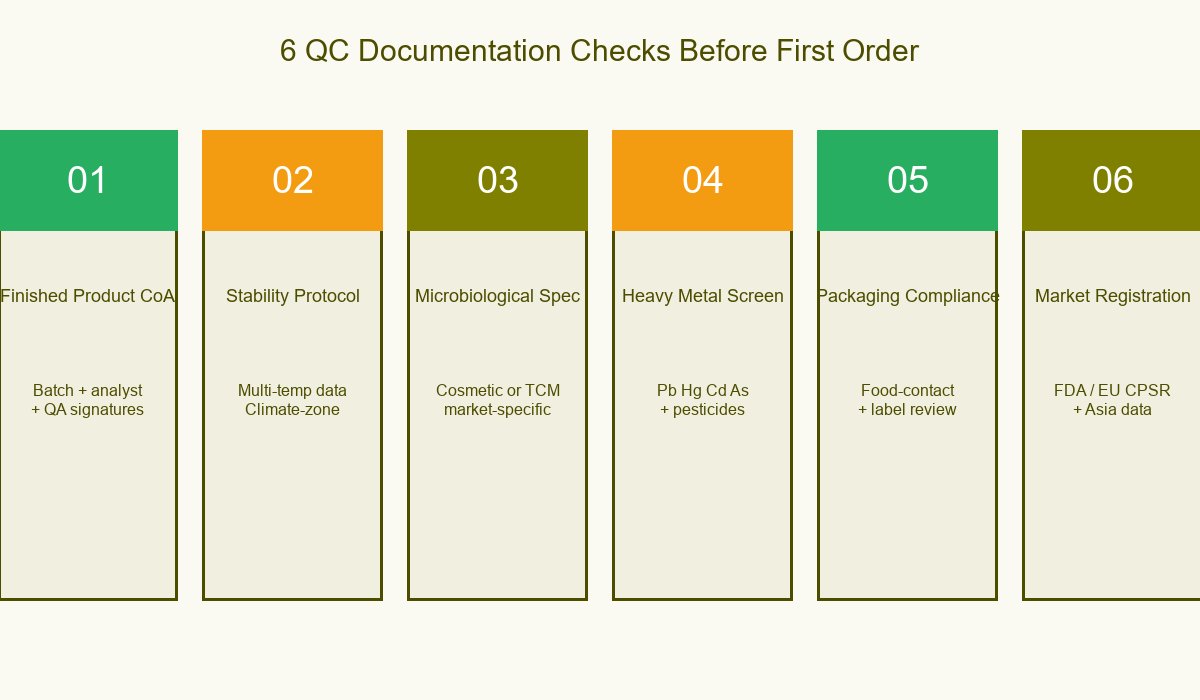
QC documentation covers six distinct deliverables: the finished product certificate of analysis, the stability protocol summary, the microbiological specification, the heavy metal screening, the packaging compliance statement, and the market-specific registration data. Each deliverable supports a specific claim the brand makes about the product. KONGDY has manufactured consumer health patches for 36 years and supplies QC documentation for herbal plaster programs across North America, Europe, and Asia. The facility is ISO 22716 GMP certified, FDA registered, and operates in-house analytical, microbiological, and stability laboratories.
This guide walks through the six documentation checks a traditional medicine brand should complete before issuing a first purchase order. The checks are ordered by their impact on customs clearance, retail onboarding, and post-market surveillance.
2. Check 1: Finished Product Certificate of Analysis
The finished product certificate of analysis is the document the customs broker, the retail buyer, and the post-market surveillance authority all reference to verify the product's release status. An incomplete CoA is the most common cause of customs hold.
2.1 Required CoA Elements (KONGDY)
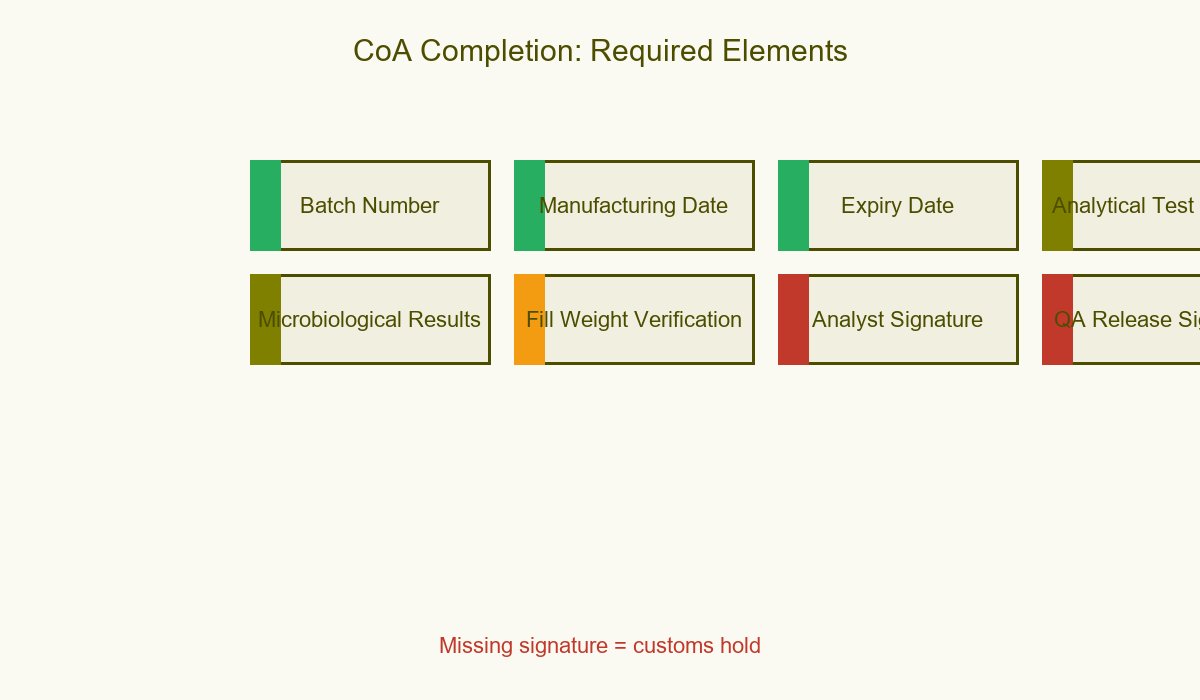
A complete CoA includes the batch number, the manufacturing date, the expiry date, the analytical test results against the specification, the microbiological test results, the fill weight verification, and the signatures of the analyst and the QA release authority. KONGDY's CoA format is documented in the quotation and locked for the duration of the program.
2.2 CoA Signature Gap (KONGDY)
A CoA missing either the analyst signature or the QA release signature cannot be used at customs clearance. KONGDY's quality system requires both signatures before a CoA is issued, and the documentation file is reviewed annually for completeness.
2.3 CoA Per Batch Versus Per Program (KONGDY)
Each batch has its own CoA, but the analytical method, the specification, and the test schedule are documented at the program level. KONGDY's program-level documentation carries forward across batches and across markets, while the batch-level CoA documents the specific batch.
3. Check 2: Stability Protocol and Shelf Life Assignment
Stability data justifies the shelf life statement on the label and the destination market's regulatory authority accepts the data as part of the registration file. Missing or mismatched stability data is the second most common cause of customs hold.
3.1 Stability Storage Conditions (KONGDY)
KONGDY maintains stability chambers qualified and calibrated to ICH conditions, with storage at 25 degrees Celsius / 60 percent RH for temperate markets, 30 degrees Celsius / 65 percent RH for subtropical markets, and 40 degrees Celsius / 75 percent RH for tropical markets. The stability data is generated at multiple storage conditions to support multi-market distribution.
3.2 Shelf Life Assignment per Market (KONGDY)
The shelf life is assigned based on the stability data for the destination market's storage condition. A herbal plaster shipped to a tropical market receives a shorter shelf life than the same product shipped to a temperate market, and the assignment is documented in the CoA and the registration file.
3.3 Roll-Forward Stability Data (KONGDY)
KONGDY rolls stability observations forward year over year for repeat programs. The shelf life assignment is reaffirmed each year, and any stability drift triggers a customer notification before the next production run.
4. Check 3: Microbiological Specification Match
The microbiological specification on the CoA must match the destination market's regulatory limit. A specification that is more lenient than the destination's limit triggers a regulatory hold at customs.
4.1 Cosmetic Versus Traditional Medicine Classification (KONGDY)
Herbal plasters classified as cosmetic products follow the destination market's cosmetic microbiological limits. Herbal plasters classified as traditional medicine follow the destination market's traditional medicine or natural health regulation. KONGDY specifies the microbiological limit against the destination market's regulation, not against a generic cosmetic limit.
4.2 Microbiological Test Methods (KONGDY)
KONGDY runs microbiological testing in-house against documented test methods: total aerobic microbial count, yeast and mould count, and specified pathogen screening. The test methods are referenced in the CoA and the market-specific dossier.
4.3 Stability Microbiological Pull-Points (KONGDY)
Microbiological limits are verified at stability pull-points, not just at finished product release. KONGDY's stability protocol includes microbiological testing at the start, middle, and end of the stability program, with results documented in the stability data file.
5. Check 4: Heavy Metal Screening and Contaminant Testing
Heavy metal screening and contaminant testing protect the consumer from ingredient-level contamination and protect the brand from regulatory action. The destination market's authority may require specific contaminant limits depending on the active profile.
5.1 Heavy Metal Screening Scope (KONGDY)
KONGDY coordinates heavy metal screening with accredited partners for lead, mercury, cadmium, and arsenic against the destination market's contaminant limits. The screening covers the herbal extract actives and the plaster matrix, with results documented in the compliance dossier.
5.2 TCM Active Contaminant Considerations (KONGDY)
Traditional medicine actives sourced from herbal extracts require additional contaminant screening for pesticide residues and microbial contaminants. KONGDY's sourcing standards include documentation from the active supplier, with the screening results reviewed before the active enters the production line.
5.3 Contaminant Testing Cadence (KONGDY)
Contaminant testing is part of the finished product CoA and the stability protocol. KONGDY tests contaminants at finished product release and at stability pull-points, with the test cadence documented in the quality agreement.
6. Check 5: Packaging Compliance Statement per Destination Market
The packaging compliance statement documents that the primary packaging (pouch, tin, tube), the secondary packaging (carton), and the printed labels meet the destination market's packaging regulation. Missing packaging compliance is the third most common cause of retail onboarding delay.
5.1 Primary Packaging Compliance (KONGDY)
KONGDY maintains packaging component compliance statements for every primary packaging format in use, covering food-contact regulation, child-resistant compliance where required, and barrier film compliance for moisture and oxygen transmission. The statement is reviewed annually and updated when the packaging component changes.
5.2 Label Compliance Statement (KONGDY)
The label compliance statement covers ingredient declaration (INCI or local equivalent), direction for use, warnings, shelf-life statement, GTIN placement, and the destination market's required regulatory text. KONGDY's artwork review process checks the label against the destination market's labelling rules before printing.
5.3 Sustainability Compliance (KONGDY)
Many destination markets require sustainability claims to be documented against the FSC or the local sustainability framework. KONGDY supplies the sustainability compliance statement for FSC certified cartons, recycled paper inserts, and soy-based inks where the program uses these formats.
7. Check 6: Market-Specific Registration Data
The market-specific registration data confirms that the product is registered with the destination market's regulatory authority. The registration scope differs by market and by product classification.
7.1 FDA Cosmetic Registration (KONGDY)
For the United States market, FDA cosmetic establishment registration and product listing place the facility and the SKU in the FDA database. KONGDY maintains both for every herbal plaster SKU manufactured for the US market, with the registration number and product listing confirmation provided in the documentation dossier.
7.2 EU CPSR and Responsible Person (KONGDY)
For the European Union, the Cosmetic Product Safety Report is prepared by a qualified safety assessor and the Responsible Person is established in the EU. KONGDY prepares the CPSR and supplies the ingredient and stability data behind it.
7.3 Asia and Middle East Registration (KONGDY)
For Asia and the Middle East, KONGDY coordinates market-specific testing and documentation per the destination market's regulatory pathway. The documentation scope is documented in the quotation and reviewed annually with the buyer's regulatory advisor.
8. Pre-Shipment Documentation Audit Checklist
The pre-shipment documentation audit confirms that every deliverable above is in place before the shipment leaves the warehouse. KONGDY's QC team runs the audit on the first commercial run and confirms each item against the documented checklist.
8.1 First Run Versus Repeat Run (KONGDY)
The first run audit is comprehensive and includes verification of every deliverable. Repeat runs rely on the documented program-level file, with the QC team verifying the batch-level CoA and the market-specific dossier against the agreed scope.
8.2 Audit Documentation and Customer Notification (KONGDY)
The pre-shipment audit results are documented in the pre-shipment inspection report, with photographs of the shipment and the packaging configuration. KONGDY issues the report with every shipment and notifies the customer of any deviation from the agreed scope.
8.3 Documentation Update Cadence (KONGDY)
Documentation updates follow the annual review cycle, with any change triggering a customer notification under KONGDY's documented change control procedure. The customer has a defined review window before any change takes effect.
9. Common Herbal Plaster QC Documentation Failures
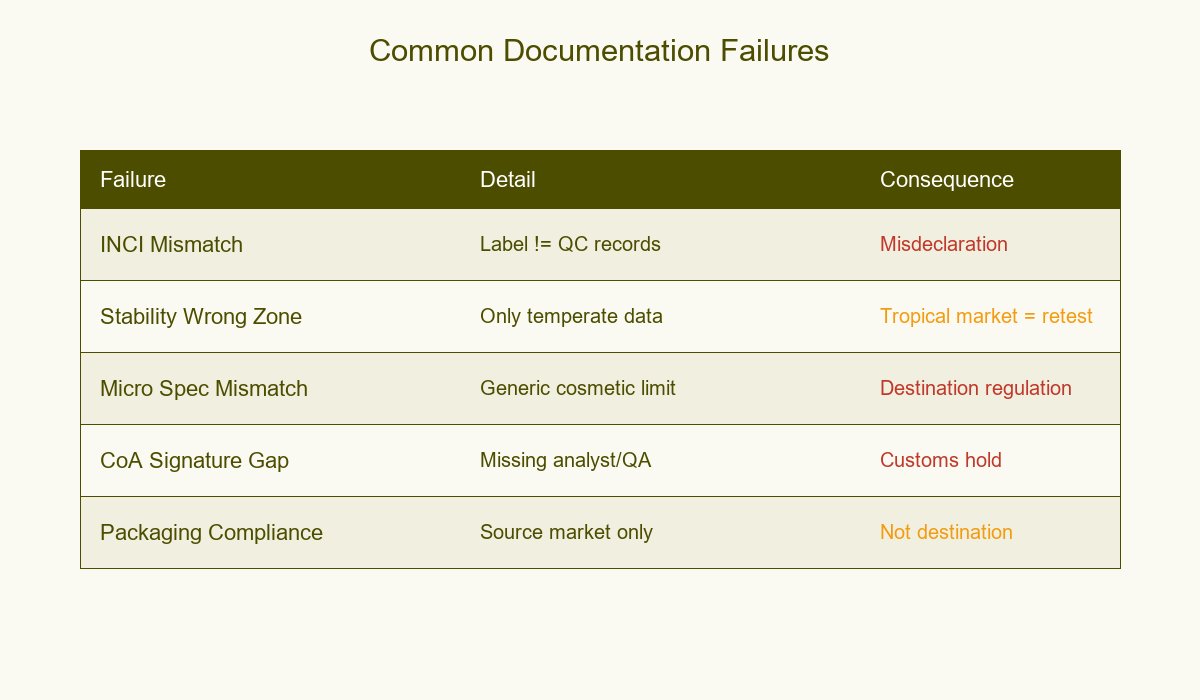
First-time importers commonly fail on five documentation items. Each is fixable before the first shipment but expensive to fix after.
9.1 Mismatched INCI Declaration (KONGDY)
The INCI declaration on the label does not match the formulation in the QC records. The mismatch is often a minor naming difference but customs authorities treat it as misdeclaration. KONGDY's QC team verifies that the label INCI declaration matches the formula record before shipment release.
9.2 Stability Data Missing for the Destination Climate (KONGDY)
Stability data exists but only covers temperate storage, while the shipment is destined for tropical climate where storage temperature exceeds 30 degrees Celsius. KONGDY generates stability data at multiple storage conditions including 30 degrees Celsius / 65 percent RH and 40 degrees Celsius / 75 percent RH for tropical market shipments.
9.3 Microbiological Specification Mismatch (KONGDY)
The microbiological specification in the finished product CoA is more lenient than the destination market's regulatory limit. KONGDY specifies microbiological limits against the destination market's regulation, not against a generic cosmetic limit.
9.4 Missing or Incomplete CoA Signatures (KONGDY)
The finished product CoA is missing the QA release signature or the analyst signature, which means customs cannot verify release and may hold the shipment. KONGDY's QC system requires both signatures before a CoA is issued.
9.5 Packaging Component Compliance Gap (KONGDY)
Packaging components meet food-contact regulations in one market but not the destination market. KONGDY maintains packaging component compliance statements per destination market.
10. Conclusion: Treat QC Documentation as a Sourcing Filter
Herbal plaster QC documentation is a sourcing filter, not a future risk to manage. Each documentation check that the traditional medicine brand catches before the first order is one less customs hold, one less retail onboarding rejection, and one less consumer complaint in the first six months of operation. The brands that win the category are the ones that treat QC documentation as a sourcing filter and reject suppliers whose systems fail the verification.
KONGDY's documentation-first QC system covers raw material qualification, in-process control, finished product testing, stability, microbiological, packaging compliance, customs, and post-market documentation for FDA cosmetic, EU CPSR, and Asia market pathways. The system is ISO 22716 GMP certified, FDA registered, and audited annually by accredited bodies, with 7-year document retention and electronic batch record indexing.
Request KONGDY's herbal plaster QC documentation pack within 48 hours — the commercial team will return the QC manual summary, redacted ISO 22716 audit report, finished product CoA template, stability protocol summary, packaging compliance statement, and the destination market's HS code and tariff classification for your shipment.
Schedule a factory audit or live video tour at KONGDY's ISO 22716 facility to review the production line, QC laboratory, and stability chamber room, and request a free sample to validate adhesion, sensation, and packaging acceptance in your channel. Brand owners planning a launch within two quarters can additionally reserve a pilot batch slot while QC documentation and stability work are completed in parallel, so sample approval and customs preparation finish on the same timeline.

