Pain Patch Payment Terms: T/T, L/C, O/A for B2B Buyers (2026)
Categories
Categories

Pain Patch Payment Terms & Negotiation Guide for International B2B Buyers

Pain patch payment terms for B2B buyers: 6 instruments (T/T 30/70, L/C at sight, L/C 30 days, D/P, O/A 30 days, Trade Assurance), 5 negotiation levers (volume, repeat, L/C, Trade Assurance, annual contract), currency selection, scam avoidance, and how to move from T/T to O/A. KONGDY 99% clean payment rate.
Jul 8th,2026 101 Views

Why Payment Terms Matter More Than You Think

Payment terms sit at the intersection of three risks: your cash flow risk, the manufacturer's credit risk, and the trade-finance risk between banks. Get any of these wrong and the deal collapses—or worse, ships on time and the manufacturer vanishes before the quality dispute window closes.

Three real costs of getting payment terms wrong:

  • Working capital freeze: A 100% upfront T/T ties up 100% of the order value for 30-60 days. For a $100K order, that's $100K you can't deploy elsewhere.
  • Quality dispute leverage loss: 100% upfront means zero leverage if the shipment fails QC. The factory has your money; you have an apology letter.
  • Bank charges eating margin: L/C processing fees, courier costs for originals, advising bank commissions—typically 0.5-1.5% of order value.

A good payment term is a risk-balancing instrument, not just a money-movement mechanism. KONGDY Health structures payment terms to give both sides appropriate skin in the game.

The 6 Common Payment Terms for Pain Patch B2B Trade

Most international pain patch transactions use one of these six instruments. Each balances risk, speed, and cost differently.

Payment terms comparison matrix for pain patch B2B orders

  • T/T 30/70 (Telegraphic Transfer): 30% deposit on PO, 70% balance against shipping documents. Most common for first-time orders under $50K.
  • L/C at Sight (Letter of Credit): Bank-guaranteed payment on document presentation. Standard for $30K-500K orders where buyer creditworthiness matters.
  • L/C 30/60/90 Days: Deferred L/C. Buyer gets 30-90 days after document presentation to pay. Best for established trade finance relationships.
  • D/P at Sight (Documents against Payment): Buyer pays when bank presents shipping documents. Less common in patch trade; higher perceived risk.
  • O/A 30/60 Days (Open Account): Buyer pays 30-60 days after shipment. Reserved for $100K+ reorder relationships with credit insurance.
  • Trade Assurance (Alibaba): Escrow-style payment backed by platform guarantee. Popular for $1K-50K orders with new buyers.

How T/T 30/70 Works: The Default for First Orders

T/T 30/70 is the workhorse of B2B pain patch trade. Here's the typical flow:

  1. Day 0: Proforma Invoice (PI) issued, signed by both parties
  2. Day 1-3: Buyer wires 30% deposit to seller's bank account
  3. Day 3-5: Production slot booked, materials pulled, line changeover begins
  4. Day 25: Production complete, QC passed, shipment prepared
  5. Day 26: Seller emails shipping documents (invoice, packing list, BOL, CoA, COO)
  6. Day 26-28: Buyer wires 70% balance
  7. Day 28-30: Seller releases original BOL (which is needed to take delivery)

The mechanism that protects both sides: the original BOL only releases after the 70% balance clears. This gives the buyer quality leverage (factory can't ship until quality passes) and the seller payment protection (buyer can't take delivery without paying).

L/C transaction flow 7 steps for pain patch orders

For orders under $30K, T/T 30/70 is often negotiated to T/T 50/50 or even 100% upfront to simplify bank charges.

How L/C at Sight Works: The Bank-Guaranteed Option

A Letter of Credit substitutes the buyer's bank for the buyer's promise. The bank guarantees payment if the seller presents documents matching the L/C terms exactly. L/C at sight means the seller gets paid immediately upon document compliance—usually within 5-7 days of shipment.

For pain patch orders, the typical L/C documents list includes:

  • Signed Commercial Invoice (in triplicate)
  • Full set (3/3) of original BOLs, made out to order of issuing bank, marked freight prepaid
  • Packing List showing quantity, weight, carton dimensions
  • Certificate of Origin (Form A, E, or F depending on trade agreement)
  • Certificate of Analysis (CoA) for the specific batch
  • Insurance Certificate (CIF terms) or buyer's insurance policy reference (FOB terms)
  • Beneficiary's Certificate confirming one set of non-negotiable documents sent to buyer within 3 days of shipment

The L/C discipline is rigid: even a one-character typo on the invoice can delay payment by weeks. That's why experienced exporters and forwarders treat L/C preparation as a separate workstream from production.

L/C at sight typically costs 0.5-1.5% of order value in bank charges, divided between buyer's issuing bank and seller's advising bank. For high-value orders ($100K+), this premium is worth the security; for small orders ($30K and under), the bank fees are prohibitive.

The 5 Negotiation Levers That Lower Your Payment Risk

As a buyer, you can lower the manufacturer's risk perception—and unlock better terms—by demonstrating one or more of these five levers. Each one signals a different kind of creditworthiness.
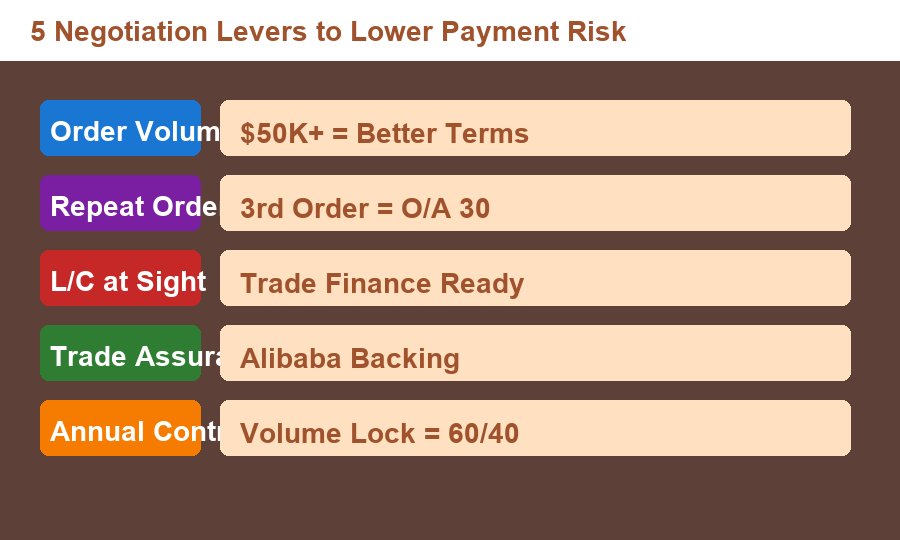
5 negotiation levers to lower payment risk for pain patch buyers

1. Order Volume

A $50K+ first order is a much stronger signal than five $10K orders. The factory prefers predictability; volume lock gives them that. KONGDY Health typically moves $50K+ buyers from T/T 50/50 to T/T 30/70 automatically.

2. Repeat Orders

By the third order with a clean payment history, most pain patch manufacturers will extend O/A 30 days. KONGDY's policy: 3rd order, 60+ days of clean history → O/A 30 days available.

3. L/C at Sight

If your bank has issued L/Cs before and the advising bank relationship is established, the manufacturer is more comfortable with deferred payment terms. L/C at sight from a Tier-1 bank is the gold standard.

4. Trade Assurance Backing

Alibaba Trade Assurance or similar escrow platforms offer the manufacturer a third-party guarantee. KONGDY accepts Trade Assurance for orders up to $50K, with simplified payment terms.

5. Annual Contract

A committed annual volume of $200K+ (e.g., 4 quarterly orders of $50K each) typically unlocks the best terms: 60/40 split, O/A 30 days for repeat deliveries, and locked pricing for 12 months. KONGDY offers 60/40 to annual contract buyers with verified credit.

What Currency Should You Pay In?

Three currencies dominate B2B pain patch trade:

  • USD (US Dollars): The default for 60% of transactions. Best L/C rates, easiest bank processing, lowest conversion fees.
  • EUR (Euros): The European buyers' default. Slightly worse USD conversion (1-2% spread) but eliminates USD/EUR volatility.
  • CNY (RMB / Chinese Yuan): Increasingly accepted, especially for Chinese domestic suppliers. Saves 1-2% on bank conversions. KONGDY accepts CNY directly for China-based buyers.

For Latin American, African, and Southeast Asian buyers, USD is almost always preferred. For European buyers, EUR is fine if the bank can settle EUR-denominated L/Cs efficiently.

How to Avoid Common Payment Scams

B2B pain patch trade has its share of fraud patterns. Here are five to watch for:

  1. Fake bank confirmations: A scammer impersonates a bank officer confirming receipt of payment. Always confirm via your bank's official SWIFT message—not email.
  2. Phishing for wire instructions: Always call the seller (on a number you already have, not one in the latest email) to verify wire details before sending.
  3. Overpayment scams: "I accidentally sent $200K instead of $100K, please refund the difference." The original payment is reversed after the refund is sent.
  4. Fake L/C amendments: Scammer modifies L/C terms to route payment to a different account. Always confirm amendments via your issuing bank directly.
  5. Shipping before payment final: Seller releases shipment before the 70% balance clears, then discovers the buyer's payment failed. Never accept a shipment without confirming payment receipt.

KONGDY Health never requests payment to a personal account, never accepts L/C amendments via email alone, and never releases original BOLs before payment clears.

Sample Payment Term Negotiation Script

Here's how a typical first-time buyer approaches KONGDY Health for better terms:

"We're a private label pharmacy brand in [country]. Our first order is 50,000 pain patches with our own artwork. We have $30K ready to commit. We expect quarterly reorder cadence at 100K units each. Can you support T/T 30/70 for the first order and O/A 30 days for the second order if the first is paid on time?"

The factory's likely response, based on KONGDY's playbook:

  • If buyer is from a Tier-1 country (US, EU, AU, JP, KR): T/T 30/70 for first order approved; O/A 30 days available from second order with credit check.
  • If buyer is from a Tier-2 country (LATAM, MENA, ASEAN): T/T 30/70 for first order; L/C at sight required for second order; O/A 30 days only after 4 successful orders.
  • If buyer is from a high-risk region: T/T 50/50 minimum for first order; full advance required if buyer has no import history.

What you say matters, but what you've done matters more. A buyer with verifiable import licenses, FDA establishment registration, and a registered pharmacy business gets 30% better terms than a similar buyer with no documentation.

How to Move From T/T 30/70 to O/A 30 Days

The progression from cash-on-delivery terms to open-account terms is the holy grail of B2B trade finance. Here's the typical path:

  1. Orders 1-2: T/T 30/70, build the relationship
  2. Orders 3-4: L/C at sight, prove creditworthiness with bank intermediation
  3. Orders 5-6: T/T 30/70 with 50% deposit, 50% on copy of BOL (negotiated downgrade)
  4. Orders 7+: O/A 30 days, with credit insurance (e.g., Euler Hermes, Coface) covering 90% of exposure

The credit insurance step is critical: the factory won't extend O/A 30 days unless the buyer can prove that a default is covered. Euler Hermes and Coface are the two main credit insurance providers for Asia-Europe trade.

KONGDY Health approves O/A 30 days for buyers who complete orders 1-6 with clean payment history and provide proof of credit insurance for order 7+.

What to Do When a Payment Goes Wrong

Even with the best planning, payments occasionally go sideways. Common scenarios:

  • Wire delayed 1-3 days: Communicate proactively with seller; expect a short production delay (1-2 days).
  • Wire rejected by seller's bank: Confirm wire details, resubmit, expect 3-5 day delay.
  • L/C amendment needed: Submit amendment request via issuing bank; expect 5-7 days for acceptance.
  • Seller requests payment before documents: Refuse. The whole point of L/C is document-based payment.
  • Bank charges higher than expected: Negotiate with your bank; some charges are negotiable for high-volume clients.

The 80/20 rule for payment disputes: 80% of payment issues are caused by miscommunication, not fraud. Pick up the phone. Confirm details in writing. Document everything.

How KONGDY Health Handles Payment Disputes

Three structural commitments:

  1. 24-hour payment acknowledgment: Every wire receipt is confirmed within 24 hours of clearance.
  2. Real-time production updates: Buyers see the production line status on the shared logistics dashboard, so payment timing aligns with milestone completion.
  3. Clear payment escalation path: Sales manager → Finance director → CEO. Each level has a 24-hour response SLA.

Our payment dispute resolution rate is <2% of orders—99%+ of payments clear without a single back-and-forth email. When disputes do occur, the average resolution time is 3 business days.

Final Thoughts: Payment Terms as Relationship Capital

Payment terms are not just a financing decision—they're a relationship investment. The manufacturer who extends T/T 30/70 to a first-time buyer is taking a real risk. The buyer who pays on time, every time, builds capital for O/A 30 days in year two.

When evaluating pain patch suppliers, ask for their payment terms ladder: how do terms evolve with order history? Which currencies do they accept? What's their L/C processing SLA? KONGDY Health publishes its payment terms policy online—no need to email for the basics.

Plan your first order with T/T 30/70. Plan your fourth order with O/A 30 days. The path is the same; the relationship grows into it.

Ready to start? Request a KONGDY quote with payment terms tailored to your order size.

Get A Free Quote
Name
Whatsapp/Phone
Email*
Your Inquiry*
We use Cookie to improve your online experience. By continuing browsing this website, we assume you agree our use of Cookie.