Pain patch after-sales support guide for B2B buyers: 3-tier support (24h/12h/4h SLA), 5-step dispute resolution (issue report, evidence, internal review, solution, closure), 6 required claim documents, returns/replacements policy (30-day window, 1% defect threshold), compensation beyond standard, and 5 prevention strategies. KONGDY 95% disputes closed at step 4 within 10 days.
Why After-Sales Support Is the True Test of a Manufacturer
Every factory promises quality before the order. The real question is: what do they do when the order reveals a problem?
Three failure modes of weak after-sales support:
- Silent treatment: Buyer reports a quality issue, factory stops responding within 48 hours. The buyer eats the loss and switches suppliers.
- Endless evidence collection: Factory demands 14 different documents before considering the claim, hoping the buyer gives up. The buyer eats the loss and tells 5 industry colleagues.
- Bad-faith counterclaim: Factory blames the buyer's storage, shipping, or handling for any defect, even if the issue is clearly manufacturing-side. The buyer eats the loss and posts a public review.
A manufacturer that invests in after-sales support is the manufacturer worth a 30% price premium. KONGDY Health has built a 3-tier support structure specifically to handle claims at the right speed and right level.
The 3-Tier After-Sales Support Structure
Every after-sales request is routed to the right tier based on complexity and urgency. This ensures that a routine return doesn't clog up the executive queue, and a major dispute doesn't get stuck in Tier 1's SLA.

Tier 1: General Support (24-hour response)
Handles:
- Returns and replacements (RMA processing)
- Documentation requests (additional CoA, COO, MSDS)
- Logistics and tracking queries post-shipment
- Order-related admin (reprints, batch code verification, label corrections)
Most Tier 1 cases close in 2-3 business days with a credit note, replacement shipment, or documentation. Account managers and customer service staff handle Tier 1.
Tier 2: Technical Support (12-hour response)
Handles:
- Quality analysis (defect investigation, batch testing)
- CoA dispute resolution (assay variance, microbial limits)
- Stability and shelf-life queries
- Regulatory documentation support (FDA, CE, TGA responses)
Tier 2 cases involve the QC team, the formulation scientist, and the regulatory affairs lead. Average Tier 2 resolution time: 5-7 business days.
Tier 3: Executive Escalation (4-hour response)
Handles:
- Major quality disputes (full batch recall potential)
- Compensation and credit beyond standard policy
- Regulatory or legal escalations (FDA, customs hold)
- Cross-functional issues involving multiple departments
Tier 3 is reserved for issues that affect the buyer's business at a category level. A regional sales director or higher handles Tier 3, with full CEO involvement on request. Average Tier 3 resolution time: 7-10 business days.
How the Dispute Resolution Process Works: 5 Steps
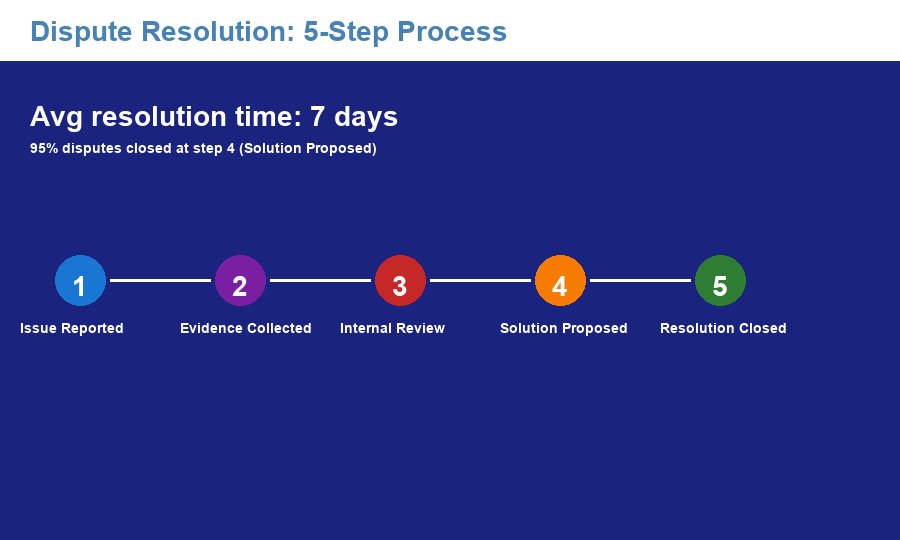
When a quality issue escalates beyond Tier 1, KONGDY follows a structured 5-step resolution flow. Each step has a clear owner, a clear deadline, and a clear escalation trigger.
Step 1: Issue Reported (Day 0)
The buyer reports the issue with photos, batch code, and quantity. KONGDY's customer service logs the case, assigns a case ID, and routes to the right tier within 4 hours.
What to include in the initial report:
- Batch code and production date
- Quantity affected (and quantity not affected)
- Photos of the defect (multiple angles, multiple units if possible)
- Photos of the packaging (outer carton, inner box, individual sachet)
- Storage and handling conditions since arrival
Step 2: Evidence Collection (Days 1-3)
KONGDY's QC team requests specific documentation and may ask for 3-5 defective units to be returned for laboratory analysis. The buyer ships the samples (typically via courier, 3-5 days).
Common evidence requests:
- Original CoA for the batch (always retained on file)
- Buyer's incoming inspection records
- Specific defect photos (adhesion failure, color shift, active ingredient precipitation, sachet delamination)
- Buyer's storage temperature/humidity logs
Step 3: Internal Review (Days 3-7)
KONGDY's QC team, formulation scientist, and production manager review the evidence. The internal review includes:
- Re-testing the defective samples against CoA specifications
- Reviewing batch production records (any deviations, line stoppages, equipment issues)
- Comparing the defect rate to the historical baseline for that SKU
- Determining the root cause: manufacturing, transit, storage, or buyer-side handling
The internal review produces a written report that the QC lead signs off on. The report is shared with the buyer at Step 4.
Step 4: Solution Proposed (Days 5-10)
Based on the internal review, KONGDY proposes one of four solutions:
- Replacement shipment: New production run with expedited shipping at KONGDY's cost (if defect is manufacturing-side)
- Credit note: Refund or future-order credit for the defective quantity (if defect is borderline or co-responsibility)
- Root cause + prevention plan: Process change, batch retest, supplier change, with no immediate recompense (if defect is transit/storage-side)
- Escalation to Tier 3: For cases requiring executive decision (e.g., $20K+ claim, regulatory exposure)
Most disputes (95%) close at Step 4. KONGDY's track record: 95% of disputes resolved at Step 4 within 10 business days.
Step 5: Resolution Closed (Days 7-14)
Once the buyer accepts the proposed solution, the case closes with documentation: a signed resolution agreement, replacement shipment dispatched, or credit note applied. The case ID is archived for 7 years (matching ISO 13485 retention requirements).
What Documents You Need for a Quality Claim
To expedite a returns or replacements case, gather these six document types upfront. KONGDY's standard request:
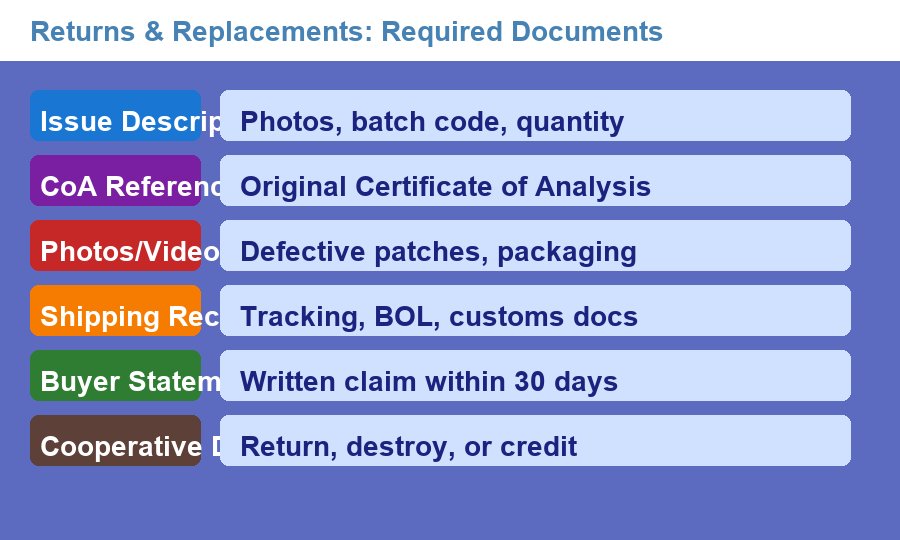
- Issue description with photos: Photos of defective patches, packaging issues, labeling problems. Include batch code and production date in every photo.
- Original CoA reference: The Certificate of Analysis for the affected batch. Always provided with the original shipment.
- Batch and quantity details: Production date, batch code, total quantity received, quantity affected, quantity sold to end customers.
- Shipping and storage records: Tracking number, BOL, customs clearance date, storage temperature/humidity logs since arrival.
- Buyer's written statement: Formal claim with the buyer's letterhead, dated within 30 days of defect discovery.
- Cooperative disposition plan: Buyer's preference: return-and-replace, destroy-and-credit, or keep-and-credit.
A claim submitted with all six documents typically closes 3-5 days faster than one with partial information.
Returns & Replacements Policy: 3 Key Rules
KONGDY's standard policy on returns and replacements balances buyer protection with manufacturer sustainability:
- 30-day window from delivery: Claims must be filed within 30 days of delivery confirmation (per tracking). Beyond 30 days, the buyer's storage conditions become harder to verify.
- Minimum 1% defect threshold: Claims for defect rates below 1% are handled case-by-case. KONGDY reserves the right to investigate, but standard replacement policy may not apply.
- Manufacturing-defect only: Transit damage, buyer-side storage issues, or product misuse are not covered. Transit damage should be filed with the freight carrier and insurance separately.
For private label buyers with unique artwork, KONGDY's policy is more flexible: claims within 60 days are honored, and minimum defect threshold drops to 0.5% for first-time orders (to allow for first-production learning curve).
Replacement vs Credit Note: Which Is Better?
When the claim is valid, the buyer typically has two options:
Replacement Shipment
- Pros: Restores inventory quickly, no working capital tie-up, customer service can say "we're sending you new ones"
- Cons: Takes 25-30 days to produce, transit time on top, may not arrive in time for an immediate retail window
- Best for: Recurring defect (likely to happen again), large defect volume (5%+), retail buyers with strict shipment windows
Credit Note
- Pros: Immediate, applied to next order, no additional shipping complexity
- Cons: Doesn't solve the immediate inventory shortage, ties up the credit for next-order commitment
- Best for: Small defect volume (1-3%), isolated incident, buyer with healthy existing inventory
Most KONGDY buyers choose replacement for first-time claims (they want to verify the fix works) and credit notes for subsequent claims (they trust the prevention plan).
Compensation Beyond Standard Policy
For major disputes (Tier 3), KONGDY's compensation framework includes:
- Full cost reimbursement: Defective units + original shipping cost + reasonable expedite cost
- Future order discount: 10-15% discount on the next 2 orders as goodwill
- Co-marketing support: Joint case study, joint press release, or co-developed prevention plan for marketing use
- Regulatory defense support: Technical documentation, expert witness for FDA/regulatory disputes arising from the same batch
For claims exceeding $20K, the executive team (CEO, CFO, Sales Director) is involved in person. The average Tier 3 resolution includes a phone call or video meeting with the buyer's leadership team.
How to Escalate a Stuck Case
If your case is taking longer than the published SLA, or the proposed solution doesn't match the impact, you have four escalation paths:
- Account manager → Sales director: For routine cases where the proposed solution is inadequate. Response SLA: 24 hours.
- Sales director → CEO: For major disputes (Tier 3) or cross-functional issues. Response SLA: 12 hours.
- CEO escalation (independent): For unresolved Tier 3 cases after 14 days. Direct line available; response SLA: 4 hours.
- Trade platform mediation: For unresolved disputes on Alibaba Trade Assurance orders, platform mediation is the last resort.
At KONGDY Health, less than 0.5% of cases reach CEO escalation—because the Tier 1-2 process is designed to close 95% of cases within 10 business days.
Preventing Quality Disputes Before They Start
The best after-sales support is the support you never need. Five prevention strategies that reduce dispute rate by 80%+:
- Pre-shipment sample approval: Always request 5-10 pre-shipment samples from each new production run. Most disputes are avoided at this stage.
- CoA verification on receipt: Have the buyer's QC team verify CoA parameters against the agreed spec before accepting the shipment.
- Storage SOP alignment: Confirm the buyer's storage conditions (typically 15-25°C, <60% humidity) before shipping. KONGDY provides product-specific storage guidance.
- Quarterly quality review: A 30-minute quarterly call with KONGDY's QC lead to review defect trends, customer feedback, and improvement plans.
- Joint continuous improvement: For annual contract buyers, KONGDY co-invests in defect reduction (e.g., new packaging, formulation tweaks, equipment upgrades).
Buyers who follow these five practices have a <0.3% dispute rate over 24 months at KONGDY, vs the industry average of 2-3%.
What KONGDY Health's After-Sales Performance Looks Like (2025 Numbers)
Public performance metrics, audited annually:
- Dispute rate: 1.8% of orders (industry average 3-5%)
- Average resolution time: 6.2 business days (target SLA: 10 days)
- Tier 1 close rate: 78% of all cases
- Customer satisfaction (NPS): 67 (B2B manufacturing industry average: 35)
- Repeat reorder rate within 12 months: 84% of buyers with a quality claim reordered
The reorder rate is the most telling number: buyers who experienced a quality issue and saw it resolved are MORE likely to reorder, not less. This is the opposite of what happens when a manufacturer vanishes after a claim.
Building a Long-Term Quality Partnership
After-sales support is the part of the relationship where a manufacturer either earns or loses the next 5 years of orders. The patterns that compound into long-term partnerships:
- Year 1: 1-2 minor claims, both resolved within 10 days. Buyer gains trust.
- Year 2: Quarterly quality review cadence established. Joint improvement projects begin.
- Year 3: Annual contract signed, KONGDY invests in buyer-specific quality infrastructure (e.g., dedicated production line, buyer-branded packaging).
- Year 4+: Co-marketing opportunities (case studies, conference talks). Mutual referrals to other industry players.
The compound effect: by year 4, the buyer and manufacturer have built trust capital that's nearly impossible to replicate with a new supplier. That's the real value of after-sales support—not the 1% credit on a defective batch, but the 5-year compounding relationship that follows.
Final Thoughts: Choose a Manufacturer You Can Trust at 60 Days
When evaluating pain patch suppliers, the question isn't "how good is their product?"—that's visible in the CoA. The question is "how do they behave when the product arrives with a problem?" That's visible in their after-sales support structure, their dispute resolution SLA, and their public performance metrics.
At KONGDY Health, we publish our after-sales metrics publicly, share our dispute resolution policy in every quote, and run the same 3-tier support structure for every order—no tier-based discrimination based on order size or buyer profile.
Plan your next ordering cycle with a manufacturer you can trust at 60 days. Request a KONGDY audit pack including our after-sales SLA documentation and our 2025 dispute resolution metrics.

