Heat patch shipping represents 8-15% of total landed cost in B2B heat patch procurement, yet it is the most underestimated variable in pricing decisions. According to KONGDY's logistics data across 5,000+ international heat patch shipments, brands that optimize shipping mode and Incoterm selection reduce total logistics cost by 25-40% and avoid customs-related delays of 4-12 weeks.
Heat patch shipping is uniquely complex because the product is temperature-sensitive (active ingredients can degrade above 40°C), moisture-sensitive (requires sealed foil packaging), and bulky relative to value (low dollar density per cubic meter). These characteristics affect container choice, freight mode, insurance valuation, and customs classification.
This article provides the complete framework for B2B heat patch shipping decisions: Incoterm selection, container types, freight modes, customs clearance, HS codes, and freight cost benchmarks. Whether you are shipping your first 1,000-unit sample or 100,000-unit commercial shipment, this guide gives you the structure to ship cost-effectively and reliably. KONGDY's heat patch manufacturer facility has shipped to 60+ countries with 97% on-time delivery rate over the past 5 years.
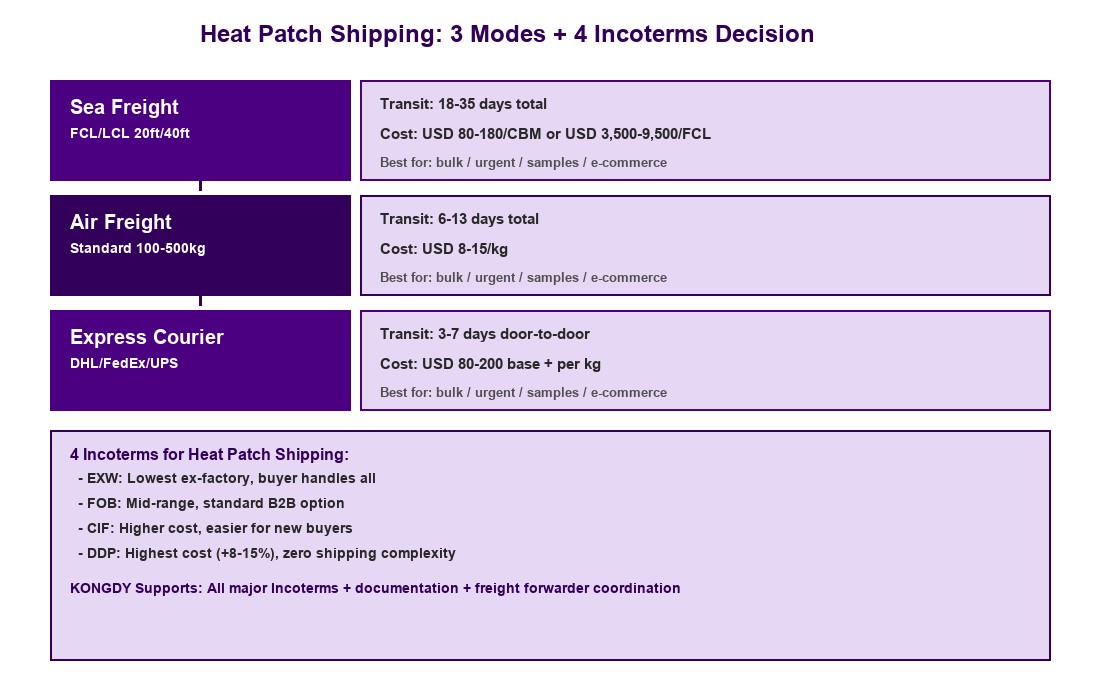
Three primary shipping modes serve B2B heat patch shipments, each with different cost, speed, and capacity characteristics. Most brands use a combination: sea freight for routine bulk orders, air freight for urgent restocking, and express for samples and small urgent shipments.
| Mode | Capacity | Transit Time | Cost (USD) | Best For |
|---|---|---|---|---|
| Sea Freight (FCL 20ft) | ~100K units | 18-28 days | 3,500-6,500 | Commercial bulk orders |
| Sea Freight (FCL 40ft) | ~220K units | 18-28 days | 5,500-9,500 | Large commercial orders |
| Sea Freight (LCL) | 1-15 cubic meters | 25-40 days | 4,500-8,000 | Mid-volume orders without full container |
| Air Freight (Standard) | 100-500 kg | 5-10 days | 8-15/kg | Urgent restocking, samples |
| Air Freight (Express) | 5-100 kg | 3-5 days | 15-30/kg | Small urgent shipments |
| Express Courier (DHL/FedEx) | 1-50 kg | 3-7 days | 80-200/shipment + per kg | Samples, small e-commerce |
Heat patch container selection affects per-unit shipping cost, packaging integrity during transit, and customs handling. Three container types are commonly used.
| Container | Capacity (Heat Patches) | Use Case | Cost Range |
|---|---|---|---|
| 20ft FCL | 80,000-120,000 standard patches | Mid-volume commercial orders | USD 3,500-6,500 |
| 40ft FCL | 180,000-240,000 standard patches | Large commercial orders | USD 5,500-9,500 |
| 40ft HC (High Cube) | 200,000-270,000 standard patches | Bulk commercial orders | USD 6,500-11,000 |
| LCL (per cubic meter) | 5,000-15,000 patches per CBM | Small orders below FCL threshold | USD 80-180 per CBM |
KONGDY's KONGDY heat patch manufacturer facility provides optimized container loading plans that maximize unit count per container, typically achieving 95-98% cube utilization for standard orders.
Incoterms (International Commercial Terms) define buyer and seller responsibilities for transportation, insurance, and customs clearance. Selecting the right Incoterm affects total cost, risk allocation, and operational complexity.
| Incoterm | Seller Responsibility | Buyer Responsibility | Cost Impact | Best For |
|---|---|---|---|---|
| EXW (Ex Works) | Make goods available at factory | All transport + customs + insurance | Lowest ex-factory price | Buyers with own freight network |
| FCA (Free Carrier) | Deliver to carrier at named location | Main transport + customs + insurance | Low factory + handling cost | Standard B2B shipments |
| FOB (Free on Board) | Transport to port + load on vessel | Ocean freight + customs + inland | Mid-range total cost | Standard B2B shipments |
| CIF (Cost, Insurance, Freight) | Ocean freight + insurance to dest port | Customs clearance + inland | Higher total cost | Buyers new to international shipping |
| DAP (Delivered at Place) | Transport to named destination | Customs clearance + import duties | Higher total cost | Buyers wanting destination delivery |
| DDP (Delivered Duty Paid) | All transport + customs + duties to door | None | Highest total cost (+8-15%) | Buyers wanting zero shipping complexity |
HS (Harmonized System) codes classify products for customs purposes. Correct HS code classification affects import duty rates, customs clearance speed, and regulatory compliance. Misclassification causes shipment detention, fines, and reputational damage.
| Region | HS Code | Description | Duty Range |
|---|---|---|---|
| USA | 3004.90.92 | Medicaments, transdermal | 0% (most patches) |
| EU | 3004.90.00 | Medicaments, other | 0% (medicinal patches) |
| Canada | 3004.90 | Medicaments, other | 0-5% |
| Australia | 3004.90 | Medicaments, other | 0% |
| 3004.90 | Medicaments, other | 0% | |
| 3004.90 | Medicaments, other | 4-6% | |
| Brazil | 3004.90 | Medicaments, other | 8-14% |
| India | 3004.90 | Medicaments, other | 10-12% |
| Russia | 3004.90 | Medicaments, other | 5-10% |
Always verify HS code with local customs authority before shipment. HS codes can vary based on: active ingredient type, claimed therapeutic use, and product format. KONGDY's regulatory team provides HS code guidance and supporting documentation for 60+ countries. Misclassification risk: 2-8 weeks detention plus 10-30% fines on declared value.
Customs clearance requires specific documentation. Missing or incorrect documents are the #1 cause of heat patch shipment delays. Below is the standard documentation package.
KONGDY's KONGDY heat patch manufacturer export team prepares all required documents and provides regulatory support for 60+ country customs authorities.
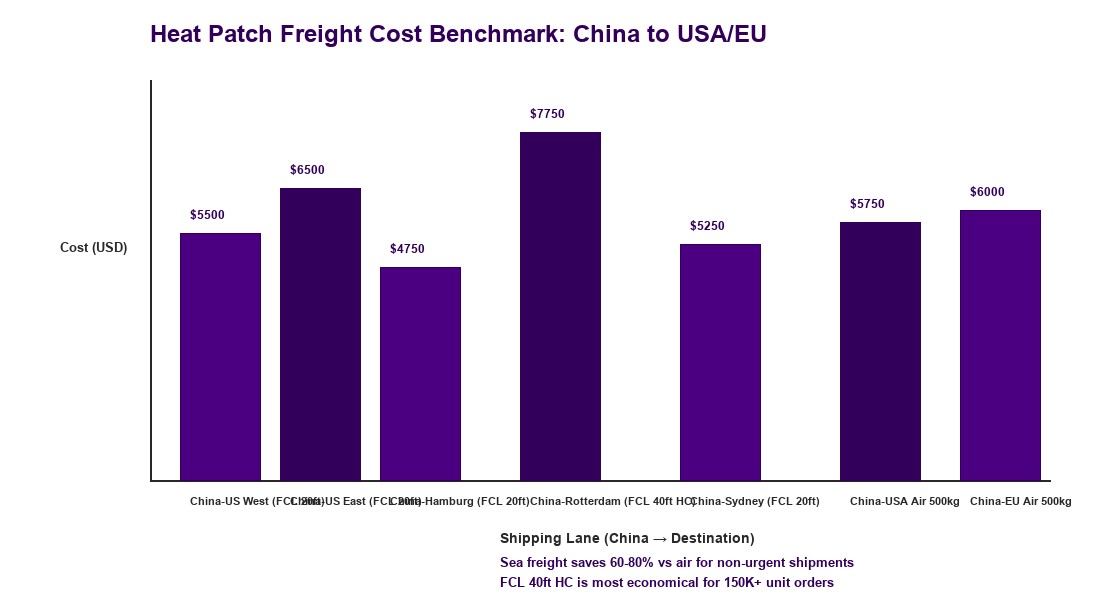
Heat patch freight cost varies based on mode, route, season, and fuel prices. Below are current benchmark ranges for 2026 (subject to market fluctuation).
| Lane | Mode | Volume | Cost Range |
|---|---|---|---|
| China to USA West Coast | Sea FCL 20ft | 100K units | USD 4,500-6,500 |
| China to USA East Coast | Sea FCL 20ft | 100K units | USD 5,500-7,500 |
| China to Hamburg | Sea FCL 20ft | 100K units | USD 4,000-5,500 |
| China to Rotterdam | Sea FCL 40ft HC | 220K units | USD 6,500-9,000 |
| China to Sydney | Sea FCL 20ft | 100K units | USD 4,500-6,000 |
| China to USA | Air Freight 500kg | 50K units | USD 4,000-7,500 |
| China to EU | Air Freight 500kg | 50K units | USD 4,500-7,500 |
Heat patches are temperature-sensitive products. Active ingredients can degrade above 40°C, and humidity can affect adhesive performance. Proper shipping conditions protect product quality.
Heat patch shipments require marine cargo insurance to protect against loss, damage, and theft. Insurance typically covers 0.3-0.5% of cargo value.
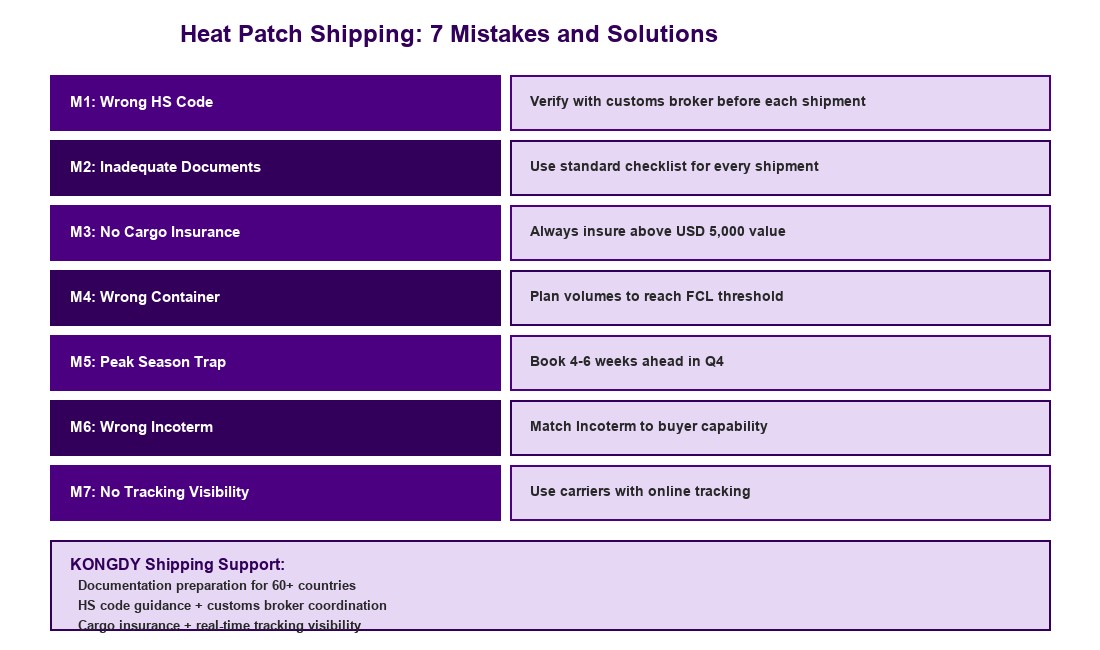
Seven common mistakes cause 75% of B2B heat patch shipping failures. Avoid these to keep your shipments on track and your costs predictable.
Mistake 1: Wrong HS Code. Misclassification causes customs detention and fines. Always verify with customs broker before shipment.
Mistake 2: Inadequate Documentation. Missing or incorrect documents cause 2-8 week delays. Use standard documentation checklist for every shipment.
Mistake 3: No Cargo Insurance. Skipping insurance on high-value shipments risks 100% loss. Always insure shipments above USD 5,000.
Mistake 4: Wrong Container Selection. Choosing LCL when FCL is economical wastes 20-40% in freight cost. Plan volumes to reach FCL threshold.
Mistake 5: Ignoring Peak Season. Shipping during peak season (Q4) without early booking faces 2-4 week delays and 15-30% rate increases. Book 4-6 weeks ahead in peak season.
Mistake 6: Wrong Incoterm Selection. Choosing DDP when buyer can handle customs wastes 8-15% in cost. Match Incoterm to buyer capability.
Mistake 7: No Tracking Visibility. Shipping without real-time tracking creates anxiety and missed ETAs. Use carriers with online tracking and proactive notifications.
Sea freight FCL (Full Container Load) is most cost-effective for orders of 50,000+ units. Per-unit shipping cost drops 60-80% vs air freight. For orders below 50,000 units, LCL or sea freight consolidation may be more cost-effective than air.
Sea freight: 18-28 days transit + 3-7 days customs clearance = 21-35 days total. Air freight: 5-10 days transit + 1-3 days customs = 6-13 days total. Express courier: 3-7 days door-to-door (DDP included).
Most heat patches are classified under HS code 3004.90 (Medicaments, other) with 0% duty in USA, EU, Canada, and Australia. Some specific patches (e.g., warming patches without active ingredients) may classify under different codes. Verify with customs broker.
Most countries do not require special import license for standard heat patches. However, medicated heat patches with regulated active ingredients may require: FDA Drug Listing (USA), CE Marking (EU), Health Canada MDL, or TGA ARTG (Australia). KONGDY supports regulatory documentation for all major markets.
DDP (Delivered Duty Paid) is best for first-time buyers because it removes shipping complexity. The premium of 8-15% is offset by reduced coordination overhead and faster customs clearance. Established buyers should transition to FOB or FCA for cost optimization.
Consolidate orders to FCL threshold, negotiate annual freight contracts, ship during off-peak season, optimize carton dimensions for cube utilization, and consider sea over air for non-urgent orders. KONGDY's logistics team helps B2B brands identify cost optimization opportunities.
FCL 20ft typically requires 50,000+ heat patches. FCL 40ft requires 100,000+ units. Below these thresholds, LCL (Less than Container Load) is used with per-cubic-meter pricing. KONGDY helps buyers determine optimal order size for FCL economics.
KONGDY supports buyers through documentation preparation, HS code guidance, and coordination with customs brokers. KONGDY does not directly clear customs in destination countries but provides all necessary documentation and regulatory support for smooth clearance.
KONGDY is a leading heat patch manufacturer based in Henan, China, with 36 years of transdermal patch manufacturing experience and 18 years of structured export logistics. Our 36,000 m² facility has shipped 5,000+ international heat patch shipments to 60+ countries with 97% on-time delivery rate.
Our heat patch shipping support includes: export documentation preparation (commercial invoice, packing list, COO, COA, health certificates), HS code guidance for 60+ countries, freight forwarder coordination, container loading optimization (95-98% cube utilization), cargo insurance coordination, and real-time shipment tracking. KONGDY's logistics team includes 8 export specialists supporting English, Spanish, French, German, and Russian-speaking buyers.
Beyond heat patches, KONGDY also ships pain patch manufacturer products and capsicum plaster manufacturer offerings with the same logistics excellence. Contact us at KONGDY Heat Patch Collection to discuss shipping options, request freight quotations, or schedule a logistics consultation.
Heat patch shipping is not a transactional afterthought. It is a strategic cost lever that affects 8-15% of total landed cost, 2-4 weeks of lead time, and 30-50% of customer satisfaction. The shipping mode, Incoterm, container type, and customs strategy frameworks in this article give you the structure to ship cost-effectively and reliably.
The single most important variable is the integration between manufacturer and logistics. A manufacturer like KONGDY with 18 years of export logistics, document preparation expertise, container optimization, and freight forwarder relationships delivers smooth shipping. A manufacturer with only product capability and no logistics support leaves buyers managing documentation, customs, and freight coordination alone.
If you are evaluating KONGDY for your heat patch shipping needs, request our freight rate benchmark report, sample documentation package, and customer reference list at our KONGDY heat patch collection page. KONGDY responds to all shipping inquiries within 24 hours and can typically provide freight quotations within 3-5 business days of receiving order specifications.

