Heat patch pricing strategy is the single most important commercial decision in B2B heat patch brand success. While product quality, marketing, and distribution matter, pricing directly determines unit profitability, market positioning, and brand sustainability. According to KONGDY's commercial data across 800+ B2B heat patch brands, brands with strategic pricing achieve 40-80% higher gross margins and 3-5x faster market penetration than brands with ad-hoc pricing decisions.
Heat patch pricing is uniquely complex because the product category spans multiple price points (USD 0.20-1.50 per unit at wholesale, USD 1.50-8.00 at retail), multiple channels (DTC, marketplaces, retail, wholesale), and multiple customer segments (mass market, premium, healthcare, specialty). A pricing strategy that works in one channel often fails in another, requiring thoughtful differentiation.
This article provides the complete framework for B2B heat patch pricing strategy: cost structure analysis, pricing methodologies, channel-specific pricing, competitive positioning, margin optimization, and 6 pricing tactics for different growth stages. Whether you are pricing your first heat patch or optimizing an established brand's pricing structure, this guide gives you the framework to price for profitability, market position, and growth. KONGDY's heat patch manufacturer facility supports 600+ B2B brands globally, providing pricing benchmarks across 60+ markets.
Before setting any price, you must understand your total cost structure. Cost components include: product cost (manufacturer pricing), packaging cost, shipping/logistics, customs/duties, marketing, channel commissions, and overhead allocation.
| Cost Component | Per Unit (USD) | % of Total |
|---|---|---|
| Manufacturer Cost (wholesale) | 0.40-0.55 | 30-40% |
| Packaging (sachet + carton) | 0.11-0.25 | 8-15% |
| Shipping + Customs | 0.10-0.20 | 8-12% |
| Marketing (DTC ad spend) | 0.30-0.80 | 20-30% |
| Channel Commission | 0.30-1.50 | 20-35% |
| Overhead Allocation | 0.10-0.30 | 8-15% |
| Total Cost | 1.31-3.60 | 100% |
Understanding cost structure enables strategic pricing decisions. Brands that ignore cost structure end up underpricing (losing money) or overpricing (losing market share). KONGDY provides transparent manufacturer pricing so B2B brands can build accurate cost models.
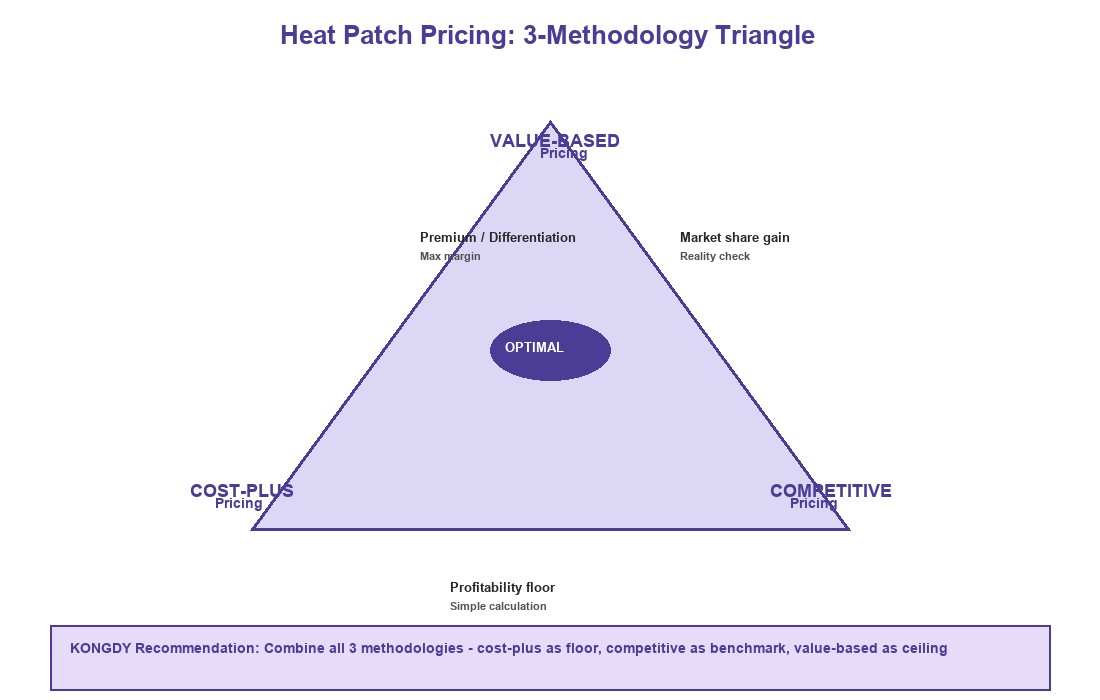
Three primary pricing methodologies work for B2B heat patch brands, each with different strategic implications.
Cost-plus pricing calculates total unit cost and adds a markup percentage. Formula: Selling Price = Total Cost × (1 + Markup %). Typical markup for B2B heat patch: 30-60% for wholesale, 100-200% for retail. Cost-plus ensures profitability on every unit but ignores competitive positioning.
Competitive-based pricing sets prices relative to competitor benchmarks. Formula: Selling Price = Competitor Price × Relative Position (e.g., 0.95x for value positioning, 1.10x for premium positioning). This approach captures market share dynamics but ignores cost structure.
Value-based pricing sets prices based on perceived customer value rather than cost or competition. Formula: Selling Price = Customer Perceived Value × Value Capture Rate (typically 30-60% for heat patches). This approach maximizes profitability for differentiated brands.
Most successful B2B heat patch brands combine all three methodologies: cost-plus as floor, competitive as benchmark, and value-based as ceiling. The actual price is set within this triangulated range based on brand strategy.
Different distribution channels have different margin structures, customer expectations, and pricing dynamics. Successful heat patch brands use channel-specific pricing rather than uniform pricing.
| Channel | Wholesale Price (per unit) | Retail Price (per unit) | Brand Margin |
|---|---|---|---|
| Direct-to-Consumer (DTC) | USD 0.40-0.55 | USD 2.50-5.00 | 85-92% |
| Amazon / Marketplaces | USD 0.40-0.55 | USD 2.00-4.50 | 80-88% |
| Specialty Retail | USD 0.45-0.60 | USD 2.50-5.50 | 60-75% |
| Mass Retail | USD 0.50-0.70 | USD 1.80-3.50 | 55-65% |
| Wholesale / Distribution | USD 0.30-0.45 | USD 1.50-3.00 | 45-60% |
| B2B Healthcare | USD 0.50-0.70 | USD 3.00-6.00 (patient price) | 70-85% |
KONGDY's KONGDY heat patch manufacturer brand team helps B2B clients design channel-specific pricing strategies aligned with their brand positioning and growth objectives.
Heat patch brands typically target one of three customer segments, each with different pricing expectations.
| Segment | Target Customer | Price Range (USD/unit retail) | Brand Examples |
|---|---|---|---|
| Premium | Quality-focused, willing to pay for efficacy and brand | 3.50-8.00 | High-end pharma, specialty health brands |
| Mid-Market | Balanced price/quality, mainstream consumers | 2.00-4.00 | Most DTC and specialty retail brands |
| Value | Price-sensitive, mass market, commodity buyers | 0.80-2.50 | Mass retail, discount channels |
Six pricing tactics work for heat patch brands at different growth stages. Most brands use 2-3 tactics simultaneously based on their stage and objectives.
Set initial price 15-30% below competitor average to gain market share quickly. Use for first 6-12 months. After building brand awareness and customer base, raise prices gradually. Penetration pricing sacrifices short-term margin for long-term market position.
Set initial price 20-40% above competitor average to capture premium positioning. Use for first 6-12 months. Skimming works for differentiated products with strong brand story and unique benefits. After establishing premium perception, maintain or expand pricing.
Offer multi-unit bundles (3-pack, 5-pack, 10-pack) at 10-25% discount vs single-unit price. Bundle pricing increases average order value by 30-50% and reduces per-unit shipping cost. Best for subscription models and family-use products.
Offer 10-30% discount for orders above certain thresholds (e.g., 10+ units, 50+ units, 100+ units). Volume discount encourages larger orders, improves customer retention, and reduces per-order overhead. Best for repeat customers and B2B buyers.
Offer 10-20% loyalty discount for repeat customers or subscription customers. Loyalty pricing improves customer lifetime value by 30-60% and reduces churn. Best for established brands with repeat purchase customer base.
A/B test different price points to find optimal revenue/margin balance. Test 2-3 price points for 4-8 weeks each. Price testing can identify 10-30% revenue lift opportunities. Best for established brands with sufficient traffic volume for statistical significance.
Competitive analysis is essential for strategic pricing. Use this 4-step framework to analyze competitor pricing effectively.
Direct competitors are brands selling similar products to similar customers. For heat patches, direct competitors include: other B2B heat patch brands, KONGDY-sourced competitors, in-house manufacturer brands, and pharmacy private labels. Identify 5-10 direct competitors for analysis.
Collect competitor pricing data from: brand websites, Amazon listings, retail store visits, industry reports, and buyer interviews. Standardize pricing by unit volume (e.g., price per single patch, per 5-pack, per 10-pack) for fair comparison.
Look for: price ranges by segment, pricing patterns by channel, promotional pricing frequency, and bundle pricing structures. Identify opportunities: underpriced segments, overpriced segments, and pricing gaps.
Choose positioning: value (below market), competitive (at market), or premium (above market). Position should align with brand differentiation and target customer. KONGDY's brand team supports competitive analysis for 600+ B2B partner brands.
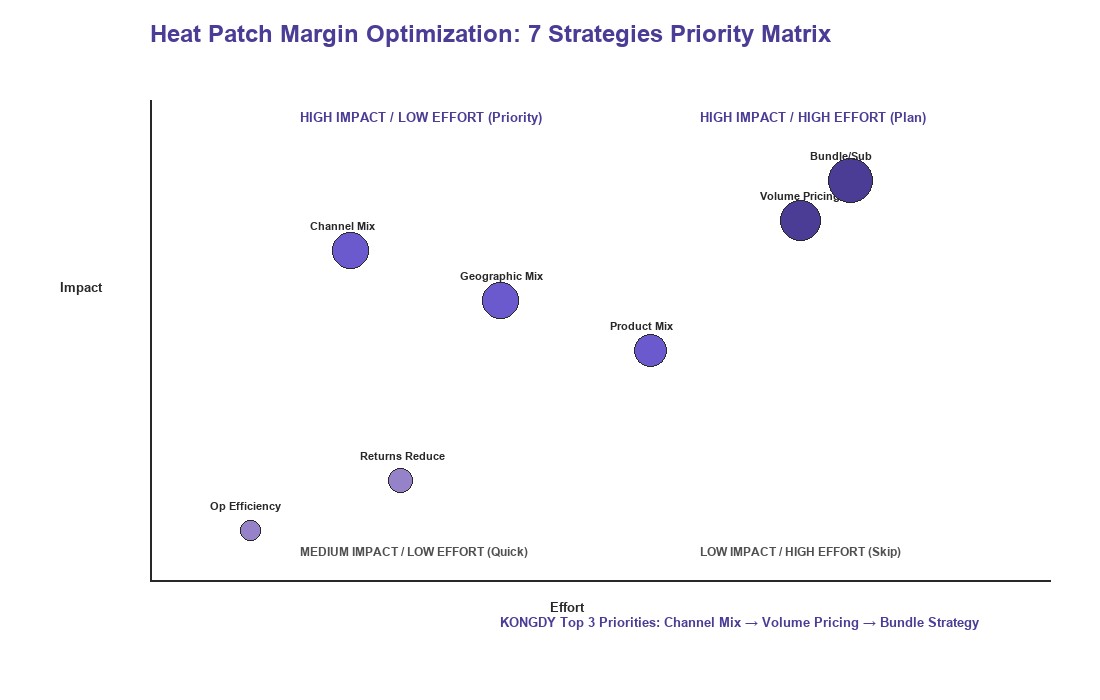
Margin optimization is the ongoing process of improving profitability through pricing, cost, and channel decisions. Seven strategies consistently improve heat patch brand margins.
| Strategy | Mechanism | Margin Impact |
|---|---|---|
| Channel Mix Shift | Move to higher-margin channels (DTC, specialty) | +10-25 percentage points |
| Volume Pricing Negotiation | Negotiate lower manufacturer cost at higher volumes | +5-15 percentage points |
| Bundle and Subscription | Increase average order value | +15-30 percentage points |
| Geographic Mix | Focus on higher-margin markets (EU, NA) | +10-20 percentage points |
| Product Mix | Promote higher-margin SKUs | +5-15 percentage points |
| Reduce Returns | Improve quality and customer expectations | +3-8 percentage points |
| Operational Efficiency | Reduce overhead per unit | +2-5 percentage points |
Dynamic pricing adjusts prices based on demand, competition, and inventory. For B2B heat patch brands, dynamic pricing is most relevant for promotional campaigns and seasonal adjustments.
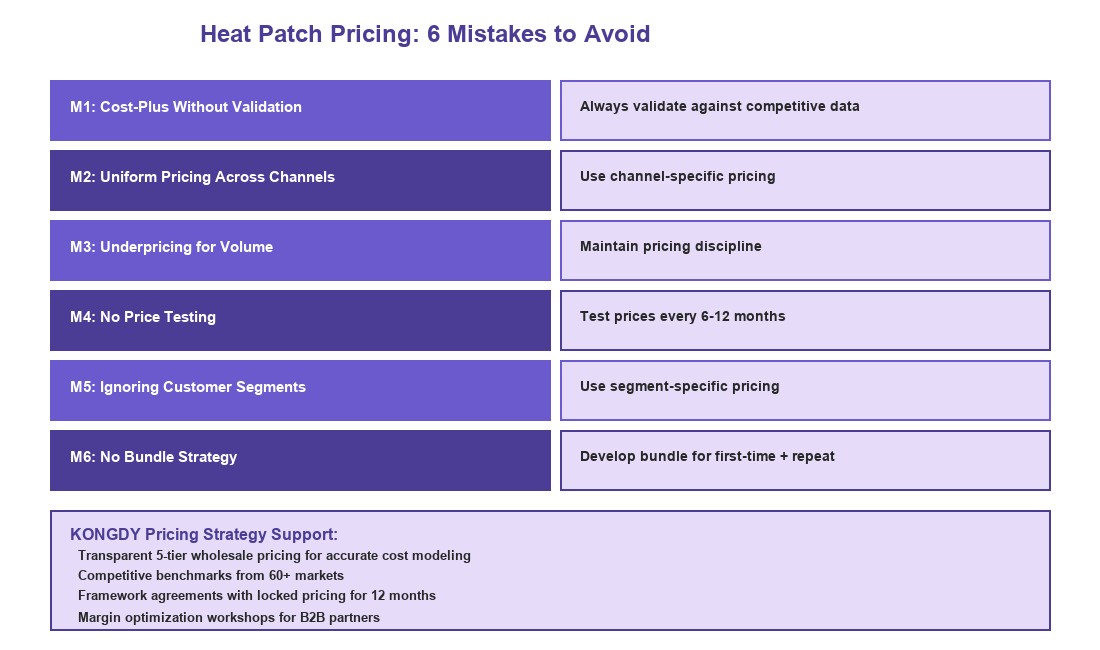
Six common mistakes cause 70% of B2B heat patch brands to misprice their products. Avoid these to maintain healthy margins and market position.
Mistake 1: Cost-Plus Without Market Validation. Cost-plus pricing without checking market rates can result in prices 20-50% above or below market. Always validate cost-plus pricing against competitive analysis.
Mistake 2: Uniform Pricing Across Channels. Setting the same price for DTC, retail, and wholesale ignores channel economics. Use channel-specific pricing to optimize per-channel profitability.
Mistake 3: Underpricing to Win Volume. Aggressive low pricing sacrifices 20-40% margin and attracts price-sensitive customers who churn when prices rise. Maintain pricing discipline even when chasing volume.
Mistake 4: No Price Testing. Setting prices once and never reviewing leaves 10-30% revenue lift opportunities on the table. Test pricing every 6-12 months to capture optimization opportunities.
Mistake 5: Ignoring Customer Segments. Same pricing for premium and value customers leaves money on the table. Use segment-specific pricing or product variants for different segments.
Mistake 6: No Bundle Strategy. Selling only single units misses 30-50% average order value lift from bundles. Develop bundle strategy for first-time and repeat customers.
Standard formulation wholesale price ranges from USD 0.30-0.55 per unit depending on order volume. Custom formulation adds 25-60% premium. KONGDY's pricing tiers: USD 0.40-0.55 (1-5K), USD 0.32-0.45 (5-20K), USD 0.25-0.38 (20-50K), USD 0.20-0.30 (50-200K), USD 0.18-0.26 (200K+).
Healthy retail margins: DTC 85-92%, Amazon 80-88%, Specialty retail 60-75%, Mass retail 55-65%, Wholesale 45-60%. Brands achieving below 50% retail margin should evaluate cost structure or pricing strategy.
Penetration (below market) suits differentiated brands entering crowded markets, where rapid share gain matters. Skimming (above market) suits premium brands with unique formulation and strong brand story. Most brands: penetration for first 6-12 months, then gradual price increases.
Quarterly review minimum. Annual comprehensive review. Pricing review should consider: cost changes, competitor moves, market dynamics, and customer feedback. KONGDY recommends pricing reviews aligned with re-order cycles (typically 3-6 months for B2B).
Yes, channel-specific pricing is standard practice. Different channels have different margin structures and customer expectations. Ensure pricing differences are justified by channel value (e.g., DTC includes direct customer relationship, retail includes shelf placement). Avoid extreme differences that could cause channel conflict.
Value-based pricing with skimming: set 20-40% above market, justify with unique formulation, premium packaging, and brand story. Maintain premium perception through consistent quality, marketing, and channel selection (specialty retail, premium DTC, healthcare).
KONGDY supports buyer pricing through: transparent manufacturer pricing tiers, sample cost modeling, competitive pricing benchmarks from 60+ markets, and partner introductions to brand-building agencies. KONGDY does not set retail pricing for buyers but provides the cost foundation for pricing decisions.
KONGDY's best wholesale pricing tier starts at 200,000+ units per order (USD 0.18-0.26 per unit). However, 50,000+ unit orders already access significant volume discounts. Annual framework agreements can achieve best-tier pricing at lower per-order volumes.
KONGDY is a leading heat patch manufacturer based in Henan, China, with 36 years of transdermal patch manufacturing experience and transparent pricing across 5 volume tiers. Our 36,000 m² facility supports B2B heat patch brands with cost modeling, competitive benchmarks, and pricing strategy guidance across 60+ markets.
KONGDY's pricing support includes: 5-tier transparent wholesale pricing, sample cost modeling for buyer projections, competitor pricing benchmarks from 60+ markets, payment term flexibility (T/T, L/C, Net-30 for established buyers), framework supply agreements with locked pricing for 12-month periods, and brand-building agency introductions for pricing strategy support. KONGDY's commercial team includes 12 account managers supporting English, Spanish, French, German, and Russian-speaking buyers.
Beyond heat patches, KONGDY also provides pricing support for pain patch manufacturer products and capsicum plaster manufacturer offerings, allowing B2B brands to consolidate procurement and leverage cross-category pricing benefits. Contact us at KONGDY Heat Patch Collection to discuss pricing options, request volume quotations, or schedule a pricing strategy consultation.
Heat patch pricing is not a one-time decision. It is an ongoing strategic discipline that affects unit profitability, market position, and brand sustainability. The cost structure, pricing methodologies, channel-specific pricing, competitive analysis, and margin optimization frameworks in this article give you the structure to price for profitability and growth.
The single most important variable is the integration between manufacturer pricing, channel strategy, and customer segment positioning. A manufacturer like KONGDY with transparent pricing tiers, cost modeling support, and competitive benchmarks provides the foundation for strategic pricing. A manufacturer with opaque pricing and no commercial support leaves buyers guessing at costs and pricing structures.
If you are evaluating KONGDY for your heat patch pricing strategy needs, request our pricing benchmark report, sample cost modeling worksheet, and competitive positioning guide at our KONGDY heat patch collection page. KONGDY responds to all pricing inquiries within 24 hours and can typically provide volume quotations within 3-5 business days of receiving order specifications.

