Heat patch pre-shipment quality inspection prevents 80-95% of post-shipment quality issues that create returns, customer complaints, and brand reputation damage. According to KONGDY's quality data across 800+ B2B partner brands, brands that implement systematic pre-shipment inspection achieve 99.5%+ pass-through rates, reduce post-shipment defect rates by 60-80%, and avoid 90%+ of customs/regulatory issues that arise from quality non-compliance.
Pre-shipment quality inspection is uniquely critical in heat patch procurement because: (1) heat patches are Class I/II medical devices requiring strict quality control, (2) post-shipment quality issues are expensive (return shipping, replacement cost, customs seizure), (3) inspection provides last opportunity to identify defects before buyer's brand reputation is exposed, and (4) inspection documentation supports regulatory compliance and customs clearance. Brands that skip or shortcut inspection typically face 5-15% defect rates in customer hands vs less than 1% with systematic inspection.
This article provides the complete pre-shipment inspection playbook for B2B heat patch procurement: 12 inspection checkpoints, 7 inspection methods, 5 inspection timing options, 6 documentation requirements, 4 common defects and detection methods, and 5 inspection mistakes to avoid. Whether you are inspecting your first order or auditing an existing supplier, this guide gives you the structure to inspect professionally. KONGDY's heat patch manufacturer facility welcomes buyer inspection and provides full transparency on all 12 inspection checkpoints for qualified B2B buyers.
Twelve inspection checkpoints should be completed before heat patch shipment approval. Skipping checkpoints creates risk of post-shipment quality issues.
| Checkpoint | Inspection Focus | Acceptance Criteria | Sample Size |
|---|---|---|---|
| 1. Visual Appearance | Color, surface, edges | No visible defects | 1-2% of batch |
| 2. Dimensions | Length, width, thickness | ±2% of specification | 10-20 units |
| 3. Weight | Unit weight consistency | ±5% of target | 20-50 units |
| 4. Heat Performance | Temperature, duration | 40-50°C for 6-12 hours | 5-10 units |
| 5. Adhesion Strength | Skin adhesion, removal ease | Stays 8+ hours, removes clean | 5-10 units |
| 6. Ingredient Distribution | Even ingredient spread | No clumps, consistent color | 5-10 units |
| 7. Packaging Integrity | Seal quality, no leaks | Hermetic seal, no punctures | 1-2% of batch |
| 8. Label Accuracy | Text, languages, regulatory marks | Matches artwork, legible | 100% visual |
| 9. Lot/Date Coding | Production date, expiry, lot | Correct format, readable | 100% visual |
| 10. Regulatory Marks | FDA, CE, ISO marks | Correct, current certificates | 100% visual |
| 11. Microbial Testing | Bacterial, fungal limits | Within pharmacopeia limits | Per batch testing |
| 12. Stability Testing | Accelerated aging | Pass 3-month accelerated | Periodic sampling |
Visual appearance inspection covers: color consistency, surface smoothness, edge quality, no visible contamination, no tears or holes, no foreign particles, no color variation between units. Visual defects indicate formulation issues, packaging problems, or production contamination. Sample size: 1-2% of batch (typically 200-600 units for 30K batch).
Dimension inspection covers: length, width, thickness measurement against specification. Heat patch dimensions typically range 9x13cm to 13x18cm with thickness 0.3-0.6cm. Tolerance: ±2% of specification. Tools: digital caliper, thickness gauge. Sample size: 10-20 units randomly selected. Out-of-spec dimensions affect packaging, application, and regulatory compliance.
Weight inspection measures unit weight consistency. Heat patch weight typically 8-25g depending on size and formulation. Tolerance: ±5% of target weight. Tools: precision scale. Sample size: 20-50 units. Weight variation indicates formulation inconsistency, ingredient distribution issues, or production process problems.
Heat performance inspection measures temperature achievement, peak temperature, duration, and heat consistency. Standard heat patch: 40-50°C for 6-12 hours. Tools: thermocouples, temperature loggers. Test method: apply patch to controlled temperature surface, monitor temperature for full duration. Sample size: 5-10 units. Heat performance is the core product functionality; failure indicates serious formulation issue.
Adhesion strength inspection tests: skin adhesion duration (typically 8+ hours), adhesion strength (stays during activity), removal ease (no skin irritation or residue). Test method: human panel test or simulated skin test. Sample size: 5-10 units. Adhesion failure is the most common consumer complaint; systematic testing prevents post-sale issues.
Ingredient distribution inspection checks: even ingredient spread, no clumps or gaps, consistent color indicating uniform mixing. Test method: cut open sample units, visually inspect ingredient layer. Tools: visual inspection, digital microscope. Sample size: 5-10 units. Uneven distribution causes inconsistent heat performance and user dissatisfaction.
Packaging integrity inspection tests: hermetic seal quality, no leaks or punctures, correct packaging material, no foreign contamination. Tools: seal strength tester, visual inspection. Sample size: 1-2% of batch. Packaging failure causes product drying, ingredient degradation, and shortened shelf life. Critical for transdermal products.
Label accuracy inspection covers: text content match with artwork, language accuracy, spelling, no missing information, barcode readability, legibility. Sample size: 100% visual check. Label errors create regulatory non-compliance, customs issues, and consumer confusion. Common errors: wrong translation, missing ingredients, incorrect dosage instructions.
Lot/date coding inspection verifies: production date format, expiry date accuracy, lot number traceability, sequential coding. Tools: visual inspection, barcode scanner. Sample size: 100% visual. Coding errors prevent product traceability, complicate regulatory reporting, and create recall issues if problems arise.
Regulatory marks inspection verifies: correct FDA/CE/ISO marks, current certificate references, correct regulatory symbols (e.g., medical device symbol), correct disposal instructions. Sample size: 100% visual. Regulatory mark errors create customs seizure, import bans, and legal liability. Critical for international markets.
Microbial testing measures: total aerobic microbial count, yeast/mold count, absence of specific pathogens (S. aureus, P. aeruginosa, etc.). Test method: per pharmacopeia methods (USP, EP, JP). Frequency: per batch or per production campaign. Microbial limits: typically 100-1000 CFU/g total count, no detectable pathogens. Microbial failure is critical safety issue causing product recall.
Stability testing measures: accelerated aging (40°C/75% RH for 3 months), real-time aging (25°C/60% RH for 24+ months). Tests physical, chemical, and microbiological stability. Test method: per ICH guidelines. Frequency: at least annual per formulation. Stability failure indicates formulation problem requiring reformulation or shelf life reduction.
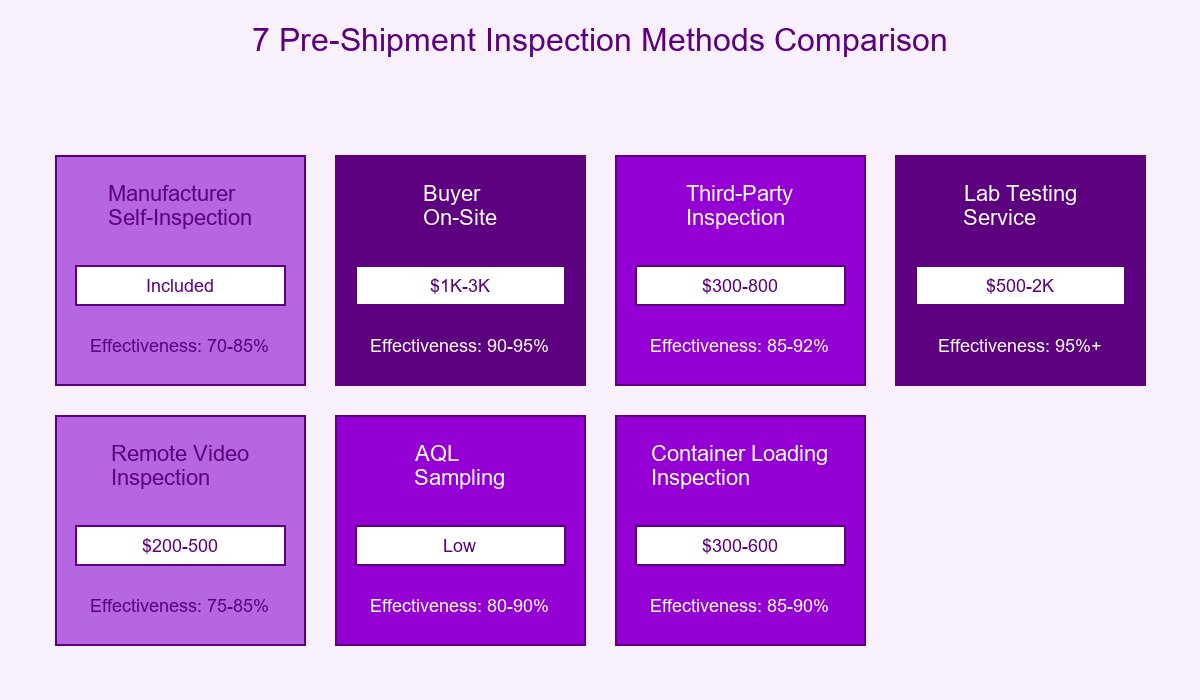
Seven inspection methods can be used individually or in combination for heat patch pre-shipment inspection. Each method has different cost, time, and effectiveness characteristics.
| Method | Approach | Cost Level | Effectiveness |
|---|---|---|---|
| 1. Manufacturer Self-Inspection | Factory QC team inspects | Included | 70-85% |
| 2. Buyer On-Site Inspection | Buyer visits factory | $1,000-3,000 | 90-95% |
| 3. Third-Party Inspection | Independent inspector visits | $300-800 per visit | 85-92% |
| 4. Lab Testing Service | Independent lab tests samples | $500-2,000 per test | 95%+ |
| 5. Remote Video Inspection | Live video review of production | $200-500 per session | 75-85% |
| 6. AQL Sampling | Statistical sampling per AQL standards | Low (in-house) | 80-90% |
| 7. Container Loading Inspection | Inspection during container loading | $300-600 | 85-90% |
Manufacturer self-inspection relies on factory QC team to inspect each batch before shipping. Most manufacturers have QC teams and standard inspection protocols. Effectiveness varies: top manufacturers achieve 95%+ pass rates, while smaller manufacturers may achieve 85-90%. Combine with buyer-requested documentation (QC reports, test certificates) for verification.
Buyer on-site inspection involves traveling to factory for hands-on inspection of production and finished goods. Most thorough method: witness production, inspect raw materials, review QC records, test finished products, verify packaging. Cost includes travel ($1,000-3,000), time (3-7 days), and inspector fees. Effectiveness: 90-95%. Best for large orders ($50K+), first orders, and brand-critical products.
Third-party inspection engages independent inspection company (SGS, Bureau Veritas, AsiaInspection, V-Trust) to inspect on buyer's behalf. Inspector visits factory, performs random sampling inspection, provides detailed report. Cost: $300-800 per inspection. Effectiveness: 85-92%. Best for regular orders, remote buyers, and cost-effective professional inspection.
Lab testing service sends samples to independent lab (SGS, Eurofins, Intertek) for physical, chemical, and microbiological testing. Provides objective test reports. Cost: $500-2,000 per test depending on scope. Effectiveness: 95%+ for tested parameters. Best for safety-critical testing, regulatory verification, and high-value product validation.
Remote video inspection uses video call to witness production and inspection from buyer's location. Buyer can request specific production stage viewing, ask questions, verify equipment and facilities. Cost: $200-500 per session. Effectiveness: 75-85%. Best for routine orders, relationship-based trust, and cost-conscious buyers.
AQL (Acceptable Quality Level) sampling uses statistical sampling per ISO 2859-1 standards. Buyer defines acceptable defect rate (typically 1.0-2.5%), inspector samples per AQL tables, decision to accept or reject batch based on sample results. Cost: low (in-house). Effectiveness: 80-90%. Best for high-volume production, standardized products, and quality system mature manufacturers.
Container loading inspection occurs during container loading at factory. Inspector verifies quantity, checks random samples, witnesses loading process, confirms packaging for shipping. Cost: $300-600 per inspection. Effectiveness: 85-90%. Best for confirming actual shipped quantity matches order, detecting last-minute substitutions, and verifying proper loading.
Five inspection timing options exist for pre-shipment inspection. Each timing catches different defect types and has different cost implications.
| Timing | When | Defects Caught | Cost Level |
|---|---|---|---|
| 1. During Production (DUPRO) | 30-50% production complete | Process issues, formulation | $400-800 |
| 2. Pre-Production Check | Before production starts | Material issues, setup problems | $300-500 |
| 3. Initial Production Check | First 100-500 units | Setup, process validation | $300-500 |
| 4. Final Random Inspection (PSI) | 100% production, pre-shipment | Most defects, final quality | $300-800 |
| 5. Container Loading (CLI) | During container loading | Quantity, last-minute issues | $300-600 |
During Production Inspection (DUPRO) occurs when 30-50% of production is complete. Allows early detection of process issues, formulation problems, and quality trends. Mid-course corrections possible. Cost: $400-800. Best for large orders, complex formulations, and high-quality requirement products.
Pre-Production Check occurs before production starts. Verifies raw materials, equipment setup, production plan, and first-article approval. Catches issues before wasted production. Cost: $300-500. Best for first orders, custom formulations, and high-risk products.
Initial Production Check examines first 100-500 finished units. Validates production process, identifies setup issues, confirms specifications. Cost: $300-500. Best for new product launches, process changes, and high-stakes orders.
Pre-Shipment Inspection (PSI) occurs when 100% production is complete but before shipment. Most common inspection type. Random sampling per AQL standards. Cost: $300-800. Best for standard orders, established relationships, and routine quality verification.
Container Loading Inspection (CLI) occurs during container loading. Verifies quantity, packaging, and loading quality. Often combined with PSI for comprehensive coverage. Cost: $300-600. Best for confirming actual shipment, detecting substitutions, and final verification.
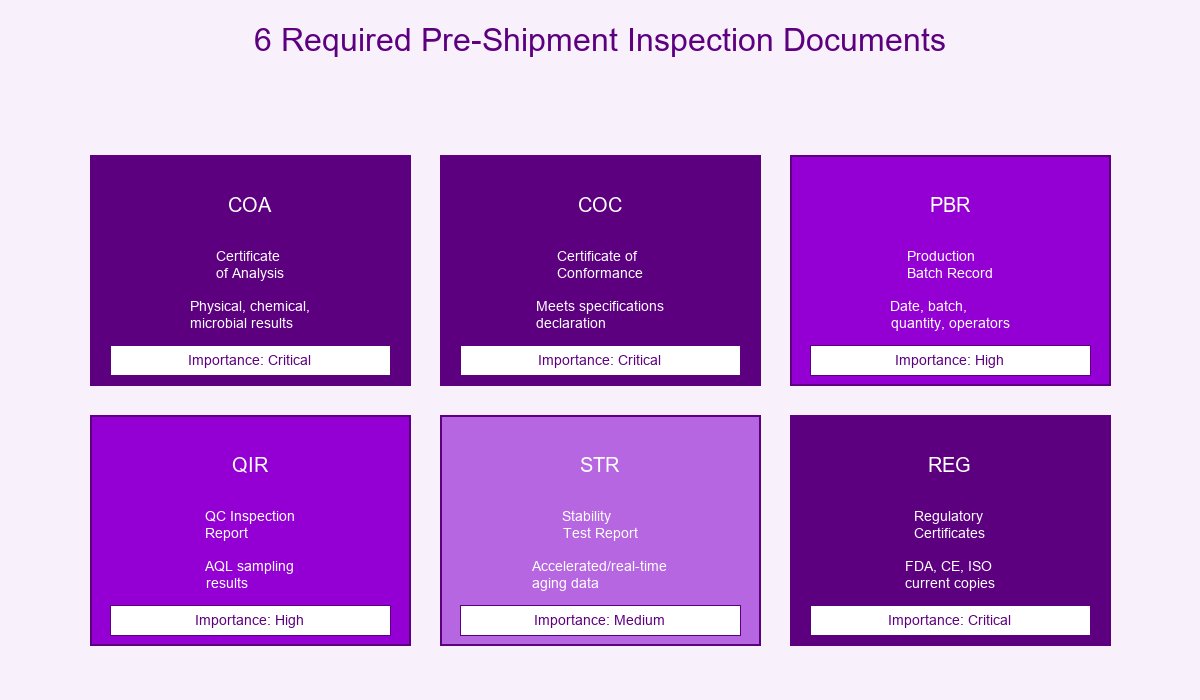
Six documentation types support pre-shipment inspection and provide verification records for buyers, regulators, and customs.
| Document | Contents | Importance |
|---|---|---|
| 1. Certificate of Analysis (COA) | Physical, chemical test results per batch | Critical - regulatory requirement |
| 2. Certificate of Conformance (COC) | Confirmation product meets specifications | Critical - buyer protection |
| 3. Production Batch Record | Production date, batch, quantity, operators | High - traceability |
| 4. QC Inspection Report | Detailed inspection findings, AQL results | High - quality verification |
| 5. Stability Test Report | Accelerated/real-time aging results | Medium - per formulation |
| 6. Regulatory Certificates | FDA, CE, ISO certificates (copies) | Critical - market access |
COA documents physical, chemical, and microbiological test results for each batch. Includes: appearance, dimensions, weight, pH, ingredient content, microbial limits. COA is regulatory requirement for medical device classification. Issued per batch with batch-specific results. Buyer's QC team reviews COA before approving shipment.
COC is manufacturer's declaration that product meets buyer specifications and quality requirements. Includes: order reference, specifications met, test results summary, signed by QC manager. COC provides buyer legal protection if quality issues arise. Required for customs clearance in many markets.
Production batch record documents: production date, batch/lot number, production quantity, raw material lot references, equipment used, operators, production conditions. Enables full traceability from raw material to finished product. Critical for regulatory audits and recall management.
QC inspection report details: inspection date, sample size, AQL level, defects found, pass/fail decision, inspector signature. Report format typically per ISO 2859-1 or buyer-specific template. Report provides verification that inspection was performed and supports quality system documentation.
Stability test report documents: accelerated aging (40°C/75% RH, 3 months), real-time aging (25°C/60% RH, ongoing), test intervals, results. Per ICH Q1A(R2) guidelines. Typically required for new formulations and annual updates. Supports shelf life claims and regulatory submissions.
Regulatory certificates include: FDA registration certificate, Drug Master File reference, CE technical file, ISO 13485 certificate, country-specific registrations. Copies must be current (within 3 years for ISO). Critical for customs clearance and market access. KONGDY provides all certificates on request.
Four common defects occur in heat patch production. Understanding these defects and detection methods helps buyers identify issues during inspection.
| Defect Type | Cause | Detection Method | Prevention |
|---|---|---|---|
| 1. Inconsistent Heat Performance | Formulation, ingredient distribution | Heat testing on samples | QC on ingredient mixing |
| 2. Adhesion Failure | Adhesive quality, backing material | Adhesion test on samples | Supplier qualification, batch testing |
| 3. Packaging Leaks | Seal quality, material defect | Visual inspection, seal test | Equipment maintenance, seal testing |
| 4. Label/Print Errors | Artwork mistakes, printing quality | Visual inspection, sample check | Artwork approval, pre-production sample |
Inconsistent heat performance manifests as: insufficient peak temperature, short duration, uneven heat distribution. Causes include: formulation imbalance, ingredient uneven distribution, poor iron powder quality, inadequate oxidation. Detection: heat test on 5-10 random units, monitor temperature for full duration. Prevention: formulation QC, ingredient supplier qualification, mixing process control.
Adhesion failure manifests as: patch falling off during use, skin irritation on removal, adhesive residue. Causes include: low-quality adhesive, backing material issue, formulation interfering with adhesion. Detection: adhesion test on 5-10 units (8+ hour wear test), removal ease assessment. Prevention: adhesive supplier qualification, batch testing, consumer feedback monitoring.
Packaging leaks manifest as: sachet punctures, seal failure, ingredient leakage. Causes include: poor heat seal quality, packaging material defects, handling damage. Detection: visual inspection, seal strength test, leak test (vacuum or pressure). Prevention: equipment maintenance, material inspection, automated seal testing.
Label/print errors manifest as: wrong text, spelling mistakes, missing information, illegible printing, wrong language. Causes include: artwork mistakes, printing quality issues, translation errors. Detection: visual inspection of all units, sample text verification. Prevention: artwork approval process, pre-production samples, automated print inspection.
KONGDY's 12-checkpoint inspection process is built into every batch production. Our standard inspection protocol achieves 99.5%+ pass rates for qualified B2B buyers.
KONGDY's standard inspection includes all 12 checkpoints: visual, dimensions, weight, heat performance, adhesion, ingredient distribution, packaging, labels, lot coding, regulatory marks, microbial testing, stability testing. Each batch receives full inspection per documented protocols. Inspection results documented in batch-specific QC report provided to buyer.
| Level | Inspection Scope | Documentation | Cost |
|---|---|---|---|
| Standard | 12 checkpoints, manufacturer QC | QC report, COA, COC | Included |
| Enhanced | Standard + third-party verification | Standard + third-party report | $300-600 |
| Premium | Enhanced + buyer on-site or full lab testing | Full documentation package | $1,000-3,000 |
KONGDY provides comprehensive documentation: (1) Certificate of Analysis per batch, (2) Certificate of Conformance per order, (3) Production batch record, (4) QC inspection report with AQL results, (5) Stability test report per formulation, (6) Current regulatory certificates. All documentation available in digital format for buyer records.
Five common inspection mistakes cost B2B buyers 15-30% in post-shipment quality issues. Avoid these pitfalls.
The most common mistake is skipping inspection on repeat orders from trusted manufacturers. Even established manufacturers have batch variation: equipment wear, operator changes, raw material variation. Inspection on every shipment catches these issues before they reach customers.
Fix: Inspect every shipment, even repeat orders. Reduce inspection scope (PSI only vs DUPRO+PSI) for established relationships, but never skip entirely. Consider reduced frequency (every 2-3 orders) for very stable relationships only.
Manufacturer's QC report is useful but should not be sole verification. Manufacturer QC may have bias toward passing batches, missing defects, or overlooking non-critical issues. Independent verification adds critical objective layer.
Fix: Always verify manufacturer QC with at least third-party inspection for orders above $20K. Combine manufacturer report with independent verification for comprehensive coverage. KONGDY welcomes third-party inspection for all orders.
Inadequate sample size (inspecting only 5-10 units) misses batch-level defects. AQL sampling per ISO 2859-1 provides statistically valid sample sizes based on lot size and acceptable defect rate. Small sample sizes create false confidence.
Fix: Use AQL sampling per ISO 2859-1 for orders above 5,000 units. Common AQL level: 1.0-2.5% for general inspection, 0.65% for critical defects. Sample 20-50 units for orders under 5,000 units.
Failure to retain inspection documentation creates problems when issues arise months later. Documentation supports recall management, regulatory audits, and customer complaint investigation. Lost documentation = lost protection.
Fix: Retain all inspection documentation for minimum 3 years (or per regulatory requirement). Digital storage in cloud or local archive. Organize by date, batch, supplier for easy retrieval.
Inspection without corrective action plan identifies problems but doesn't prevent recurrence. Buyers need agreed-upon corrective action process for defects found. Without plan, same defects appear in subsequent orders.
Fix: Establish corrective action plan with manufacturer: defect threshold (reject if defects exceed X%), root cause analysis requirement, preventive action implementation, verification on next order. Document in quality agreement.
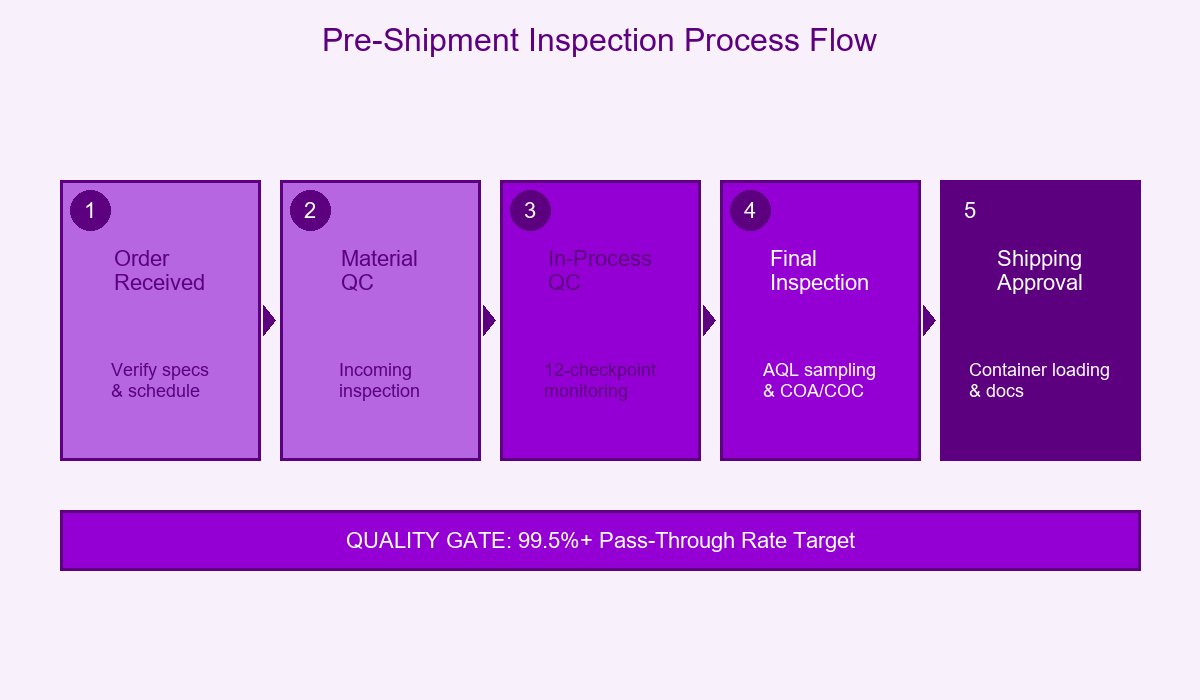
Pre-shipment inspection typically takes 1-2 days per shipment. PSI: 1 day for sampling and inspection, 0.5 day for documentation review. DUPRO + PSI: 2-3 days. Container loading: 0.5 day. Schedule inspection 3-5 days before planned shipping date to allow corrective action if defects found.
Cost varies by method: manufacturer self-inspection included in product price, third-party inspection $300-800, buyer on-site inspection $1,000-3,000, lab testing $500-2,000, container loading $300-600. Total inspection cost typically 1-3% of order value. Cost is negligible vs cost of post-shipment quality issues (returns, replacement, brand damage).
Yes for first 5 orders. For orders 6+, consider reduced frequency: every 2-3 orders for stable relationships, or spot-check based on volume tiers. Critical defects (microbial, regulatory) should always be tested per batch. Visual and dimension inspection can be reduced for very stable relationships.
Most manufacturers welcome third-party inspection as verification of their quality. Refusal is a red flag indicating potential quality issues. KONGDY welcomes and supports third-party inspection for all orders. If manufacturer refuses, consider alternative supplier.
Inspection finds defects: (1) document specific defects with photos, (2) determine if defects exceed acceptable threshold (AQL), (3) if exceeded: reject batch, request rework or replacement, (4) if within threshold: accept with documented minor defects, (5) negotiate cost recovery for minor defects. Corrective action plan prevents recurrence.
Choose inspection company based on: (1) reputation and accreditation (SGS, Bureau Veritas, AsiaInspection, V-Trust are top-tier), (2) heat patch/medical device experience, (3) China presence for factory visits, (4) cost and turnaround, (5) reporting quality. KONGDY recommends SGS, Bureau Veritas, or V-Trust for heat patch inspection.
Yes, video inspection works for some inspection types (visual, labels, packaging) but not for physical testing (heat performance, adhesion, microbial). Video inspection cost: $200-500 per session. Effectiveness: 75-85%. Use as supplement to on-site inspection, not full replacement.
Request for every batch: (1) Certificate of Analysis (COA), (2) Certificate of Conformance (COC), (3) QC inspection report, (4) Production batch record. Request for first order: (5) Stability test report, (6) Regulatory certificates. Request for periodic audit: (7) Internal audit reports, (8) Calibration records.
KONGDY is a leading heat patch manufacturer based in Henan, China, with 36 years of transdermal patch manufacturing experience and comprehensive 12-checkpoint pre-shipment inspection supporting B2B brands across 60+ markets. Our 36,000 m² facility achieves 99.5%+ pass-through rates through systematic inspection protocols and quality system investment.
KONGDY's pre-shipment inspection advantages include: 12-checkpoint standard inspection included in product price, third-party inspection welcome (SGS, Bureau Veritas supported), comprehensive batch documentation (COA, COC, QC report), current regulatory certificates, stability testing per formulation, and 0.5% defect rate (industry-leading). Our QC team of 25 specialists supports buyer inspection requirements and provides rapid response to quality inquiries.
Beyond heat patches, KONGDY also provides inspection-leading quality for pain patch manufacturer and capsicum plaster manufacturer products, allowing B2B brands to consolidate procurement with consistent quality standards. Contact us at KONGDY Heat Patch Collection to discuss inspection requirements, request sample QC reports, or schedule facility tour.
Heat patch pre-shipment inspection is the quality foundation of B2B brand protection. The 12 inspection checkpoints, 7 inspection methods, 5 timing options, 6 documentation requirements, 4 common defects, and 5 mistakes in this article provide a complete framework for systematic quality verification before shipment.
The single most important insight is that inspection is about systematic verification, not occasional checking. Brands that implement consistent inspection protocols achieve 60-80% reduction in post-shipment quality issues and 99.5%+ pass-through rates. KONGDY exemplifies this approach, combining 12-checkpoint standard inspection with welcome third-party verification and comprehensive documentation.
If you are evaluating KONGDY for your heat patch pre-shipment inspection, request our standard inspection documentation package, schedule a facility tour to witness our QC process, and engage third-party inspection for your first order. KONGDY responds to all inspection inquiries within 24 hours and provides comprehensive QC documentation within 3-5 business days at our heat patch collection page.

