Heat patch payment terms negotiation determines 10-20% of total procurement cost through financing cost optimization, cash flow management, and risk allocation. According to KONGDY's procurement analysis across 800+ B2B partner brands, brands that systematically negotiate payment terms reduce working capital requirements by 20-35%, lower effective procurement cost by 8-15% through financing cost savings, and strengthen supplier relationships through transparent financial structures.
Payment terms negotiation is uniquely critical in heat patch procurement because: (1) heat patch orders typically require 30-50% deposit upfront plus balance payment before shipping, creating significant working capital pressure, (2) payment terms directly impact cash flow and financing costs, (3) payment structure signals partnership trust and commitment level, and (4) negotiated terms establish financial framework for 3-5 year supplier relationships. Brands that default to standard payment terms without negotiation often overpay 5-15% in effective costs and tie up unnecessary working capital.
This article provides the complete payment terms negotiation playbook for B2B heat patch procurement: 8 standard payment structures, 12 negotiation tactics, 5 manufacturer red lines, 6 alternative financing structures, and 4 common mistakes to avoid. Whether you are launching your first order or scaling an existing product line, these tactics help you achieve optimal payment economics while maintaining supplier partnership health. KONGDY's heat patch manufacturer facility provides transparent payment terms and welcomes payment structure negotiation for qualified B2B partners.
Eight standard payment structures exist in heat patch B2B procurement. Each structure has different risk allocation, financing implications, and partnership signals.
| Structure | Buyer Cash Flow Impact | Manufacturer Risk | Best For |
|---|---|---|---|
| 1. 100% T/T upfront | Highest upfront burden | Lowest risk | Cash buyers, small orders |
| 2. 30/70 T/T (deposit + balance) | High upfront burden | Low risk | First orders, new buyers |
| 3. 50/50 T/T split | Balanced burden | Medium risk | Established relationships |
| 4. 30/40/30 T/T (staged) | Lower upfront burden | Medium risk | Long-term contracts |
| 5. 100% L/C at sight | Low upfront burden | Low risk (LC secured) | Large orders, established buyers |
| 6. L/C + balance T/T | Balanced burden | Low risk | Mixed-size orders |
| 7. Open Account (Net 30/60) | Lowest upfront burden | Highest risk | Trusted long-term partners |
| 8. Consignment payment | Pay-on-sale basis | Highest manufacturer risk | Strategic partnerships |
100% T/T upfront requires full payment before production begins. Buyer carries 100% of production risk; manufacturer carries 0% credit risk. This structure is common for very small orders (under $5,000), cash buyers seeking maximum discount, and new brand relationships. Buyer benefit: typically 5-10% discount vs deposit structures. Drawback: maximum upfront capital requirement and risk exposure if production fails.
30/70 T/T is the industry standard for new B2B relationships. Buyer pays 30% deposit to start production, 70% balance after QC approval but before shipping. This structure balances buyer risk (deposit only) with manufacturer risk (70% balance). Most common structure for first 3-5 orders in new relationships.
50/50 T/T splits payment equally: 50% deposit to start production, 50% balance before shipping. This structure provides more cash flow flexibility for buyers while signaling serious commitment. Common for established relationships (3+ orders), repeat customers, and buyers seeking slight cost reduction through stronger commitment.
30/40/30 T/T staged structure: 30% deposit at order, 40% mid-production (after first batch QC), 30% before shipping. This structure provides manufacturers with progressive cash flow while reducing buyer risk. Common for orders above $50,000, long-term contract orders, and buyers with limited working capital.
100% L/C at sight requires buyer to open Letter of Credit covering full order value. Bank guarantees payment upon shipping document presentation. Buyer benefits: 0% upfront capital, bank-managed risk. Manufacturer benefits: guaranteed payment via bank. Cost: 1-3% L/C issuance fee. Common for large orders ($100K+), first-time international buyers, and risk-averse procurement teams.
L/C + balance T/T structure: 30% deposit via T/T, 70% balance via L/C at sight. This structure reduces L/C issuance costs (only 70% via L/C) while providing security for both parties. Common for orders $50K-150K, established buyers seeking L/C benefits without full L/C cost.
Open Account Net 30/60 means buyer pays 30 or 60 days after shipping. Manufacturer carries 100% credit risk. This structure is reserved for buyers with 12+ month track records, strong credit history, and long-term contracts. Buyer benefit: maximum cash flow flexibility. Manufacturer risk: high default exposure.
Consignment payment means buyer pays only when inventory is sold to end customer. Manufacturer holds inventory and carries all inventory risk. Buyer benefit: zero inventory investment. Manufacturer risk: highest in standard structures. Used for strategic partnerships, new product launches with uncertain demand, and innovation-stage products.
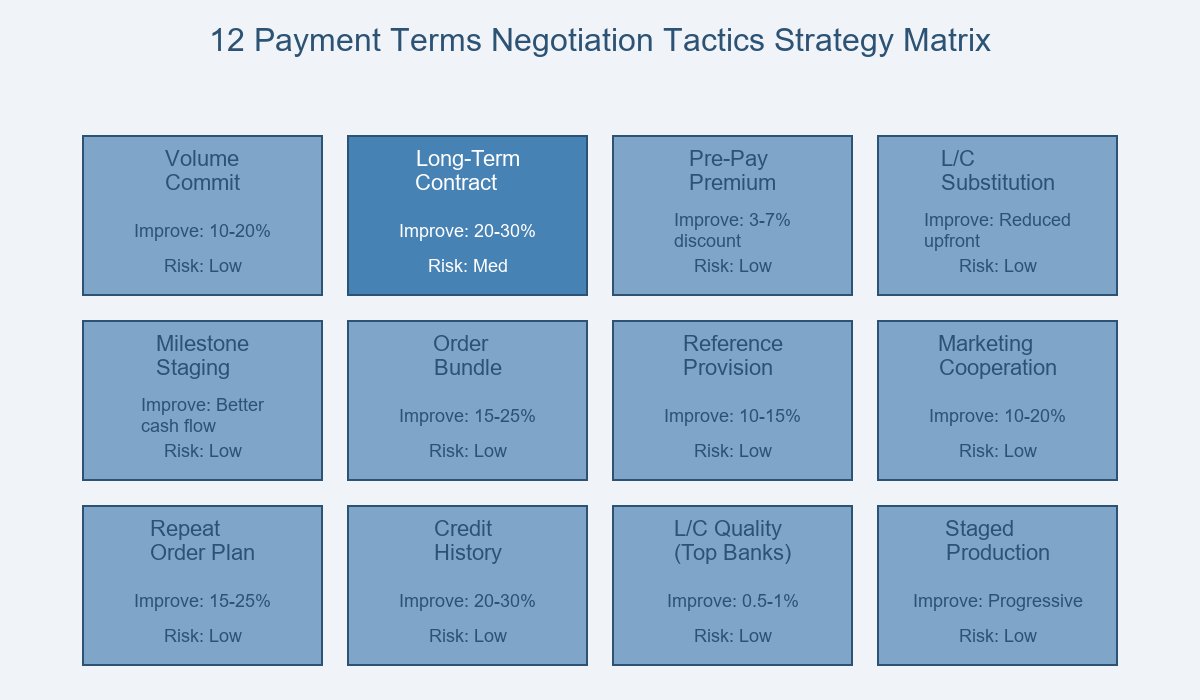
Twelve negotiation tactics work effectively for heat patch payment terms. Each tactic works best in specific situations and requires preparation.
| Tactic | Best For | Expected Improvement | Risk Level |
|---|---|---|---|
| 1. Volume Commitment | Multi-order planning | 10-20% deposit reduction | Low risk |
| 2. Long-Term Contract | 12+ month commitments | 20-30% deposit reduction | Medium risk |
| 3. Pre-Pay Premium | Cash-rich buyers | 3-7% price discount | Low risk |
| 4. L/C Substitution | Large orders | Reduced upfront payment | Low risk |
| 5. Milestone Staging | Custom formulations | Better cash flow | Low risk |
| 6. Order Bundle | Multi-category orders | 15-25% deposit reduction | Low risk |
| 7. Reference Provision | Strong brand reputation | 10-15% deposit reduction | Low risk |
| 8. Marketing Cooperation | Brand-conscious manufacturers | 10-20% deposit reduction | Low risk |
| 9. Repeat Order Plan | Growth-stage brands | 15-25% deposit reduction | Low risk |
| 10. Credit History | Established brands | 20-30% deposit reduction | Low risk |
| 11. L/C Issuance Quality | Top-tier banks | Reduced L/C costs | Low risk |
| 12. Staged Production | Large orders | Progressive payment matching production | Low risk |
Volume commitment tactics offer guaranteed multi-order volume in exchange for reduced deposit requirements. Typical structure: commit to 3-5 orders over 6-12 months, accept 12-month price hold, and receive 10-20% deposit reduction. Manufacturer benefits from guaranteed production planning; brand benefits from lower upfront capital.
Implementation example: KONGDY brand commits to 100K units over 3 orders within 12 months; KONGDY accepts 20% deposit (vs 30% standard) and locks pricing for 12 months. Brand reduces upfront capital by 33% with 100% volume commitment.
Long-term contract tactics commit to 12-24 month supplier relationship in exchange for significantly reduced deposit requirements. Typical structure: 12-month minimum commitment, 3-5 order schedule, locked pricing tiers, and 20-30% deposit reduction. Combined with net terms or staged payments for maximum impact.
Implementation example: Brand commits to 200K unit annual volume over 4 orders. KONGDY accepts 20% deposit + Net 30 balance (vs 30% deposit + before-shipping), locks pricing for 12 months. Result: 33% upfront capital reduction + post-shipment payment flexibility.
Pre-pay premium tactics offer 100% upfront payment in exchange for 3-7% price discount. Buyer benefits from maximum discount; manufacturer benefits from zero credit risk and immediate cash flow. Common for cash-rich buyers, inventory liquidation situations, and brands seeking maximum cost efficiency.
Implementation example: Standard price $0.50/unit with 30/70 T/T. Pre-pay offer: $0.47/unit with 100% T/T upfront. Brand saves 6% on unit cost but requires 100% upfront capital ($47,000 vs $30,000 deposit on 100K order). Break-even depends on buyer's financing cost vs discount savings.
L/C substitution tactics offer Letter of Credit in exchange for reduced upfront payment. Bank-issued L/C provides manufacturer with payment guarantee, enabling 10-20% deposit reduction. Buyer pays L/C issuance fee (1-3%) but gains working capital flexibility. Common for orders above $50K and risk-averse procurement teams.
Implementation example: Standard 30% T/T deposit. L/C alternative: 0% T/T deposit + 100% L/C at sight. Brand pays 1.5% L/C issuance fee ($1,500 on $100K order) but saves $30,000 upfront capital. Net benefit: $28,500 working capital freed.
Milestone staging tactics split payment into 3-4 stages tied to production milestones. Common stages: deposit, material procurement, production completion, QC approval. Each stage payment tied to verifiable milestone. Buyer benefits from reduced risk; manufacturer benefits from progressive cash flow matching production progress.
Implementation example: Standard 30/70 T/T. Milestone alternative: 20% deposit + 30% material ready + 30% production complete + 20% before shipping. Brand reduces upfront capital by 33% and increases payment-to-progress alignment.
Order bundle tactics combine multiple product categories in single order, enabling 15-25% deposit reduction. Manufacturer benefits from larger total order value; brand benefits from lower per-category deposit. Common for brands launching multiple product lines.
Implementation example: Single category order requires 30% deposit. Multi-category bundle (heat + pain + capsicum) requires 20% deposit. Brand reduces upfront capital by 33% while consolidating procurement.
Reference provision tactics offer brand reputation, customer references, and case study rights in exchange for deposit reduction. Manufacturers value references for sales and marketing, enabling 10-15% deposit reduction. Common for well-known brands, strong reputation, and media-visible companies.
Implementation example: Brand offers KONGDY as "featured manufacturer" on website, provides testimonial, and includes KONGDY logo in retail packaging. KONGDY reduces deposit from 30% to 25% (17% reduction) in exchange for marketing cooperation.
Marketing cooperation tactics offer brand marketing support (joint PR, social media, trade show) in exchange for deposit reduction. Typical 10-20% deposit reduction in exchange for marketing commitments spanning 12-24 months. Common for brand-conscious manufacturers and DTC brands.
Implementation example: Brand commits to featuring KONGDY in 2 trade shows per year, joint social media campaigns, and case study publication. KONGDY reduces deposit from 30% to 24% (20% reduction) in exchange for 24-month marketing cooperation.
Repeat order plan tactics commit to 3+ orders over 6-12 months in exchange for deposit reduction. First order carries standard deposit; subsequent orders carry reduced deposit. Common for growth-stage brands and brands in expansion mode.
Implementation example: Brand commits to 4 orders over 12 months. KONGDY accepts 30% deposit for first order, 20% deposit for orders 2-4. Brand reduces average deposit by 25% across annual volume.
Credit history tactics leverage buyer's strong credit profile to negotiate deposit reduction. Buyers with 3+ years business history, clean credit reports, and stable financials qualify for 20-30% deposit reduction. Common for established brands and corporate buyers with strong credit ratings.
Implementation example: Brand provides 3-year audited financials, D&B credit report, and business registration showing 5+ years history. KONGDY reduces deposit from 30% to 20% (33% reduction) based on creditworthiness.
L/C issuance quality tactics offer L/C from top-tier banks (HSBC, Standard Chartered, Bank of China) in exchange for lower L/C fees. Premium L/C carries lower risk for manufacturer, enabling 0.5-1% L/C fee reduction. Common for corporate buyers with established banking relationships.
Implementation example: Standard L/C fee: 2% of order value. Brand offers L/C from HSBC (top-tier). KONGDY reduces L/C fee to 1% in exchange. Brand saves 1% ($1,000 on $100K order) on L/C issuance.
Staged production tactics align payment with production batches. Multiple smaller batches enable progressive payment, reducing per-batch payment and total risk. Common for large orders, custom formulations, and inventory-constrained manufacturers.
Implementation example: Standard 100K unit order with 30/70 T/T. Staged alternative: 4 batches of 25K units, each with 30% deposit + 70% before batch shipping. Brand reduces per-batch capital by 75% ($7,500 vs $30,000) and increases payment-to-delivery alignment.
Five manufacturer payment red lines should never be crossed during payment negotiation. Violating these creates failed deals or partnership damage.
| Red Line | Why It Exists | Consequence of Violation |
|---|---|---|
| 1. Below-cost deposit | Material procurement coverage | Manufacturer refuses order |
| 2. Net 60+ for new buyer | Cash flow protection | Refused, standard terms required |
| 3. Non-bank-guaranteed terms | Credit risk management | Refused, secured terms required |
| 4. 100% post-delivery payment | Manufacturer survival protection | Refused outright |
| 5. USD vs RMB exchange risk shift | Currency risk allocation | Manufacturer walks away |
Manufacturers require deposits covering material procurement costs (typically 20-30% of order value). Deposits below 15% create material procurement risk for manufacturer and are typically refused. KONGDY's heat patch material costs range from 40-60% of order value, requiring minimum 15-20% deposit to cover material procurement.
New buyers (no purchase history) cannot demand Net 60 or longer payment terms. Manufacturers require established track record (12+ months, 3+ orders) before extending net terms. New buyers should expect deposit balance (30-50%) before shipping.
Manufacturers require payment security through bank instruments (T/T, L/C) or credit insurance. Unsecured payment terms (personal guarantees, post-dated checks) are typically refused. For international orders, L/C from reputable bank is minimum standard for orders above $50K.
Manufacturers will not accept 100% post-delivery payment terms. Even consignment structures require some upfront commitment. 100% post-delivery payment creates unacceptable cash flow risk and is typically refused outright.
Currency exchange risk allocation is non-negotiable. Buyers cannot shift 100% of exchange risk to manufacturer. Standard practice: 50/50 split, or buyer bears full risk via USD payment. Manufacturers will walk away from deals attempting to force full exchange risk shift.
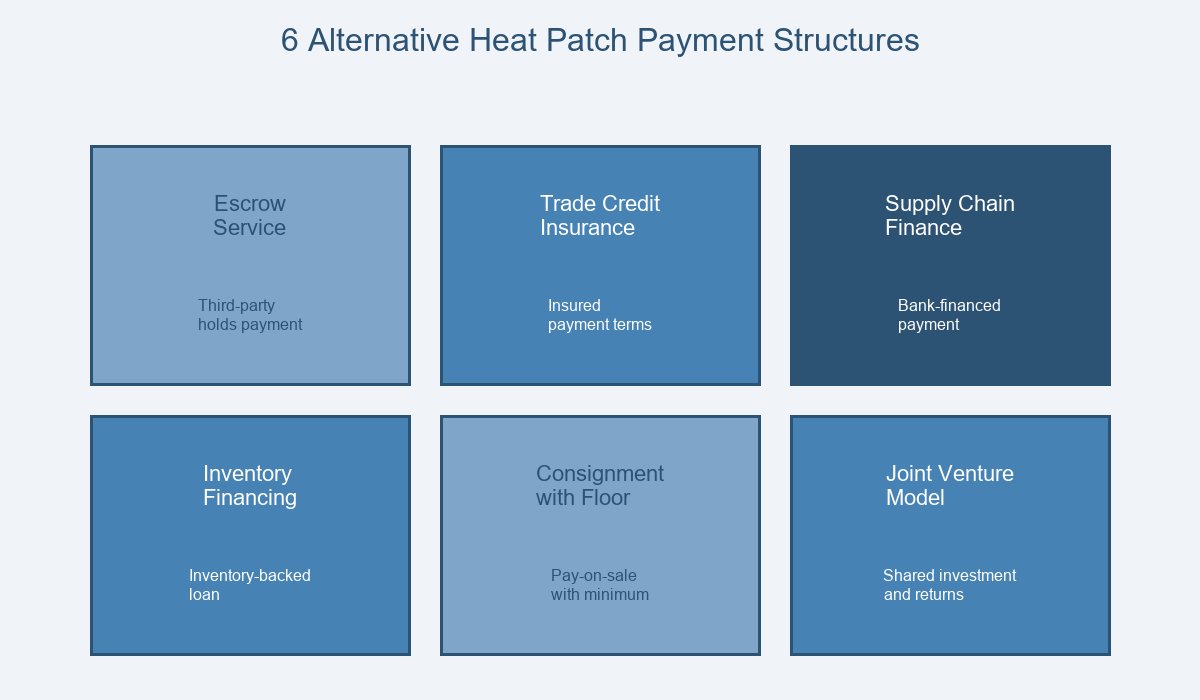
Six alternative payment structures provide flexibility for special buyer situations. Creative structures can unlock better terms for both parties.
| Structure | How It Works | Best For |
|---|---|---|
| 1. Escrow Service | Third-party holds payment | First-time relationships |
| 2. Trade Credit Insurance | Insured payment terms | New international buyers |
| 3. Supply Chain Finance | Bank-financed payment | Cash-constrained brands |
| 4. Inventory Financing | Financing backed by inventory | Growing brands |
| 5. Consignment with Floor | Pay-on-sale with minimum guarantee | Innovation-stage products |
| 6. Joint Venture Model | Shared investment and returns | Strategic partnerships |
Escrow service structure: third-party (Alibaba Trade Assurance, escrow.com) holds payment until buyer confirms quality. Buyer deposits full payment to escrow, manufacturer ships order, buyer has 7-30 days to inspect, escrow releases payment upon approval. Cost: 1-3% escrow fee. Best for first-time relationships and high-value orders.
Trade credit insurance structure: buyer purchases credit insurance (Euler Hermes, Coface) covering manufacturer against non-payment. Insurance premium (1-2% of order value) enables manufacturer to accept Net 60/90 terms. Best for new international buyers and growth-stage brands.
Supply chain finance structure: bank provides financing to buyer for manufacturer payment, buyer repays bank over 60-180 days. Bank pays manufacturer per agreed terms (typically 30/70 T/T or L/C). Buyer benefits: extended payment terms. Cost: 3-8% annualized interest. Best for cash-constrained brands with strong credit.
Inventory financing structure: bank or financing company provides loan using finished goods inventory as collateral. Buyer purchases inventory, finances holding via inventory loan, repays loan as inventory sells. Cost: 4-10% annualized. Best for growing brands and seasonal inventory builds.
Consignment with floor structure: manufacturer produces inventory, holds in consignment, buyer pays as sold but guarantees minimum purchase (e.g., 70% of order within 12 months). Buyer benefits: reduced risk. Manufacturer benefits: minimum revenue guarantee. Best for innovation-stage products and new market entries.
Joint venture model: buyer and manufacturer share investment and returns for specific product/market. Buyer contributes capital and market access; manufacturer contributes production and expertise. Returns split per agreement. Best for strategic partnerships and emerging market entries.
KONGDY approaches payment terms as partnership-building rather than single-transaction optimization. Our standard payment terms and negotiation flexibility reflect 36 years of B2B partnership experience.
| Buyer Type | Standard Terms | Negotiated Terms (with tactics) |
|---|---|---|
| New buyer (first order) | 30% T/T deposit + 70% T/T before shipping | 20% deposit + 80% before shipping (with tactics) |
| Established buyer (3+ orders) | 30% T/T + 70% T/T before shipping | 20% deposit + 80% Net 30 |
| Long-term partner (12+ months) | 30% T/T + 70% Net 30 | 15% deposit + 85% Net 60 |
| Strategic partner (24+ months) | 20% T/T + 80% Net 60 | 10% deposit + 90% Net 90 |
| L/C buyers (any stage) | 100% L/C at sight | Negotiable L/C fees |
| Consignment partners (rare) | Pay-on-sale with minimum | Custom negotiation |
KONGDY offers flexibility in 5 payment areas: (1) deposit percentage (negotiation reduces 30% to 15-20% range), (2) balance payment timing (Net 30 to Net 90 for established buyers), (3) payment method (T/T, L/C, mixed), (4) installment staging (3-4 stage milestone payments), (5) currency (USD, EUR, RMB options).
KONGDY maintains 3 payment constraints: (1) minimum 15% deposit (below material procurement cost coverage), (2) standard T/T or L/C payment methods (no unsecured terms), (3) currency exchange risk shared equally (or buyer bears full). These constraints ensure sustainable operations while allowing meaningful payment flexibility.
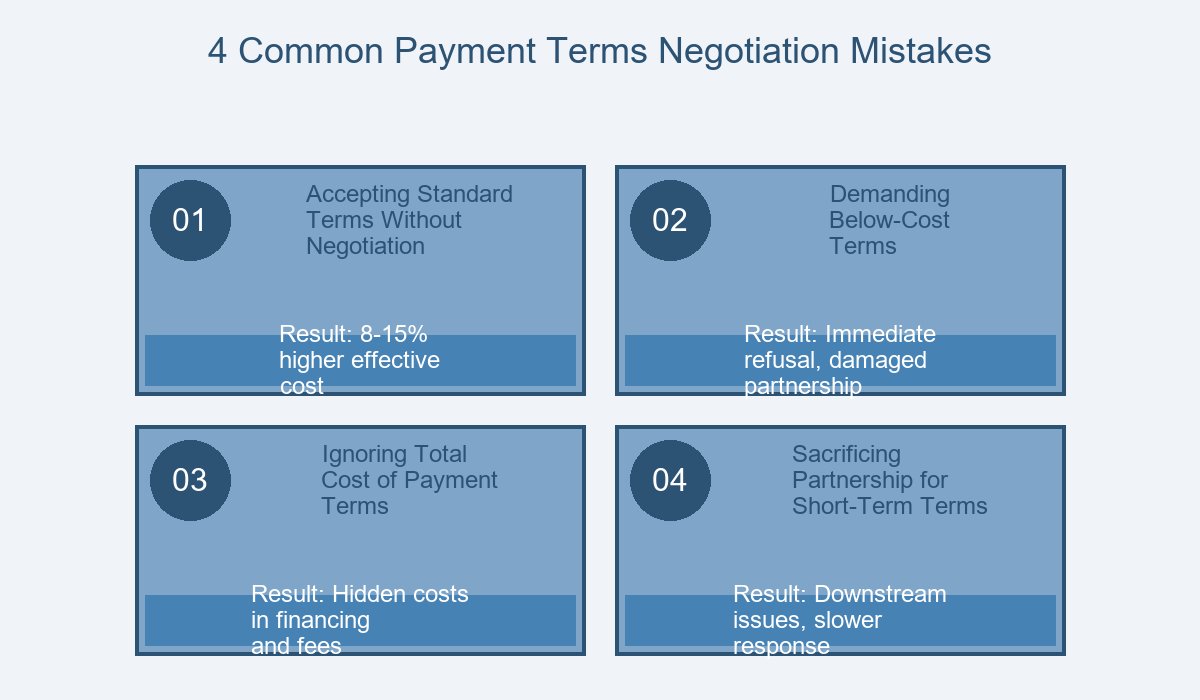
Four common payment terms negotiation mistakes cost B2B buyers 10-25% in unnecessary costs or failed partnerships. Avoid these pitfalls.
The most common mistake is accepting manufacturer's standard payment terms without negotiation. Standard terms benefit manufacturer cash flow position; negotiation aligns terms with buyer's actual needs. Brands that skip negotiation typically overpay 8-15% in effective financing costs.
Fix: Always negotiate payment terms using 2-3 applicable tactics from this article. Even modest improvements (5-10% deposit reduction) yield significant working capital savings over 12-month procurement cycles.
Unrealistic demands (e.g., 100% Net 90 for new buyer, 5% deposit for $100K order) damage partnership credibility and result in immediate refusal. Such demands signal inexperience and create manufacturer resistance to future negotiations.
Fix: Respect 5 manufacturer red lines. Demands below these thresholds signal either ignorance or bad faith, both of which damage partnership. Negotiate within realistic ranges using tactics from this article.
Focusing only on deposit percentage misses total cost of payment terms. Longer payment terms (Net 60 vs Net 30) may have higher effective cost when factoring financing rates. Lower deposit may require L/C with 1-3% fees. Calculate total cost of payment structure, not just headline terms.
Fix: Calculate total cost of payment structure: deposit % × capital cost + balance % × financing cost × time period + L/C fees + bank fees. Compare structures on total cost basis, not headline deposit only.
Extreme payment term aggression (demanding unrealistic terms) damages partnership and creates downstream issues: slower response, lower priority, reduced flexibility in quality issues. Short-term payment savings often cost more in partnership friction.
Fix: Balance payment term optimization with partnership health. Negotiate firmly but respectfully. Manufacturers value partnerships where both parties achieve reasonable economics. Aggressive negotiation damages long-term value.
Standard heat patch payment terms for new B2B relationships: 30% T/T deposit + 70% T/T balance before shipping. Established relationships (3+ orders): 30% T/T + 70% Net 30. Long-term partners (12+ months): 20% T/T + 80% Net 60. KONGDY's standard terms are 30% deposit + 70% before shipping, with negotiation flexibility reducing deposit to 15-20% range for qualified partners.
Generally no for new buyers. 100% post-delivery payment (Net 90 or open account) requires 12+ month track record, 3+ successful orders, and strong credit history. New buyers should expect 30-50% deposit upfront. KONGDY accepts 100% post-delivery only for buyers with 24+ month partnership history and 5+ successful orders.
Most cost-effective payment method depends on buyer's financing cost: (1) 100% T/T upfront offers 3-7% discount but requires upfront capital, (2) 30/70 T/T is industry standard with no fees, (3) 100% L/C costs 1-3% but provides 0% upfront capital, (4) Supply chain finance costs 3-8% annualized but extends payment 60-180 days. Calculate total cost based on buyer's financing rate and available capital.
Realistic deposit reduction depends on partnership structure: volume commitment 10-20%, long-term contract 20-30%, repeat order plan 15-25%, credit history 20-30%, marketing cooperation 10-20%. Combined tactics can achieve 30-50% deposit reduction (from 30% standard to 15-20% range). KONGDY brands using 3-4 tactics typically achieve 25-40% deposit reduction.
T/T (Telegraphic Transfer) is direct bank-to-bank transfer, typically used for deposit + balance. L/C (Letter of Credit) is bank-guaranteed payment upon shipping document presentation, providing security for both parties at 1-3% cost. D/P (Documents against Payment) means manufacturer releases shipping documents upon buyer's payment, common in established relationships. T/T is most common for small-medium orders; L/C for large orders; D/P for trusted relationships.
Currency choice depends on buyer's home currency and exchange risk tolerance. USD is standard for international orders and eliminates buyer's exchange risk on USD-denominated sales. RMB offers 1-2% discount typically but exposes buyer to currency fluctuation. KONGDY accepts both USD and RMB. Buyers selling in USD should pay in USD to avoid exchange risk. Buyers selling in EUR or other currencies should evaluate exchange costs.
Yes, combining tactics yields best results. Common combinations: (1) volume commitment + long-term contract + marketing cooperation (achieves 30-40% deposit reduction), (2) repeat order plan + credit history (achieves 25-35% deposit reduction), (3) order bundle + L/C substitution (achieves 15-25% deposit reduction). However, balance tactics against manufacturer margin; over-negotiation creates partnership strain.
Late deposit payment typically triggers: (1) production delay until deposit received, (2) potential order cancellation if deposit delayed beyond 7-14 days, (3) credit history damage affecting future negotiations, (4) potential requirement for 100% upfront on subsequent orders. Communicate proactively with manufacturer if payment delay anticipated; most manufacturers offer 7-14 day grace period for buyers with good track record.
KONGDY is a leading heat patch manufacturer based in Henan, China, with 36 years of transdermal patch manufacturing experience and flexible payment terms supporting B2B brands of all sizes. Our 36,000 m² facility supports brands from sample orders to multi-million-unit production with transparent pricing, multiple payment methods, and partnership-focused terms.
KONGDY's payment terms advantages include: standard 30% deposit (industry-competitive), negotiation flexibility reducing to 15-20% for qualified partners, multiple payment methods (T/T, L/C, mixed), installment staging for large orders, USD and RMB currency options, and transparent terms without hidden fees. Our 12 account managers across 5 languages are trained in partnership-focused payment terms negotiation.
Beyond heat patches, KONGDY also provides payment flexibility for pain patch manufacturer and capsicum plaster manufacturer products, allowing B2B brands to consolidate procurement with consistent payment policies. Contact us at KONGDY Heat Patch Collection to discuss payment terms, request quotation, or explore partnership structures.
Heat patch payment terms negotiation is the financial foundation of B2B supplier partnership. The 8 standard structures, 12 negotiation tactics, 5 manufacturer red lines, 6 alternative structures, and 4 mistakes in this article provide a complete playbook for achieving optimal payment economics while building sustainable supplier relationships.
The single most important insight is that payment terms negotiation is about cash flow optimization and partnership structure, not minimum deposit. Brands that negotiate holistically across deposit, balance, timing, and method achieve 15-25% working capital reduction compared to brands that accept standard terms. KONGDY exemplifies the partnership-focused approach, combining flexibility with consistency to enable brands of all sizes to manage cash flow efficiently.
If you are planning to negotiate payment terms with KONGDY, start with our standard payment terms, identify 2-3 applicable tactics from this article, complete the total cost calculation, and request a negotiation meeting with our account managers. KONGDY responds to all payment inquiries within 24 hours and provides detailed quotation with multiple payment options within 3-5 business days at our heat patch collection page.

