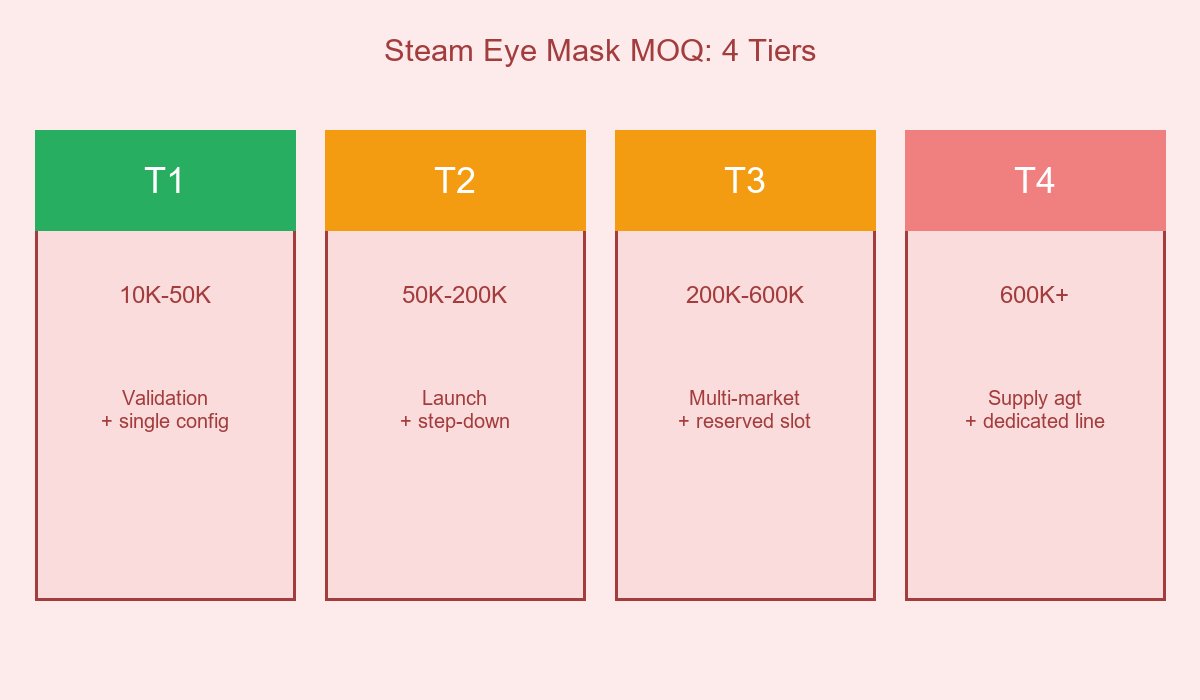
Steam eye mask MOQ 4 tiers compared for private label brands: validation tier (10K-50K), launch tier (50K-200K), multi-market tier (200K-600K), and supply agreement tier (600K+). Side-by-side comparison of unit cost, validation scope, packaging configuration, documentation scope, and production slot.
1. Why Steam Eye Mask MOQ Tiers Need a Side-by-Side Comparison
Steam eye mask MOQ tiers differ from flat patch tiers because the bill of materials carries more components, the packaging drives a larger share of the unit cost, and the warming curve validation has to be repeated when the formulation changes between tiers. A private label brand that compares tiers on price alone misses the validation scope, the packaging increment, and the documentation carry-forward that move the real cost.
KONGDY has manufactured consumer health patches and eye masks for 36 years and runs steam eye mask OEM programs for private label brands across North America, Europe, and Asia. The facility is ISO 22716 GMP certified, FDA registered, and operates in-house analytical, microbiological, and stability laboratories, plus eye mask-specific warming curve and ear-loop tension testing rigs. This guide compares the four MOQ tiers side by side across the unit cost driver, the validation scope, the packaging configuration, the documentation scope, and the production slot.
This guide walks through the four tiers, what changes between them, and how the private label brand selects the tier against the launch plan.
2. Tier 1: 10K - 50K Masks - The Validation Tier
Tier 1 is the validation tier. It covers 10,000 to 50,000 masks per production run and is designed for the first commercial run that proves the channel demand before the brand commits to a larger volume.
2.1 Tier 1 Cost Driver (KONGDY)
The Tier 1 unit cost is driven by the smaller production run and the single packaging configuration, with the converting line changeover spread across fewer units. KONGDY's Tier 1 pricing reflects the validation run size.
2.2 Tier 1 Validation Scope (KONGDY)
The Tier 1 validation covers the warming curve specification and the ear-loop tension range. KONGDY's validation documents both on the warming curve and ear-loop tension testing rigs.
2.3 Tier 1 Documentation (KONGDY)
The Tier 1 documentation covers the ISO 22716 GMP certificate, the FDA cosmetic registration, the EU CPSR, the finished product CoA, and the stability protocol. KONGDY's Tier 1 documentation supports the single-market validation.
3. Tier 2: 50K - 200K Masks - The Launch Tier
Tier 2 is the launch tier. It covers 50,000 to 200,000 masks per production run and is designed for the retail and marketplace launch where the channel demand is confirmed and the packaging configuration expands.
3.1 Tier 2 Cost Driver (KONGDY)
The Tier 2 unit cost drops as the changeover is spread across more units and the packaging configurations multiply. KONGDY's Tier 2 pricing adds the volume step-down on the entire shipment quantity.
3.2 Tier 2 Validation Scope (KONGDY)
The Tier 2 validation repeats the warming curve and ear-loop validation for any formulation or carrier change introduced at launch. KONGDY's validation is documented per formulation and per carrier.
3.3 Tier 2 Documentation (KONGDY)
The Tier 2 documentation adds the multi-market dossier and the artwork refresh without tooling change. KONGDY's Tier 2 documentation supports the two-market launch.
4. Tier 3: 200K - 600K Masks - The Multi-Market Tier
Tier 3 is the multi-market tier. It covers 200,000 to 600,000 masks per production run and is designed for the pharmacy chain and multi-channel distribution where the artwork matrix and the documentation roll-forward expand.
4.1 Tier 3 Cost Driver (KONGDY)
The Tier 3 unit cost drops further as the dedicated production slot reduces the changeover frequency. KONGDY's Tier 3 pricing includes the reserved production slot.
4.2 Tier 3 Validation Scope (KONGDY)
The Tier 3 validation covers the multi-market warming curve variants where the destination markets require different warming profiles. KONGDY's validation documents each market variant on the warming curve testing rig.
4.3 Tier 3 Documentation (KONGDY)
The Tier 3 documentation adds the per-market stability roll-forward and the post-market surveillance record. KONGDY's Tier 3 documentation supports the multi-channel distribution.
5. Tier 4: 600K+ Masks - The Supply Agreement Tier
Tier 4 is the supply agreement tier. It covers 600,000+ masks per production run and is designed for the long-term supply commitment where the dedicated converting line allocation and the multi-year documentation carry-forward apply.
5.1 Tier 4 Cost Driver (KONGDY)
The Tier 4 unit cost is the lowest across the four tiers as the dedicated line allocation removes the changeover cost. KONGDY's Tier 4 pricing is documented in the multi-year supply agreement.
5.2 Tier 4 Validation Scope (KONGDY)
The Tier 4 validation covers the annual formulation review and the per-market warming curve maintenance. KONGDY's validation rolls the stability and warming data forward annually.
5.3 Tier 4 Documentation (KONGDY)
The Tier 4 documentation adds the multi-year supply agreement scope, the change control procedure, and the per-market documentation carry-forward. KONGDY's Tier 4 documentation supports the long-term supply commitment.
6. Side-by-Side Comparison: What Changes Between the Four Tiers
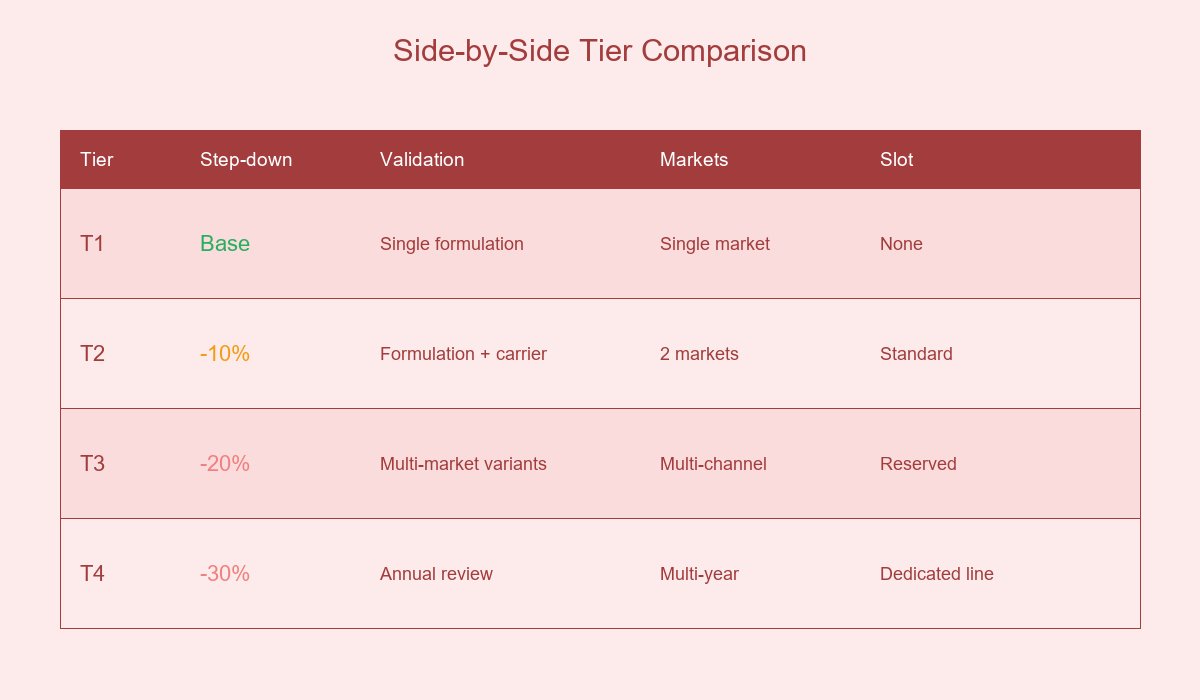
The side-by-side comparison summarises the four tiers across the unit cost driver, the validation scope, the packaging configuration, the documentation scope, and the production slot. The private label brand that reads the comparison can match the tier to the launch plan rather than to the purchase budget alone.
6.1 Unit Cost and Step-Down (KONGDY)
The unit cost steps down from Tier 1 to Tier 4 with the step-down applied to the entire shipment quantity. KONGDY's tier pricing documents the step-down at each threshold.
6.2 Validation Scope Progression (KONGDY)
The validation scope progresses from a single-formulation validation at Tier 1 to the multi-market warming curve variants at Tier 3 and the annual review at Tier 4. KONGDY's validation documents each progression stage.
6.3 Documentation Scope Progression (KONGDY)
The documentation scope progresses from the single-market pack at Tier 1 to the multi-year carry-forward at Tier 4. KONGDY's documentation system rolls the dossier forward per market and per tier.
7. Packaging Configuration Differences by Tier
The packaging configuration is the cost element that moves most between the tiers. Tier 1 supports a single configuration, while Tier 3 and Tier 4 support the multi-count sets, the premium formats, and the per-market artwork variants on the same converting line.
7.1 Tier 1-2 Packaging (KONGDY)
The Tier 1-2 packaging covers the standard sachet count and the standard secondary carton. KONGDY's Tier 1-2 packaging supports the launch configuration.
7.2 Tier 3 Packaging (KONGDY)
The Tier 3 packaging adds the multi-count sets, the premium boxes, and the per-market language panel. KONGDY's Tier 3 packaging supports the multi-channel distribution.
7.3 Tier 4 Packaging (KONGDY)
The Tier 4 packaging adds the annual artwork refresh without tooling change and the brand mark refresh. KONGDY's Tier 4 packaging supports the long-term brand maintenance.
8. Selecting the Tier Against the Launch Plan
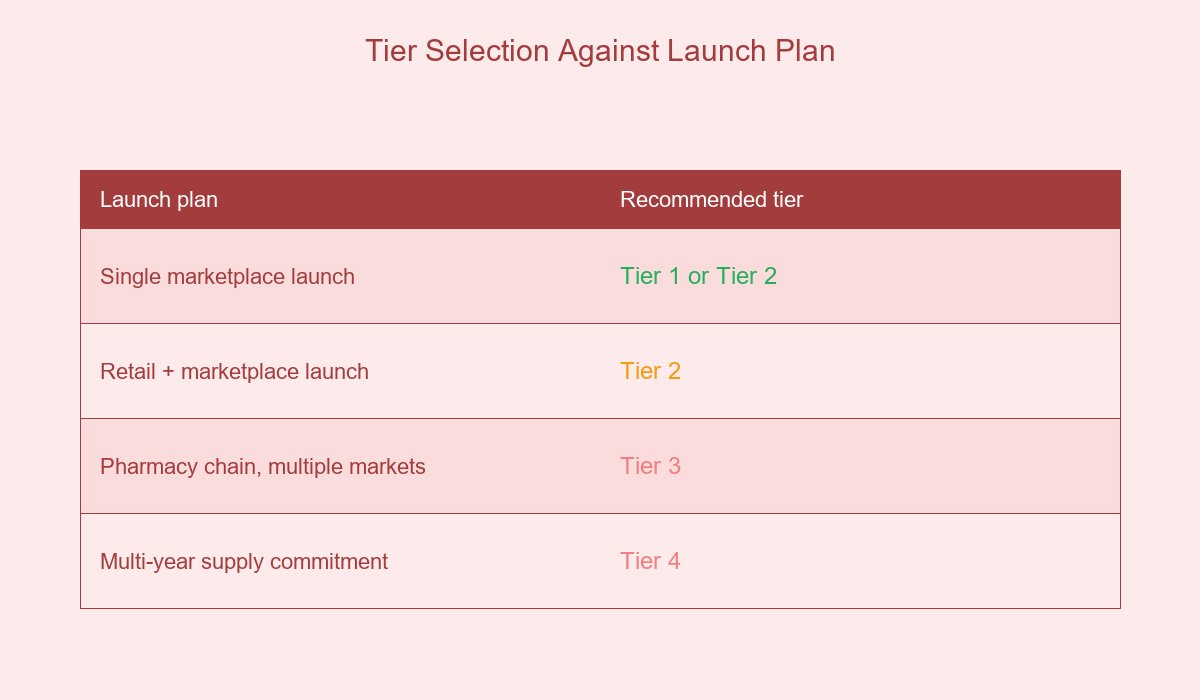
The tier selection follows the launch plan rather than the purchase budget. A brand launching into one marketplace selects Tier 1 or Tier 2; a brand launching into a pharmacy chain across two markets selects Tier 3; a brand with a multi-year supply commitment selects Tier 4.
8.1 Single-Channel Launch (KONGDY)
The single-channel launch maps to Tier 1 or Tier 2 depending on the channel demand. KONGDY's commercial team supports the selection with the channel sell-through data.
8.2 Multi-Channel Launch (KONGDY)
The multi-channel launch maps to Tier 3 where the artwork matrix and the documentation roll-forward apply. KONGDY's commercial team supports the Tier 3 selection with the destination market scope.
8.3 Long-Term Supply Commitment (KONGDY)
The long-term supply commitment maps to Tier 4 where the dedicated line allocation and the multi-year agreement apply. KONGDY's commercial team documents the Tier 4 scope in the supply agreement.
9. Common Tier Selection Mistakes and How to Avoid Them
Most tier selection mistakes trace back to four predictable decisions. The list below covers the most common ones and how KONGDY supports the brand in avoiding them.
9.1 Selecting Tier 1 for a Multi-Market Launch (KONGDY)
A brand that selects Tier 1 for a multi-market launch loses the per-market artwork capability and the documentation roll-forward. KONGDY's commercial team supports the tier selection with the launch scope.
9.2 Selecting Tier 4 Without a Channel Model (KONGDY)
A brand that selects Tier 4 without a channel model ties up capital in inventory ahead of the sell-through. KONGDY's working capital model projects the carrying cost by month.
9.3 Ignoring the Validation Repetition Cost (KONGDY)
A brand that ignores the validation repetition cost discovers it when the formulation changes between tiers. KONGDY's validation scope is documented per tier.
9.4 Treating the Step-Down as the Only Difference (KONGDY)
A brand that treats the step-down as the only tier difference misses the validation, packaging, and documentation differences. KONGDY's tier comparison documents all five dimensions.
10. Conclusion: Tier Selection as a Launch Plan Decision
Steam eye mask MOQ tier selection is a launch plan decision, not a purchase budget decision. The private label brand that compares the four tiers across the cost driver, the validation scope, the packaging configuration, the documentation scope, and the production slot selects the tier that matches the channel plan.
KONGDY runs steam eye mask OEM programs under ISO 22716 GMP certification with FDA registration, EU CPSR preparation, in-house analytical, microbiological, and stability laboratories, eye mask-specific warming curve and ear-loop tension testing rigs, and documented change control. The four-tier MOQ structure supports the private label brand with tiered pricing, staged validation, packaging progression, and documentation carry-forward.
Request KONGDY's steam eye mask MOQ tier comparison within 48 hours — share your target market, launch channel, expected volume, and packaging direction, and the commercial team will return the four-tier comparison across unit cost, validation scope, packaging configuration, documentation scope, and production slot.
Book a factory audit or live video tour at KONGDY's ISO 22716 facility to review the eye mask converting line, the warming curve and ear-loop tension testing rigs, the analytical laboratory, and the stability chamber room, and request a free sample to validate warming curve, ear-loop comfort, and packaging acceptance in your channel. Private label brands planning a launch within two quarters can start at the validation tier while artwork and documentation work run in parallel.

