Slimming patch OEM private label 7 steps for first-time importers: active profile and adhesion window, artwork lock and brand registration, documentation planning, packaging design, multi-day adhesion validation, reorder cadence, and working capital cycle. ISO 22716 GMP manufacturer with seven-step engagement model.
1. Why Slimming Patch Private Label Programs Need a First-Time Framework
Slimming patch private label programs combine a topical botanical active, a multi-day adhesion profile, and an export-grade cosmetic regulation dossier into a single program. A slimming patch is a transdermal laminate where the herbal active, the carrier non-woven, the moisture barrier, and the multi-day adhesion each have to be validated against the destination market's cosmetic regulation, slimming-claim regulation, and labelling scope. A first-time importer who treats slimming patch private label as a single purchase order misses the active profile scope, the multi-day adhesion validation, the labelling matrix, and the documentation carry-forward that the program delivers.
KONGDY has manufactured consumer health patches for 36 years and runs slimming patch private label programs for brand owners across North America, Europe, and Asia. The facility is ISO 22716 GMP certified, FDA registered, and operates in-house analytical, microbiological, and stability laboratories, plus slimming patch-specific multi-day adhesion and skin-contact safety testing rigs. The private label program is built on a seven-step path that walks the first-time importer from the active selection through the launch inventory, with documentation delivered per step.
This guide walks through the seven private label steps: how to select the active profile, how to lock the artwork, how to plan the documentation, how to design the packaging, how to validate the multi-day adhesion, how to lock the reorder cadence, and how to model the working capital cycle.
2. Step 1: Active Profile and Adhesion Window Selection
The first private label step is the active profile and the adhesion window selection. The active profile decides the labelling claim and the destination market's regulatory scope. The adhesion window decides the consumer's multi-day experience and the channel acceptance profile.
2.1 Active Profile Library (KONGDY)
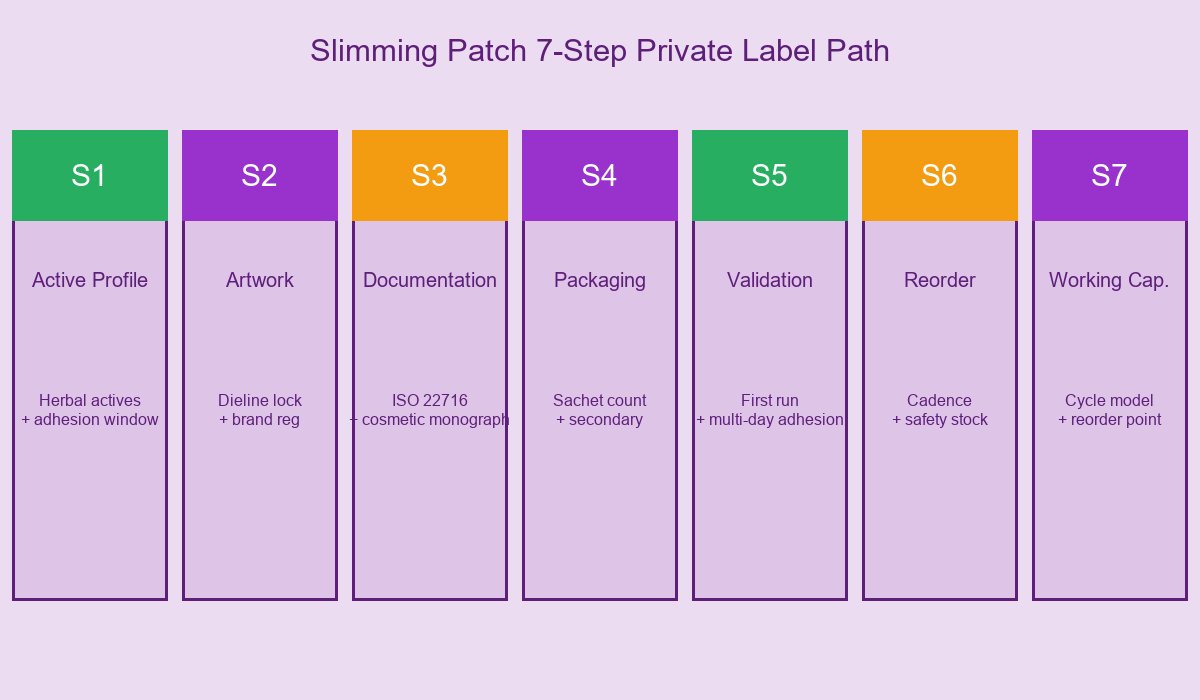
KONGDY's slimming patch active library covers herbal slimming actives including green tea extract, caffeine, capsicum, ginger, fennel, and combination profiles. The first-time importer selects the active profile that matches the destination market's cosmetic regulation and the consumer's first-impression expectation.
2.2 Multi-Day Adhesion Window (KONGDY)
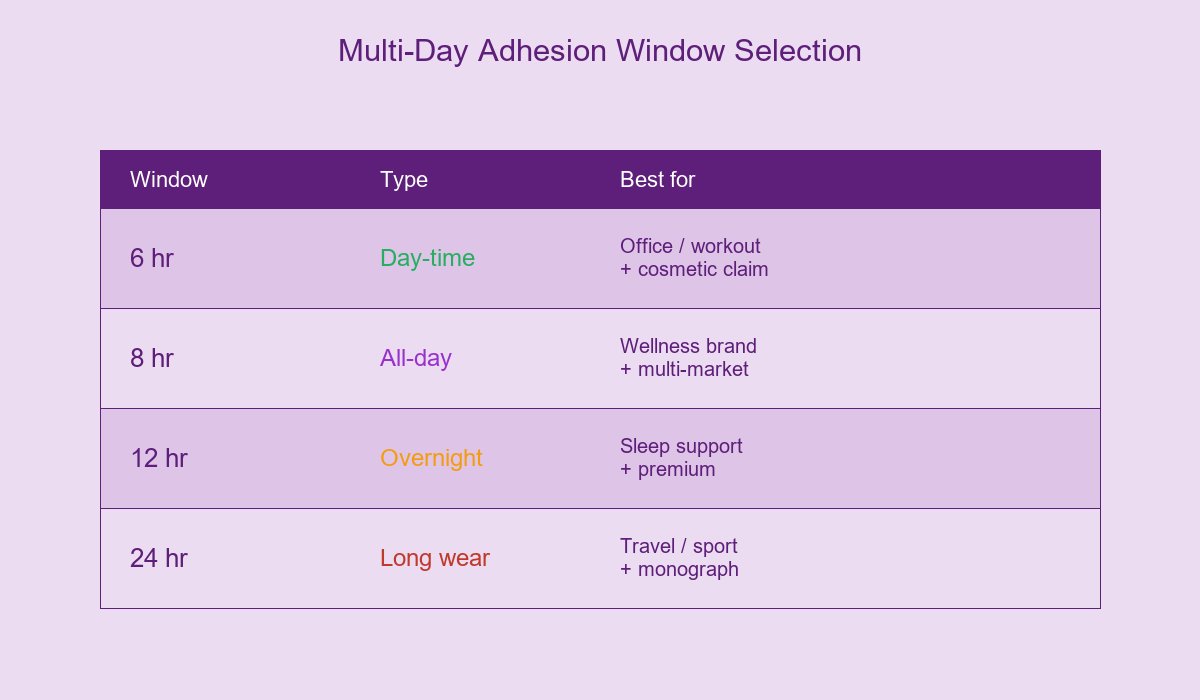
The multi-day adhesion window covers 6, 8, 12, and 24 hour profiles, with each profile documented against skin-contact safety, post-use residue, and the destination market's labelling scope. KONGDY's adhesion window is validated on the in-house adhesion testing rig.
2.3 Skin-Contact Safety and Wash-Off Profile (KONGDY)
The skin-contact safety and the wash-off profile are documented per formulation. KONGDY's safety profile covers the destination market's cosmetic regulation, the irritation potential, and the wash-off procedure.
2.4 Active + Window Selection Decision (KONGDY)
The active and window selection decision is documented in the private label brief. KONGDY's commercial team supports the decision with the destination market's regulatory scope and the slimming-claim language.
3. Step 2: Artwork Lock and Brand Registration
The second private label step is the artwork lock and the brand registration. The artwork locks the dieline, the language panel, the regulatory text, and the brand mark. The brand registration secures the brand mark and the regulatory label in the destination market.
3.1 Artwork Dieline Lock (KONGDY)
The artwork dieline is locked at the second private label step. KONGDY's dieline library supports standard slimming patch body-area sizes, and the artwork refresh capability without tooling change keeps the per-market artwork cost low.
3.2 Language Panel Selection (KONGDY)
The language panel is selected per destination market. KONGDY supports the multi-language rollout with the language-specific text panel and the regulatory text verification per market.
3.3 Regulatory Text Verification (KONGDY)
The regulatory text verification covers the ingredient declaration, the slimming-claim language, the usage directions, and the warning text. KONGDY's regulatory review supports the first-time importer with the destination market's text requirements.
3.4 Brand Registration Process (KONGDY)
The brand registration process secures the brand mark in the destination market. KONGDY supports the brand registration with the brand mark file, the regulatory label, and the documentation dossier.
4. Step 3: Documentation Planning Per Destination Market
The third private label step is the documentation planning per destination market. The documentation scope depends on the destination market, the slimming-claim language, and the destination market's cosmetic monograph status.
4.1 ISO 22716 GMP Certificate (KONGDY)
The ISO 22716 GMP certificate is the foundation. KONGDY's ISO 22716 certification covers patch, gel, balm, and cream formats, audited annually by an accredited certification body.
4.2 FDA Cosmetic Registration and EU CPSR (KONGDY)
The FDA cosmetic establishment registration and the EU CPSR support the United States and European Union markets. KONGDY maintains the FDA registration and prepares the CPSR with a qualified safety assessor.
4.3 Destination Market Cosmetic Monograph Review (KONGDY)
The destination market's cosmetic monograph review covers the slimming-claim scope, the active profile limit, and the labelling requirement. KONGDY supports the cosmetic monograph review per destination market.
4.4 Finished Product Certificate of Analysis (KONGDY)
The finished product CoA is delivered with each shipment. KONGDY's CoA carries the analyst signature, the QA release signature, and the destination market's specification reference.
4.5 Stability Protocol and Microbiological Specification (KONGDY)
The stability protocol and microbiological specification support the destination market's regulatory file. KONGDY's stability chambers are qualified to ICH conditions, with multi-temperature storage and accelerated protocols for the first year.
5. Steps 4-5: Packaging Design and Multi-Day Adhesion Validation
The fourth and fifth private label steps are the packaging design and the multi-day adhesion validation. The packaging design locks the sachet count, the secondary packaging configuration, and the brand mark application. The multi-day adhesion validation confirms the consumer's full adhesion experience.
5.1 Packaging Configuration Selection (KONGDY)
The packaging configuration covers the sachet count per box, the secondary packaging material, and the brand mark application. KONGDY supplies packaging configurations from 1 sachet to 30 sachets per box, with multi-count sets and premium boxes.
5.2 Secondary Packaging and Brand Mark Application (KONGDY)
The secondary packaging and the brand mark application are validated at the pilot batch stage. KONGDY's packaging line documents the artwork application procedure and the brand mark verification per configuration.
5.3 Multi-Day Adhesion Validation (KONGDY)
The multi-day adhesion validation is documented per formulation and per adhesion window. KONGDY's adhesion validation covers the surface adhesion strength, the post-use residue profile, and the skin-contact safety across the full window.
5.4 First Commercial Run Validation (KONGDY)
The first commercial run validation covers the converting line verification, the analytical release, the documentation lock, and the launch inventory. KONGDY's first commercial run ships with the CoA, the stability protocol summary, and the destination market's documentation dossier.
6. Steps 6-7: Reorder Cadence and Working Capital Cycle
The sixth and seventh private label steps are the reorder cadence and the working capital cycle. The reorder cadence documents the rhythm that the brand owner follows to refill the launch inventory. The working capital cycle projects the inventory carrying cost and the reorder point per channel.
6.1 Reorder Cadence Documentation (KONGDY)
The reorder cadence is documented at the first commercial run approval gate. KONGDY's commercial team supports the cadence with the working capital model and the reorder point calculation per channel.
6.2 Working Capital Cycle Modeling (KONGDY)
The working capital cycle modeling projects the inventory carrying cost by month. KONGDY's commercial team supports the modeling with the production lead time, the channel sell-through rate, and the safety stock calculation.
6.3 Repeat Run Pricing Tier (KONGDY)
The repeat run pricing tier applies the volume step-down to the reorder cadence. KONGDY's repeat run tier supports 50,000 to 500,000 patches per reorder with the step-down documented in the multi-year supply agreement.
6.4 Working Capital Stabilisation (KONGDY)
The working capital stabilisation captures the reorder rhythm that the first-time importer follows to keep the launch inventory stable. KONGDY supports the stabilisation with the reorder trigger and the safety stock formula.
7. Multi-Market Rollout for Slimming Patch Private Label
Slimming patch private label programs typically launch in one destination market and then roll out across multiple markets. The rollout sequence, the documentation sequencing, and the artwork refresh cadence determine the total cost and the total time to market.
7.1 Launch Market Selection (KONGDY)
The launch market selection considers the destination market's slimming-claim regulation, the cosmetic monograph status, and the consumer acceptance profile. KONGDY supports the launch market selection with the regulatory scope and the consumer acceptance data.
7.2 Sequence Across Markets (KONGDY)
The market sequence is documented at the pilot batch approval gate. KONGDY's commercial team supports the sequence planning with the destination market's regulatory scope, the documentation deliverable list, and the lead time per market.
7.3 Artwork Refresh Across Markets (KONGDY)
Artwork refresh across markets uses the same dieline and the same printing plates, with the language panel updated. KONGDY supports the artwork refresh without changing the tooling, reducing the per-market artwork cost.
7.4 Documentation Roll-Forward (KONGDY)
Documentation roll-forward applies the stability data, the change control, and the post-market surveillance across the multi-market rollout. KONGDY's documentation system rolls data forward per market.
8. Common First-Time Importer Mistakes and How to Avoid Them
Most first-time importer failures trace back to four predictable issues. The list below covers the most common ones and how KONGDY supports the first-time importer in avoiding them.
8.1 Skipping the Active Profile Selection Gate (KONGDY)
A first-time importer who skips the active profile selection gate ends up with a formulation that does not match the destination market's slimming-claim regulation. KONGDY's active profile selection gate documents the active profile, the multi-day adhesion, and the safety profile per formulation.
8.2 Artwork Refresh Without Dieline Lock (KONGDY)
An artwork refresh without the dieline lock forces a tooling change that the first-time importer did not budget. KONGDY's dieline lock at the second private label step freezes the cutting pattern and the artwork refresh scope.
8.3 Incomplete Cosmetic Monograph Review (KONGDY)
An incomplete cosmetic monograph review produces a destination market registration rejection. KONGDY's cosmetic monograph review covers the slimming-claim scope, the active profile limit, and the labelling requirement per market.
8.4 Working Capital Model Gap (KONGDY)
A working capital model gap produces a reorder cadence that runs out of stock or carries excess inventory. KONGDY's working capital model projects the cycle by month with the reorder trigger and the safety stock.
9. Cost Structure: Active, Converting, and Documentation
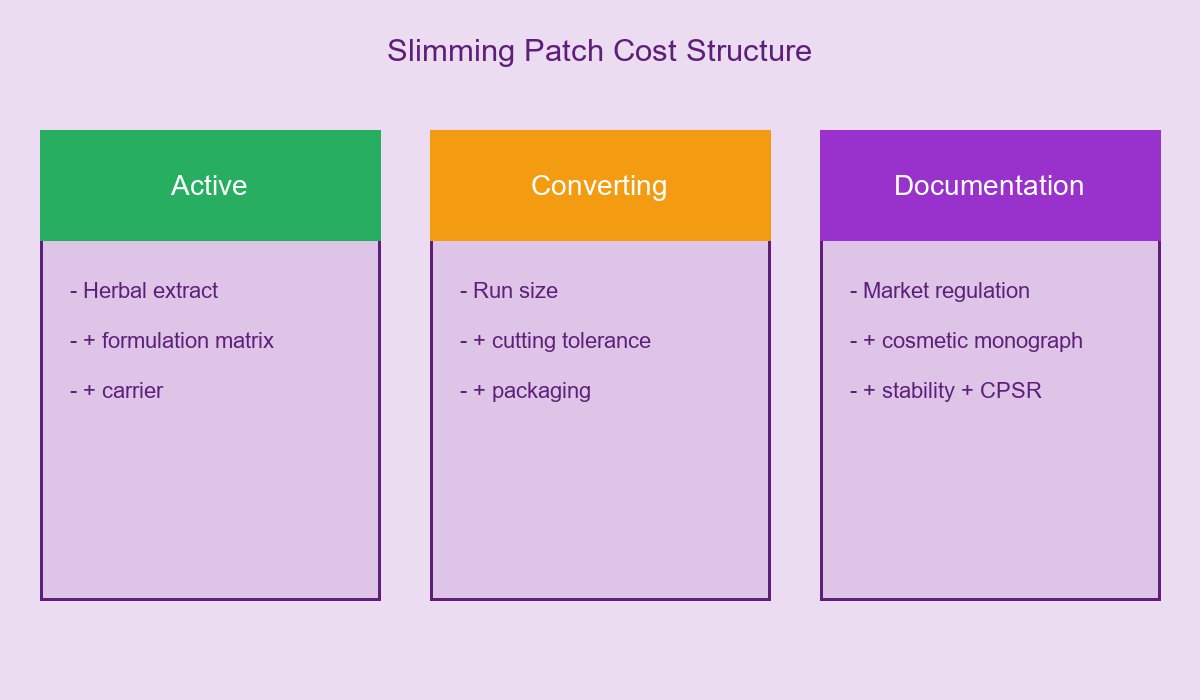
Slimming patch private label cost structure has three components: active cost, converting cost, and documentation cost. The active cost is set by the active profile and the multi-day adhesion; the converting cost is set by the production run size and the packaging configuration; the documentation cost is set by the destination market's regulatory file.
9.1 Active Cost Drivers (KONGDY)
Active cost drivers include the active raw material, the formulation matrix, and the carrier non-woven. KONGDY's commercial team returns a tiered active cost per formulation per volume tier.
9.2 Converting Cost Drivers (KONGDY)
Converting cost drivers include the production run size, the cutting tolerance, the packaging configuration, and the artwork refresh cadence. KONGDY's converting cost is documented in the quotation and locked for the duration of the program.
9.3 Documentation Cost Drivers (KONGDY)
Documentation cost drivers include the destination market's regulatory file, the cosmetic monograph, the stability protocol, and the change control scope. KONGDY's documentation cost is documented per destination market.
9.4 Volume Tier Step-Down (KONGDY)
The volume tier step-down applies to the entire quantity, not only to the units above the threshold. KONGDY's private label program supports tiered pricing with the step-down documented in the multi-year supply agreement.
10. Conclusion: Slimming Patch Private Label as a 7-Step Path
Slimming patch private label programs win when the first-time importer runs them as a seven-step path with documented gate decisions, artwork lock, and reorder cadence. The brand that treats slimming patch private label as a single purchase order loses the active profile verification, the multi-day adhesion validation, the documentation scope, and the launch timing that the seven-step model delivers.
KONGDY runs slimming patch private label programs under ISO 22716 GMP certification with FDA registration, EU CPSR preparation, in-house analytical, microbiological, and stability laboratories, slimming patch-specific multi-day adhesion and skin-contact safety testing rigs, and documented change control. The seven-step engagement model supports the first-time importer with active profile selection, artwork lock, documentation deliverable per step, and reorder cadence modeling.
Request KONGDY's slimming patch private label seven-step quotation within 48 hours — share your target market, expected launch volume, active profile preference, and packaging direction, and the commercial team will return tiered active cost, converting line schedule, documentation deliverable list, and the lead time schedule for your launch date.
Book a factory audit or live video tour at KONGDY's ISO 22716 facility to review the slimming patch converting line, the multi-day adhesion testing rig, the analytical laboratory, and the stability chamber room, and request a free sample to validate adhesion window, skin-contact comfort, and first-impression in your channel. Brand owners planning a launch within two quarters can additionally reserve a pilot batch slot while artwork and documentation work run in parallel.

