Shoulder pain patch wholesale complete guide for distributors: product scope and SKU portfolio, 5-step buying workflow, documentation chain for customs and retail and regulatory, channel strategy across pharmacy and marketplace and DTC, replenishment and seasonal planning, margin model, and first-year program calendar.
1. Why Shoulder Pain Patch Wholesale Needs a Complete Distributor Guide
Shoulder pain patch wholesale is a mature B2B category with a specific set of buying requirements. A shoulder patch is a flexible, high-mobility laminate that sits across the deltoid and the upper trapezius, so the adhesive flexibility, the skin-contact safety under a tight fit, and the destination market's labelling scope each carry their own verification scope. A distributor who treats a shoulder pain patch order as a generic patch order misses the mobility validation, the documentation chain, and the replenishment rhythm that the category requires.
KONGDY has manufactured consumer health patches for 36 years and runs shoulder pain patch wholesale programs for distributors, wholesalers, and pharmacy chains across North America, Europe, and Asia. The facility is ISO 22716 GMP certified, FDA registered, and operates in-house analytical, microbiological, and stability laboratories, plus shoulder patch-specific flexibility and adhesion testing rigs. This guide covers the whole wholesale operation: the product scope, the buying workflow, the documentation chain, the channel strategy, the replenishment planning, and the margin model.
This guide walks through the complete wholesale picture: how to scope the SKU portfolio, how to run the buying workflow, how to assemble the documentation, how to build the channel strategy, how to plan the replenishment, and how to model the margin.
2. Product Scope: What Shoulder Pain Patch Buyers Actually Order
The shoulder pain patch buyer orders a narrow SKU portfolio with a wide format range. A distributor who stocks too many variants ties up working capital in slow-moving stock; a distributor who stocks too few loses the shelf space to a competitor with a broader range.
2.1 Active Profile Range (KONGDY)
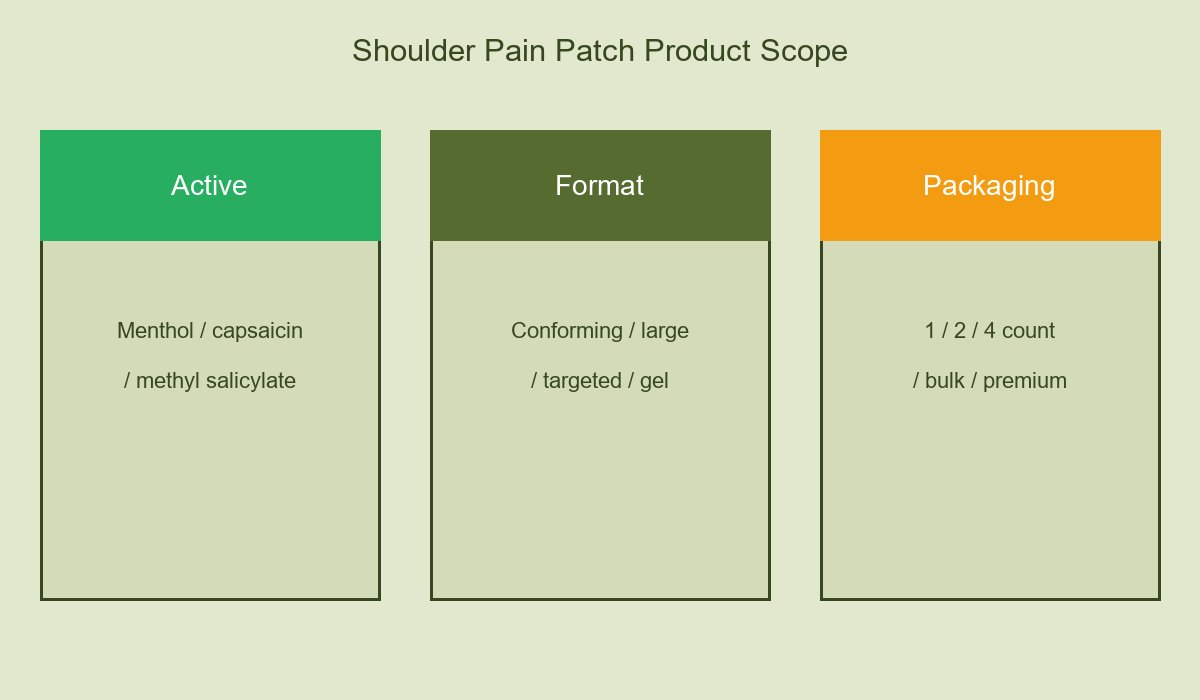
The active profile range covers menthol, capsaicin, methyl salicylate, and combination formats with the concentration documented per formulation. KONGDY's shoulder patch portfolio covers the four profiles that carry the volume in the category.
2.2 Format Range (KONGDY)
The format range covers the flexible shoulder-conforming patch, the rectangular large-format patch, the smaller targeted patch, and the gel patch. KONGDY supplies all four formats on the same converting line.
2.3 Packaging Range (KONGDY)
The packaging range covers single sachets, the 2-count and 4-count boxes, the multi-count bulk pack, and the premium rigid box. KONGDY's packaging configurations are documented with the unit cost increment per configuration.
2.4 What the Scope Decides (KONGDY)
The scope decides the working capital investment, the shelf coverage, and the reorder structure. KONGDY's commercial team returns the SKU portfolio recommendation with the volume allocation per format.
3. The Buying Workflow: From Inquiry to Purchase Order
The buying workflow runs in a documented sequence that protects the distributor from a documentation hold and a channel mismatch. Each step produces a deliverable that the next step consumes.
3.1 Step 1: Scope Review (KONGDY)
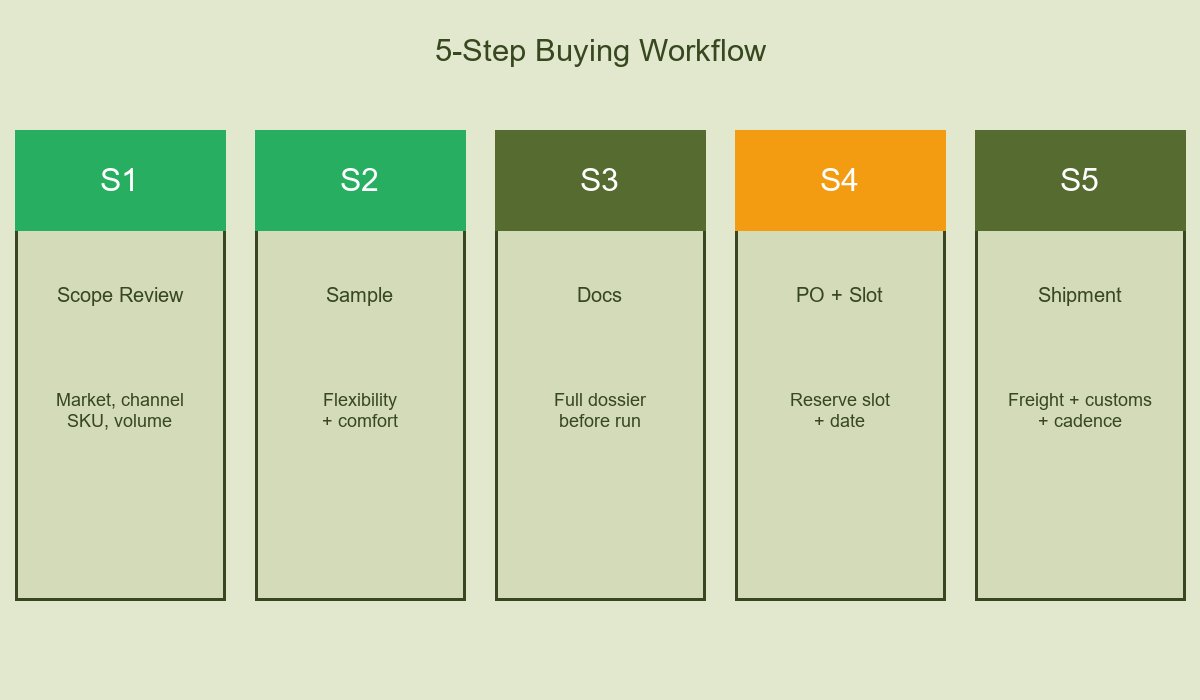
The scope review confirms the destination market, the channel, the SKU portfolio, and the expected annual volume. KONGDY's commercial team returns the scope review summary with the quotation.
3.2 Step 2: Sample and Evaluation (KONGDY)
The sample and evaluation step confirms the adhesion flexibility, the skin-contact comfort, and the first-impression in the channel. KONGDY supplies the sample with the written analytical summary.
3.3 Step 3: Documentation Pack (KONGDY)
The documentation pack assembles the ISO 22716 GMP certificate, the FDA cosmetic registration or OTC monograph, the EU CPSR, the finished product CoA, the stability protocol, and the destination market's dossier. KONGDY delivers the pack before the production run.
3.4 Step 4: Purchase Order and Slot Reservation (KONGDY)
The purchase order and slot reservation step books the production slot and confirms the shipment date. KONGDY's slot calendar is documented and reviewed weekly.
3.5 Step 5: Shipment and Replenishment Setup (KONGDY)
The shipment and replenishment setup step confirms the freight mode, the customs documentation pack, and the reorder cadence. KONGDY's commercial team sets the cadence with the channel sell-through data.
4. The Documentation Chain for Wholesale Buyers
The documentation chain for wholesale buyers has to clear the customs broker, the retail buyer, and the destination market's regulatory authority. A missing item at any one of the three points delays the inventory that the distributor already paid for.
4.1 Customs Clearance Documents (KONGDY)
The customs clearance documents cover the commercial invoice, the packing list, the certificate of origin, the HS code, and the finished product CoA. KONGDY's customs documentation pack supports the clearance at the destination port.
4.2 Retail Onboarding Documents (KONGDY)
The retail onboarding documents cover the compliance file, the ingredient declaration, the packaging artwork, the GTIN, and the safety data sheet. KONGDY provides each deliverable in the buyer's preferred format.
4.3 Regulatory Authority Documents (KONGDY)
The regulatory authority documents cover the ISO 22716 GMP certificate, the FDA registration, the EU CPSR, and the stability protocol with the storage condition map. KONGDY's destination market dossier covers each item.
4.4 Documentation Carry-Forward (KONGDY)
The documentation carry-forward applies the same dossier across the channels that share a destination market. KONGDY's documentation system rolls the dossier forward per market.
5. Channel Strategy: Pharmacy, Marketplace, and DTC
The channel strategy decides which shoulder pain patch format goes where. The pharmacy channel rewards the larger multi-count format and the compliance file; the marketplace channel rewards the small trial size and the listing imagery; the DTC channel rewards the premium presentation.
5.1 Pharmacy Channel (KONGDY)
The pharmacy channel takes the multi-count boxes and the pharmacy-exclusive formats with the full compliance file. KONGDY supports the pharmacy onboarding call and the compliance file.
5.2 Marketplace Channel (KONGDY)
The marketplace channel takes the single sachet and the 2-count format with listing imagery and the safety documentation. KONGDY supports the marketplace listing optimization.
5.3 DTC and Specialty Wellness Channel (KONGDY)
The DTC and specialty wellness channel takes the premium rigid box and the gift formats with the practitioner recommendation language. KONGDY supports the specialty channel with the premium packaging configuration.
5.4 Channel Format Allocation (KONGDY)
The channel format allocation maps each format to its channel with the volume split documented. KONGDY's commercial team returns the allocation recommendation with the SKU portfolio.
6. Replenishment Planning and Inventory Turn
The replenishment planning decides whether the distributor's shoulder pain patch inventory turns or ties up. The planning covers the trigger level, the safety stock, the lead time, the target turn, and the seasonality of the pain-relief category.
6.1 Replenishment Trigger (KONGDY)
The replenishment trigger is the inventory level that starts the next order. KONGDY's commercial team supports the trigger calculation with the channel sell-through rate and the production lead time.
6.2 Safety Stock (KONGDY)
The safety stock covers the demand variance during the production lead time. KONGDY supports the safety stock formula and the reorder point per channel.
6.3 Seasonality in the Pain Relief Category (KONGDY)
The pain relief category runs a documented seasonal pattern with a higher sell-through in the winter months and a softer period in the late spring. KONGDY's commercial team supports the seasonal build plan with the historical channel data.
6.4 Inventory Turn Target (KONGDY)
The inventory turn target defines how many times per year the distributor rotates the shoulder pain patch inventory. KONGDY's commercial team supports the turn target with the channel data and the replenishment cadence.
7. Margin Model and Channel Economics
The margin model ties the landed unit cost to the shelf price and the distributor's gross margin per channel. A distributor who models the margin from the landed cost rather than the ex-works price prices the channel correctly.
7.1 Landed Cost Build-Up (KONGDY)
The landed cost build-up combines the ex-works price, the freight per mode, the duty and tariff, the brokerage, and the documentation cost. KONGDY's commercial team returns the landed cost per Incoterm.
7.2 Channel Margin Target (KONGDY)
The channel margin target documents the gross margin the distributor needs at each channel. KONGDY's commercial team supports the margin model with the landed cost and the retail price point.
7.3 Format Mix Margin Effect (KONGDY)
The format mix margin effect shows how the multi-count and premium formats raise the absolute margin per unit. KONGDY's margin model returns the effect per format.
7.4 Annual Margin Review (KONGDY)
The annual margin review is documented with the distributor at the end of the program year. KONGDY's commercial team returns the margin review with the annual program summary.
8. Common Wholesale Mistakes and How to Avoid Them
Most wholesale failures trace back to four predictable issues. The list below covers the most common ones and how KONGDY supports the distributor in avoiding them.
8.1 Overstocking the SKU Range (KONGDY)
A distributor who overstocks the SKU range ties up working capital in slow-moving formats. KONGDY's commercial team supports the portfolio recommendation with the volume allocation per format.
8.2 Skipping the Sample Evaluation Step (KONGDY)
A distributor who skips the sample evaluation discovers the flexibility or comfort gap in the channel. KONGDY's sample step includes the written analytical summary and the channel acceptance profile.
8.3 Ordering Below the Volume Tier (KONGDY)
A distributor who orders below the volume tier loses the step-down on the entire shipment. KONGDY's commercial team supports the tier selection with the inventory target and the seasonal plan.
8.4 No Seasonal Build Plan (KONGDY)
A distributor with no seasonal build plan either stocks out in the winter peak or carries the inventory through the soft period. KONGDY's commercial team supports the seasonal plan with the historical channel data.
9. The First-Year Wholesale Program Structure
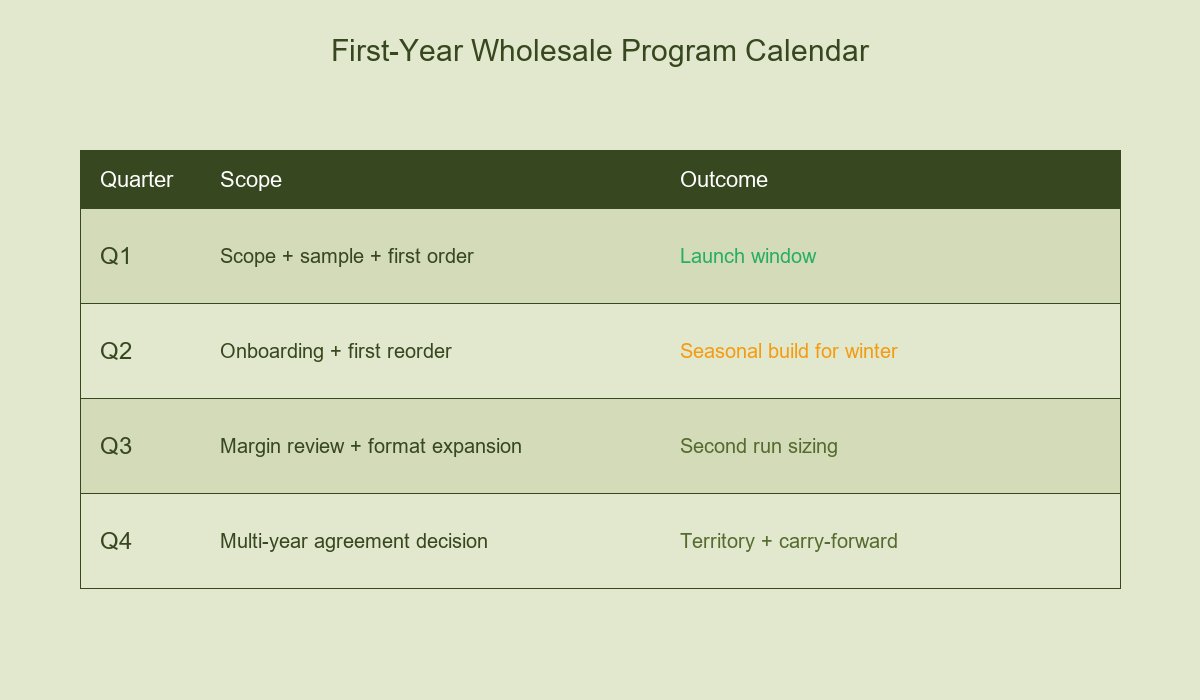
The first-year wholesale program structure turns the guide into a calendar. A distributor who follows the structure hits the launch window, clears the winter peak, and reaches the second production run with the data to size it properly.
9.1 Quarter 1: Scope, Sample, and First Order (KONGDY)
Quarter one covers the scope review, the sample evaluation, the documentation pack, and the first production run. KONGDY's commercial team supports each step with the deliverable list.
9.2 Quarter 2: Channel Onboarding and First Reorder (KONGDY)
Quarter two covers the pharmacy onboarding, the marketplace listing, the first reorder trigger, and the seasonal build plan for the winter peak. KONGDY's commercial team supports the reorder cadence with the sell-through data.
9.3 Quarter 3: Margin Review and Format Expansion (KONGDY)
Quarter three covers the margin review, the format expansion decision, and the second production run sizing. KONGDY's commercial team returns the margin review with the format expansion recommendation.
9.4 Quarter 4: Multi-Year Agreement Decision (KONGDY)
Quarter four covers the multi-year supply agreement decision, the territory scope, and the documentation carry-forward. KONGDY's commercial team returns the supply agreement draft with the price lock terms.
10. Conclusion: Shoulder Pain Patch Wholesale as an Operating Model
Shoulder pain patch wholesale is an operating model, not a purchase order. The distributor that runs the scope, the buying workflow, the documentation chain, the channel strategy, the replenishment plan, and the margin model captures the category economics that a transactional relationship does not deliver.
KONGDY runs shoulder pain patch wholesale programs under ISO 22716 GMP certification with FDA registration, EU CPSR preparation, in-house analytical, microbiological, and stability laboratories, shoulder patch-specific flexibility and adhesion testing rigs, and documented change control. The wholesale program supports the distributor with the SKU portfolio, the buying workflow deliverable list, the documentation chain, the channel allocation, the replenishment and seasonal planning, and the margin model.
Request KONGDY's shoulder pain patch wholesale quotation within 48 hours — share your destination market, channel mix, target annual volume, and packaging direction, and the commercial team will return the SKU portfolio recommendation, the tiered unit pricing, the landed cost per Incoterm, the documentation deliverable list, and the first-year program calendar.
Book a factory audit or live video tour at KONGDY's ISO 22716 facility to review the shoulder patch converting line, the flexibility and adhesion testing rigs, the analytical laboratory, and the stability chamber room, and request a free sample to validate flexibility, skin-contact comfort, and first-impression in your channel. Distributors planning a first container within one quarter can reserve a production slot while artwork and documentation work run in parallel.

