Pain relief patch OEM 7 compliance documents every buyer should request before issuing a first purchase order. Covers ISO 22716 GMP certificate, FDA cosmetic registration, EU CPSR, finished product CoA, stability protocol, microbiological specification, and packaging compliance statement.
1. Why Pain Relief Patch OEM Compliance Documents Matter
Pain relief patch OEM programs involve a wide range of active profiles: menthol, capsaicin, lidocaine, methyl salicylate, and combination formats. Each active profile carries its own compliance scope, its own documentation chain, and its own regulatory classification. A buyer who issues an OEM purchase order without the right compliance documents is accepting risk that the first customs clearance, the first retail onboarding, and the first post-market surveillance cycle will expose.
The compliance documents that a buyer should request before issuing an OEM purchase order are the same documents the manufacturer should have ready without being asked. The seven documents in this guide are the deliverables that close the gap between the supplier's quotation and the buyer's customs clearance. KONGDY has manufactured consumer health patches for 36 years and supplies pain relief patch OEM programs across North America, Europe, and Asia. The facility is ISO 22716 GMP certified, FDA registered, and operates in-house analytical, microbiological, and stability laboratories.
This guide walks through the seven compliance documents, what each one supports, and how the buyer should evaluate each document against the destination market's requirement.
2. Document 1: ISO 22716 GMP Certificate (Cosmetic GMP)
The ISO 22716 GMP certificate is the foundation of the documentation dossier. It documents the cosmetic good manufacturing practice system that covers premises, equipment, raw materials, production, quality control, and documentation.
2.1 What the Certificate Confirms (KONGDY)
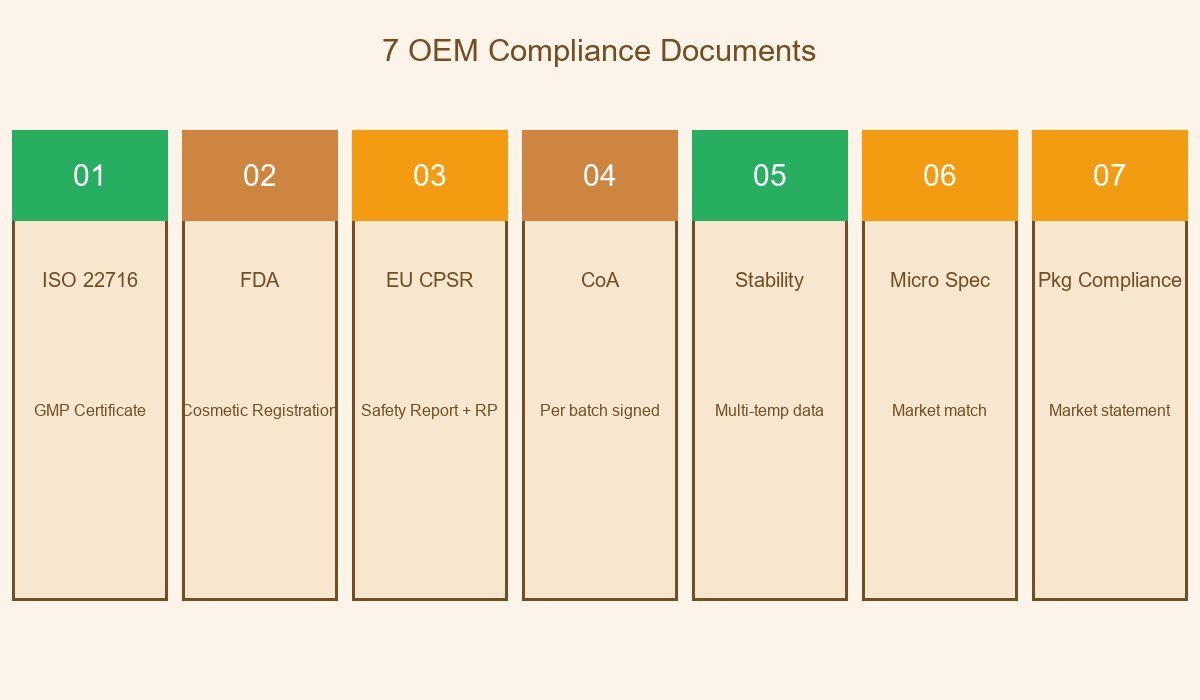
KONGDY holds ISO 22716 certification with a scope covering patch, gel, balm, and cream formats, audited by an accredited certification body with annual surveillance. The certificate number is verifiable against the issuing body's public registry.
2.2 What the Buyer Should Look For (KONGDY)
The buyer should request the ISO 22716 certificate number, the scope of certification, the issuing body, and the most recent surveillance audit date. KONGDY provides certificate numbers for independent verification and shares redacted audit reports with qualified buyers.
3. Documents 2-3: FDA Cosmetic Registration + EU CPSR
The FDA cosmetic establishment registration and the EU Cosmetic Product Safety Report are the market-specific documentation deliverables that support the United States and European Union markets.
3.1 FDA Cosmetic Registration (KONGDY)
The FDA cosmetic establishment registration and product listing place the facility and the SKU in the FDA database. KONGDY maintains both for every pain relief patch SKU manufactured for the US market, with the registration number and product listing confirmation provided in the documentation dossier.
3.2 EU CPSR and Responsible Person (KONGDY)
The EU Cosmetic Product Safety Report is prepared by a qualified safety assessor. KONGDY prepares the CPSR and supplies the ingredient and stability data behind it, and coordinates with the buyer's nominated Responsible Person.
3.3 What the Buyer Should Look For (KONGDY)
The buyer should request the FDA registration number and the CPSR document. KONGDY provides both in the destination market dossier before the production run.
4. Document 4: Finished Product Certificate of Analysis (CoA)
The finished product certificate of analysis is the document the customs broker and the retail buyer reference to verify the product's release status.
4.1 Required CoA Elements (KONGDY)
A complete CoA includes the batch number, the manufacturing date, the expiry date, the analytical test results against the specification, the microbiological test results, the fill weight verification, and the analyst and QA release signatures. KONGDY's CoA format is documented in the quotation and locked for the duration of the program.
4.2 CoA Signature Gap (KONGDY)
A CoA missing either the analyst signature or the QA release signature cannot be used at customs clearance. KONGDY's quality system requires both signatures before a CoA is issued.
4.3 What the Buyer Should Look For (KONGDY)
The buyer should request a sample CoA from a recent batch and confirm whether the analyst signature, the QA release signature, and the destination market's specification are all present. KONGDY's CoA template includes all three.
5. Document 5: Stability Protocol and Shelf Life Assignment
Stability data justifies the shelf life statement on the label and the destination market's regulatory authority accepts the data as part of the registration file.
5.1 Stability Storage Conditions (KONGDY)
KONGDY maintains stability chambers qualified and calibrated to ICH conditions, with storage at 25, 30, and 40 degrees Celsius for multi-market distribution. The stability data is generated at multiple storage conditions to support the destination market's storage reality.
5.2 Shelf Life Assignment per Market (KONGDY)
The shelf life is assigned based on the stability data for the destination market's storage condition. KONGDY assigns shelf life from the stability data and confirms the assignment per shipment.
5.3 What the Buyer Should Look For (KONGDY)
The buyer should request the stability protocol summary, the storage conditions tested, and the assigned shelf life for the destination market. KONGDY supplies each in the destination market dossier.
6. Documents 6-7: Microbiological Specification + Packaging Compliance
The microbiological specification and the packaging compliance statement round out the seven documents. Together with the previous four, they form the compliance dossier that closes the customs clearance and retail onboarding loops.
6.1 Microbiological Specification (KONGDY)
The microbiological specification on the CoA must match the destination market's regulatory limit. KONGDY specifies microbiological limits against the destination market's regulation, not against a generic cosmetic limit.
6.2 Packaging Compliance Statement (KONGDY)
The packaging compliance statement documents that the primary packaging, the secondary packaging, and the printed labels meet the destination market's packaging regulation. KONGDY maintains packaging component compliance statements for every primary packaging format in use.
6.3 What the Buyer Should Look For (KONGDY)
The buyer should request both documents and confirm they match the destination market's requirement. KONGDY's documentation dossier includes both per destination market.
7. How the Seven Documents Close the Compliance Loop
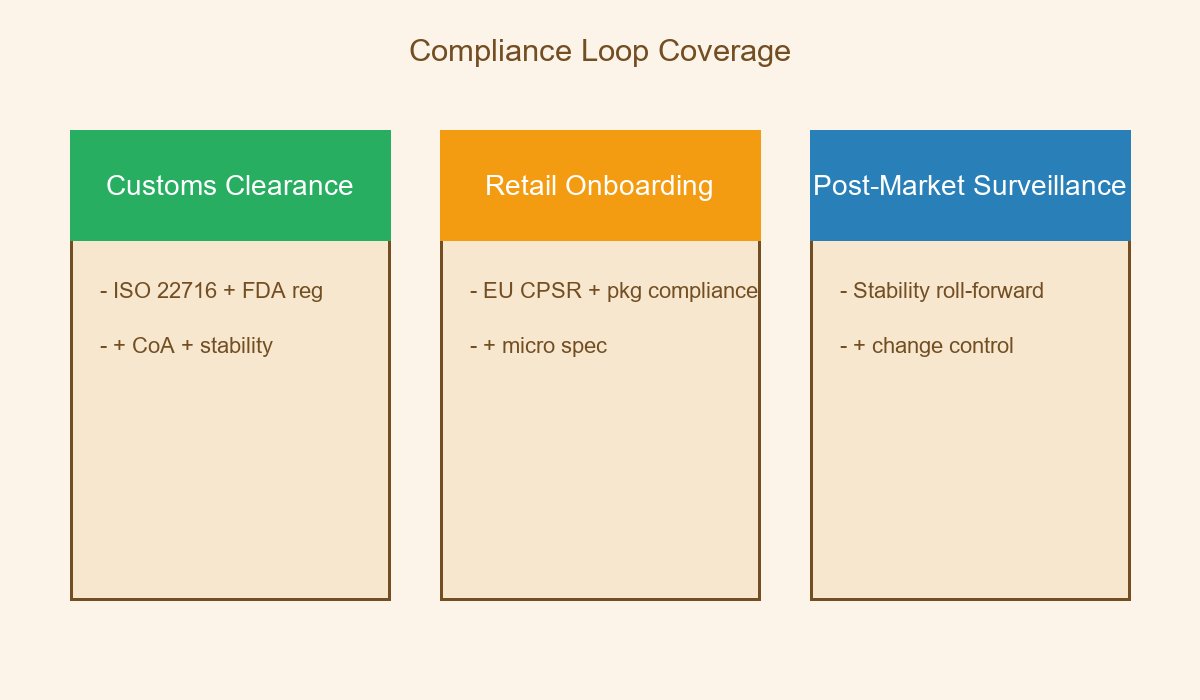
The seven documents close the customs clearance and retail onboarding loops. Together they form the documentation dossier that supports the buyer's program from the first OEM purchase order through the post-market surveillance cycle.
7.1 Customs Clearance Loop (KONGDY)
The ISO 22716 certificate, the FDA registration, the CoA, and the stability data close the customs clearance loop. KONGDY's documentation prepares each deliverable per shipment so the customs broker can clear the shipment without a documentation hold.
7.2 Retail Onboarding Loop (KONGDY)
The EU CPSR, the packaging compliance statement, and the microbiological specification close the retail onboarding loop. KONGDY's documentation prepares each deliverable in the buyer's preferred format so the retail buyer can list the SKU without documentation rework.
7.3 Post-Market Surveillance Loop (KONGDY)
The stability data and the change control procedure close the post-market surveillance loop. KONGDY rolls stability observations forward year over year and notifies the buyer before any change takes effect.
8. Pre-Shipment Documentation Audit Checklist
The pre-shipment documentation audit confirms that every deliverable above is in place before the shipment leaves the warehouse. KONGDY's QC team runs the audit on the first commercial run and confirms each item against the documented checklist.
8.1 First Run Versus Repeat Run (KONGDY)
The first run audit is comprehensive and includes verification of every deliverable. Repeat runs rely on the documented program-level file, with the QC team verifying the batch-level CoA and the market-specific dossier against the agreed scope.
8.2 Audit Documentation and Customer Notification (KONGDY)
The pre-shipment audit results are documented in the pre-shipment inspection report, with photographs of the shipment and the packaging configuration. KONGDY issues the report with every shipment and notifies the customer of any deviation from the agreed scope.
8.3 Documentation Update Cadence (KONGDY)
Documentation updates follow the annual review cycle, with any change triggering a customer notification under KONGDY's documented change control procedure.
9. Common OEM Documentation Failures and How to Avoid Them
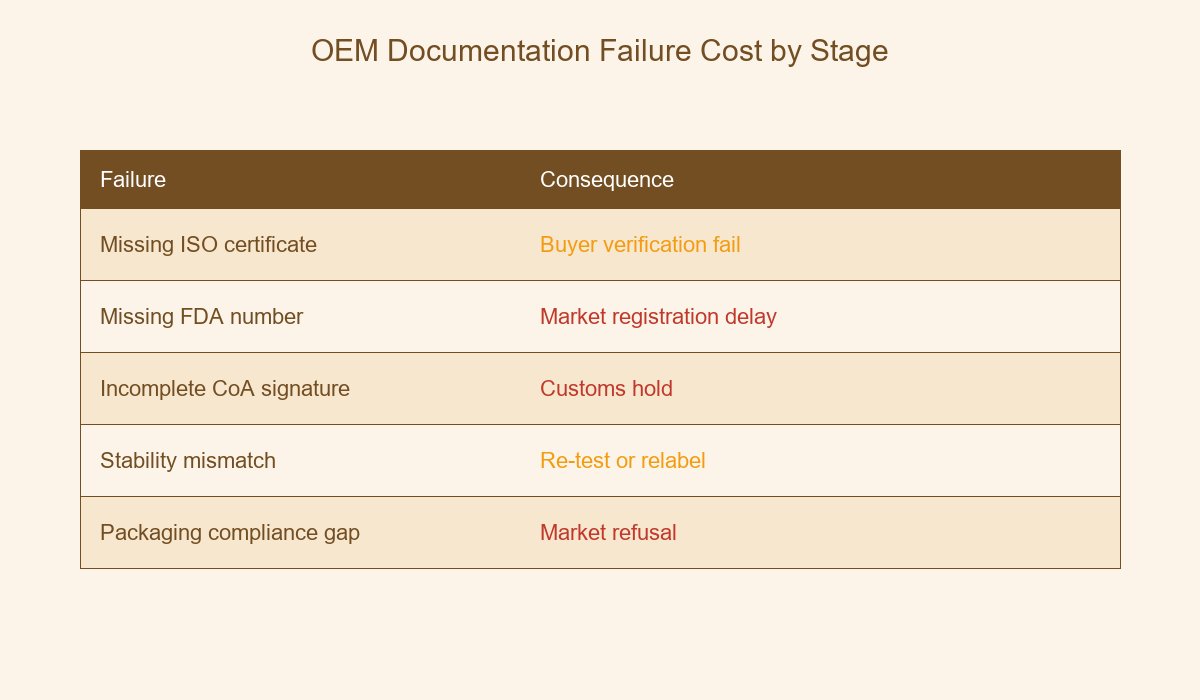
OEM documentation failures trace back to four predictable issues. The list below covers the most common ones and how KONGDY supports the buyer in avoiding them.
9.1 Missing ISO 22716 Certificate Number (KONGDY)
An unverifiable ISO 22716 certificate number produces a buyer-side verification failure. KONGDY's certificate number is verifiable against the issuing body's public registry.
9.2 Incomplete CoA Signature (KONGDY)
An incomplete CoA signature produces a customs hold. KONGDY's quality system requires both analyst and QA release signatures before a CoA is issued.
9.3 Stability Data Mismatch (KONGDY)
Stability data must match the destination market's storage condition. KONGDY generates stability data at multiple storage conditions and assigns shelf life per market.
9.4 Packaging Compliance Gap (KONGDY)
Packaging components must meet the destination market's regulation. KONGDY maintains packaging component compliance statements per destination market.
10. Conclusion: Treat OEM Documentation as a Sourcing Filter
Pain relief patch OEM documentation is a sourcing filter, not a future risk to manage. Each document that the buyer catches before the first order is one less customs hold, one less retail onboarding rejection, and one less consumer complaint in the first six months of operation. The brands that win the category are the ones that treat OEM documentation as a sourcing filter and reject suppliers whose systems fail the verification.
KONGDY's documentation-first OEM system covers the seven documents in this guide plus the multi-year supply agreement, the annual documentation review, and the change control procedure. The system is ISO 22716 GMP certified, FDA registered, and audited annually by accredited bodies, with 7-year document retention and electronic batch record indexing.
Request KONGDY's pain relief patch OEM documentation pack within 48 hours — the commercial team will return the QC manual summary, redacted ISO 22716 audit report, FDA registration number, finished product CoA template, stability protocol summary, packaging compliance statement, and the destination market's HS code and tariff classification for your shipment.
Schedule a factory audit or live video tour at KONGDY's ISO 22716 facility to review the production line, QC laboratory, and stability chamber room, and request a free sample to validate adhesion, sensation, and packaging acceptance in your channel. Brand owners planning a launch within two quarters can additionally reserve a pilot batch slot while QC documentation and stability work are completed in parallel.

