Neck pain patch wholesale bulk pricing guide for distributors: component-level cost breakdown (active system, adhesive matrix, packaging, converting), 4 volume tiers with step-down, packaging cost increment, landed cost modeling, price lock and currency terms, replenishment cadence, and channel margin planning.
1. Why Neck Pain Patch Bulk Pricing Needs a Component-Level View
Neck pain patch bulk pricing follows a cost curve that a distributor cannot read off the unit price. A neck patch is a small, high-flexibility, high-contact laminate where the adhesive system, the carrier non-woven, and the packaging configuration each carry a documented share of the unit cost. A distributor who negotiates only the headline price ends up with a lower number and the same landed cost, the same working capital, and the same documentation overhead.
KONGDY has manufactured consumer health patches for 36 years and runs neck pain patch bulk pricing programs for distributors, wholesalers, and pharmacy chains across North America, Europe, and Asia. The facility is ISO 22716 GMP certified, FDA registered, and operates in-house analytical, microbiological, and stability laboratories, plus neck patch-specific flexibility and adhesion testing rigs. The bulk pricing program is built on the component-level cost breakdown, the tiered volume structure, and the landed cost modeling that keeps the distributor's margin intact.
This guide walks through the bulk pricing structure: how the cost components break down, how the volume tiers apply, how the packaging configuration moves the unit cost, how the landed cost is modeled, and how the pricing is locked for the program term.
2. Cost Components: Where Neck Pain Patch Unit Cost Actually Sits
The neck pain patch unit cost breaks into four components: the active system, the adhesive matrix, the packaging, and the converting labor. A distributor who understands the component split can negotiate the right lever at the right volume.
2.1 Active System (KONGDY)
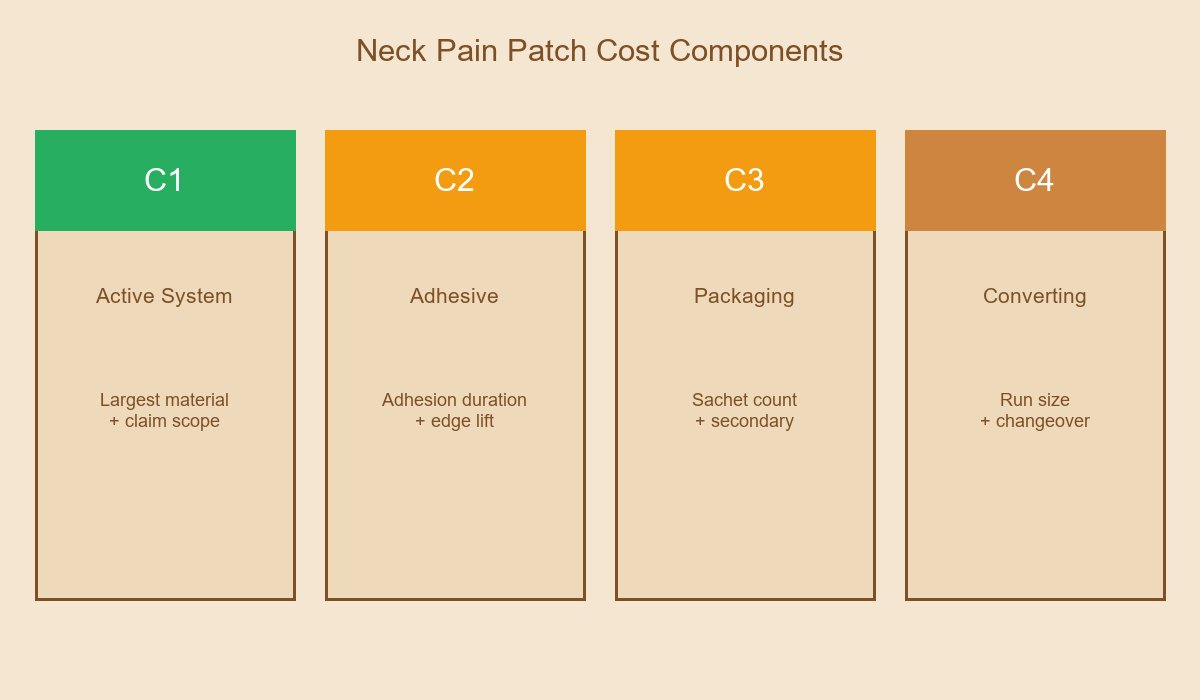
The active system is the single largest material cost and the component that drives the destination market's claim scope. KONGDY's active library covers menthol, capsaicin, methyl salicylate, lidocaine, and combination profiles with the concentration documented per formulation.
2.2 Adhesive Matrix (KONGDY)
The adhesive matrix carries the adhesion duration, the edge lift resistance, and the post-use residue profile. KONGDY's neck patch adhesive systems are validated on the flexibility and adhesion testing rigs with the profile documented per formulation.
2.3 Packaging (KONGDY)
The packaging carries the sachet count, the secondary packaging material, and the brand mark application. KONGDY supplies packaging configurations from 1 patch to 30 patches per box with multi-count sets and premium boxes.
2.4 Converting Labor (KONGDY)
The converting labor is driven by the production run size and the line changeover frequency. KONGDY's converting cost is documented in the quotation and locked for the duration of the program.
3. Volume Tier Structure and Step-Down Application
The volume tier structure gives the distributor a documented price at each volume level, and the step-down applies to the entire shipment quantity rather than only to the units above the threshold.
3.1 Tier 1: 20K - 100K Patches (KONGDY)
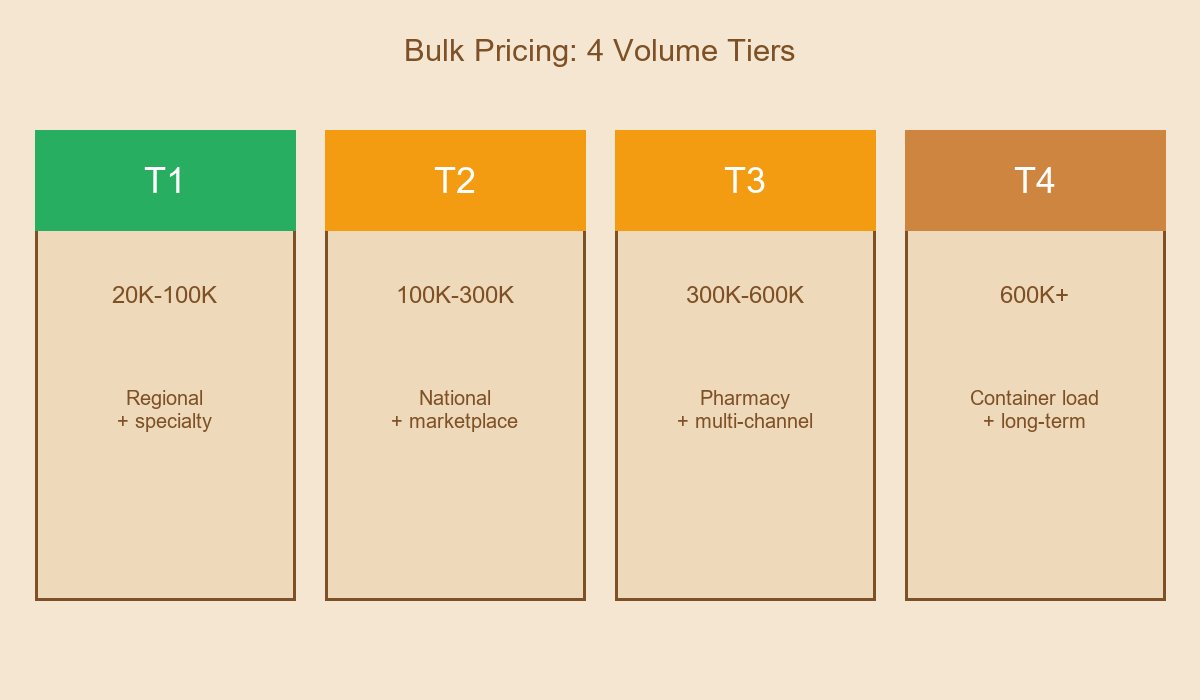
Tier 1 covers 20,000 to 100,000 patches per shipment, suited for regional distributors and specialty wellness wholesalers. KONGDY's Tier 1 supports the standard documentation pack and the single-market labelling configuration.
3.2 Tier 2: 100K - 300K Patches (KONGDY)
Tier 2 covers 100,000 to 300,000 patches per shipment, suited for national distributors and marketplace bulk sellers. KONGDY's Tier 2 adds the volume step-down and the multi-market artwork refresh capability.
3.3 Tier 3: 300K - 600K Patches (KONGDY)
Tier 3 covers 300,000 to 600,000 patches per shipment, suited for pharmacy chains and multi-channel distributors. KONGDY's Tier 3 adds the reserved production slot and the documentation roll-forward per market.
3.4 Tier 4: 600K+ Patches (KONGDY)
Tier 4 covers 600,000+ patches per shipment, suited for long-term supply agreements and container-load distributors. KONGDY's Tier 4 adds the multi-year supply agreement scope and the dedicated converting line allocation.
4. Packaging Configuration and Its Effect on Unit Cost
The packaging configuration moves the unit cost more than most distributors expect. Sachet count, secondary material, and premium format each add a documented increment to the landed unit cost, and the distributor who models the packaging upfront avoids the margin surprise at the container stage.
4.1 Sachet Count Per Box (KONGDY)
The sachet count per box drives the packaging material volume and the retail price point. KONGDY supplies configurations from 1 patch to 30 patches per box with the packaging cost documented per configuration.
4.2 Secondary Packaging Material (KONGDY)
The secondary packaging material ranges from standard carton to rigid box. KONGDY's material options are documented with the unit cost increment per option.
4.3 Premium and Multi-Count Formats (KONGDY)
The premium and multi-count formats carry a higher retail price and a higher unit cost. KONGDY's premium formats support the specialty wellness and corporate gifting channels.
4.4 Packaging Cost Optimization (KONGDY)
The packaging cost optimization balances the retail price point against the unit cost increment. KONGDY's commercial team returns the packaging cost table with the bulk quotation.
5. Landed Cost Modeling: Freight, Duty, and Brokerage
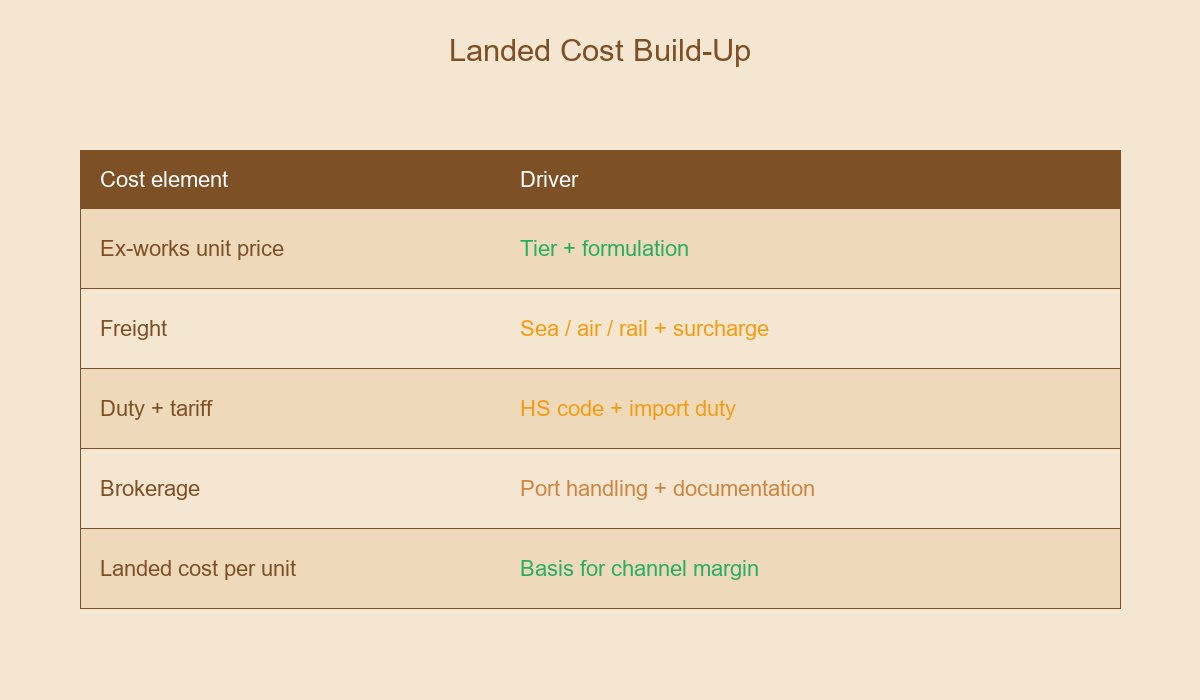
The landed cost modeling combines the unit price, the freight, the duty, and the customs brokerage into a single per-unit figure. A distributor who compares unit prices without the landed cost compares the wrong number and prices the channel margin against the wrong base.
5.1 Freight Mode and Cost (KONGDY)
The freight mode covers sea freight, air freight, and rail freight, and the cost is driven by the shipment volume, the destination port, and the seasonal surcharge. KONGDY's freight coordination returns the cost per mode and per destination.
5.2 Duty and Tariff Classification (KONGDY)
The duty and tariff classification covers the HS code and the destination market's import duty. KONGDY provides the HS code and the tariff classification for the distributor's broker.
5.3 Brokerage and Customs Clearance (KONGDY)
The brokerage and customs clearance covers the destination port handling and the documentation fees. KONGDY's customs documentation pack supports the clearance without a documentation hold.
5.4 Incoterm Selection and Cost Split (KONGDY)
The Incoterm selection covers FOB, CIF, and DDP, each with a documented cost split between the manufacturer and the distributor. KONGDY quotes each Incoterm for the bulk order.
6. Price Lock, Quotation Validity, and Currency Terms
The price lock and quotation validity decide whether the distributor's margin survives the production lead time. A bulk order quoted without a price lock absorbs the raw material movement between the quotation date and the production run.
6.1 Quotation Validity Window (KONGDY)
The quotation validity window documents how long the quoted price holds before a re-quote. KONGDY's commercial team documents the validity window in the bulk quotation.
6.2 Price Lock for the Program Term (KONGDY)
The price lock holds the unit price for the program term, subject to the documented raw material clause. KONGDY's price lock is documented in the supply agreement.
6.3 Currency Terms and Hedging Option (KONGDY)
The currency terms cover USD, EUR, GBP, and CNY pricing, with a hedging option for multi-year programs. KONGDY's commercial team returns the currency option with the bulk quotation.
6.4 Payment Terms (KONGDY)
The payment terms cover T/T and L/C structures. KONGDY's payment terms are documented per tier and per program scope.
7. Replenishment Cadence and Inventory Turn
The replenishment cadence is the rhythm that keeps the distributor's neck pain patch inventory turning. A bulk order without a documented replenishment cadence either runs out of stock in the channel or ties up working capital in a slow-moving pallet.
7.1 Replenishment Trigger (KONGDY)
The replenishment trigger is the inventory level that starts the next bulk order. KONGDY's commercial team supports the trigger calculation with the channel sell-through rate and the production lead time.
7.2 Safety Stock Calculation (KONGDY)
The safety stock covers the demand variance during the production lead time. KONGDY supports the safety stock formula and the reorder point per channel.
7.3 Inventory Turn Target (KONGDY)
The inventory turn target defines how many times per year the distributor rotates the inventory. KONGDY's commercial team supports the turn target with the channel data and the replenishment cadence.
7.4 Cadence Documentation (KONGDY)
The cadence documentation captures the trigger level, the safety stock, the lead time, and the target turn. KONGDY's cadence documentation is part of the supply agreement.
8. Common Bulk Pricing Mistakes and How to Avoid Them
Most bulk pricing mistakes trace back to four predictable decisions. The list below covers the most common ones and how KONGDY supports the distributor in avoiding them.
8.1 Comparing Unit Prices Without the Landed Cost (KONGDY)
A distributor who compares unit prices without the freight, duty, and brokerage compares the wrong number. KONGDY quotes FOB, CIF, and DDP and supports the landed cost calculation.
8.2 Ignoring the Packaging Cost Increment (KONGDY)
A distributor who treats the packaging as a rounding item discovers the margin gap at the container stage. KONGDY's packaging cost table documents the unit cost increment per configuration.
8.3 Ordering Below the Tier Threshold (KONGDY)
A distributor who orders just below the tier threshold loses the step-down on the entire shipment. KONGDY's commercial team supports the tier selection with the inventory target.
8.4 No Price Lock Duration (KONGDY)
A distributor without a price lock duration absorbs the raw material movement between quotation and production. KONGDY's supply agreement documents the validity window and the price lock.
9. Channel Margin and Retail Price Point Planning
The channel margin and retail price point planning ties the landed unit cost to the shelf price and the distributor's gross margin. A distributor who models the margin from the landed cost rather than the ex-works price prices the channel correctly.
9.1 Channel Margin Target (KONGDY)
The channel margin target documents the gross margin the distributor needs at each channel. KONGDY's commercial team supports the margin model with the landed cost and the retail price point.
9.2 Retail Price Point Positioning (KONGDY)
The retail price point positioning maps the packaging configuration to the shelf price band. KONGDY's commercial team returns the price point options per configuration.
9.3 Multi-Count and Premium Format Margin (KONGDY)
The multi-count and premium formats carry a higher retail price and a higher absolute margin per unit. KONGDY supplies the multi-count and premium formats on the same converting line.
9.4 Channel Margin Review (KONGDY)
The channel margin review is documented annually with the distributor. KONGDY's commercial team returns the margin review with the annual program summary.
10. Conclusion: Bulk Pricing as a Margin Decision
Neck pain patch bulk pricing is a margin decision, not a discount negotiation. The distributor who models the component cost, the volume step-down, the packaging increment, and the landed cost captures the channel margin that the bulk pricing program is designed to deliver.
KONGDY runs neck pain patch bulk pricing programs under ISO 22716 GMP certification with FDA registration, EU CPSR preparation, in-house analytical, microbiological, and stability laboratories, neck patch-specific flexibility and adhesion testing rigs, and documented change control. The bulk pricing program supports the distributor with the component-level cost breakdown, the tiered step-down, the packaging cost table, the landed cost model, and the program-term price lock.
Request KONGDY's neck pain patch bulk pricing quotation within 48 hours — share your destination market, target shipment volume, channel mix, and packaging direction, and the commercial team will return the component-level cost breakdown, the tiered unit pricing, the landed cost per Incoterm, and the documentation deliverable list for your shipment date.
Book a factory audit or live video tour at KONGDY's ISO 22716 facility to review the converting line, the flexibility and adhesion testing rigs, the analytical laboratory, and the stability chamber room, and request a free sample to validate adhesion, skin-contact comfort, and first-impression in your channel. Distributors planning a first container within one quarter can reserve a production slot while artwork and documentation work run in parallel.

