Magnetic eye mask factory tour 6 stations that decide quality: receiving and magnetic source quarantine, formulation and converting line, warming curve testing rig, stability chamber, and documentation archive. Brand owner verification guide with tour walk-through order and destination market compliance file.
1. Why Magnetic Eye Mask Factory Tours Reveal More Than a Quotation
A magnetic eye mask factory tour is the buyer's most direct window into the production system. The tour walks the converting line, the analytical laboratory, the warming curve testing rig, the stability chamber room, and the documentation archive, and the buyer sees the equipment, the operators, and the documentation in their actual production state. The tour closes the gap between the supplier's quotation and the buyer's verification.
KONGDY has manufactured consumer health patches and eye masks for 36 years and runs magnetic eye mask factory tours for brand owners, retail buyers, and third-party auditors across North America, Europe, and Asia. The facility is ISO 22716 GMP certified, FDA registered, and operates in-house analytical, microbiological, and stability laboratories, plus magnetic eye mask-specific warming curve and ear-loop tension testing rigs. The factory tour covers six stations, and each station decides a different element of the buyer's compliance file.
This guide walks through the six stations, what each one decides, and how the brand owner can use the tour to verify the supplier's system before issuing the first purchase order.
2. Station 1: Receiving and Magnetic Source Quarantine
The first station is the receiving and magnetic source quarantine area. This is where the magnetic source, the carrier non-woven, the ear-loop, and the packaging components enter the facility and are released to production.
2.1 What This Station Decides (KONGDY)
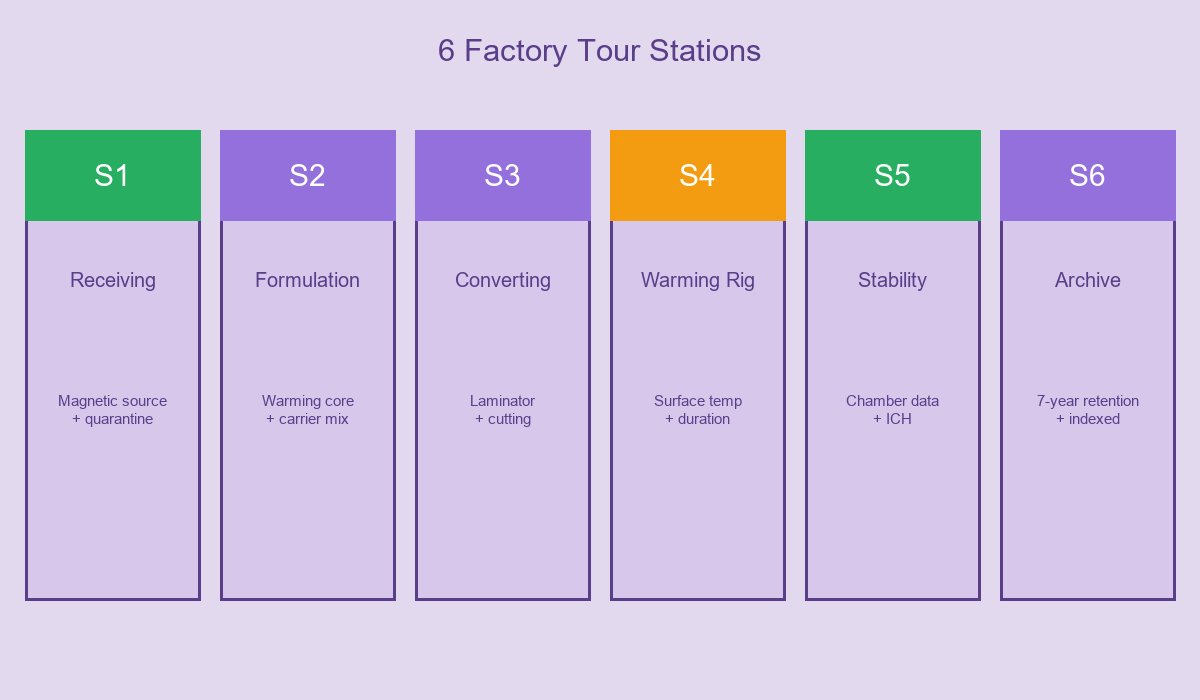
The receiving and quarantine area decides whether the magnetic source is verified against the destination market's cosmetic monograph. KONGDY's receiving system logs the supplier, the lot number, the CoA, and the analytical verification result before releasing the magnetic source to production.
2.2 What the Buyer Observes (KONGDY)
The buyer observes the receiving log, the quarantine area, and the analytical verification records. KONGDY's receiving system records the temperature, the storage condition, and the quarantine status per magnetic source lot.
2.3 What the Buyer Documents (KONGDY)
The buyer documents the supplier list, the verification scope, and the quarantine release procedure. KONGDY's receiving system is documented in the QC manual summary.
3. Station 2: Formulation and Converting Line
The second and third stations are the formulation and the converting line. The formulation stage mixes the warming core, the carrier non-woven, and the magnetic source. The converting line laminates the layers and cuts the finished patch shape.
3.1 Station 2: Formulation (KONGDY)
The formulation stage mixes the warming core, the carrier non-woven, and the magnetic source with the supplier's documented formulation matrix. KONGDY's formulation stage is documented per formulation and per production run.
3.2 Station 3: Converting Line (KONGDY)
The converting line laminates the warming core, the carrier, and the magnetic source and cuts the finished patch shape. KONGDY's converting line capability supports 200,000 to 800,000 patches per production run with documented cutting tolerance.
3.3 What the Buyer Observes (KONGDY)
The buyer observes the formulation matrix, the converting line capability, the cutting tolerance, the operator workflow, and the in-process sampling point. KONGDY's formulation and converting line is documented per production run.
4. Station 4: Warming Curve Testing Rig
The fourth station is the warming curve testing rig. The warming curve decides the consumer's first-impression experience and the destination market's warming-claim regulation. A buyer who inspects the warming curve testing rig captures the validation data that the labelling claim depends on.
4.1 What This Station Decides (KONGDY)
The warming curve testing rig decides whether the warming duration and the surface temperature are validated against the destination market's cosmetic claim regulation. KONGDY's warming curve testing rig measures the surface temperature, the warming duration, and the cool-down profile per formulation.
4.2 What the Buyer Observes (KONGDY)
The buyer observes the warming curve testing rig calibration records, the surface temperature profile, the warming duration, the cool-down, and the validation data. KONGDY's warming curve testing rig is documented per formulation.
4.3 What the Buyer Documents (KONGDY)
The buyer documents the warming duration, the surface temperature profile, the validation data, and the destination market's labelling claim alignment. KONGDY's warming curve validation is part of the documentation dossier.
5. Stations 5-6: Stability Chamber and Documentation Archive
The fifth and sixth stations are the stability chamber and the documentation archive. The stability chamber generates the data that supports the shelf life statement, and the documentation archive supports the regulatory file and the customer retrieval cycle.
5.1 Station 5: Stability Chamber (KONGDY)
The stability chamber is qualified and calibrated to ICH conditions, with storage at 25, 30, and 40 degrees Celsius for multi-market distribution. KONGDY's stability chambers support the per-market shelf life assignment and the documentation roll-forward.
5.2 Station 6: Documentation Archive (KONGDY)
The documentation archive stores the production records, the analytical results, the warming curve data, and the customer correspondence for 7 years. KONGDY's documentation archive is electronic and indexed per batch.
5.3 What the Buyer Observes (KONGDY)
The buyer observes the chamber qualification records, the calibration schedule, the storage condition map, the documentation archive index, and the batch retrieval procedure. KONGDY's stability chamber and documentation archive are documented per destination market.
6. The Tour Day Walk-Through: What Buyers and Auditors Verify
The tour day walk-through covers the production line, the analytical laboratory, the warming curve testing rig, the stability chamber room, and the documentation archive. The walk-through is documented per station with verification of the equipment, the operators, and the documentation chain.
6.1 Pre-Tour Preparation (KONGDY)
The pre-tour preparation includes the QC manual summary, the destination market's specification, and the buyer's verification scope. KONGDY's commercial team provides the pre-tour documentation one week before the tour.
6.2 Tour Walk-Through Order (KONGDY)
The walk-through order follows the production flow: receiving, formulation, converting, in-process, finished product laboratory, packaging, microbiological laboratory, stability chamber, and documentation archive. KONGDY's tour follows this order, with the QC team guiding.
6.3 Post-Tour Documentation (KONGDY)
The post-tour documentation captures the verification data, the corrective action items, and the next-stage scope. KONGDY's tour ends with a written tour summary and a follow-up schedule.
7. The Tour Reveals: Equipment, Operators, Documentation
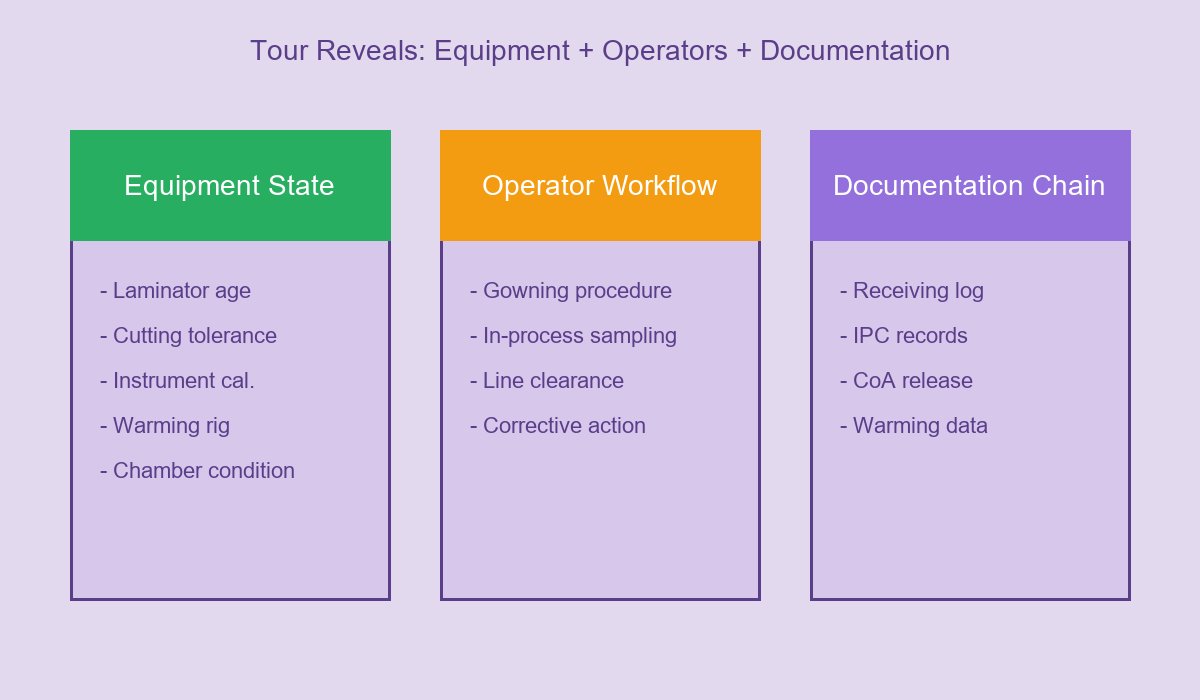
The tour reveals three things: the equipment's actual state, the operators' workflow, and the documentation chain. A buyer who finds a gap in any of the three areas will issue a corrective action request that the supplier must close before the first production run.
7.1 Equipment State (KONGDY)
The equipment state includes the laminator's age, the cutting tolerance, the analytical instrument calibration, the warming curve testing rig, and the stability chamber condition. KONGDY's equipment state is documented in the QC manual summary and verifiable during the tour.
7.2 Operator Workflow (KONGDY)
The operator workflow includes the gowning procedure, the in-process sampling, the line clearance, and the corrective action procedure. KONGDY's operator workflow is documented and observed during the tour.
7.3 Documentation Chain (KONGDY)
The documentation chain includes the receiving log, the in-process control records, the CoA release, the packaging records, and the warming curve data. KONGDY's documentation chain is electronic and verifiable during the tour.
8. Common Tour Findings and How to Address Them
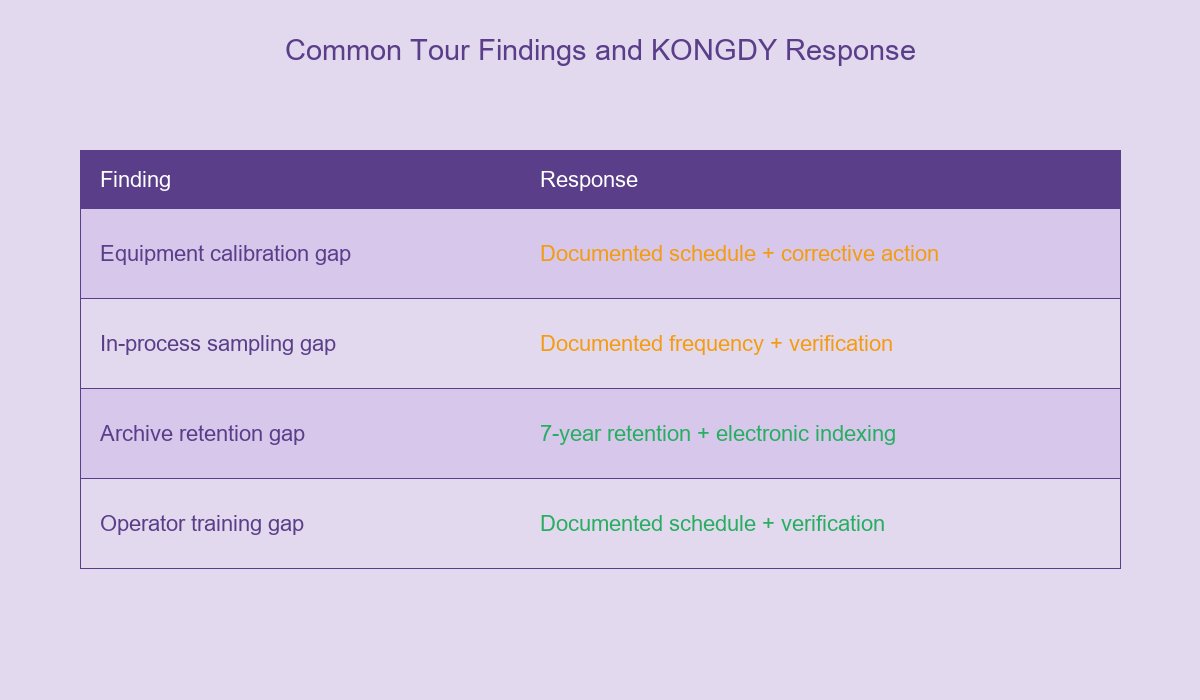
Most factory tours surface four predictable findings. The list below covers the most common ones and how KONGDY addresses them.
8.1 Equipment Calibration Records Gap (KONGDY)
A calibration record gap indicates that an instrument's last calibration date is overdue. KONGDY's calibration schedule is documented and verifiable during the tour, with corrective action triggered by any gap.
8.2 In-Process Sampling Frequency Gap (KONGDY)
An in-process sampling frequency gap indicates the sampling is below the documented procedure. KONGDY's in-process sampling is documented and verified during the tour.
8.3 Documentation Archive Retention Gap (KONGDY)
A documentation archive retention gap indicates that a record is past the retention period. KONGDY's documentation archive retention is 7 years and verified during the tour.
8.4 Operator Training Gap (KONGDY)
An operator training gap indicates that an operator's training record is overdue. KONGDY's operator training schedule is documented and verifiable during the tour.
9. The Tour as a Sourcing Decision
The tour is a sourcing decision. The brand owner who treats the tour as a sourcing decision captures the regulatory scope, the change control procedure, and the post-market surveillance chain that the documented tour program delivers.
9.1 Verify the Equipment (KONGDY)
Verify the equipment by reviewing the laminator calibration, the cutting tolerance, the analytical instrument calibration, the warming curve testing rig, and the stability chamber condition. KONGDY's equipment is documented per production run.
9.2 Verify the Operator Workflow (KONGDY)
Verify the operator workflow by reviewing the gowning procedure, the in-process sampling, the line clearance, and the corrective action procedure. KONGDY's operator workflow is documented per station.
9.3 Verify the Documentation Chain (KONGDY)
Verify the documentation chain by reviewing the receiving log, the in-process control records, the CoA release, the packaging records, and the warming curve data. KONGDY's documentation chain is electronic and indexed per batch.
9.4 Verify the Destination Market Compliance (KONGDY)
Verify the destination market compliance by reviewing the FDA cosmetic registration, the EU CPSR, and the per-market labelling scope. KONGDY's documentation system supports the per-market regulatory file.
10. Conclusion: Magnetic Eye Mask Factory Tour as a Sourcing Decision
A magnetic eye mask factory tour is a sourcing decision, not a courtesy visit. The brand that treats the tour as a sourcing decision captures the regulatory scope, the change control procedure, and the post-market surveillance chain that the documented tour program delivers.
KONGDY runs magnetic eye mask factory tours under ISO 22716 GMP certification with FDA registration, EU CPSR preparation, in-house analytical, microbiological, and stability laboratories, magnetic eye mask-specific warming curve and ear-loop tension testing rigs, and documented change control. The six-station tour supports the brand owner with the equipment verification, the operator workflow review, the documentation chain confirmation, and the destination market compliance file.
Schedule a magnetic eye mask factory tour at KONGDY's ISO 22716 facility — the QC team will guide the walk-through the production line, the analytical laboratory, the warming curve testing rig, the stability chamber room, and the documentation archive, share the QC manual summary, the calibration records, and the documentation archive samples, and return a written tour summary within one week.
Request a remote live video tour or factory audit quotation for a remote walk-through of the production line, the analytical laboratory, the warming curve testing rig, and the stability chamber room, and request a free magnetic eye mask sample to validate magnetic intensity, warming duration, and first-impression in your channel. Brand owners planning a launch within two quarters can additionally reserve a pilot batch slot while artwork and documentation work run in parallel.

