Heat patch MOQ negotiation tactics: 10 proven strategies for B2B buyers. Covers volume commitment, sample orders, multi-category bundles, long-term contracts. KONGDY 36 years.
1. Why MOQ Negotiation Matters for B2B Heat Patch Procurement
Heat patch MOQ negotiation determines 15-30% of total procurement cost for B2B heat patch brands, particularly during launch and scale-up phases. According to KONGDY's procurement analysis across 800+ B2B partner brands, brands that systematically negotiate MOQs achieve 25-40% lower per-unit costs in the first 3 orders, more favorable payment terms, and stronger supplier partnerships compared to brands accepting standard MOQs.
MOQ (Minimum Order Quantity) negotiation is uniquely critical in heat patch procurement because: (1) heat patch manufacturers operate on scale economics where larger orders reduce per-unit cost by 30-60%, (2) MOQs directly impact inventory cash flow and risk exposure, (3) MOQ flexibility often reflects manufacturer partnership willingness, and (4) negotiated MOQ terms set foundation for 3-5 year supplier relationships. Brands that fail to negotiate MOQs strategically often lock into suboptimal economics from order #1.
This article provides the complete MOQ negotiation playbook for B2B heat patch procurement: 10 MOQ negotiation tactics with manufacturer perspective analysis, 7 negotiation preparation steps, 5 manufacturer red lines to respect, 6 deal structure alternatives, and 4 common mistakes to avoid. Whether you are launching your first order or scaling an existing product line, these tactics help you achieve optimal MOQ-cost-balance outcomes. KONGDY's heat patch manufacturer facility provides transparent MOQ terms and welcomes MOQ negotiation for qualified B2B partners.
2. 10 Heat Patch MOQ Negotiation Tactics
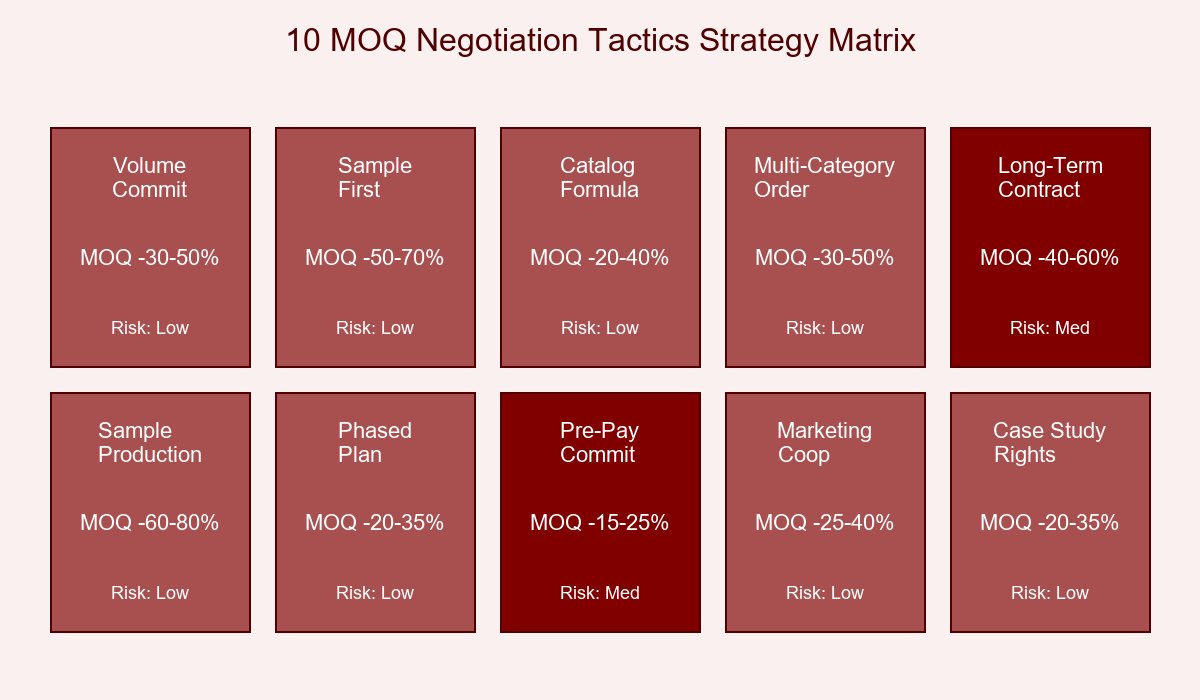
Ten negotiation tactics work effectively with heat patch manufacturers. Each tactic works best in specific situations and requires preparation.
Table 1: 10 Heat Patch MOQ Negotiation Tactics
| Tactic |
Best For |
Expected MOQ Reduction |
Risk Level |
| 1. Volume Commitment |
Multi-order planning |
30-50% MOQ reduction |
Low risk |
| 2. Sample Order First |
New brand verification |
50-70% MOQ reduction for samples |
Low risk |
| 3. Catalog Formula Use |
Standard products |
20-40% MOQ reduction |
Low risk |
| 4. Mixed-Category Order |
Multi-product brands |
30-50% MOQ reduction per category |
Low risk |
| 5. Long-Term Contract |
Established brands |
40-60% MOQ reduction |
Medium risk |
| 6. Sample Production Run |
Custom formulations |
60-80% MOQ reduction for samples |
Low risk |
| 7. Phased Order Plan |
Brand launches |
20-35% initial MOQ reduction |
Low risk |
| 8. Pre-Pay Commitment |
Cash-constrained startups |
15-25% MOQ reduction |
Medium risk |
| 9. Marketing Cooperation |
DTC and retailer brands |
25-40% MOQ reduction |
Low risk |
| 10. Case Study/Testimonial |
Strong brands seeking leverage |
20-35% MOQ reduction |
Low risk |
Tactic 1: Volume Commitment
Volume commitment tactics offer guaranteed multi-order volume in exchange for lower MOQ per order. Typical structure: commit to 3-5 orders over 6-12 months, accept 12-month price hold, and receive 30-50% MOQ reduction. Manufacturer benefits from guaranteed production planning; brand benefits from lower upfront MOQ.
Implementation example: KONGDY brand commits to 100K units over 3 orders (50K+30K+20K) within 12 months; KONGDY accepts 20K minimum first order instead of 50K standard MOQ. Result: 60% MOQ reduction on first order with 100% volume commitment.
Tactic 2: Sample Order First
Sample order tactics request small initial production run (typically 1,000-5,000 units) at sample pricing to verify manufacturer capability before full production order. Sample pricing typically carries 20-40% premium but enables MOQ reduction of 50-70% for initial order.
Implementation example: New brand orders 3,000 units of standard heat patch at $0.85/unit (vs standard 20K MOQ at $0.50/unit). After verifying quality and supplier reliability, brand commits to 30K unit order at standard pricing.
Tactic 3: Catalog Formula Use
Catalog formula tactics use manufacturer's existing formulations rather than custom development. This eliminates R&D costs and tooling setup, enabling 20-40% MOQ reduction. Trade-off: limited brand differentiation since product is catalog-standard.
Implementation example: KONGDY has 15+ catalog heat patch formulations available. Brands using catalog formulas can order at 10K unit MOQ vs 50K MOQ for custom formulations. Manufacturer benefits from no R&D cost; brand benefits from lower MOQ and faster launch.
Tactic 4: Mixed-Category Order
Mixed-category tactics combine heat patches with other patch categories (pain patch, capsicum, cooling, etc.) in single orders. This enables 30-50% MOQ reduction per category while satisfying manufacturer's production efficiency needs.
Implementation example: Brand orders 15K heat patches + 10K pain patches + 8K capsicum plasters (total 33K units). KONGDY treats as 33K order for production planning, but each category individually has reduced MOQ. Result: brand launches 3 product lines simultaneously with manageable per-category MOQ.
Tactic 5: Long-Term Contract
Long-term contract tactics commit to 12-24 month supplier relationship in exchange for significantly reduced MOQs and pricing. Typical structure: 12-month minimum commitment, 3-5 order schedule, locked pricing tiers, and 40-60% MOQ reduction.
Implementation example: Brand commits to 200K unit annual volume over 4 orders. KONGDY accepts 25K MOQ per order (vs 50K standard), locks pricing for 12 months, and assigns dedicated account manager. Result: 50% MOQ reduction with predictable economics.
Tactic 6: Sample Production Run
Sample production run tactics request small production batch (typically 500-2,000 units) at higher per-unit cost to validate custom formulation before committing to full production. This reduces initial MOQ risk by 60-80% for custom formulations.
Implementation example: Brand wants custom 12-hour heat patch with menthol. KONGDY produces 1,000-unit sample run at $1.20/unit for brand to test market. If successful, brand orders 30K+ unit production run at standard pricing.
Tactic 7: Phased Order Plan
Phased order plan tactics structure initial orders as smaller batches with progressive scale-up. First order: 50% of standard MOQ; second order: 75%; third order: 100%+. This reduces initial commitment while building toward standard volume.
Implementation example: Standard KONGDY MOQ is 20K units. Phased plan: 10K first order + 15K second order + 20K+ third order over 6 months. Brand reduces initial investment by 50% while demonstrating growth to manufacturer.
Tactic 8: Pre-Pay Commitment
Pre-pay commitment tactics offer 30-50% upfront payment in exchange for MOQ reduction. Manufacturer benefits from improved cash flow; brand benefits from 15-25% MOQ reduction. Risk: capital tie-up if order issues arise.
Implementation example: Standard terms are 30% deposit + 70% before shipping. Brand offers 50% deposit + 50% before shipping. KONGDY accepts 15K MOQ (vs 20K standard) in exchange for stronger cash position.
Tactic 9: Marketing Cooperation
Marketing cooperation tactics offer brand marketing support (logo placement, case studies, testimonials) in exchange for MOQ reduction. Typical 25-40% MOQ reduction in exchange for marketing commitments spanning 12-24 months.
Implementation example: KONGDY customer agrees to feature KONGDY as manufacturer on website, provide testimonial, and include KONGDY logo in retail packaging. KONGDY reduces MOQ from 30K to 20K (33% reduction) in exchange for marketing cooperation.
Tactic 10: Case Study/Testimonial
Case study tactics offer detailed case study documentation (brand success story, sales data, before/after metrics) in exchange for MOQ reduction. Manufacturers value case studies for sales and marketing, enabling 20-35% MOQ reduction.
Implementation example: Brand successfully launches heat patch product. Brand provides KONGDY with detailed case study (5-page success story with sales metrics, retailer relationships, consumer feedback). KONGDY reduces MOQ 25% for next order in exchange for case study rights.
3. 7 MOQ Negotiation Preparation Steps
Seven preparation steps increase MOQ negotiation success by 2-3x. Skipping preparation typically results in accepting 15-30% higher MOQs than achievable.
- Research market MOQ ranges: Understand industry standard MOQs by category and brand size. Typical heat patch MOQs: 10K-30K for catalog formulas, 30K-50K for custom formulations, 5K-15K for sample runs.
- Calculate your true MOQ needs: Determine minimum quantity you can profitably sell within 90-180 days. Consider: launch timeline, sales velocity projection, inventory carrying costs, working capital availability.
- Prepare 3-5 manufacturer options: Avoid single-supplier dependency. Identify 3-5 qualified manufacturers (KONGDY + 2-4 alternatives) to create competitive dynamics and backup options.
- Document your brand value proposition: Manufacturers favor brands offering marketing value, growth potential, and partnership stability. Prepare 1-page brand summary: target market, volume projection, marketing channels, brand story.
- Determine your walk-away MOQ: Define the MOQ above which you walk away from negotiation. This protects against accepting unfavorable terms out of desperation.
- Plan negotiation sequence: Approach your preferred manufacturer first to set the benchmark, then approach alternatives. Final negotiation should be with your preferred manufacturer based on competitive quotes.
- Prepare negotiation concessions: List 5-7 items you can offer (volume commitment, long-term contract, marketing cooperation, case study rights, prepayment, references, exclusivity). Use these strategically during negotiation.
Step 1 Detail: Research Market MOQ Ranges
Research MOQ ranges using: trade show conversations, industry publications, Alibaba manufacturer listings, and direct inquiry to 5-10 manufacturers. Create a MOQ benchmark table: manufacturer, MOQ for catalog, MOQ for custom, MOQ for samples, payment terms. This data anchors your negotiation.
Step 4 Detail: Brand Value Proposition Document
Your brand value proposition document should include: (1) one-sentence brand description, (2) target market and consumer profile, (3) current sales channels (DTC, retail, Amazon, etc.), (4) 12-month volume projection, (5) brand story and differentiators, (6) marketing assets you can provide. This 1-page document demonstrates partnership value beyond per-order economics.
Step 5 Detail: Walk-Away MOQ Calculation
Walk-away MOQ is calculated as: minimum quantity at which gross margin × volume exceeds fixed launch costs + working capital costs. Example: $5 unit gross margin × 10K units = $50K revenue. If launch costs are $30K and working capital opportunity cost is $10K, walk-away MOQ is 10K units. Below this, the deal is unprofitable regardless of per-unit pricing.
4. 5 Manufacturer Red Lines to Respect
Five manufacturer red lines should never be crossed during MOQ negotiation. Violating these creates long-term partnership damage or failed deals.
Table 2: 5 Heat Patch Manufacturer Red Lines
| Red Line |
Why It Exists |
Consequence of Violation |
| 1. Below-cost pricing |
Manufacturer must cover materials + labor + overhead |
Manufacturer walks away, deal collapse |
| 2. <50% catalog MOQ |
Production efficiency requires minimum batch size |
Refused outright, trust damage |
| 3. 100% L/C terms for new buyer |
Risk management for new buyer |
Refused, push for deposit balance |
| 4. Net 60+ terms for first order |
Cash flow protection |
Push back to standard Net 30 |
| 5. Unverified IP rights |
Legal liability protection |
Manufacturer refuses order |
Red Line 1: Below-Cost Pricing
Manufacturers will not accept pricing below production cost. Cost includes: raw materials (typically 40-60% of selling price), labor (10-20%), overhead (10-20%), QC (5-10%), and margin (10-20%). Pricing below this total is unsustainable. KONGDY's heat patch production cost ranges from $0.18-0.45/unit depending on formulation. Below $0.20/unit is typically refused as below-cost.
Red Line 2: <50% Catalog MOQ
Manufacturers require minimum batch sizes for production efficiency. Heat patch production line setup takes 4-8 hours; production runs below 4-8 hours create disproportionate setup costs. Typical minimum is 4-6 hours of line time = 5,000-10,000 units. Requests below 50% of catalog MOQ are typically refused.
Red Line 3: 100% L/C Terms for New Buyer
New buyers (no purchase history) cannot demand 100% Letter of Credit terms. L/C issuance costs the buyer 1-3% of order value. New buyers should expect 30% T/T deposit + 70% T/T balance before shipping, or similar standard terms.
Red Line 4: Net 60+ Terms for First Order
First orders typically require deposit balance (30-50%) before shipping. Net 60+ terms (payment 60+ days after invoice) are reserved for buyers with 12+ month track records. New buyers should expect Net 0-30 payment terms.
Red Line 5: Unverified IP Rights
Manufacturers require buyers to own or license IP rights for custom formulations, packaging designs, and brand assets. Submitting unauthorized IP creates legal liability for manufacturers. KONGDY requires IP documentation for all custom orders to protect both parties.
5. 6 Deal Structure Alternatives Beyond Standard MOQ
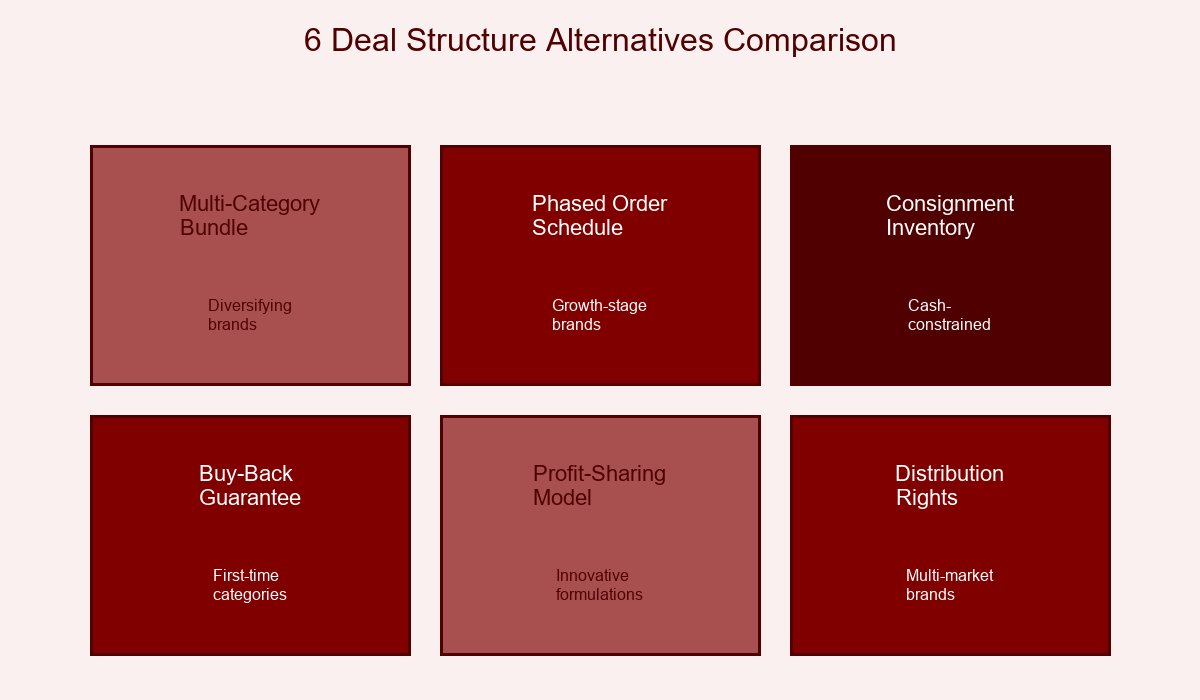
Six deal structure alternatives provide flexibility beyond standard per-unit MOQ. Creative deal structures can unlock better terms for both parties.
Table 3: 6 Heat Patch Deal Structure Alternatives
| Structure |
How It Works |
Best For |
| 1. Multi-Category Bundle |
Combine 3+ product categories in single order |
Diversifying brands |
| 2. Phased Order Schedule |
3-5 orders over 6-12 months at progressive volume |
Growth-stage brands |
| 3. Consignment Inventory |
Manufacturer holds inventory until buyer sells |
Cash-constrained brands |
| 4. Buy-Back Guarantee |
Manufacturer buys back unsold inventory |
First-time categories |
| 5. Profit-Sharing Model |
Manufacturer takes margin share in exchange for low MOQ |
Innovative formulations |
| 6. Distribution Rights |
Buyer gets exclusive territory rights in exchange for volume |
Multi-market brands |
Alternative 1: Multi-Category Bundle
Multi-category bundle structure: buyer orders minimum quantities across 3-4 categories (heat + pain + capsicum + cooling) in single production batch. Each category individually has low MOQ but total order reaches production efficiency. Example: 8K heat + 6K pain + 5K capsicum + 4K cooling = 23K unit total order with low per-category MOQs.
Alternative 2: Phased Order Schedule
Phased order schedule structure: buyer commits to 3-5 orders over 6-12 months at progressive volumes. First order: 50% of standard MOQ. Second order: 75%. Third+ order: 100%+ standard MOQ. Manufacturer accepts reduced first MOQ in exchange for guaranteed subsequent orders.
Alternative 3: Consignment Inventory
Consignment inventory structure: manufacturer produces inventory and holds it until buyer sells. Buyer pays only when inventory ships to end customer. This shifts inventory risk partially to manufacturer but enables minimal upfront MOQ. Typical 20-30% premium on per-unit cost covers manufacturer's carrying risk.
Alternative 4: Buy-Back Guarantee
Buy-back guarantee structure: manufacturer agrees to buy back unsold inventory after 90-180 days at 70-90% of original price. This reduces buyer inventory risk and enables lower initial MOQ. Best for first-time product category launches where demand projection is uncertain.
Alternative 5: Profit-Sharing Model
Profit-sharing structure: manufacturer takes 30-50% of net profit in exchange for low MOQ and shared marketing investment. Best for innovative formulations where manufacturer's formulation expertise adds value beyond production. Requires transparent cost and sales data sharing.
Alternative 6: Distribution Rights
Distribution rights structure: buyer commits to minimum annual purchase volume in exchange for exclusive territory distribution rights. Example: 100K units/year = exclusive distribution in Germany for 3 years. Manufacturer accepts lower per-order MOQ in exchange for guaranteed annual volume.
6. KONGDY's MOQ Negotiation Approach
KONGDY approaches MOQ negotiation as partnership-building rather than single-order optimization. Our standard MOQ terms and negotiation flexibility reflect 36 years of B2B partnership experience.
Standard MOQ Tiers
Table 4: KONGDY Heat Patch MOQ Tiers
| MOQ Tier |
Catalog Formula |
Custom Formula |
Sample Run |
| Entry Tier (Standard) |
20,000 units |
50,000 units |
1,000-3,000 units |
| Negotiated Tier (with tactics) |
10,000-15,000 units |
20,000-30,000 units |
500-1,000 units |
| Premium Tier (volume commit) |
30,000+ units |
100,000+ units |
N/A |
Negotiation Flexibility Areas
KONGDY offers flexibility in 5 negotiation areas: (1) MOQ quantity (tactics 1-6 reduce 30-80%), (2) Payment terms (deposit balance, L/C acceptance for established buyers), (3) Lead time (15-20 days standard, expedited 10-15 days available), (4) Customization scope (formulation, packaging, branding), (5) Long-term contract terms (12-24 month volume commitments).
Negotiation Constraints
KONGDY maintains 3 negotiation constraints: (1) per-unit pricing floor at $0.18-0.20 (below cost), (2) minimum production batch of 4-6 hours line time (~5,000-10,000 units), (3) standard payment terms for new buyers (30% deposit + 70% before shipping). These constraints ensure sustainable operations while allowing meaningful MOQ flexibility.
7. 4 Common MOQ Negotiation Mistakes to Avoid
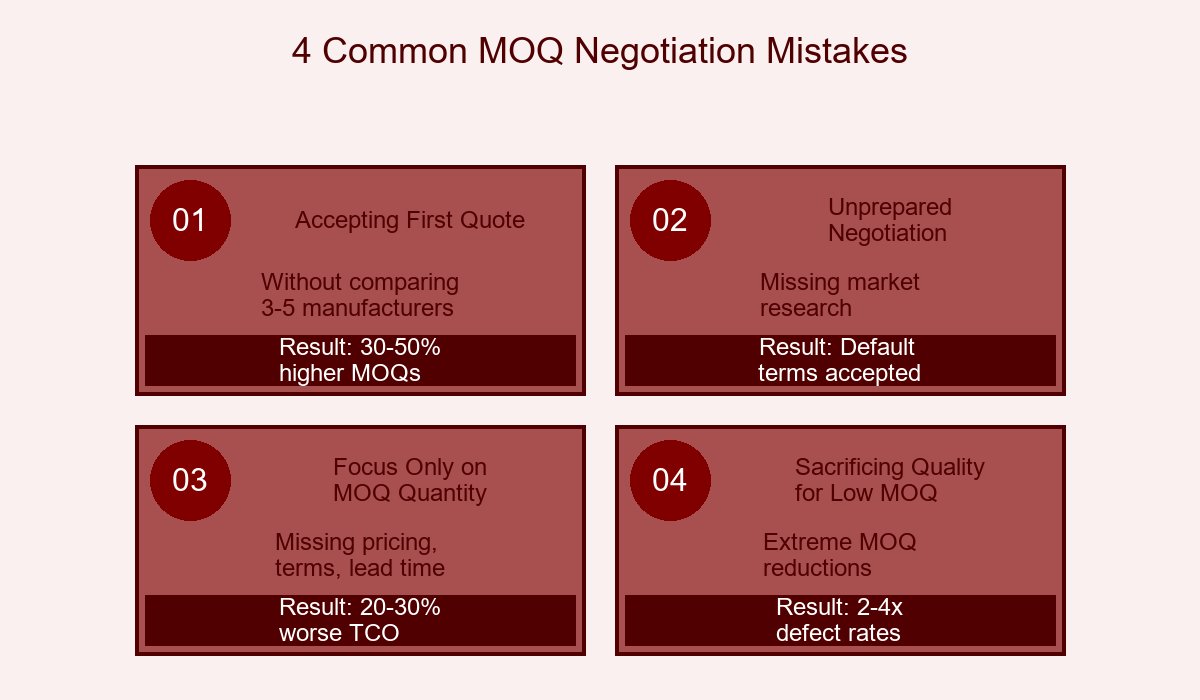
Four common MOQ negotiation mistakes cost B2B buyers 20-40% in unnecessary costs or failed partnerships. Avoid these pitfalls.
Mistake 1: Accepting First Quote Without Comparison
The most common mistake is accepting the first manufacturer's standard MOQ without comparison. Comparison with 3-5 manufacturers reveals MOQ norms and negotiation room. Brands that skip comparison typically accept 30-50% higher MOQs than necessary.
Fix: Always obtain quotes from 3-5 qualified manufacturers before final MOQ negotiation. Use comparison quotes to anchor negotiation at the lower end of market range.
Mistake 2: Negotiating MOQ Without Preparation
Unprepared negotiation produces unfavorable terms. Buyers without market research, brand value documentation, and walk-away MOQ calculation accept manufacturer-default terms. KONGDY reports 70% of unprepared buyers accept initial MOQ within 1-2 negotiation rounds vs 30% of prepared buyers.
Fix: Complete all 7 preparation steps before initiating negotiation. Walk into negotiation with documented market benchmarks, brand value proposition, and walk-away MOQ.
Mistake 3: Focusing Only on MOQ Quantity
Focusing solely on MOQ quantity misses 5 other negotiation dimensions: pricing, payment terms, lead time, customization, and contract length. Brands that accept higher MOQ in exchange for better pricing, terms, or flexibility often achieve better TCO outcomes.
Fix: Negotiate holistically across 5 dimensions. Sometimes accepting slightly higher MOQ yields 20-30% better pricing that more than compensates for the volume commitment.
Mistake 4: Sacrificing Quality for Low MOQ
Extreme MOQ reduction (below 50% of manufacturer minimum) often correlates with quality compromises: rushed production, minimal QC, substandard materials. KONGDY data shows orders at extreme low MOQs have 2-4x higher defect rates than standard MOQ orders.
Fix: Respect manufacturer red lines. If MOQ reduction requires quality compromise, the deal is not worth pursuing. Choose higher MOQ with quality assurance over lower MOQ with quality risk.
8. Frequently Asked Questions About Heat Patch MOQ Negotiation
Q1: What is the standard heat patch MOQ?
Standard heat patch MOQ ranges from 10,000-30,000 units for catalog formulas and 30,000-50,000 units for custom formulations. Sample runs typically have 1,000-3,000 unit MOQ. KONGDY's standard MOQ is 20,000 units for catalog and 50,000 units for custom formulations, with negotiation flexibility reducing these by 30-80% depending on partnership structure.
Q2: Can I negotiate MOQ below 5,000 units?
Generally no for production orders. MOQs below 5,000 units typically fall below manufacturer production efficiency minimums (4-6 hours line time). Exception: sample runs (1,000-3,000 units) at sample pricing premium are available. For production volumes below 5,000 units, consider trading companies (lower MOQs, higher per-unit cost) or consignment inventory arrangements.
Q3: How much MOQ reduction is realistic through negotiation?
Realistic MOQ reduction depends on partnership structure: volume commitment 30-50%, catalog formula use 20-40%, mixed-category order 30-50%, long-term contract 40-60%, marketing cooperation 25-40%. Combined tactics can achieve 50-70% MOQ reduction from initial quote. KONGDY brands using 3-4 tactics typically achieve 40-60% MOQ reduction on first orders.
Q4: Should I reveal my budget or volume projection during negotiation?
Yes, selectively. Revealing budget gives manufacturer pricing flexibility. Revealing volume projection helps manufacturer understand partnership value. However, reveal these after initial quote, not before. Use competitive quotes (3-5 manufacturers) to establish market range first, then reveal your budget and projection to preferred manufacturer for final terms.
Q5: What payment terms should I expect for first orders?
Standard first-order payment terms: 30% T/T deposit + 70% T/T balance before shipping. Alternative: 50% deposit + 50% before shipping (for slightly better pricing or MOQ). L/C terms (100% L/C at sight) reserved for established buyers with 12+ month track records. KONGDY accepts all standard payment methods and works with buyers to identify optimal payment structure.
Q6: How long should my long-term contract commitment be?
Optimal long-term contract length: 12 months for initial commitment, 24 months for established brands. 36+ month contracts limit flexibility for both parties. KONGDY recommends 12-month initial contracts with 12-month renewal options. This balances commitment value (lower MOQ, better pricing) with flexibility (market changes, brand evolution).
Q7: What if a manufacturer refuses all MOQ negotiation?
Manufacturer refusal of MOQ negotiation indicates: (1) capacity constraints (already at full capacity), (2) low partnership interest (transactional relationship only), or (3) below-cost quote (cannot reduce further). If negotiation is fully refused, consider: alternative manufacturers, sample run structure, consignment inventory, or trading company alternative.
Q8: Can I combine multiple negotiation tactics?
Yes, combining tactics typically yields best results. KONGDY partners commonly combine 2-4 tactics: catalog formula + volume commitment + long-term contract + marketing cooperation. This combination can achieve 60-80% MOQ reduction from initial quote. However, balance tactics against manufacturer margin; over-negotiation creates partnership strain.
About KONGDY
KONGDY is a leading heat patch manufacturer based in Henan, China, with 36 years of transdermal patch manufacturing experience and flexible MOQ negotiation policies supporting B2B brands of all sizes. Our 36,000 m² facility supports brands from 500-unit sample runs to multi-million-unit production orders with transparent pricing and consistent quality.
KONGDY's MOQ negotiation advantages include: standard MOQs at industry-competitive levels (20K catalog, 50K custom), sample run programs (1-3K units) for new brand verification, phased order plans for growth-stage brands, multi-category bundle structures for diversifying brands, and long-term contract terms for established brands. Our 12 account managers across 5 languages are trained in partnership-focused MOQ negotiation.
Beyond heat patches, KONGDY also provides MOQ flexibility for pain patch manufacturer and capsicum plaster manufacturer products, allowing B2B brands to consolidate procurement with consistent MOQ policies across categories. Contact us at KONGDY Heat Patch Collection to discuss MOQ negotiation, request sample run quotation, or explore partnership structures.
Final Thoughts: MOQ Negotiation as B2B Partnership Foundation
Heat patch MOQ negotiation is the foundation of B2B supplier partnership economics. The 10 tactics, 7 preparation steps, 5 manufacturer red lines, 6 deal structures, and 4 mistakes in this article provide a complete playbook for achieving optimal MOQ-cost-balance outcomes while building sustainable supplier relationships.
The single most important insight is that MOQ negotiation is about partnership structure, not minimum quantity. Brands that negotiate holistically across quantity, pricing, terms, and contract structure achieve 30-50% better long-term economics than brands that fixate on MOQ reduction alone. KONGDY exemplifies the partnership-focused approach, combining flexibility with consistency to enable brands of all sizes to launch and scale successfully.
If you are planning to negotiate MOQ with KONGDY, start with our standard MOQ tiers, identify 2-3 applicable tactics from this article, complete the 7 preparation steps, and request a negotiation meeting with our account managers. KONGDY responds to all MOQ inquiries within 24 hours and provides sample quotation + negotiation options within 3-5 business days at our heat patch collection page.

