Heat patch manufacturer quality control: 7 inspection checkpoints for B2B buyers. Covers incoming materials, in-process testing, finished product release, stability monitoring, and supplier audit. KONGDY 36 years QC experience.
1. Why Heat Patch Manufacturer Quality Control Is the Backbone of B2B Procurement
Heat patch manufacturer quality control is the single most important factor that determines whether your B2B heat patch brand delivers on customer promises or drowns in returns and complaints. Unlike retail goods where quality issues cost a margin point or two, transdermal patch quality failures can cause adverse skin reactions, regulatory recalls, and brand-killing social media virality.
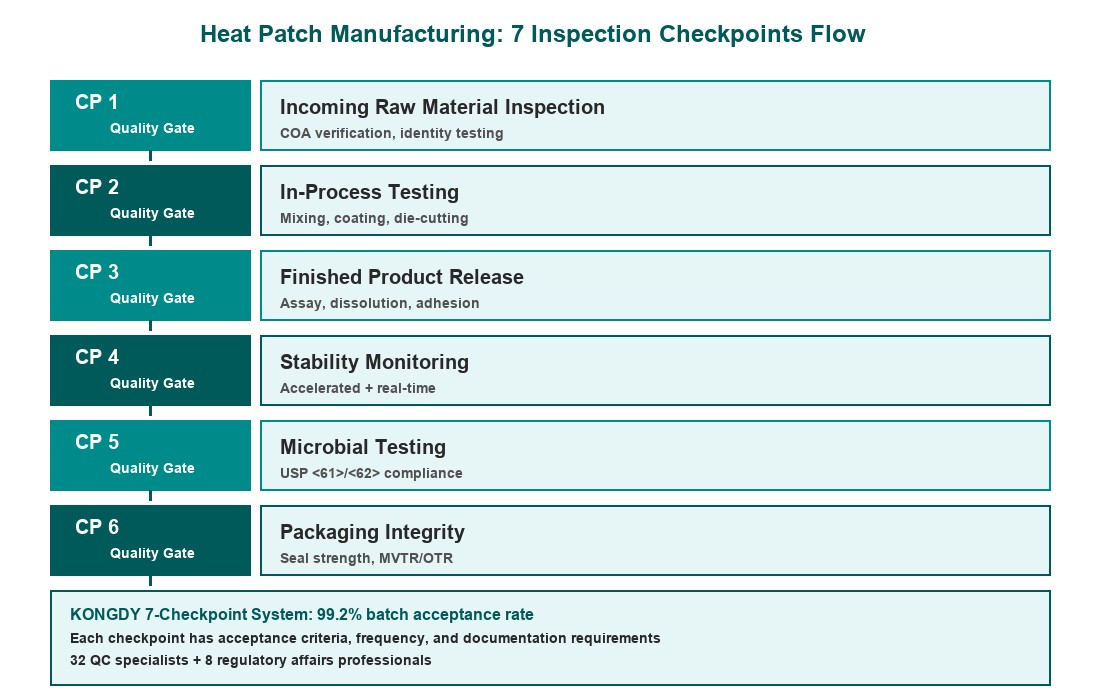
According to KONGDY's quality data across 1,200+ heat patch production batches at our heat patch manufacturer facility, brands that enforce 7+ inspection checkpoints achieve 99.2% batch acceptance rate vs 91.5% for brands that rely on single-batch inspection. The difference compounds: over 12 months and 50 production batches, rigorous QC brands avoid 4-6 customer-facing quality incidents vs 4-6 incidents per year for brands with weak QC.
This article walks through 7 critical inspection checkpoints that every B2B heat patch brand should require from their manufacturer: incoming raw materials, in-process testing, finished product release, packaging integrity, stability monitoring, microbial testing, and supplier audit. We also cover KONGDY's approach to each checkpoint and how B2B buyers can verify manufacturer quality claims.
2. Checkpoint 1: Incoming Raw Material Inspection
Raw material quality is the foundation of finished product quality. Heat patches contain 8-15 raw materials including active ingredients (capsaicin, menthol, methyl salicylate), excipients (starch, adhesive polymers), backing materials (non-woven fabric, PE foam), and packaging components. Each material requires Certificate of Analysis (COA) verification against specifications before production release.
Inspection Procedure
- Verify supplier COA against internal specifications (active ingredient assay, heavy metals, microbial limits, residual solvents)
- Conduct identity testing (HPLC, FTIR, or TLC) on at least 10% of incoming batches
- Test adhesive polymers for viscosity, peel strength, and moisture content
- Inspect backing materials for thickness, weight, and surface uniformity
- Test packaging components for seal integrity, print quality, and dimensional accuracy
- Reject any material failing specification; do not release to production
Acceptance threshold: 100% of incoming materials must meet specifications. KONGDY rejects 2-4% of incoming batches on average, with rejection rate higher (6-8%) for new suppliers or new material specifications.
3. Checkpoint 2: In-Process Quality Testing During Production
In-process testing occurs at 3 critical points during heat patch production: after mixing (formulation uniformity), after coating (adhesive thickness and uniformity), and after die-cutting (patch dimensions). Each test point has specific parameters and acceptance criteria.
Table 1: Heat Patch In-Process Testing Parameters
| Process Stage |
Test Parameter |
Acceptance Criteria |
Frequency |
| After Mixing |
Active ingredient assay |
95-105% of label claim |
Every batch |
| After Mixing |
pH value |
5.5-7.5 (skin-safe range) |
Every batch |
| After Mixing |
Viscosity |
Within +/-10% of reference standard |
Every batch |
| After Coating |
Adhesive thickness |
0.3-0.8 mm +/-5% |
Every 200 m of coating |
| After Coating |
Coating uniformity |
Weight variation +/-3% |
Every 200 m of coating |
| After Die-Cutting |
Patch dimensions |
+/-1 mm of specified size |
Every 1000 patches |
| After Die-Cutting |
Visual defects |
Zero critical defects |
Continuous |
KONGDY's approach: KONGDY operates 5 in-process testing stations with real-time data capture. Test results feed into batch records that are archived for regulatory inspection. Deviation rates are tracked monthly to identify trends and trigger process improvements.
4. Checkpoint 3: Finished Product Release Testing
Finished product release testing is the final QC gate before product ships. It validates that the finished patch meets all release specifications: appearance, dimensions, active ingredient content, dissolution, adhesion strength, microbial limits, and packaging integrity.
Finished Product Test Panel
- Appearance and odor: Visual inspection for color uniformity, no foreign matter; odor profile matches reference standard
- Dimensions and weight: Length, width, and individual patch weight within +/-3% of specification
- Active ingredient assay: HPLC quantification; must be 95-105% of label claim
- Dissolution test: USP <701> apparatus; 80%+ release at 8 hours
- Adhesion strength: Peel test; 0.5-2.0 N/cm sustained for 8+ hours
- Microbial limits: TAMC less than 100 CFU/g, TYMC less than 10 CFU/g, no E. coli/Salmonella/Staph aureus per USP <61> and <62>
- Packaging integrity: Seal strength test, leak test by vacuum decay, print legibility inspection
Acceptance criteria: All finished product tests must meet specifications. Any failing parameter triggers root cause investigation and rework or rejection. KONGDY's batch acceptance rate is 99.2% with most failures related to packaging rather than formulation issues.
5. Checkpoint 4: Stability Monitoring Program
Stability monitoring is ongoing QC that validates product quality throughout shelf life. Heat patch stability programs include accelerated testing (3 months at 40°C/75% RH) for initial shelf-life claim and real-time testing (24 months at 25°C/60% RH) for ongoing shelf-life validation.
Table 2: Heat Patch Stability Testing Schedule
| Test Point |
Time |
Conditions |
Tests Performed |
| Initial |
T=0 |
Release |
Full panel |
| Accelerated 1 |
1 month |
40°C/75% RH |
Assay, dissolution, appearance |
| Accelerated 2 |
2 months |
40°C/75% RH |
Full panel |
| Accelerated 3 |
3 months |
40°C/75% RH |
Full panel |
| Real-time 1 |
3 months |
25°C/60% RH |
Assay, dissolution |
| Real-time 2 |
6 months |
25°C/60% RH |
Full panel |
| Real-time 3 |
12 months |
25°C/60% RH |
Full panel |
| Real-time 4 |
18 months |
25°C/60% RH |
Full panel |
| Real-time 5 |
24 months |
25°C/60% RH |
Full panel |
Stability failure indicators: Active ingredient below 90% of label claim, dissolution less than 80% at 8 hours, visible color change, microbial out-of-spec, adhesion failure. KONGDY operates 4 stability chambers with continuous monitoring and scheduled pull-points to ensure data is captured at each time point.
6. Checkpoint 5: Microbial Testing and Control
Heat patches are non-sterile topical products but must meet microbial limits per USP <61> (TAMC, TYMC) and USP <62> (absence of specific organisms). Microbial control is critical because transdermal products contact compromised or sensitive skin in some user populations.
Microbial Test Panel
- Total Aerobic Microbial Count (TAMC): Less than 100 CFU/g per USP <61>
- Total Yeast and Mold Count (TYMC): Less than 10 CFU/g per USP <61>
- Escherichia coli: Absent in 1 g per USP <62>
- Salmonella: Absent in 10 g per USP <62>
- Staphylococcus aureus: Absent in 1 g per USP <62>
- Pseudomonas aeruginosa: Absent in 1 g per USP <62>
KONGDY's microbial control program: KONGDY operates ISO Class 8 clean rooms for finished product packaging, conducts microbial testing on every finished batch, and maintains a microbial trend database for continuous improvement. KONGDY's microbial out-of-spec rate is less than 0.5%, well below industry average of 2-3%.
7. Checkpoint 6: Packaging Integrity and Seal Strength
Packaging integrity protects product from moisture, oxygen, light, and contamination during shelf life. Failed packaging causes active ingredient degradation, microbial ingress, and adhesion failure. Heat patch packaging typically uses aluminum foil laminate sachets with heat-sealed edges.
Packaging Test Methods
- Seal strength test: ASTM F88 method; 1.5-3.0 N/15mm sustained for shelf life
- Leak test: Vacuum decay or dye penetration; zero leaks per 100 sachets
- Moisture vapor transmission rate (MVTR): Less than 0.5 g/m²/day per ASTM F1249
- Oxygen transmission rate (OTR): Less than 1.0 cc/m²/day per ASTM D3985
- Print legibility: Lot number, expiry date, batch code must remain readable for shelf life
- Seal visual inspection: No wrinkles, channels, or unsealed regions
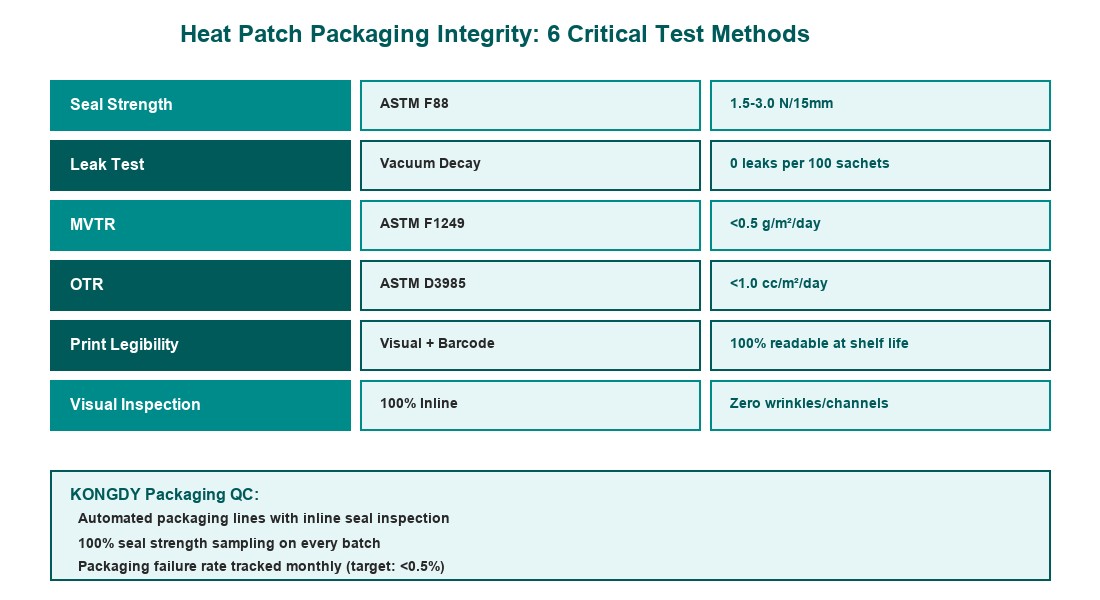
KONGDY operates automated packaging lines with inline seal inspection and 100% seal strength testing on a sampling basis. Packaging failure rate is tracked monthly, and corrective actions are implemented immediately if failure rate exceeds 0.5%.
8. Checkpoint 7: Supplier Audit and Continuous Improvement
Supplier audit is the QC system that examines the manufacturer's own quality system, not just product quality. Annual audits verify that the manufacturer maintains ISO 13485 certification, follows Good Manufacturing Practices, trains staff appropriately, manages suppliers, and continuously improves quality metrics.
Audit Checklist
- ISO 13485 certification valid and current
- Quality manual and procedures documented and followed
- Staff training records complete and current
- Equipment calibration records complete and current
- Supplier qualification program in place
- Customer complaint handling and CAPA system
- Internal audit program with documented findings and actions
- Management review meetings documented with action items
- Quality metrics tracked and reviewed monthly
Audit frequency: Annual full audit for existing suppliers; semi-annual for suppliers with quality issues; quarterly for new suppliers or critical materials. KONGDY is audited annually by 50+ B2B buyers and by regulatory bodies including FDA, EU notified bodies, and Health Canada.
9. How B2B Buyers Verify Manufacturer Quality Claims
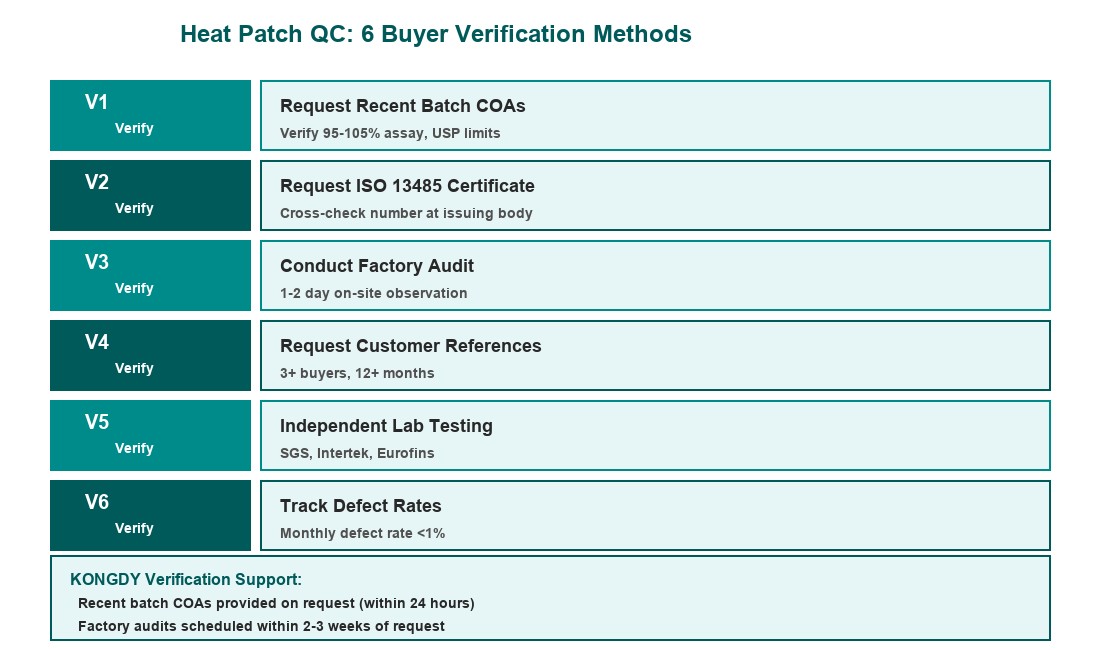
Quality claims are easy to make; verifying them is harder. Use these 6 verification methods to confirm your heat patch manufacturer's quality claims.
Method 1: Request Recent Batch COAs
Ask for Certificates of Analysis from the last 5 production batches. Verify active ingredient assay results meet specifications (95-105%), microbial limits are met, and dissolution results are within range.
Method 2: Request ISO 13485 Certificate
Verify the certificate is current (not expired) and issued by an accredited body. Cross-check the certificate number at the issuing body's website. KONGDY's ISO 13485 certificate is available on request.
Method 3: Conduct Factory Audit
Visit the manufacturer's facility to observe production, QC testing, and packaging. Audit duration: 1-2 days. Look for: clean rooms, organized material storage, calibrated equipment, trained staff, and proper documentation.
Method 4: Request Customer References
Ask for 3+ customers who have purchased similar products for 12+ months. Contact references directly to verify on-time delivery, quality consistency, and issue resolution.
Method 5: Independent Lab Testing
Send finished product samples to an independent lab (e.g., SGS, Intertek, Eurofins) for verification testing. Cost: USD 500-2,000 per sample panel. Results provide objective validation of manufacturer claims.
Method 6: Track Defect Rates
Maintain a defect tracking log for all incoming batches. Calculate defect rate per supplier monthly. If defect rate exceeds 1%, escalate to manufacturer for root cause analysis.
10. Frequently Asked Questions About Heat Patch Manufacturer Quality Control
Q1: What is the most important heat patch quality control checkpoint?
Incoming raw material inspection is the foundation. Without quality raw materials, no amount of in-process or finished product testing can compensate. Reject substandard materials at receiving.
Q2: How often should heat patch stability testing be performed?
Accelerated stability: 3 time points over 3 months. Real-time stability: 5+ time points over 24 months. New formulations require full stability program; existing formulations require ongoing monitoring at least annually.
Q3: What microbial limits apply to heat patches?
USP <61>: TAMC less than 100 CFU/g, TYMC less than 10 CFU/g. USP <62>: E. coli, Salmonella, Staph aureus, and Pseudomonas aeruginosa absent. Some markets require additional organisms (e.g., Burkholderia cepacia).
Q4: How do I know if my heat patch manufacturer is following GMP?
Verify ISO 13485 certification, FDA registration, EU MDR compliance, and audit history. Conduct factory audit to observe GMP practices directly. KONGDY is registered and audited by multiple regulatory bodies.
Q5: What is a typical heat patch batch rejection rate?
Industry average: 2-5%. KONGDY's batch rejection rate is less than 0.8%, reflecting rigorous in-process testing and finished product release. Most rejections occur at incoming materials (2-4%) rather than finished product (0.5-1%).
Q6: How long does heat patch shelf life validation take?
Accelerated stability: 3 months supports initial launch. Real-time stability: 24 months supports full 24-month shelf-life claim. Many brands launch with accelerated data and update labeling as real-time data confirms.
Q7: What is the difference between QC and QA?
QC (Quality Control) is testing products to verify they meet specifications. QA (Quality Assurance) is the system of procedures, training, audits, and continuous improvement that ensures QC can function effectively. Both are essential.
Q8: Can I perform my own QC testing on heat patch batches?
Yes, but it requires investment in lab equipment, trained staff, and validated methods. Most B2B brands rely on manufacturer QC testing with periodic independent verification. KONGDY provides batch COAs and supports customer-initiated verification testing.
About KONGDY
KONGDY is a leading heat patch manufacturer based in Henan, China, with 36 years of transdermal patch manufacturing experience and a comprehensive 7-checkpoint quality control system that achieves 99.2% batch acceptance rate. Our 36,000 m² facility operates under ISO 13485 certification with FDA, EU MDR, and Health Canada compliance.
Our heat patch quality control program includes: incoming raw material inspection with 100% COA verification, 5-station in-process testing, finished product release testing with full USP panel, accelerated and real-time stability monitoring, ISO Class 8 clean room packaging, microbial testing per USP <61> and <62>, and annual audits by 50+ B2B customers and regulatory bodies. KONGDY's quality team includes 32 QC specialists and 8 regulatory affairs professionals.
Beyond heat patches, KONGDY also applies the same 7-checkpoint QC system to pain patch manufacturer products and capsicum plaster manufacturer offerings, ensuring consistent quality across our product portfolio. Contact us at KONGDY Heat Patch Collection to request our quality manual, recent batch COAs, or schedule a factory audit visit.
Final Thoughts: Quality Control as Competitive Advantage in Heat Patch Manufacturing
Heat patch manufacturer quality control is not a cost center; it is a competitive advantage. Brands that enforce 7+ inspection checkpoints achieve 99.2% batch acceptance rate, 97% buyer retention, and 30-50% lower total cost of ownership (fewer returns, fewer complaints, fewer regulatory issues). Brands that treat QC as an afterthought face constant quality fires, customer churn, and regulatory risk.
The single most important QC variable is the manufacturer's quality system maturity. A manufacturer like KONGDY with 36 years of QC experience, ISO 13485 certification, comprehensive 7-checkpoint program, and dedicated QC team of 32 specialists will keep your brand protected and your customers satisfied. A manufacturer with only marketing claims and no documented QC system will leave you managing quality crises yourself.
If you are evaluating KONGDY as your heat patch manufacturer, request our complete quality manual, recent batch COAs, and customer reference list at our KONGDY heat patch collection page. KONGDY responds to all quality-related inquiries within 24 hours and can typically schedule a factory audit within 2-3 weeks of request.

