Foot patch factory tour 7 stations that decide quality: raw material receiving, converting line, in-process controls, finished product laboratory, packaging line, microbiological laboratory, and stability chamber room. What each station decides, what the buyer observes, and what the buyer documents.
1. Why Foot Patch Factory Tours Are Different From Generic Audits
A foot patch factory tour is the buyer's most direct window into the production system. The buyer walks the converting line, the analytical laboratory, and the stability chamber room, and sees the equipment, the operators, and the documentation in their actual production state. The tour closes the gap between the supplier's quotation and the buyer's verification.
A generic audit visits the facility once a year and reports against a checklist; a factory tour is a hands-on walk-through that lets the buyer evaluate the converting line capability, the in-process controls, and the documentation chain in real time. KONGDY has manufactured consumer health patches for 36 years and runs foot patch OEM programs across North America, Europe, and Asia. The facility is ISO 22716 GMP certified, FDA registered, and operates seven quality-deciding stations that the buyer should walk during a foot patch factory tour.
This guide walks through the seven stations, what each station decides, and what the buyer should observe and document at each stop.
2. Station 1: Raw Material Receiving and Quarantine
The first station is the raw material receiving and quarantine area. This is where the carrier non-woven, the adhesive, the active, and the packaging components enter the facility and are released to production.
2.1 What This Station Decides (KONGDY)
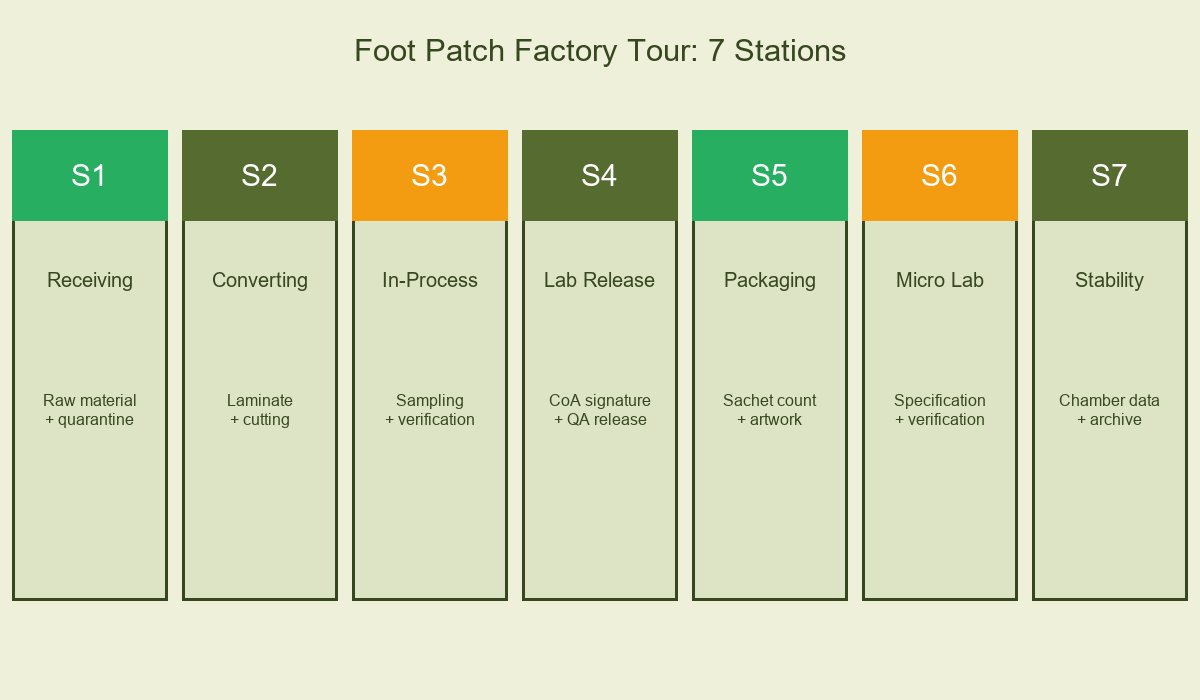
The receiving and quarantine area decides whether the raw material enters the production line. KONGDY's receiving system logs the supplier, the lot number, the CoA, and the analytical verification result before releasing the raw material to production.
2.2 What the Buyer Should Observe (KONGDY)
The buyer should observe the receiving log, the quarantine area, and the analytical verification records. KONGDY's receiving system records the temperature, the storage condition, and the quarantine status per raw material lot.
2.3 What the Buyer Should Document (KONGDY)
The buyer should document the supplier list, the verification scope, and the quarantine release procedure. KONGDY's receiving system is documented in the QC manual summary.
3. Stations 2-3: Converting Line + In-Process Controls
The converting line and the in-process control stations are where the raw materials become the finished foot patch. The converting line capability decides the cutting tolerance, the adhesive uniformity, and the production throughput. The in-process control station decides the in-process analytical verification.
3.1 Station 2: Converting Line (KONGDY)
The converting line laminates the carrier non-woven, the adhesive matrix, and the active, and cuts the laminate into the finished patch shape. KONGDY's converting line capability supports 200,000 to 800,000 patches per production run with documented cutting tolerance.
3.2 What the Buyer Should Observe (KONGDY)
The buyer should observe the laminator, the cutting tolerance, the operator workflow, and the in-process sampling point. KONGDY's converting line is documented with the cutting tolerance per production run.
3.3 Station 3: In-Process Controls (KONGDY)
The in-process control station samples the laminate at documented intervals and verifies the analytical parameters. KONGDY's in-process controls cover the active concentration, the adhesive uniformity, and the cutting tolerance verification.
3.4 What the Buyer Should Document (KONGDY)
The buyer should document the in-process control frequency, the analytical parameter scope, and the corrective action procedure. KONGDY's in-process control procedure is documented in the QC manual summary.
4. Station 4: Finished Product Laboratory and CoA Release
The finished product laboratory releases the production run to the packaging line. The laboratory's CoA release procedure decides whether the production run passes or fails the destination market's specification.
4.1 What This Station Decides (KONGDY)
The finished product laboratory decides the release status of each production run. KONGDY's CoA release procedure requires the analyst signature and the QA release signature before the production run ships.
4.2 What the Buyer Should Observe (KONGDY)
The buyer should observe the analytical laboratory, the equipment list, the calibration records, and the CoA release procedure. KONGDY's analytical laboratory is equipped with HPLC, GC, and UV-Vis instrumentation.
4.3 What the Buyer Should Document (KONGDY)
The buyer should document the analytical parameter scope, the CoA template, and the analyst signature procedure. KONGDY's CoA release procedure is documented per destination market.
5. Stations 5-6: Packaging Line + Microbiological Laboratory
The packaging line and the microbiological laboratory are the fifth and sixth stations. The packaging line decides the sachet count, the secondary packaging configuration, and the artwork application. The microbiological laboratory decides the microbiological specification release.
5.1 Station 5: Packaging Line (KONGDY)
The packaging line packs the finished patches into sachets, the sachets into boxes, and the boxes into cartons. KONGDY's packaging line supports sachet counts from 1 to 30 per box, multi-count sets, and premium gift tins.
5.2 What the Buyer Should Observe (KONGDY)
The buyer should observe the sachet count verification, the artwork application, and the secondary packaging configuration. KONGDY's packaging line is documented with the artwork application procedure per configuration.
5.3 Station 6: Microbiological Laboratory (KONGDY)
The microbiological laboratory verifies the microbiological specification against the destination market's regulation. KONGDY's microbiological laboratory is equipped with incubation chambers, colony counting equipment, and identification systems.
5.4 What the Buyer Should Document (KONGDY)
The buyer should document the microbiological specification, the incubation conditions, and the regulatory limit reference. KONGDY's microbiological specification is documented per destination market.
6. Station 7: Stability Chamber Room and Documentation Archive
The seventh station is the stability chamber room and the documentation archive. The stability chamber generates the data that supports the shelf life statement, and the documentation archive supports the regulatory file and the customer retrieval cycle.
6.1 What This Station Decides (KONGDY)
The stability chamber room decides the shelf life assignment per destination market. KONGDY's stability chambers are qualified and calibrated to ICH conditions, with storage at 25, 30, and 40 degrees Celsius for multi-market distribution.
6.2 What the Buyer Should Observe (KONGDY)
The buyer should observe the chamber qualification records, the calibration schedule, the storage condition map, and the stability protocol. KONGDY's stability chambers are documented with the qualification and calibration records per chamber.
6.3 Documentation Archive (KONGDY)
The documentation archive stores the production records, the analytical results, the stability data, and the customer correspondence for 7 years. KONGDY's documentation archive is electronic and indexed per batch.
6.4 What the Buyer Should Document (KONGDY)
The buyer should document the storage conditions, the calibration schedule, the documentation retention period, and the electronic indexing system. KONGDY's stability chamber procedure is documented per destination market.
7. The Factory Tour Checklist: What to Walk and What to Document
A factory tour runs more productively when the buyer has a written checklist. The list below covers the seven stations and what the buyer should observe and document at each stop.
7.1 Pre-Tour Preparation (KONGDY)
The pre-tour preparation includes the QC manual summary, the destination market's specification, and the buyer's verification scope. KONGDY's commercial team provides the pre-tour documentation one week before the tour.
7.2 Tour Walk-Through Order (KONGDY)
The walk-through order follows the production flow: receiving, converting, in-process, finished product laboratory, packaging, microbiological laboratory, stability chamber, and documentation archive. KONGDY's tour follows this order, with the QC team guiding.
7.3 Post-Tour Documentation (KONGDY)
The post-tour documentation captures the verification data, the corrective action items, and the next-stage scope. KONGDY's tour ends with a written summary and a follow-up schedule.
8. What the Tour Reveals: Equipment, Operators, Documentation
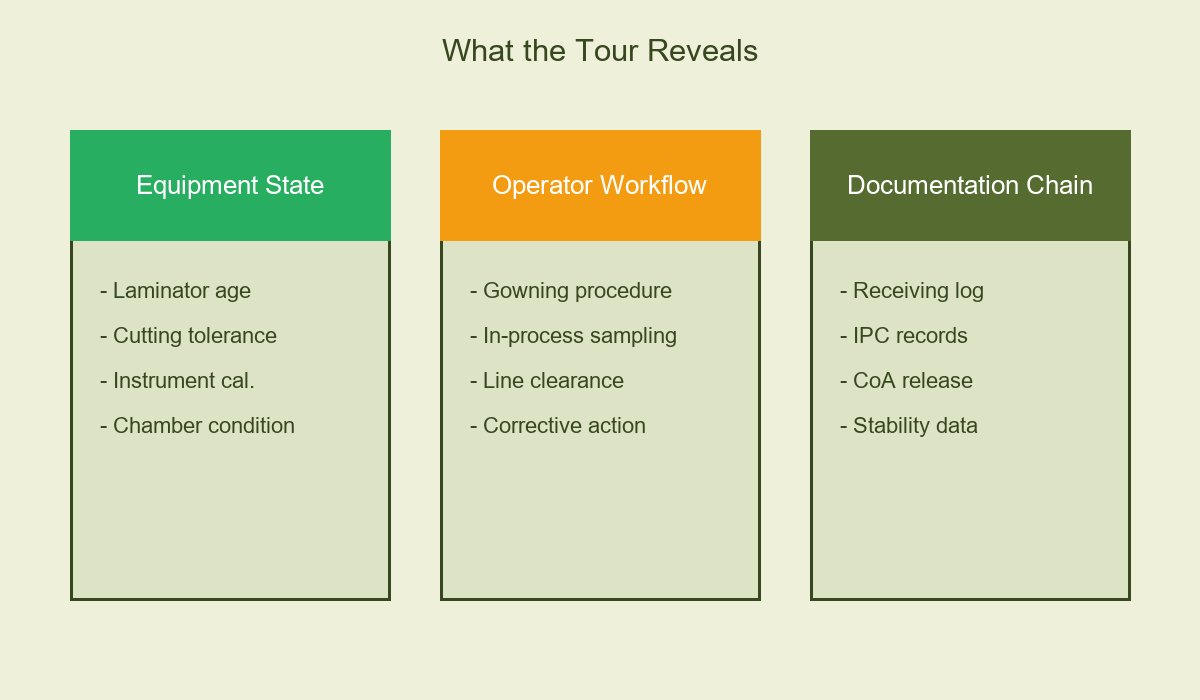
The tour reveals three things that a quotation cannot: the equipment's actual state, the operators' workflow, and the documentation chain. A buyer who invests one day in a factory tour gains verification data that no audit report can deliver.
8.1 Equipment State (KONGDY)
The equipment state includes the laminator's age, the cutting tolerance, the analytical instrument calibration, and the stability chamber condition. KONGDY's equipment state is documented in the QC manual summary and verifiable during the tour.
8.2 Operator Workflow (KONGDY)
The operator workflow includes the gowning procedure, the in-process sampling, the line clearance, and the corrective action procedure. KONGDY's operator workflow is documented and observed during the tour.
8.3 Documentation Chain (KONGDY)
The documentation chain includes the receiving log, the in-process control records, the CoA release, the packaging records, and the stability data. KONGDY's documentation chain is electronic and verifiable during the tour.
9. Common Factory Tour Findings and How to Address Them
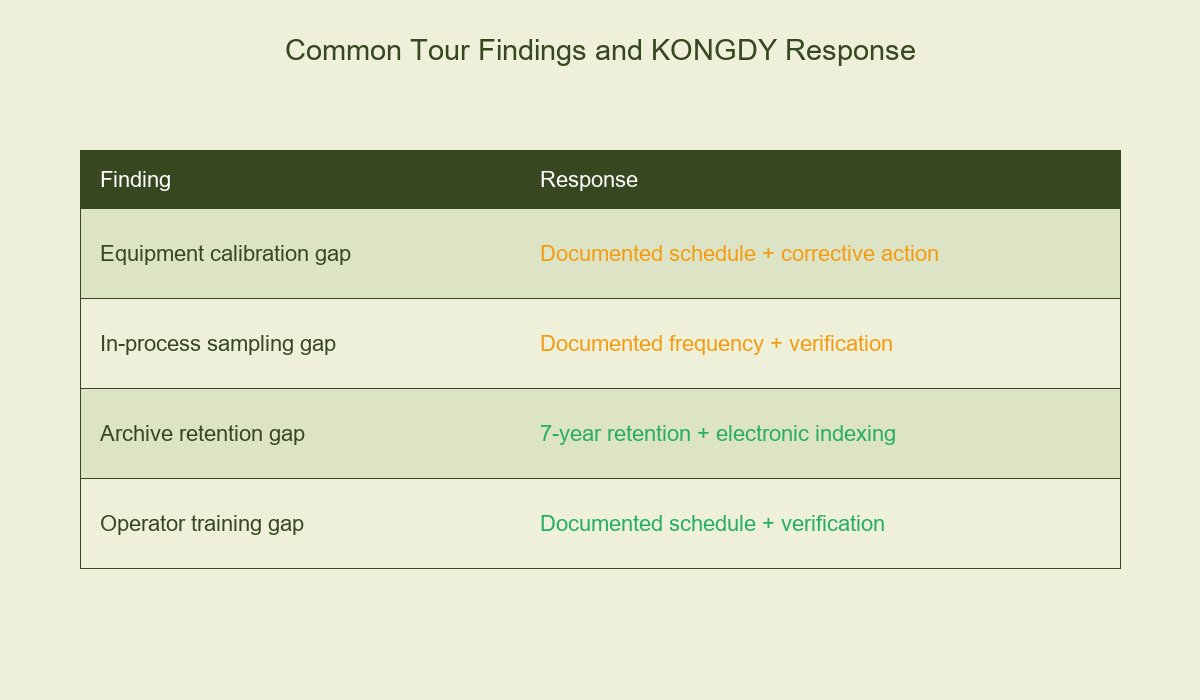
Most factory tours surface four predictable findings. The list below covers the most common ones and how KONGDY addresses them.
9.1 Equipment Calibration Records Gap (KONGDY)
A calibration record gap indicates that an instrument's last calibration date is overdue. KONGDY's calibration schedule is documented and verifiable during the tour, with corrective action triggered by any gap.
9.2 In-Process Sampling Frequency Gap (KONGDY)
An in-process sampling frequency gap indicates the sampling is below the documented procedure. KONGDY's in-process sampling is documented and verified during the tour.
9.3 Documentation Archive Retention Gap (KONGDY)
A documentation archive retention gap indicates that a record is past the retention period. KONGDY's documentation archive retention is 7 years and verified during the tour.
9.4 Operator Training Gap (KONGDY)
An operator training gap indicates that an operator's training record is overdue. KONGDY's operator training schedule is documented and verifiable during the tour.
10. Conclusion: Foot Patch Factory Tour as a Sourcing Decision
A foot patch factory tour is the buyer's most direct verification of the production system. The brand that invests one day in the tour captures the verification data, the corrective action items, and the multi-year supply agreement scope that the audit report cannot deliver.
KONGDY's foot patch factory tour covers the seven stations in this guide plus the QC laboratory, the documentation archive, and the post-tour summary. The facility is ISO 22716 GMP certified, FDA registered, and audited annually by accredited bodies, with 7-year documentation retention and electronic batch record indexing.
Schedule a foot patch factory tour at KONGDY's ISO 22716 facility — the QC team will guide the walk-through the seven stations, share the QC manual summary, the calibration records, and the documentation archive samples, and return a written tour summary within one week.
Request a live video tour or factory audit quotation for a remote walk-through of the converting line, the analytical laboratory, and the stability chamber room, and request a free foot patch sample to validate adhesion, peel experience, and first-impression in your channel. Brand owners planning a launch within two quarters can additionally reserve a pilot batch slot while artwork and documentation work run in parallel.

