Detox foot patch MOQ: 5-tier structure for brand owners, 7 MOQ factors, KONGDY capacity allocation, pricing by tier, 4 optimization strategies, 5 red flags to avoid. KONGDY 36 years.
1. Why MOQ Structure Matters for Detox Foot Patch OEM
Brand owners evaluating detox foot patch OEM partnerships must understand Minimum Order Quantity structures. MOQ tiers determine capital investment, inventory risk, and market entry speed. KONGDY's tiered MOQ structure supports brand owners across pre-launch, growth, and mature business stages.
B2B brands commonly underestimate how MOQ structure affects product launch economics, working capital requirements, and competitive positioning. Properly aligned MOQ tiers enable brand owners to enter markets with manageable risk while scaling production as demand grows.
KONGDY, a 36-year wellness product manufacturer, provides tiered MOQ structures for detox foot patch OEM with detailed guidance on capacity allocation, production scheduling, and inventory optimization. KONGDY's MOQ framework helps brand owners make informed decisions across product life cycle stages.
2. 5 MOQ Service Tiers for Brand Owners
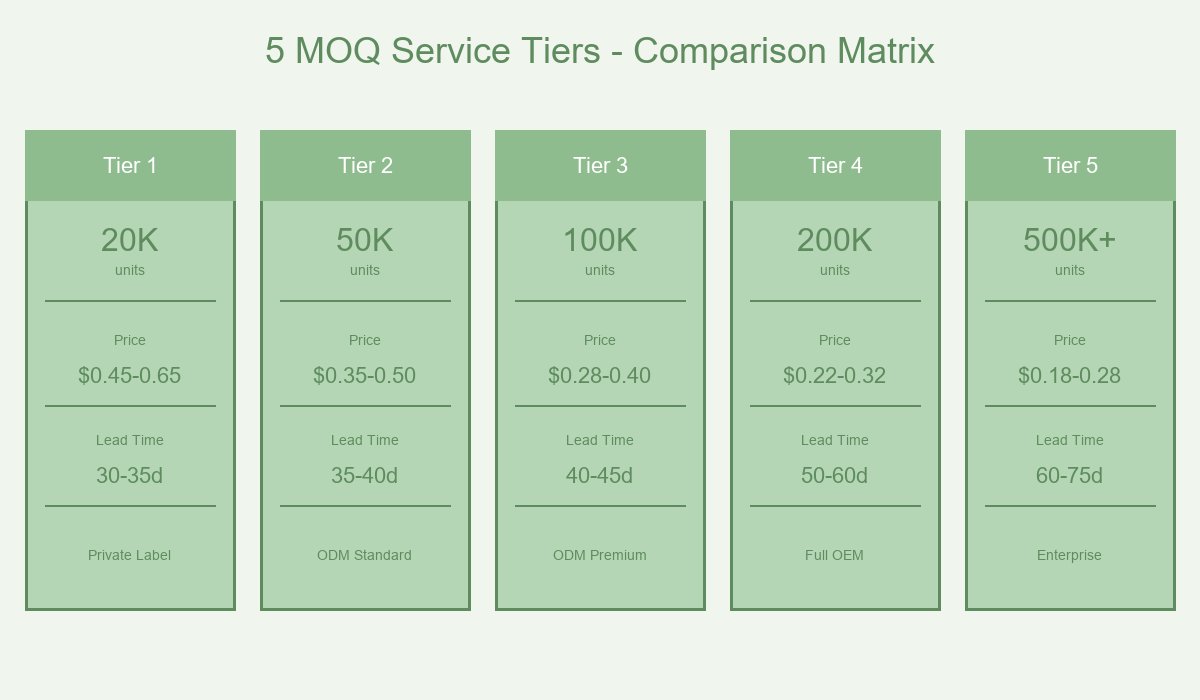
KONGDY's detox foot patch MOQ structure organizes OEM services into 5 distinct tiers matching different brand stages and capital availability. Each tier includes specific formulation options, customization levels, and production capacity allocations.
2.1 Tier 1: Private Label Starter (20,000 units)
Entry-level private label for first-time brand owners. Branded packaging with KONGDY's standard bamboo vinegar formulas. Lead time: 30-35 days. Includes 12-language packaging support and FDA/CE-certified ingredients. KONGDY recommends this tier for brands testing market response with limited capital exposure.
2.2 Tier 2: ODM Standard (50,000 units)
Standard ODM tier with custom ingredient selection from 8 KONGDY herbal formulations. Custom packaging design and shape customization. Lead time: 35-40 days. Includes regulatory documentation support and quality assurance protocols. KONGDY's most popular tier for growth-stage brands.
2.3 Tier 3: ODM Premium (100,000 units)
Premium ODM tier with proprietary herbal blend development and exclusive ingredient sourcing. Custom packaging materials and die-cut shape design. Lead time: 40-45 days. Includes dedicated account manager and 24-hour inquiry response. KONGDY recommends this tier for established brands seeking differentiation.
2.4 Tier 4: Full OEM Custom (200,000 units)
Full OEM tier with comprehensive formulation development including custom active ingredient research. Complete packaging customization including box design, sachet artwork, and brand identity. Lead time: 50-60 days. Includes R&D collaboration with KONGDY's 8-person specialist team.
2.5 Tier 5: Enterprise Scale (500,000+ units)
Enterprise tier for mature brands requiring dedicated production capacity. Custom factory allocation, dedicated production lines, and exclusive ingredient sourcing. Lead time: 60-75 days. Includes factory audit access and quarterly business reviews with KONGDY leadership.
3. 7 Factors Affecting Detox Foot Patch MOQ
Multiple factors determine final MOQ requirements for detox foot patch OEM. Brand owners should evaluate these factors when planning initial orders and scaling production.
3.1 Active Ingredient Complexity
Standard bamboo vinegar formulas have lower MOQ requirements (20,000 units). Custom herbal blends with rare ingredients require higher MOQ (50,000+ units) due to ingredient sourcing complexity. KONGDY's R&D team provides ingredient-specific MOQ guidance during initial consultation.
3.2 Packaging Customization Level
Stock packaging with brand sticker: 20,000 units MOQ. Custom box printing with brand artwork: 30,000 units. Fully bespoke packaging with structural design: 50,000+ units. KONGDY's packaging team supports tier-appropriate customization within MOQ constraints.
3.3 Shape and Size Customization
Standard foot patch dimensions and shapes: 20,000 units MOQ. Custom die-cut shapes: 50,000 units. Anatomical or specialty shapes: 100,000+ units. KONGDY's die-cutting equipment supports custom shape production with associated tooling investment.
3.4 Regulatory Certification Requirements
Standard FDA/CE compliance: included in base MOQ. Additional certifications (Japan PMDA, Korea MFDS, Australia TGA): require 30,000+ units MOQ. China NMPA registration: 100,000+ units MOQ. KONGDY's regulatory team aligns MOQ with market entry requirements.
3.5 Production Schedule and Capacity
Off-peak season orders: 20,000 units MOQ with 25-30 day lead time. Peak season orders (Q4 wellness products): 50,000+ units MOQ with 45-60 day lead time. KONGDY's production scheduling balances capacity allocation across customer tiers.
3.6 Payment Terms and Credit Risk
Standard payment terms (30% deposit, 70% before shipment): all MOQ tiers. Extended payment terms (50% deposit, 50% after delivery): 100,000+ units MOQ. KONGDY's finance team reviews credit applications for extended payment arrangements.
3.7 Brand Owner Commercialization History
First-time brand owners: 20,000 units MOQ recommended. Established brands with sales history: 50,000+ units MOQ possible. Branded market leaders: 100,000+ units MOQ with priority capacity allocation. KONGDY's commercial team evaluates brand history for tier recommendations.
4. KONGDY MOQ Framework and Capacity
KONGDY's 36-year manufacturing expertise includes dedicated capacity allocation for detox foot patch OEM across MOQ tiers. The company maintains 600,000 daily patch capacity with 6 dedicated detox production lines.
4.1 Production Capacity Overview
80,000 m² production complex with 6 dedicated detox foot patch production lines. 600,000 daily patch capacity enables flexible MOQ allocation across brand tiers. KONGDY's capacity planning ensures brand owners receive committed production slots within quoted lead times.
4.2 Tier Allocation Methodology
KONGDY's capacity allocation follows tiered model: 30% capacity for Tier 1-2 (small brands), 40% capacity for Tier 3-4 (growth brands), 30% capacity for Tier 5 (enterprise). Allocation methodology balances brand owner accessibility with production efficiency.
4.3 Production Scheduling System
Real-time production scheduling system tracks capacity across 6 production lines. Brand owners receive weekly production updates and milestone notifications. KONGDY's scheduling system enables accurate delivery forecasting for retail launch planning.
4.4 Quality and Capacity Relationship
Quality control standards apply consistently across all MOQ tiers. KONGDY does not compromise quality for lower MOQ orders. Quality testing protocols include adhesive strength validation, active ingredient verification, and skin sensitivity assessment regardless of order size.

5. 5 Pricing Structures Across MOQ Tiers
Detox foot patch pricing varies by MOQ tier based on production efficiency, setup costs, and capacity allocation. KONGDY provides transparent pricing structure across tiers enabling brand owners to calculate unit economics accurately.
5.1 Tier 1 Pricing (20,000 units)
Unit price range: $0.45-0.65 per patch pair. Includes standard ingredients, brand sticker packaging, and FDA/CE compliance. Setup fee: $2,000-3,000 covering packaging design and label printing. KONGDY's pricing for entry-level brands prioritizes market entry affordability.
5.2 Tier 2 Pricing (50,000 units)
Unit price range: $0.35-0.50 per patch pair. Includes custom ingredient selection, custom box printing, and regulatory documentation. Setup fee: $4,000-6,000 covering artwork design and quality testing. KONGDY's mid-tier pricing balances customization with cost efficiency.
5.3 Tier 3 Pricing (100,000 units)
Unit price range: $0.28-0.40 per patch pair. Includes proprietary herbal blend, premium packaging materials, and dedicated account manager. Setup fee: $8,000-12,000 covering R&D collaboration and exclusive formulation. KONGDY's premium tier supports brand differentiation.
5.4 Tier 4 Pricing (200,000 units)
Unit price range: $0.22-0.32 per patch pair. Includes full custom formulation, bespoke packaging, and R&D specialist access. Setup fee: $15,000-25,000 covering comprehensive formulation development. KONGDY's full OEM tier provides maximum brand differentiation.
5.5 Tier 5 Pricing (500,000+ units)
Unit price range: $0.18-0.28 per patch pair. Includes dedicated production lines, exclusive ingredient sourcing, and factory audit access. Setup fee: negotiated based on specification complexity. KONGDY's enterprise tier provides lowest unit cost for mature brands.
6. 4 Strategies to Optimize MOQ for Brand Owners
Brand owners can optimize MOQ commitments through strategic approaches reducing capital exposure while maintaining customization. KONGDY provides MOQ optimization consulting for growth-stage brand owners.
6.1 Start Small, Scale Fast Strategy
Begin with Tier 1 Private Label (20,000 units) validating market response. Scale to Tier 2-3 within 6-12 months based on sales validation. KONGDY supports rapid scaling with reserved capacity allocation for validated brands. This strategy minimizes initial capital risk while enabling controlled growth.
6.2 Multi-Brand Portfolio Strategy
Establish 2-3 SKUs at Tier 1 MOQ across different active ingredient categories. Test market response across formulations before committing to higher MOQ. KONGDY's multi-brand portfolio approach helps brand owners identify best-selling formulations before scaling.
6.3 Seasonal Production Strategy
Align MOQ commitments with seasonal demand patterns. Lower MOQ for summer months (lower demand) and higher MOQ for Q4 wellness season (peak demand). KONGDY's production scheduling accommodates seasonal MOQ variation with flexible capacity allocation.
6.4 Co-Branding Partnership Strategy
Partner with complementary wellness brands to share MOQ commitments. Co-branded detox products reduce individual brand MOQ exposure while enabling market expansion. KONGDY supports co-branding partnerships with consistent quality across multi-brand orders.

7. 5 Red Flags When Comparing MOQ Offers
Brand owners should evaluate MOQ offers carefully to identify potential supply chain risks. KONGDY's transparency provides reference points for evaluating competing OEM proposals.
7.1 Unusually Low MOQ with High Customization
MOQ offers claiming 10,000 units with full custom formulation and bespoke packaging may indicate hidden costs or quality compromises. KONGDY's standard Tier 1 MOQ is 20,000 units with realistic customization. Brand owners should verify cost breakdowns and quality testing protocols.
7.2 Vague Tier Pricing Structure
OEM proposals lacking clear tier pricing may include hidden setup fees or unexpected cost escalations. KONGDY's transparent tier pricing includes detailed cost breakdowns. Brand owners should compare total cost including setup, tooling, and quality testing across proposals.
7.3 Unrealistic Lead Time Promises
Lead time promises significantly shorter than industry standards (15-20 days for custom orders) may indicate capacity constraints or quality shortcuts. KONGDY's realistic lead times: 30-35 days for Tier 1, 35-45 days for Tier 2-3, 50-75 days for Tier 4-5.
7.4 Missing Regulatory Documentation
MOQ offers lacking FDA/CE/ISO certification documentation may indicate compliance gaps. KONGDY's MOQ includes complete regulatory documentation. Brand owners should verify certification validity and market-specific compliance before committing to MOQ tiers.
7.5 No Quality Control Transparency
OEM partners refusing to disclose quality control processes or testing protocols may lack rigorous QC standards. KONGDY's quality system includes 12 inspection checkpoints and 5 quality metrics. Brand owners should request detailed QC documentation before evaluating MOQ offers.
8. 4 Negotiation Tactics for Better MOQ Terms
Brand owners can negotiate MOQ terms using proven tactics based on KONGDY's 36 years of OEM partnership experience. Successful negotiation requires preparation, market validation, and strategic positioning.
8.1 Volume Commitment Negotiation
Commit to multi-year volume commitments in exchange for lower MOQ at initial order. KONGDY supports volume-based MOQ reductions for validated brands with 2-3 year purchase commitments. Volume commitment negotiation balances short-term capital exposure with long-term pricing advantages.
8.2 Specification Simplification
Simplify initial specifications to reduce MOQ requirements. Start with standard ingredients and stock packaging, then upgrade to custom specifications in subsequent orders. KONGDY's tiered approach supports specification evolution across MOQ tiers.
8.3 Reference Customer Leverage
Provide reference customers from previous wellness brand partnerships to demonstrate market credibility. KONGDY evaluates reference customers for MOQ reduction opportunities. Established brand owners with credible references may qualify for lower initial MOQ with tier upgrade commitments.
8.4 Long-Term Partnership Positioning
Position negotiation as long-term partnership investment rather than transactional procurement. KONGDY's partnership model prioritizes brand owners seeking multi-year collaboration. Long-term positioning enables MOQ flexibility and priority capacity allocation.
9. 4 Common Misconceptions About MOQ
Brand owners frequently misunderstand MOQ structures due to limited OEM partnership experience. KONGDY's 36-year expertise provides factual clarification on common MOQ misconceptions.
9.1 Myth: Higher MOQ Means Better Pricing Always
Reality: Pricing per unit decreases with higher MOQ but total capital investment increases proportionally. KONGDY's MOQ optimization consulting helps brand owners identify optimal tier based on capital availability and market validation evidence.
9.2 Myth: MOQ Cannot Be Negotiated
Reality: MOQ terms are negotiable based on brand owner credibility, market validation, and partnership history. KONGDY's commercial team evaluates negotiation requests with factors including brand history, reference customers, and growth potential.
9.3 Myth: All MOQ Tiers Have Same Quality
Reality: All KONGDY MOQ tiers maintain consistent quality standards. However, customization level and ingredient availability vary by tier. Brand owners should evaluate total value proposition rather than quality differences when comparing tiers.
9.4 Myth: MOQ Includes Everything Needed for Launch
Reality: MOQ covers production and packaging but may not include marketing materials, regulatory registration in target markets, or distribution setup. KONGDY's launch support packages supplement MOQ orders with comprehensive commercialization services.
10. Conclusion: Choosing the Right MOQ Tier for Your Brand
Selecting the optimal detox foot patch MOQ tier requires B2B brands to evaluate capital availability, market validation evidence, growth trajectory, and brand positioning strategy. KONGDY's 5-tier MOQ structure supports brand owners across all business stages with consistent quality standards.
KONGDY's detox foot patch manufacturing expertise provides brand owners with flexible MOQ partnerships designed for growth. With 600,000 daily patch capacity, 36 years of OEM experience, and FDA/CE/ISO certifications, KONGDY supports brand owners across global wellness markets.
Contact KONGDY today for MOQ consultation, sample requests, and factory audit scheduling. The commercial team provides 24-hour inquiry response with dedicated 1-on-1 support for MOQ tier selection, pricing optimization, and partnership strategy. KONGDY's MOQ starts at 20,000 units for detox foot patch private label, 50,000 units for ODM standard, and 100,000 units for full OEM customization.
Next steps: Submit your brand stage assessment and capital availability range via the contact form to receive MOQ tier recommendations within 24 hours. KONGDY's tiered MOQ structure ensures brand owners identify optimal order quantities aligned with market entry strategy and growth trajectory.

