Cooling gel patch MOQ 5 tiers compared for B2B buyers: sample, pilot, growth, bulk, and strategic bulk. Covers unit price, documentation scope, packaging, lead time, and reorder cadence. Supports B2B buyers with tier selection framework by channel and market, plus common tier selection mistakes.
1. Why Cooling Gel Patch MOQ Tier Comparison Matters
Cooling gel patch MOQ is not a single number; it is a ladder of tiers, each with a unit price, a documentation scope, a packaging format, and a lead time. Comparing the tiers side by side is what a B2B buyer should do before issuing a first purchase order. The comparison reveals where the supplier's economics shift, where the buyer's working capital exposure changes, and where the reorder cadence can be tuned.
A buyer who orders at the pilot tier and prices at the bulk tier margin compresses working capital in the first quarter. A buyer who orders at the bulk tier before validating the market locks up working capital in inventory that demand has not yet proven. A buyer who orders at the growth tier after the pilot validation captures the middle of the ladder, where the unit price step-down begins to matter but the working capital commitment is still manageable. KONGDY has manufactured consumer health patches for 36 years and structures cooling gel patch MOQ in tiers so a B2B buyer can compare the tiers and choose the entry point.
This guide walks through five cooling gel patch MOQ tiers, the unit price at each tier, the documentation scope at each tier, the packaging format at each tier, the lead time at each tier, and the working capital commitment at each tier. The comparison is what a B2B buyer should put in front of the supplier before the first quotation.
2. Tier 1: Sample Tier (500 to 1,000 Pieces)
The sample tier is below the production MOQ. It exists for the brand or distributor who needs to validate the patch physically before issuing a production order.
2.1 Unit Price (KONGDY)
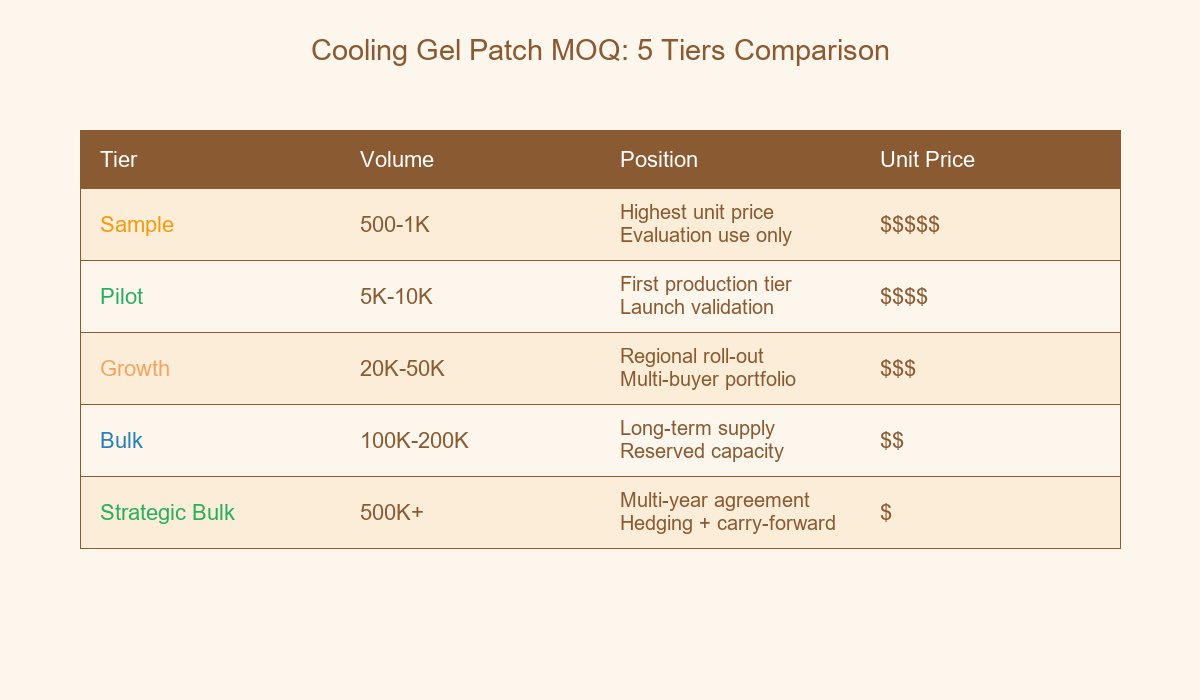
The sample tier carries the highest unit price because the supplier does not amortise the tooling and setup across a meaningful volume. KONGDY's sample tier is structured for evaluation rather than sale, and the unit price is documented as a non-production reference.
2.2 Documentation Scope (KONGDY)
The sample tier includes a finished product certificate of analysis, an ingredient declaration, and a sample artwork file. The documentation is enough to support market research and internal review, but not enough for retail onboarding.
2.3 Packaging and Lead Time (KONGDY)
The sample tier uses the manufacturer's standard packaging and ships in 1 to 2 weeks after the sample request. KONGDY's sample tier is reserved for qualified buyers with a documented first-order plan.
3. Tier 2: Pilot Tier (5,000 to 10,000 Pieces)
The pilot tier is the first production tier. It funds the launch validation in a single retail buyer without committing working capital to inventory that demand has not yet validated.
3.1 Unit Price (KONGDY)
The pilot tier carries a higher unit price than the growth and bulk tiers, but a lower unit price than the sample tier. The unit price reflects the tooling and setup cost amortised across the pilot volume.
3.2 Documentation Scope (KONGDY)
The pilot tier includes the full documentation pack: the FDA cosmetic establishment registration, the ISO 22716 GMP certificate, the finished product certificate of analysis template, the stability protocol summary, the ingredient declaration, the safety data sheet, and the market-specific dossier for the launch market.
3.3 Packaging and Lead Time (KONGDY)
The pilot tier supports custom artwork, the brand's GTIN, and a multi-count packaging configuration. The lead time is 3 to 4 weeks for stock platforms and 8 to 12 weeks for custom configurations including stability work.
3.4 Working Capital and Re-Order (KONGDY)
The pilot tier funds the launch validation with a manageable working capital commitment. The reorder cadence is triggered by sell-through data, with KONGDY's commercial team supporting the buyer with weekly inventory snapshots.
4. Tier 3: Growth Tier (20,000 to 50,000 Pieces)
The growth tier is the production tier that funds the regional roll-out after the pilot tier's sell-through data confirms demand.
4.1 Unit Price (KONGDY)
The growth tier carries a meaningful unit price step-down from the pilot tier. The fixed block (tooling, artwork setup, documentation) is amortised across enough units that material and conversion become the dominant cost lines.
4.2 Documentation Scope (KONGDY)
The growth tier includes the pilot tier's documentation plus the EU CPSR preparation, the EU Responsible Person registration, and the Asia market testing coordination. The documentation carry-forward from the pilot tier is documented in the multi-phase agreement.
4.3 Packaging and Lead Time (KONGDY)
The growth tier supports multi-count pouches, rigid boxes, dispenser cartons, and tamper-evident packaging for child-resistant compliance. The lead time is 8 to 12 weeks including stability work.
4.4 Working Capital and Re-Order (KONGDY)
The growth tier funds the regional roll-out with a working capital commitment that the buyer can model against the reorder cadence. KONGDY structures the production slot reservation around the buyer's review window.
5. Tier 4: Bulk Tier (100,000 to 200,000 Pieces)
The bulk tier is the long-term supply agreement tier. It converts a transactional relationship into a supply partnership.
5.1 Unit Price (KONGDY)
The bulk tier carries the lowest unit price per piece. The supplier's amortisation of tooling and setup is at its best, and the lead time is shortened by reserved production capacity.
5.2 Documentation Scope (KONGDY)
The bulk tier includes all the documentation from the pilot and growth tiers plus dedicated artwork plates, dedicated tooling, and reserved production capacity. The multi-phase agreement structure supports the bulk tier with documentation carry-forward and pricing tier stability.
5.3 Packaging and Lead Time (KONGDY)
The bulk tier supports premium packaging formats, custom dielines, and reserved production slots. The lead time is shortened to 6 to 8 weeks including stability work, with the production slot reserved before the peak production calendar.
5.4 Working Capital and Re-Order (KONGDY)
The bulk tier is a working capital commitment that requires a documented reorder cadence. KONGDY structures the multi-year supply agreement with reserved capacity, pricing tier stability, and a single point of commercial contact.
6. Tier 5: Strategic Bulk Tier (500,000+ Pieces)
The strategic bulk tier is the multi-year supply agreement tier. It supports the brand owner or distributor who has built the category across multiple markets and wants to lock the supply chain.
6.1 Unit Price (KONGDY)
The strategic bulk tier carries the deepest unit price step-down, with the supplier's amortisation of fixed cost shared across the largest volume. The unit price is documented in the multi-year agreement with a currency and freight surcharge clause.
6.2 Documentation Scope (KONGDY)
The strategic bulk tier includes all the documentation from the lower tiers plus dedicated documentation maintenance, annual stability data roll-forward, and a single point of commercial contact. The multi-year agreement includes a pricing tier stability clause that protects the buyer from annual price increases.
6.3 Packaging and Lead Time (KONGDY)
The strategic bulk tier supports custom dielines, premium packaging formats, dedicated production lines, and reserved production slots. The lead time is shortened to 4 to 6 weeks, with the production slot reserved for the multi-year horizon.
6.4 Working Capital and Re-Order (KONGDY)
The strategic bulk tier is a working capital commitment that the buyer can model against the multi-year reorder cadence. KONGDY structures the agreement with a hedging option for currency and freight volatility.
7. Tier Comparison Matrix
The tier comparison matrix is the B2B buyer's tool for selecting the entry tier. KONGDY's commercial team uses the matrix below to walk first-time buyers through the tier selection.
7.1 Unit Price by Tier (KONGDY)
The unit price by tier follows an inverse curve: highest at the sample tier, lowest at the strategic bulk tier. The price step-down is largest between the pilot and growth tiers because the fixed cost is amortised across meaningful volume for the first time.
7.2 Documentation Scope by Tier (KONGDY)
The documentation scope expands as the tier grows. The pilot tier includes the core documentation; the growth tier adds EU and Asia documentation; the bulk tier adds dedicated documentation maintenance; the strategic bulk tier adds multi-year carry-forward.
7.3 Lead Time by Tier (KONGDY)
The lead time shortens as the tier grows because the reserved production capacity and the documentation carry-forward reduce the start-up overhead. The strategic bulk tier can ship in 4 to 6 weeks, half the lead time of the pilot tier.
7.4 Working Capital Commitment by Tier (KONGDY)
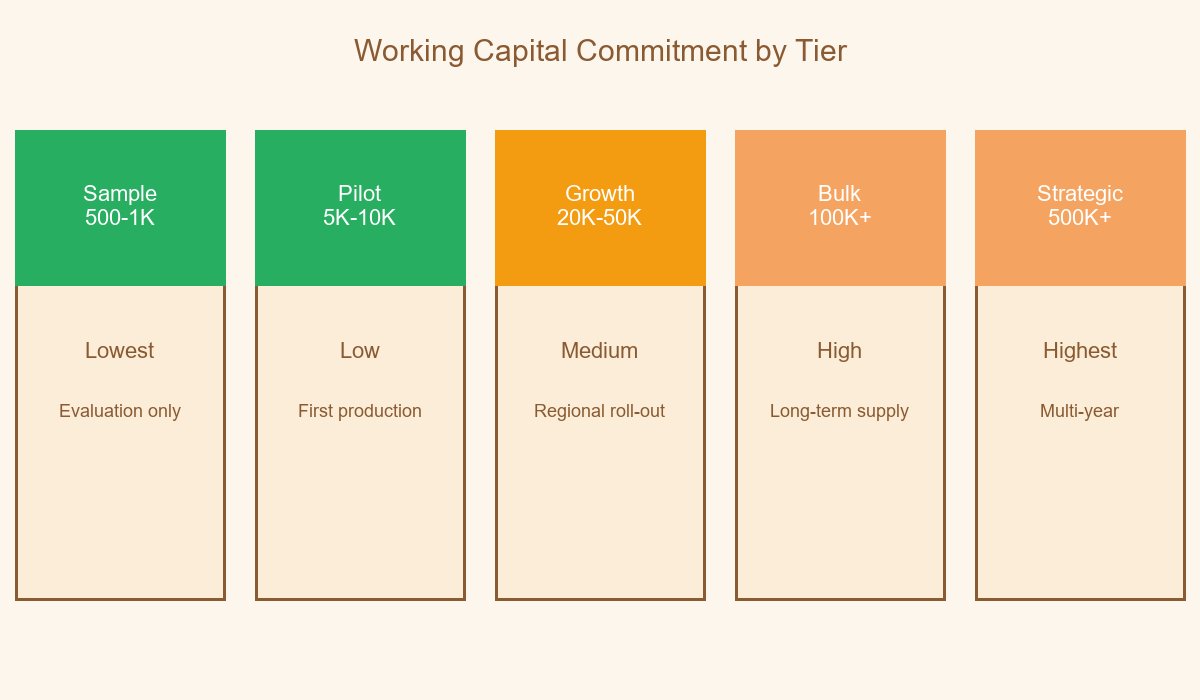
The working capital commitment grows with the tier. The buyer should select the tier that funds demand validation at the lowest total cost, not the tier that offers the lowest unit price alone.
8. Choosing the Right Tier for Your Channel and Market
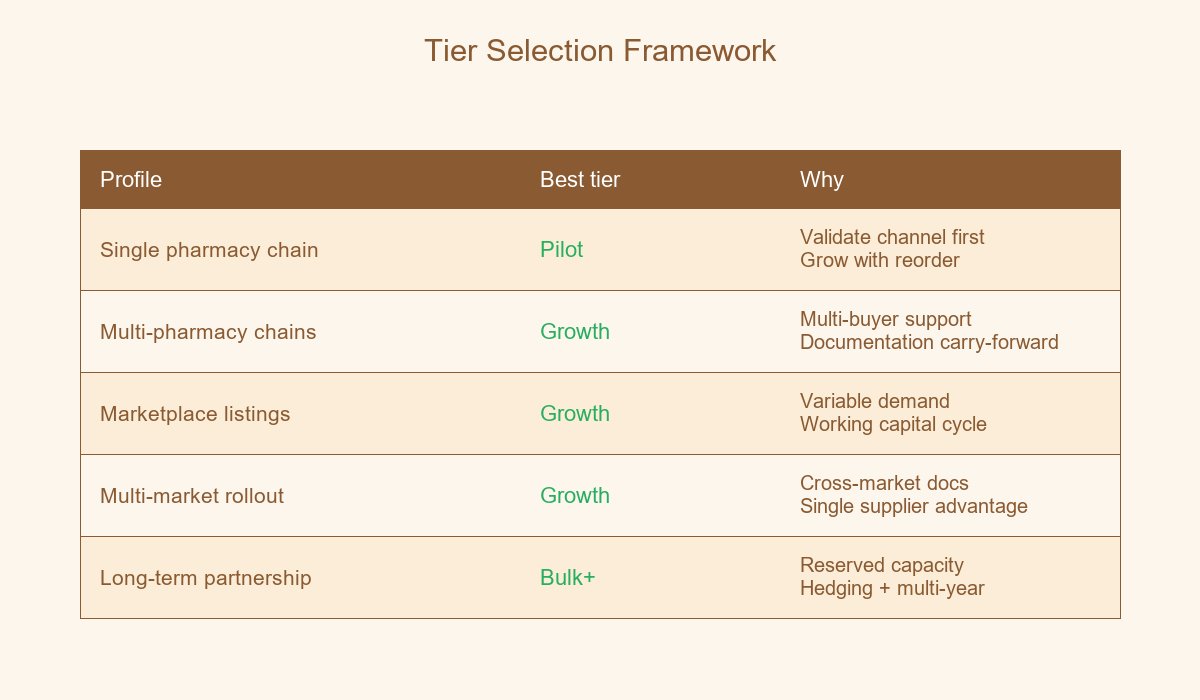
The right tier depends on the channel mix, the destination market, and the working capital cycle. KONGDY's commercial team supports the buyer with a tier selection framework.
8.1 Tier Selection by Channel (KONGDY)
A buyer who targets a single pharmacy chain can usually start at the pilot tier and move to the growth tier after the first reorder. A buyer who targets multiple pharmacy chains should start at the growth tier to support the multi-buyer portfolio. A buyer who targets marketplace listings should start at the growth tier because marketplace volume is hard to predict and the working capital must support the sell-through variability.
8.2 Tier Selection by Destination Market (KONGDY)
A buyer entering a single destination market can start at the pilot tier. A buyer entering multiple markets should start at the growth tier because the documentation carry-forward across markets supports the multi-market rollout.
8.3 Tier Selection by Working Capital Cycle (KONGDY)
A buyer with a 90-day working capital cycle can support the pilot tier and the growth tier. A buyer with a 60-day working capital cycle should start at the pilot tier and grow with the reorder cadence.
8.4 Tier Selection by Launch Timeline (KONGDY)
A buyer launching within one quarter should start at the pilot tier to validate the channel. A buyer launching within six months should plan the pilot tier and the growth tier in sequence, with the production slot reserved at the tier transition.
9. Common Tier Selection Mistakes and How to Avoid Them
Most tier selection mistakes trace back to four decisions made too early. The list below covers the most common ones and how KONGDY supports the buyer in avoiding them.
9.1 Buying at the Bulk Tier Before Validating the Market (KONGDY)
A bulk tier order before demand validation ties up working capital in inventory that the buyer has not proven the channel can absorb. KONGDY's tiered MOQ structure recommends the pilot tier as the first order.
9.2 Underestimating Documentation Cost (KONGDY)
The documentation and certification cost is part of the MOQ budget, not a separate deliverable. KONGDY separates the documentation cost from the unit price in the quotation so the buyer can budget accurately.
9.3 Choosing Custom Packaging Before Validating the Market (KONGDY)
Custom packaging and dedicated dielines are wasted if the SKU does not match the channel's best-selling configuration. KONGDY recommends launching on a stock platform and switching to custom after the sell-through validates the format.
9.4 No Re-Order Cadence Defined (KONGDY)
A reorder decision triggered by calendar rather than sell-through data can produce oversupply or stockout. KONGDY supports the buyer with a documented reorder cadence based on the destination market's demand cycle.
10. Conclusion: Choosing the Right Cooling Gel Patch MOQ Tier
Choosing the right cooling gel patch MOQ tier is a working capital decision, not a bargaining exercise. The right tier is the one that funds demand validation at the lowest total cost, keeps unit economics acceptable after the reorder, and preserves enough cash to market the product. KONGDY's tiered MOQ structure exists so the buyer can take the first step on evidence rather than on forecast, then step down unit cost as volume justifies it.
KONGDY's cooling gel patch MOQ programs run under ISO 22716 GMP certification with FDA registration, EU CPSR preparation, in-house analytical, microbiological, and stability laboratories, gel-specific stability chambers, and documented change control. The pricing tier structure supports a sample through a strategic bulk, and the documentation file carries forward across orders and markets.
Request a side-by-side tier comparison quotation within 24 hours — share your target market, expected annual volume, channel mix, and packaging direction, and the commercial team will return pilot, growth, bulk, and strategic bulk pricing side by side with a stage-by-stage lead time schedule and the certification roadmap for your destination market.
Ask about entry-tier MOQ options for a first order by sharing your channel plan and demand assumptions, and book a factory audit or live video tour at KONGDY's ISO 22716 certified facility to review converting lines, the QC laboratory, and the stability chamber room. Brand owners planning a launch within two quarters can reserve a pilot batch slot while documentation and stability work are completed in parallel, so the first order ships on the planned retail date.

