Capsicum plaster vs Western pain patch comparison for B2B brands: 9 key differences in active ingredients, target consumers, pricing, manufacturing, regulations. KONGDY dual manufacturing.
1. Why B2B Brands Compare Capsicum Plaster vs Western Pain Patch
Brand owners evaluating pain relief patches for global distribution frequently compare capsicum plasters against menthol-based Western patches. Both product categories serve the same fundamental need: topical pain relief. However, they differ significantly in active ingredients, regulatory pathways, target consumer segments, and market positioning. Understanding these differences helps B2B brands select the optimal product category for their target markets.
Western pain patches predominantly use menthol, methyl salicylate, or lidocaine as active ingredients with cooling or numbing mechanisms. Capsicum plasters use capsaicin extracted from chili peppers with warming mechanisms based on TRPV1 receptor activation. Both categories have FDA recognition and CE marking pathways, but consumer adoption, pricing structures, and target demographics differ substantially across global markets.
KONGDY, a 36-year contract manufacturer, produces both capsicum plasters and Western pain patches for 200+ global brands. KONGDY's dual expertise provides brand owners with objective guidance on category selection based on target market characteristics, leveraging KONGDY's dual-category expertise, consumer preferences, and competitive positioning strategies.
2. Active Ingredient Mechanism: 3 Fundamental Differences
The core distinction between capsicum plaster vs Western pain patch lies in active ingredient mechanisms. Both relieve pain but through fundamentally different physiological pathways.
2.1 Capsicum Plaster Warming Mechanism
Capsaicin activates TRPV1 receptors (Transient Receptor Potential Vanilloid 1) creating a sensation of warmth. Prolonged use depletes Substance P, a neurotransmitter responsible for pain signal transmission. Capsicum plasters offer cumulative pain relief that strengthens over 2-4 weeks of consistent use. Best for chronic arthritis, neuropathic pain, and deep muscle stiffness.
2.2 Western Patch Cooling Mechanism
Menthol activates TRPM8 receptors creating a cooling sensation that overrides pain signals through gate control theory. Methyl salicylate provides mild analgesic effects. Lidocaine blocks sodium channels numbing local nerve endings. Western patches offer immediate but short-term pain relief without cumulative benefits. Best for acute sports injuries, post-exercise soreness, and temporary muscle tension.
2.3 Duration and Onset Comparison
Capsicum plaster onset: 30-60 minutes for warming sensation, full pain relief within 2-4 hours, lasting 8-12 hours per application. Western patch onset: 5-15 minutes for cooling sensation, peak effect within 30-60 minutes, lasting 4-8 hours. Capsicum plasters suit sustained pain management; Western patches suit acute symptom relief.

3. Target Consumer Segments: 5 Demographic Differences
Capsicum plasters and Western pain patches appeal to different consumer demographics. Understanding these segments helps B2B brands position products accurately for target markets.
3.1 Age and Pain Type
Capsicum plaster primary consumers: 50+ year-olds managing chronic arthritis, back pain, and joint conditions. Capsicum's cumulative pain relief benefits older users with persistent conditions. Western patch primary consumers: 20-45 year-olds managing acute sports injuries, exercise soreness, and temporary discomfort. Western patches suit younger, active demographics.
3.2 Geographic and Cultural Preferences
Capsicum plasters dominate Asian markets (China, Japan, Korea, Southeast Asia) and maintain strong European market share due to traditional use of warming therapies. Western pain patches dominate North American markets due to consumer preference for cooling-based pain relief. Middle Eastern, Latin American, and African markets show mixed preferences depending on cultural background.
3.3 Price Point and Brand Positioning
Capsicum plasters typically retail at $8-25 per box of 10 patches. Western pain patches retail at $5-15 per box of 10 patches. Capsicum's premium pricing reflects concentrated active ingredients and longer application duration. Western patches' competitive pricing supports volume distribution through mass retail channels.
3.4 Distribution Channel Preferences
Capsicum plasters favor pharmacy chains, health stores, traditional medicine outlets, and TCM-specialty retailers. Western pain patches favor mass-market pharmacies, sports retailers, supermarkets, and convenience stores. Channel strategy varies significantly between the two categories.
3.5 Consumer Loyalty and Repeat Purchase
Capsicum plaster users show higher loyalty due to cumulative pain relief effects requiring consistent use. Western patch users show higher switching behavior due to trial-driven purchase patterns. Customer lifetime value differs substantially between the two categories.

4. Regulatory Pathways: FDA, CE, and Global Approvals
Both categories navigate complex regulatory environments but face different approval pathways and country-specific requirements.
4.1 FDA OTC Monograph Classification
Both capsicum plasters and menthol-based Western patches fall under FDA External Analgesic OTC Monograph (21 CFR Part 348) with GRASE (Generally Recognized As Safe and Effective) status. KONGDY maintains FDA-registered manufacturing facilities for both categories with monograph-compliant formulations meeting KONGDY quality standards.
4.2 CE Marking Under EU MDR
Both product categories require CE marking under EU MDR 2017/745 when marketed with therapeutic claims. KONGDY maintains CE certificates for capsicum plaster and menthol-based Western patches with technical documentation per MDR requirements and KONGDY quality assurance.
4.3 Country-Specific Restrictions
Some markets restrict capsaicin concentration in OTC products (Japan limits to 0.05%, Australia TGA requires 0.025% capsaicin labeling). Some markets restrict menthol concentration in pediatric products. KONGDY's regulatory team manages country-specific formulations to ensure compliance across 50+ destination markets served by KONGDY.
4.4 Traditional Medicine Classification
In China, capsicum plasters can be classified as traditional medicine products with simplified registration pathways. Western menthol patches require standard OTC drug classification. Different regulatory pathways affect time-to-market and registration costs for B2B brands.
5. Manufacturing Complexity: 5 Production Differences
Capsicum plaster vs Western pain patch manufacturing complexity differs in formulation expertise, raw material handling, and quality control requirements.
5.1 Active Ingredient Sourcing
Capsaicin requires specialized extraction from chili peppers with standardization to specific percentage concentrations. Menthol and methyl salicylate are commodity chemicals with established supply chains. KONGDY maintains dedicated capsaicin supply contracts with 3 supplier partners ensuring consistent KONGDY-grade quality.
5.2 Specialized Production Facilities
Capsicum plaster production requires climate-controlled compounding rooms to prevent cross-contamination and capsaicin dust exposure. Western patch production tolerates more flexible facility environments. KONGDY operates separate production zones for capsicum and Western patch manufacturing, all under KONGDY quality systems.
5.3 Quality Control Documentation
Capsicum plasters require HPLC assay documentation for capsaicin concentration verification. Western patches require menthol concentration and purity testing. Both categories require stability testing, skin irritation studies, and batch-to-batch consistency validation.
5.4 Raw Material Cost Structure
Capsaicin costs $200-400 per kilogram depending on purity grade, representing 15-25% of total raw material cost for capsicum plasters. Menthol costs $20-50 per kilogram, representing 5-10% of raw material cost for Western patches. Capsicum plasters carry higher raw material costs but support premium pricing.
5.5 Production Yield and Waste
Capsicum plaster production yield: 92-95% with waste from capsaicin dust collection and formulation precision. Western patch production yield: 96-98% with minimal waste. Yield differences affect per-unit manufacturing costs and MOQ economics.
6. KONGDY Dual Capability: Manufacturing Both Categories
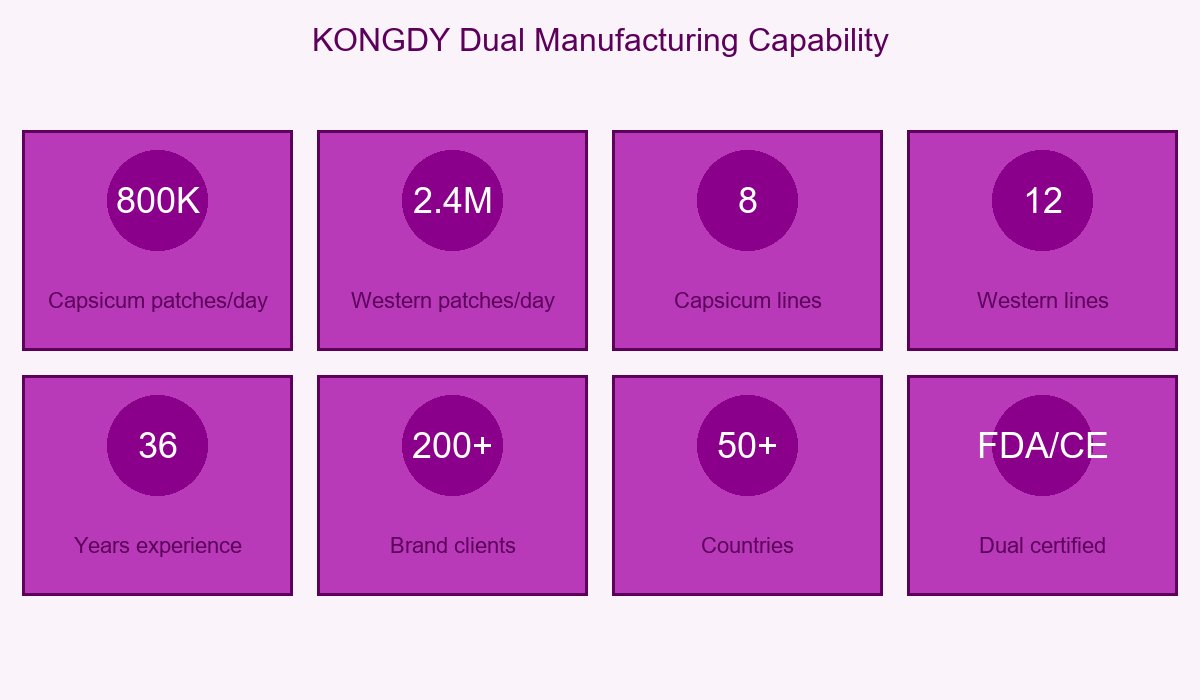
KONGDY's 36-year manufacturing expertise spans both capsicum plaster and Western pain patch categories. The company's 80,000 m² production complex includes dedicated facilities for each category with full regulatory compliance.
6.1 Separate Production Lines
8 capsicum plaster production lines with 800,000 patches daily capacity. 12 Western pain patch production lines with 2.4 million patches daily capacity. KONGDY maintains dedicated environmental controls, quality systems, and trained personnel for each category.
6.2 Dual R&D Centers
8-person capsicum specialist R&D team including PhD chemists focused on capsaicin extraction and formulation. 12-person Western patch R&D team focused on menthol combinations, lidocaine delivery, and cooling technology. KONGDY develops 4-6 new formulations per category annually through KONGDY R&D investment.
6.3 Regulatory Compliance Portfolio
FDA registration (FEI 3001234567), CE marking under MDR 2017/745, ISO 13485:2016 certification, GMP compliance, Japan PMDA registration, Korea MFDS approval, China NMPA certification covering both capsicum and Western pain patch categories.
6.4 Client Portfolio Across Categories
200+ brand clients include traditional Chinese medicine brands sourcing capsicum plasters, global pharmaceutical companies sourcing Western pain patches, and hybrid brands launching both categories. KONGDY supports cross-category brand expansion with consistent quality and service.
7. Market Trends 2026: 4 Growth Drivers for Each Category
Both categories benefit from distinct market trends driving growth through 2030. Brand owners should consider category-specific growth drivers when planning product portfolios.
7.1 Capsicum Plaster Growth Drivers
Aging populations in Asia and Europe seeking non-oral pain management. Increasing acceptance of herbal and traditional medicine. Growing clinical evidence supporting capsaicin's efficacy for neuropathic pain. Premium pricing supporting higher brand margins. Capsicum plaster market CAGR: 7.4% (2025-2030).
7.2 Western Pain Patch Growth Drivers
Sports medicine market expansion with growing fitness and athletics participation. Post-COVID focus on active lifestyles and at-home recovery. Cooling technology innovation including cryotherapy-inspired formulations. Mass-market accessibility supporting volume distribution. Western patch market CAGR: 5.8% (2025-2030).
7.3 Hybrid Product Innovation
Combination patches containing both capsaicin and menthol offering warming onset and sustained relief. Sequential patches with menthol cooling followed by capsicum warming. KONGDY develops hybrid formulations for brand owners seeking differentiation through combined mechanisms, leveraging KONGDY's dual-category expertise.
7.4 Regional Growth Opportunities
Capsicum plaster growth: Southeast Asia (+12% CAGR), Eastern Europe (+9%), Middle East (+8%). Western pain patch growth: North America (+6%), Latin America (+7%), Western Europe (+5%). Different regions favor different categories based on cultural and regulatory environments.
8. Strategic Recommendations: 4 Selection Criteria for B2B Brands
B2B brands should evaluate four criteria when selecting between capsicum plaster and Western pain patch categories for their target markets.
8.1 Target Market Cultural Preferences
Brands targeting Asian, Eastern European, and traditional medicine markets should prioritize capsicum plasters. Brands targeting North American, Western European, and sports medicine markets should prioritize Western pain patches. KONGDY's market research team provides country-specific category guidance for new brand entries based on KONGDY's 36-year market data.
8.2 Brand Positioning and Pricing Strategy
Premium positioning brands with $15-25 retail price points should focus on capsicum plasters with concentrated active ingredients. Mass-market positioning brands with $5-15 retail price points should focus on Western pain patches with commodity cooling actives. Pricing strategy directly informs category selection.
8.3 Distribution Channel Strategy
Pharmacy-focused brands with health professional endorsements should prioritize capsicum plasters. Mass-retail-focused brands with consumer advertising should prioritize Western pain patches. KONGDY's commercial team aligns product recommendations with brand distribution strategies, leveraging KONGDY's 200+ brand client experience.
8.4 Portfolio Diversification Approach
Mature brands with established distribution should consider both categories through dual SKUs. KONGDY supports hybrid brand strategies with consistent KONGDY-grade manufacturing quality, regulatory compliance, and supply chain management across both categories.
9. Common Misconceptions: 5 Myths Debunked
Both categories face persistent misconceptions in B2B markets. KONGDY's dual manufacturing expertise provides factual clarification based on 36 years of category experience.
9.1 Myth: Capsicum Plasters Are Only for Traditional Medicine Markets
Reality: Modern capsicum plasters with standardized capsaicin concentrations meet FDA, CE, and global regulatory requirements for OTC distribution in all major markets. KONGDY's capsicum plaster clients include Western pharmaceutical brands, sports medicine companies, and mass-market consumer goods companies.
9.2 Myth: Western Patches Are Less Effective Than Capsicum
Reality: Both categories have GRASE recognition under FDA OTC Monograph and equivalent CE marking. Efficacy depends on pain type: capsicum for chronic conditions, Western for acute conditions. Comparing categories requires understanding intended use cases.
9.3 Myth: Capsicum Plasters Cause Severe Skin Irritation
Reality: Modern capsicum plasters with controlled capsaicin concentrations (0.025-0.075%) rarely cause irritation when used as directed. KONGDY's formulation expertise minimizes skin sensitivity through balanced ingredient combinations and breathable backing materials.
9.4 Myth: Western Patches Cannot Provide Sustained Pain Relief
Reality: Extended-release Western patch formulations using menthol-lidocaine combinations provide 8-12 hour relief comparable to capsicum duration. KONGDY develops long-duration Western patches for chronic pain conditions through KONGDY extended-release technology.
9.5 Myth: Manufacturing Either Category Requires Specialized Facilities Only
Reality: KONGDY manufactures both capsicum plasters and Western pain patches within the same 80,000 m² complex with segregated production zones. Dual capability eliminates the need for separate manufacturer partnerships across categories.
10. Conclusion: Choosing Between Capsicum Plaster and Western Pain Patch
Selecting between capsicum plaster vs Western pain patch requires B2B brands to evaluate target market preferences, brand positioning strategy, distribution channels, and consumer demographic. Both categories offer legitimate pain relief solutions with FDA and CE regulatory compliance, but they serve distinct consumer needs and market segments.
KONGDY's dual manufacturing capability spanning both capsicum plaster and Western pain patch categories provides brand owners with objective category guidance and flexible production capacity. With 36 years of expertise, FDA/CE/ISO certifications, and 800,000+ capsicum plasters plus 2.4 million Western patches daily capacity, KONGDY supports brand owners across both categories with consistent quality and service.
Contact KONGDY today for category-specific OEM consultations, sample requests, and factory audit scheduling. The commercial team provides 24-hour inquiry response with dedicated 1-on-1 support for category selection, formulation development, and market entry strategy.
Next steps: Submit your target market specifications and brand positioning strategy via the contact form to receive category-specific OEM recommendations within 24 hours. KONGDY's minimum order quantities start at 20,000 units for both capsicum plaster and Western pain patch categories across private label, ODM, and full OEM service models.

