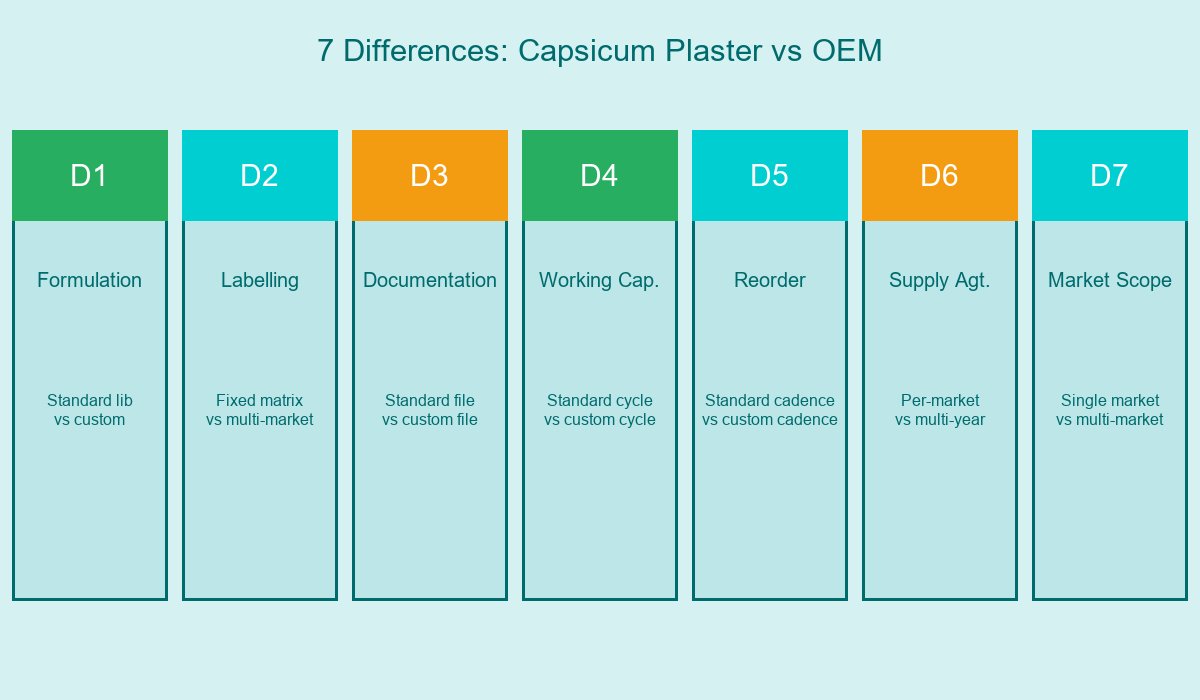
Capsicum plaster vs OEM capsicum patch 7 differences: formulation scope, labelling scope, documentation scope, working capital cycle, reorder cadence, supply agreement scope, and destination market scope. Side-by-side comparison table and decision framework for brand owners evaluating the two formats.
1. Why Capsicum Plaster and OEM Capsicum Patch Are Often Confused
Capsicum plaster and OEM capsicum patch look identical on the shelf. Both products carry the same capsaicin active, the same warming sensation, the same multi-day adhesion, and the same destination market's regulatory scope. A buyer who treats the two as interchangeable misses the formulation scope, the labelling scope, the documentation carry-forward, and the multi-year supply agreement scope that the two products deliver.
KONGDY has manufactured consumer health patches for 36 years and runs both capsicum plaster and OEM capsicum patch programs for brand owners across North America, Europe, and Asia. The facility is ISO 22716 GMP certified, FDA registered, and operates in-house analytical, microbiological, and stability laboratories, plus capsicum-specific warming sensation and adhesion testing rigs. The seven differences in this guide come from the formulation, the labelling, the documentation, the working capital, the reorder cadence, the supply agreement scope, and the destination market's regulatory file.
This guide walks through the seven differences, what each one decides, and how a brand owner can map the two products to the launch inventory and the multi-market rollout.
2. Difference 1: Formulation Scope and Warming Profile
The first difference is the formulation scope and the warming profile. A capsicum plaster and an OEM capsicum patch share the capsaicin active, but the formulation matrix, the warming duration, and the skin-contact safety profile differ between the two formats.
2.1 Capsicum Plaster Formulation (KONGDY)
Capsicum plaster formulations cover 0.025 percent to 0.075 percent capsaicin concentration, with the warming duration and the skin-contact safety profile documented per formulation. The capsicum plaster is a finished product with a fixed formulation, a fixed warming curve, and a fixed destination market scope.
2.2 OEM Capsicum Patch Formulation (KONGDY)
OEM capsicum patch formulations support the formulation library per brand owner, with the capsaicin concentration, the warming duration, and the skin-contact safety profile documented per brand owner. The OEM capsicum patch supports the brand owner's custom formulation and the multi-market rollout.
2.3 What the Difference Decides (KONGDY)
The difference decides the formulation library, the warming curve validation, and the destination market's regulatory scope. KONGDY's formulation library covers both formats and supports the brand owner in mapping the launch inventory to the destination market's regulatory file.
3. Difference 2: Labelling Scope and Language Rollout
The second difference is the labelling scope and the language rollout. A capsicum plaster carries a fixed labelling matrix per destination market. An OEM capsicum patch supports the brand owner's custom labelling, the multi-market language rollout, and the per-market regulatory text verification.
3.1 Capsicum Plaster Labelling (KONGDY)
Capsicum plaster labelling is fixed per destination market. The dieline, the language panel, and the regulatory text are locked at the production stage, with the per-market variation limited to the language panel.
3.2 OEM Capsicum Patch Labelling (KONGDY)
OEM capsicum patch labelling supports the brand owner's custom dieline, the multi-market language rollout, the per-market regulatory text verification, and the artwork refresh without tooling change. The OEM format supports the multi-market rollout scope.
3.3 What the Difference Decides (KONGDY)
The difference decides the multi-market rollout scope, the per-market artwork refresh cadence, and the destination market's labelling regulation. KONGDY's labelling system supports both formats and the per-market regulatory text verification per destination market.
4. Difference 3: Documentation Scope and Regulatory File
The third difference is the documentation scope and the regulatory file. A capsicum plaster carries a standard regulatory file per destination market. An OEM capsicum patch supports the brand owner's custom regulatory file, the documentation roll-forward, and the change control procedure.
4.1 Capsicum Plaster Documentation (KONGDY)
Capsicum plaster documentation covers the standard ISO 22716 GMP certificate, the FDA cosmetic registration, the EU CPSR, the finished product CoA, and the destination market's stability protocol. The standard documentation supports the standard launch inventory.
4.2 OEM Capsicum Patch Documentation (KONGDY)
OEM capsicum patch documentation covers the standard documentation plus the brand owner's custom documentation, the multi-market documentation roll-forward, the change control procedure, and the per-market documentation carry-forward. The OEM format supports the long-term supply commitment.
4.3 What the Difference Decides (KONGDY)
The difference decides the destination market's regulatory file, the change control scope, and the post-market surveillance chain. KONGDY's documentation system supports both formats and the per-market regulatory file per destination market.
5. Differences 4-5: Working Capital Cycle and Reorder Cadence
The fourth and fifth differences are the working capital cycle and the reorder cadence. A capsicum plaster carries a standard reorder cadence. An OEM capsicum patch supports the brand owner's custom reorder cadence, the multi-year supply agreement scope, and the dedicated production slot reservation.
5.1 Difference 4: Working Capital Cycle (KONGDY)
Capsicum plaster working capital cycle is documented per destination market, with the reorder trigger and the safety stock formula per channel. The standard working capital cycle supports the standard launch inventory.
5.2 Difference 5: Reorder Cadence (KONGDY)
OEM capsicum patch reorder cadence is documented per brand owner, with the multi-year supply agreement scope and the dedicated production slot reservation. The OEM format supports the long-term supply commitment and the recurring reorder brand.
5.3 What the Differences Decide (KONGDY)
The differences decide the inventory carrying cost, the reorder point per channel, and the production slot reservation. KONGDY's working capital model supports both formats and the per-tier working capital cycle per destination market.
6. Differences 6-7: Supply Agreement Scope and Destination Market
The sixth and seventh differences are the supply agreement scope and the destination market's regulatory file. A capsicum plaster carries a standard supply agreement. An OEM capsicum patch supports the brand owner's multi-year supply agreement, the exclusive territory option, and the per-market documentation carry-forward.
6.1 Difference 6: Supply Agreement Scope (KONGDY)
Capsicum plaster supply agreement is documented per destination market, with the per-market pricing, the reorder cadence, and the documentation scope. The standard supply agreement supports the standard launch inventory.
6.2 Difference 7: Destination Market Scope (KONGDY)
OEM capsicum patch destination market scope is documented per brand owner, with the multi-market rollout, the per-market documentation carry-forward, and the per-market stability roll-forward. The OEM format supports the long-term supply commitment.
6.3 What the Differences Decide (KONGDY)
The differences decide the multi-market rollout scope, the per-market documentation carry-forward, and the long-term supply commitment. KONGDY's supply agreement system supports both formats and the per-market destination market scope.
7. Side-by-Side Comparison Table
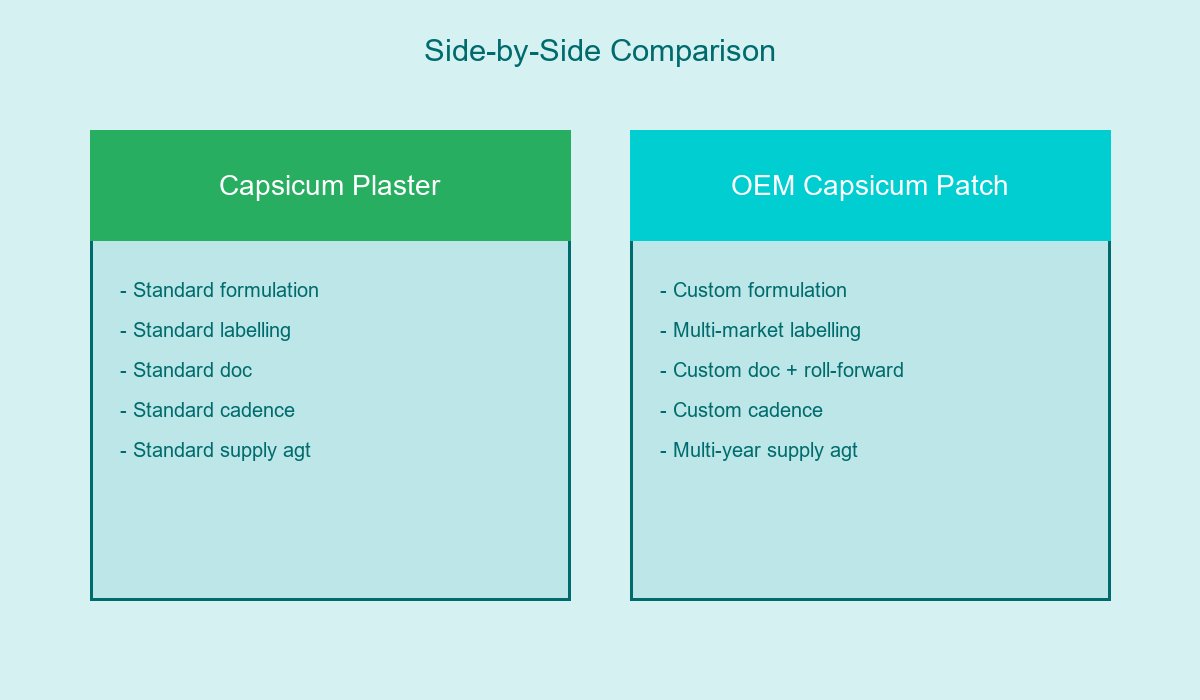
The side-by-side comparison table summarises the seven differences across the formulation, the labelling, the documentation, the working capital, the reorder cadence, the supply agreement, and the destination market scope. The table helps the brand owner map the two products to the launch inventory and the multi-market rollout.
7.1 Formulation and Warming Profile (KONGDY)
Capsicum plaster uses the standard formulation library. OEM capsicum patch supports the brand owner's custom formulation library. KONGDY's formulation library covers both formats and the warming profile validation per formulation.
7.2 Labelling and Documentation (KONGDY)
Capsicum plaster carries the standard labelling and the standard documentation. OEM capsicum patch supports the brand owner's custom labelling and the documentation roll-forward. KONGDY's labelling and documentation systems cover both formats.
7.3 Working Capital and Supply Agreement (KONGDY)
Capsicum plaster uses the standard working capital cycle and the standard supply agreement. OEM capsicum patch supports the multi-year supply agreement and the dedicated production slot reservation. KONGDY's commercial team supports both formats per destination market.
8. When to Choose Capsicum Plaster vs OEM Capsicum Patch
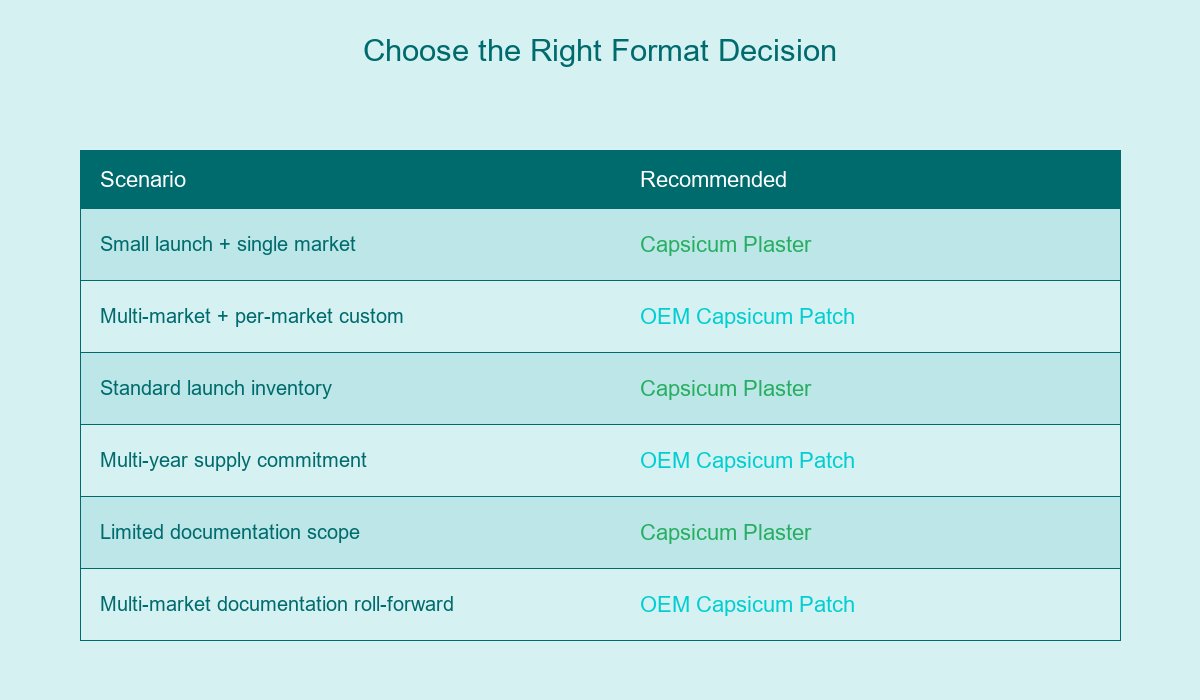
The decision between capsicum plaster and OEM capsicum patch depends on the brand owner's launch volume, the multi-market rollout scope, the per-market customisation need, and the long-term supply commitment. A brand owner who maps the two products to the launch inventory and the multi-market rollout can capture the right format per channel.
8.1 Choose Capsicum Plaster When (KONGDY)
Choose capsicum plaster when the launch volume is small, the multi-market rollout is limited, the per-market customisation is minimal, and the long-term supply commitment is short. KONGDY's capsicum plaster program supports the standard launch inventory and the standard launch market.
8.2 Choose OEM Capsicum Patch When (KONGDY)
Choose OEM capsicum patch when the launch volume is large, the multi-market rollout is broad, the per-market customisation is required, and the long-term supply commitment is multi-year. KONGDY's OEM capsicum patch program supports the multi-market rollout and the long-term supply commitment.
8.3 What the Decision Decides (KONGDY)
The decision decides the per-tier unit cost, the documentation scope, the working capital cycle, and the multi-year supply agreement scope. KONGDY's commercial team supports the decision with the launch volume, the multi-market rollout scope, and the long-term supply commitment.
9. Common Decision Mistakes and How to Avoid Them
Most decision failures trace back to four predictable issues. The list below covers the most common ones and how KONGDY supports the brand owner in avoiding them.
9.1 Choosing OEM for Small Launch Volume (KONGDY)
A brand owner who chooses OEM for a small launch volume loses the per-tier unit cost efficiency. KONGDY's commercial team supports the format selection with the launch volume and the multi-market rollout scope.
9.2 Choosing Capsicum Plaster for Multi-Market Rollout (KONGDY)
A brand owner who chooses capsicum plaster for a multi-market rollout loses the per-market customisation capability. KONGDY's OEM format supports the multi-market customisation and the documentation roll-forward per market.
9.3 Underestimating the Documentation Scope (KONGDY)
A brand owner who underestimates the documentation scope produces a destination market registration rejection. KONGDY's documentation system covers the multi-market dossier and the change control scope per format.
9.4 Incomplete Working Capital Model (KONGDY)
A brand owner with an incomplete working capital model produces a reorder cadence that runs out of stock or carries excess inventory. KONGDY's working capital model projects the cycle by month per format.
10. Conclusion: Two Formats, Two Long-Term Sourcing Decisions
Capsicum plaster and OEM capsicum patch are two formats for two long-term sourcing decisions. The brand that maps the two formats to the launch inventory, the multi-market rollout, the per-market customisation, and the long-term supply commitment captures the right format per channel and per destination market.
KONGDY runs both capsicum plaster and OEM capsicum patch programs under ISO 22716 GMP certification with FDA registration, EU CPSR preparation, in-house analytical, microbiological, and stability laboratories, capsicum-specific warming sensation and adhesion testing rigs, and documented change control. The dual format model supports the brand owner with the format selection, the per-tier pricing, the per-tier documentation, and the multi-year supply agreement scope.
Request KONGDY's capsicum plaster and OEM capsicum patch quotation within 48 hours — share your target market, expected launch volume, multi-market rollout scope, and packaging direction, and the commercial team will return format recommendation, tiered unit pricing, per-format documentation deliverable list, and the lead time schedule for your launch date.
Book a factory audit or live video tour at KONGDY's ISO 22716 facility to review the capsicum converting line, the warming sensation testing rig, the analytical laboratory, and the stability chamber room, and request a free sample to validate warming duration, adhesion experience, and first-impression in your channel. Brand owners planning a launch within two quarters can additionally reserve a pilot batch slot while artwork and documentation work run in parallel.

