Capsicum plaster QC 6 ISO 22716 standards buyers verify: GMP foundation, capsaicin concentration traceability, warming duration and adhesion profile, analytical laboratory, CoA release, stability chamber and microbiological specification. Buyer verification guide with destination market compliance.
1. Why Capsicum Plaster QC Standards Differ From Generic Patch QC
Capsicum plaster QC standards differ from generic patch QC. A capsicum plaster is a warming transdermal laminate where the capsaicin concentration, the warming duration, the skin-contact safety, and the destination market's warming-claim regulation each carry their own QC verification. A buyer who treats capsicum plaster QC as a generic cosmetic QC misses the capsaicin concentration traceability, the warming duration profile, the destination market's OTC monograph, and the post-market surveillance chain.
KONGDY has manufactured consumer health patches for 36 years and runs capsicum plaster QC programs for brand owners across North America, Europe, and Asia. The facility is ISO 22716 GMP certified, FDA registered, and operates in-house analytical, microbiological, and stability laboratories, plus capsicum-specific warming sensation and adhesion testing rigs. The QC program is built on the six ISO 22716 standards that brand owners and auditors verify at the receiving area, the formulation line, the converting line, the analytical laboratory, the packaging line, and the stability chamber room.
This guide walks through the six standards, what each one verifies, and how KONGDY's QC system answers each verification.
2. Standard 1: ISO 22716 GMP Foundation
The first ISO 22716 standard is the GMP foundation. The foundation covers the cosmetic good manufacturing practice system that addresses premises, equipment, raw materials, production, quality control, and documentation.
2.1 What the Standard Decides (KONGDY)
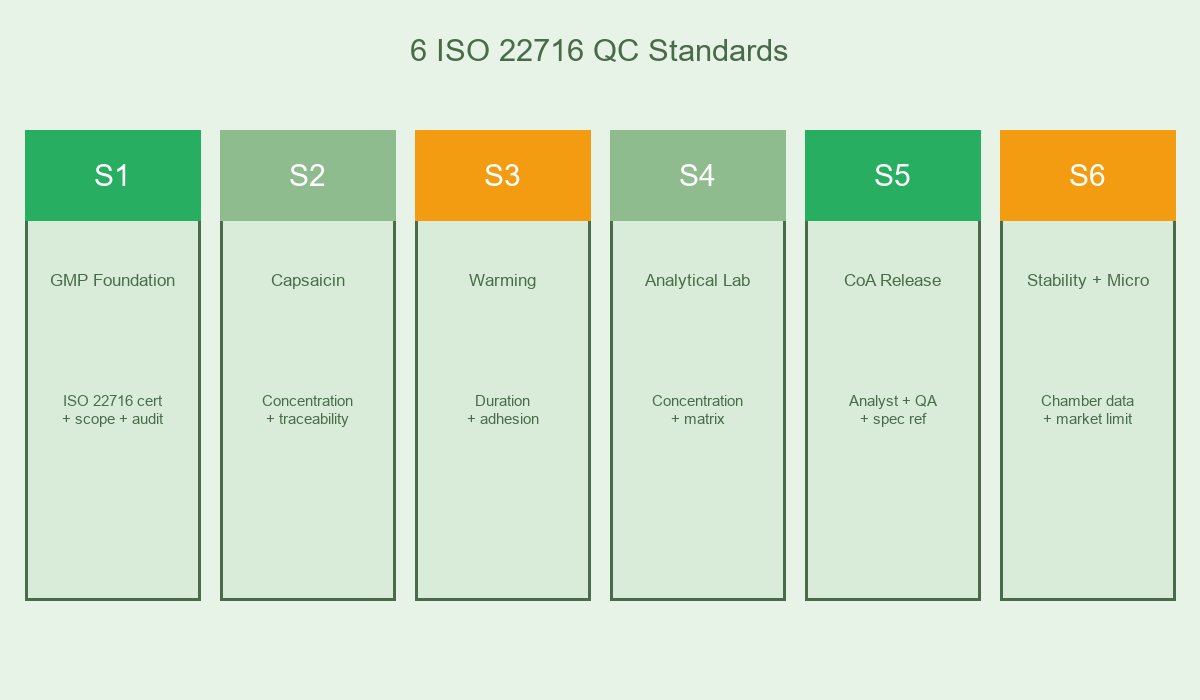
The foundation decides whether the cosmetic GMP system is verified against the destination market's warming-claim regulation. KONGDY's ISO 22716 certification covers patch, gel, balm, and cream formats, audited annually by an accredited certification body.
2.2 What the Buyer Verifies (KONGDY)
The buyer verifies the certificate number, the scope of certification, the most recent surveillance audit date, and the corrective action history. KONGDY's certification is verifiable against the issuing body's public registry.
2.3 What the Buyer Should Document (KONGDY)
The buyer should document the certificate number, the scope of certification, and the most recent surveillance audit date. KONGDY's QC manual summary includes each item for the buyer's verification file.
3. Standard 2: Capsaicin Concentration Traceability
The second ISO 22716 standard is the capsaicin concentration traceability. The capsaicin concentration traceability covers the active raw material supplier, the lot number, the analytical verification, and the formulation matrix per production run.
3.1 What the Standard Decides (KONGDY)
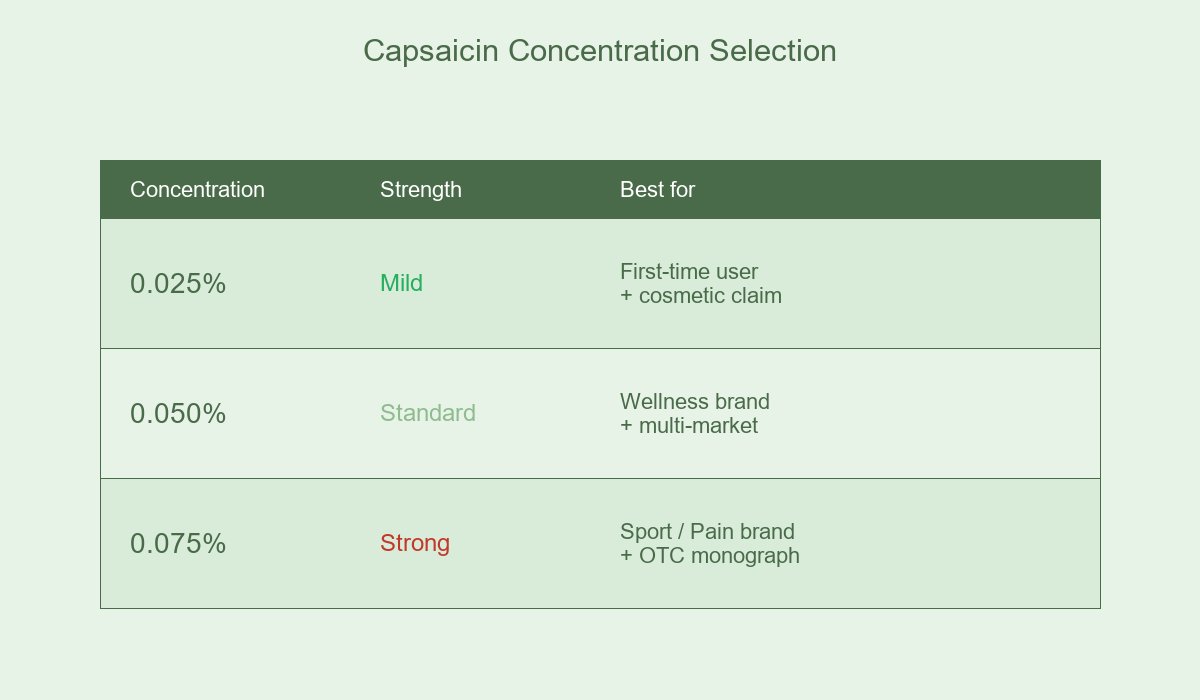
The standard decides whether the capsaicin concentration is verified against the destination market's warming-claim regulation. KONGDY's capsaicin concentration traceability documents the supplier audit, the lot release, the analytical verification, and the formulation matrix per production run.
3.2 What the Buyer Verifies (KONGDY)
The buyer verifies the supplier audit records, the lot release records, the analytical verification results, and the formulation matrix verification. KONGDY's traceability file is electronic and indexed per batch.
3.3 What the Buyer Should Document (KONGDY)
The buyer should document the supplier list, the verification scope, the analytical results, and the formulation matrix verification. KONGDY's traceability file is part of the multi-year supply agreement.
4. Standard 3: Warming Duration and Adhesion Profile
The third ISO 22716 standard is the warming duration and adhesion profile. The warming duration decides the consumer's first-impression experience and the channel acceptance profile. The adhesion profile decides the post-use residue and the consumer's full wear experience.
4.1 What the Standard Decides (KONGDY)
The standard decides whether the warming duration and adhesion profile are validated against the destination market's warming-claim regulation. KONGDY's warming duration is validated on the warming sensation testing rig and documented per formulation.
4.2 What the Buyer Verifies (KONGDY)
The buyer verifies the warming duration profile, the surface temperature profile, the post-use residue profile, and the skin-contact safety profile. KONGDY's warming sensation testing rig measures each profile per formulation.
4.3 What the Buyer Should Document (KONGDY)
The buyer should document the warming duration, the adhesion duration, the post-use residue, and the skin-contact safety scope. KONGDY's adhesion profile is documented per formulation.
5. Standards 4-5: Analytical Laboratory + CoA Release
The fourth and fifth ISO 22716 standards are the analytical laboratory and the CoA release procedure. The analytical laboratory verifies the capsaicin concentration, the formulation matrix, the warming profile, and the finished product specification. The CoA release procedure decides the release status of the production run.
5.1 Standard 4: Analytical Laboratory (KONGDY)
The analytical laboratory verifies the capsaicin concentration, the formulation matrix, and the warming profile. KONGDY's analytical laboratory is equipped with HPLC, GC, and UV-Vis instrumentation.
5.2 Standard 5: CoA Release (KONGDY)
The CoA release procedure requires the analyst signature and the QA release signature before the production run ships. KONGDY's CoA release procedure is documented per destination market.
5.3 What the Buyer Verifies (KONGDY)
The buyer verifies the analytical laboratory equipment list, the calibration records, the CoA release procedure, and the analyst training scope. KONGDY's QC system documents each item per production run.
6. Standard 6: Stability Chamber + Microbiological Specification
The sixth ISO 22716 standard is the stability chamber and the microbiological specification. The stability chamber generates the data that supports the shelf life statement. The microbiological specification supports the destination market's regulatory limit.
6.1 Stability Chamber (KONGDY)
The stability chamber is qualified and calibrated to ICH conditions, with storage at 25, 30, and 40 degrees Celsius for multi-market distribution. KONGDY's stability chambers support the per-market shelf life assignment and the documentation roll-forward.
6.2 Microbiological Specification (KONGDY)
The microbiological specification is documented per destination market. KONGDY's microbiological laboratory is equipped with incubation chambers, colony counting equipment, and identification systems.
6.3 What the Buyer Verifies (KONGDY)
The buyer verifies the chamber qualification records, the calibration schedule, the microbiological limit reference, and the regulatory alignment. KONGDY's stability protocol and microbiological specification are documented per destination market.
7. How the Six Standards Connect to Destination Market Compliance
The six standards connect to the destination market's compliance through the documentation chain. The buyer who maps the standards to the destination market's compliance file captures the regulatory scope, the change control procedure, and the post-market surveillance chain.
7.1 United States Compliance (KONGDY)
United States compliance is supported by the ISO 22716 foundation, the capsaicin concentration traceability, the warming duration profile, the analytical laboratory release, the CoA release, the stability chamber data, and the microbiological specification. KONGDY's QC system supports the FDA cosmetic establishment registration for the United States market.
7.2 European Union Compliance (KONGDY)
European Union compliance is supported by the ISO 22716 foundation, the EU CPSR preparation, the capsaicin concentration traceability, the warming duration profile, the analytical laboratory release, the stability chamber data, and the microbiological specification. KONGDY's QC system supports the EU CPSR with a qualified safety assessor.
7.3 Asia Pacific Compliance (KONGDY)
Asia Pacific compliance is supported by the ISO 22716 foundation, the capsaicin concentration traceability, the warming duration profile, the analytical laboratory release, the stability chamber data, and the destination market's warming-claim monograph. KONGDY's QC system supports the per-market regulatory file.
8. Common QC Audit Findings and How to Address Them
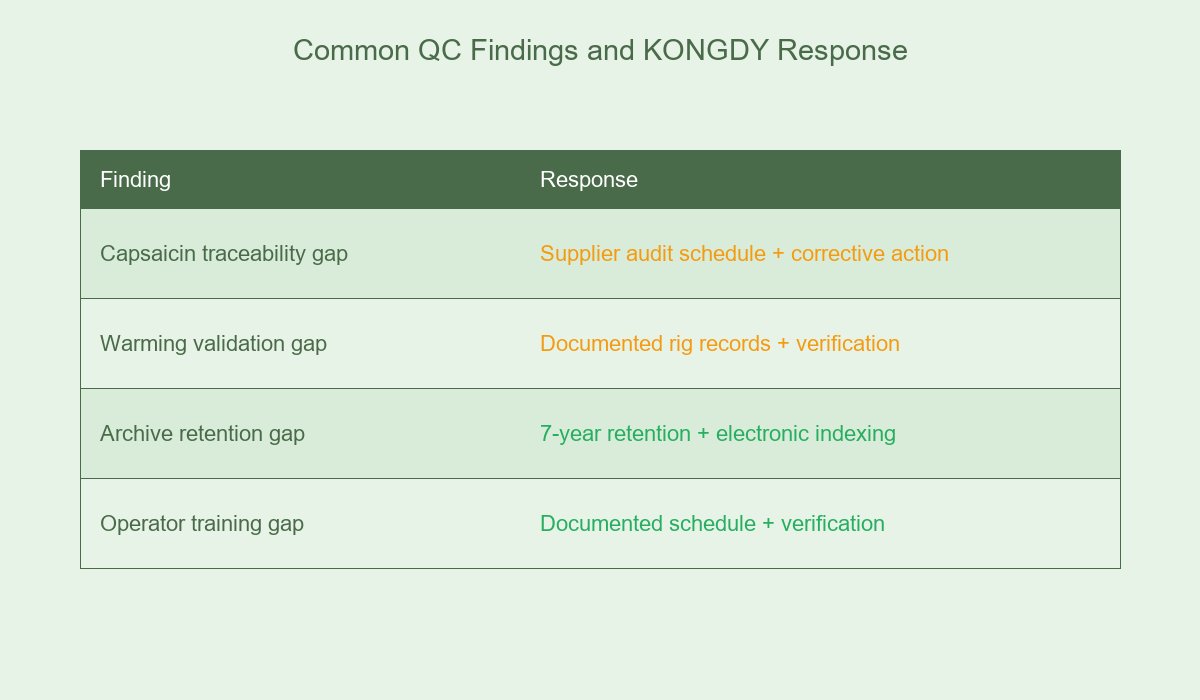
Most QC audits surface four predictable findings. The list below covers the most common ones and how KONGDY addresses them.
8.1 Capsaicin Concentration Traceability Gap (KONGDY)
A capsaicin concentration traceability gap indicates that a supplier audit is overdue. KONGDY's supplier audit schedule is documented and verifiable during the audit, with corrective action triggered by any gap.
8.2 Warming Duration Validation Gap (KONGDY)
A warming duration validation gap indicates that the validation is below the documented procedure. KONGDY's warming duration validation is documented and verified during the audit.
8.3 Documentation Archive Retention Gap (KONGDY)
A documentation archive retention gap indicates that a record is past the retention period. KONGDY's documentation archive retention is 7 years and verified during the audit.
8.4 Operator Training Gap (KONGDY)
An operator training gap indicates that an operator's training record is overdue. KONGDY's operator training schedule is documented and verifiable during the audit.
9. The Six Standards as a Sourcing Decision
The six ISO 22716 standards are a sourcing decision. The buyer who treats the standards as a sourcing decision captures the regulatory scope, the change control procedure, and the post-market surveillance chain that the standards deliver.
9.1 Verify the Foundation (KONGDY)
Verify the foundation by checking the ISO 22716 certificate number against the issuing body's public registry. KONGDY's certification is verifiable against the issuing body's public registry.
9.2 Verify the Capsaicin Traceability (KONGDY)
Verify the capsaicin traceability by reviewing the supplier audit records, the lot release records, the analytical verification, and the formulation matrix. KONGDY's traceability file is electronic and indexed per batch.
9.3 Verify the Warming and Adhesion Profile (KONGDY)
Verify the warming and adhesion profile by reviewing the warming sensation testing rig records, the adhesion duration profile, and the post-use residue profile. KONGDY's warming sensation testing rig measures each profile per formulation.
9.4 Verify the Stability and Microbiological Specification (KONGDY)
Verify the stability and microbiological specification by reviewing the chamber qualification records, the calibration schedule, and the regulatory alignment. KONGDY's stability chamber and microbiological laboratory are documented per destination market.
10. Conclusion: Six ISO 22716 Standards as the QC Foundation
The six ISO 22716 standards are the QC foundation. The buyer that treats the standards as the foundation captures the destination market's compliance, the change control procedure, and the post-market surveillance chain that the standards deliver.
KONGDY runs capsicum plaster QC programs under ISO 22716 GMP certification with FDA registration, EU CPSR preparation, in-house analytical, microbiological, and stability laboratories, capsicum-specific warming sensation and adhesion testing rigs, and documented change control. The six standards support the buyer with the QC foundation, the capsaicin traceability, the warming duration profile, the analytical laboratory release, the CoA release, the stability chamber data, and the microbiological specification.
Request KONGDY's capsicum plaster QC program documentation within 48 hours — share your target market, expected launch volume, and destination market's regulatory scope, and the QC team will return the ISO 22716 certificate number, the capsaicin concentration traceability file, the warming duration profile, the analytical laboratory release procedure, the stability protocol summary, and the microbiological specification.
Book a factory audit or live video tour at KONGDY's ISO 22716 facility to review the production line, the analytical laboratory, the warming sensation testing rig, the stability chamber room, the microbiological laboratory, and the documentation archive, and request a free sample to validate warming duration, adhesion experience, and first-impression in your channel. Brand owners planning a launch within two quarters can additionally reserve a pilot batch slot while artwork and documentation work run in parallel.

