Back pain patch QC 5 red flags in supplier documentation: certificate scope narrower than the product, CoA missing a signature, adhesion validation without a body area scope, labelling text without a market reference, and no change control record. Buyer verification guide with documentation pre-check scope.
1. Why Back Pain Patch Supplier Documentation Red Flags Matter
Back pain patch supplier documentation red flags are the earliest warning a buyer gets before a shipment becomes a customs hold, a retail rejection, or a post-market complaint. The documentation pack is where the supplier's system becomes visible: the certificate scope, the analytical release, the large-format adhesion validation, the labelling text, and the change control record. A buyer who reads the documentation pack as a formality misses the five red flags that predict a supply failure months before it happens.
KONGDY has manufactured consumer health patches for 36 years and runs back pain patch QC programs for buyers and auditors across North America, Europe, and Asia. The facility is ISO 22716 GMP certified, FDA registered, and operates in-house analytical, microbiological, and stability laboratories, plus back pain patch-specific large-format adhesion testing rigs. The QC program is built on the documentation pre-check that surfaces the five red flags before the purchase order, not after the shipment.
This guide walks through the five red flags, what each one predicts, and how KONGDY's documentation system works when the flag is absent.
2. Red Flag 1: Certificate Scope Narrower Than the Product
The first red flag is a certificate scope narrower than the product being quoted. A supplier whose ISO 22716 certificate covers creams but quotes a large-format patch program is carrying unverified scope, and the audit trail that the destination market expects does not exist for the product the buyer is ordering.
2.1 What the Red Flag Looks Like (KONGDY)
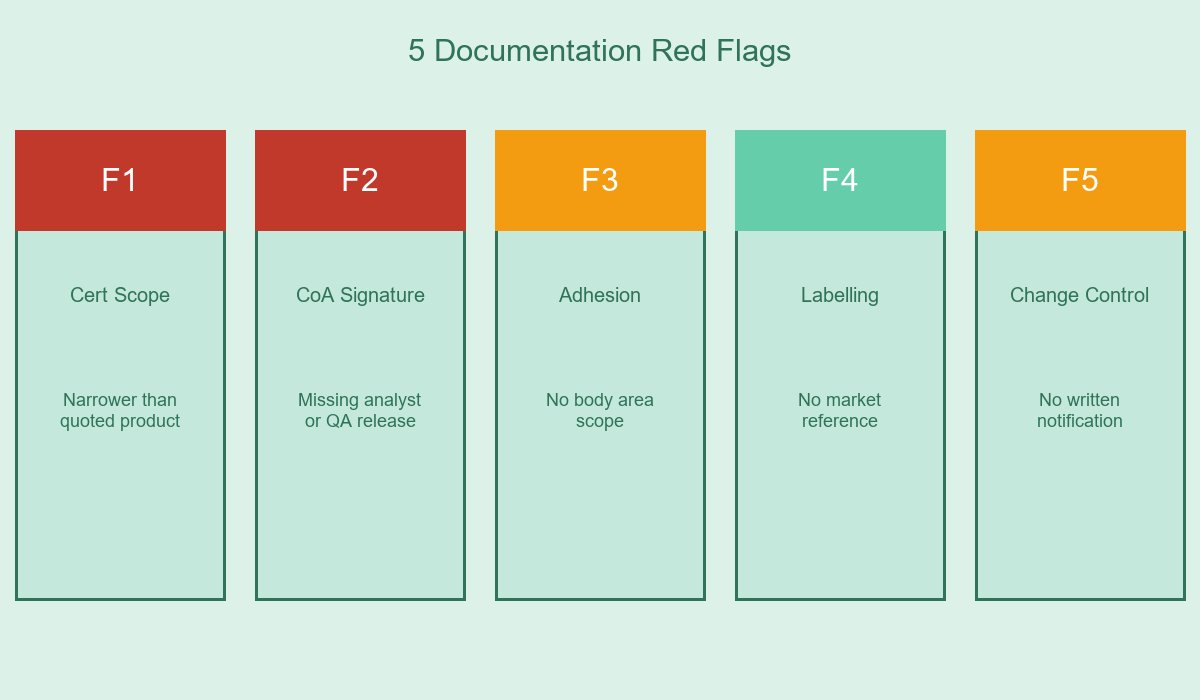
The red flag appears as a certificate scope that lists a format the buyer is not ordering, or omits the format the buyer is ordering. KONGDY's ISO 22716 certification covers patch, gel, balm, and cream formats with the scope documented on the certificate.
2.2 What the Red Flag Predicts (KONGDY)
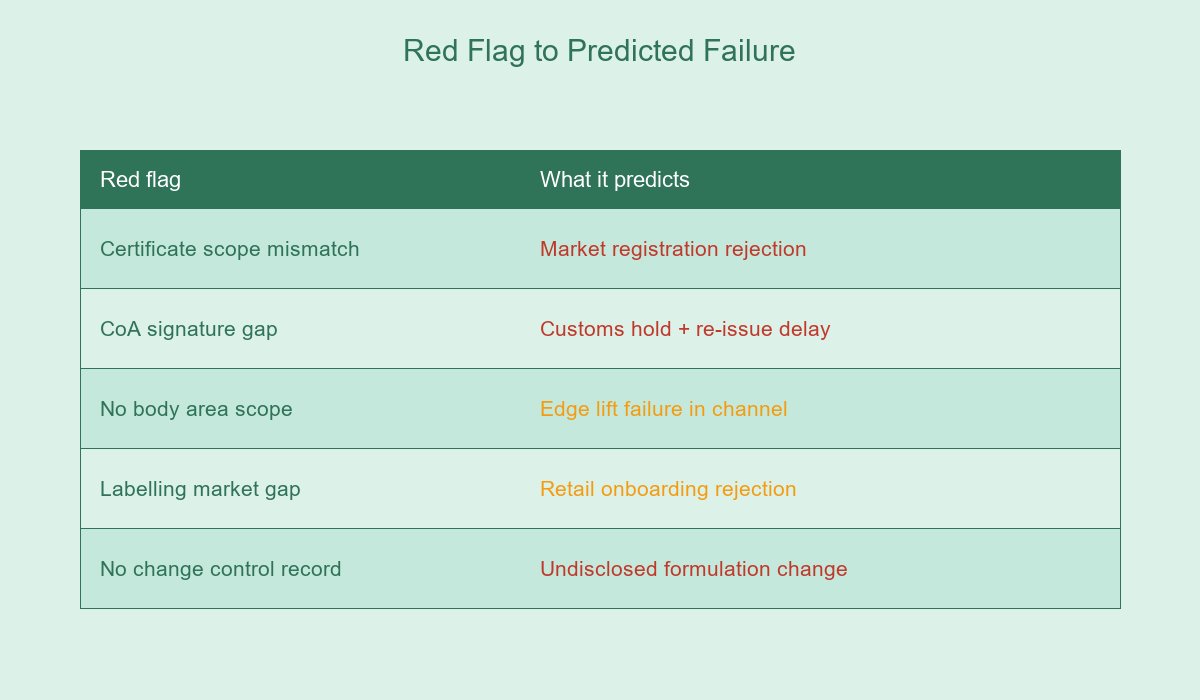
The red flag predicts a destination market rejection when the regulatory authority checks the certification scope against the product. KONGDY's certificate scope is verifiable against the issuing body's public registry.
2.3 How to Verify (KONGDY)
The buyer verifies by matching the certificate scope to the quoted product format and checking the certificate number against the issuing body's registry. KONGDY provides both the certificate number and the scope statement in the QC manual summary.
3. Red Flag 2: Certificate of Analysis Missing a Signature
The second red flag is a certificate of analysis that carries the analytical results but not both release signatures. A CoA without the analyst signature or without the QA release signature cannot be used at customs clearance, and the buyer discovers the gap when the shipment is already at the port.
3.1 What the Red Flag Looks Like (KONGDY)
The red flag appears as a CoA template with one signature field, or as a released batch with a single signature. KONGDY's CoA release procedure requires both the analyst signature and the QA release signature before any production run ships.
3.2 What the Red Flag Predicts (KONGDY)
The red flag predicts a customs hold and a re-issued documentation cycle that delays the shipment by weeks. KONGDY's CoA format is documented in the quotation and locked for the duration of the program.
3.3 How to Verify (KONGDY)
The buyer verifies by requesting a recent batch CoA and confirming both signature fields. KONGDY provides a sample CoA with the quotation.
4. Red Flag 3: Adhesion Validation Without a Body Area Scope
The third red flag is a large-format adhesion validation presented without a body area scope. A back patch sits across lumbar and thoracic areas that flex and stretch through an eight-hour workday, so an adhesion validation that does not name the application zone does not describe the product the buyer is ordering.
4.1 What the Red Flag Looks Like (KONGDY)
The red flag appears as a peel adhesion figure with no application zone, no movement scope, and no wear duration. KONGDY's large-format adhesion validation documents the body area, the movement scope, and the wear duration per formulation.
4.2 What the Red Flag Predicts (KONGDY)
The red flag predicts an edge lift failure in the channel and a consumer complaint that does not appear in the pilot data. KONGDY's large-format adhesion validation covers the edge lift resistance across the full wear window.
4.3 How to Verify (KONGDY)
The buyer verifies by requesting the adhesion validation protocol with the body area, the movement scope, and the wear duration. KONGDY supplies the protocol in the pre-check pack.
5. Red Flags 4-5: Labelling Text Without a Market Reference and No Change Control Record
The fourth and fifth red flags are the labelling text without a market reference and the absence of a change control record. The labelling text decides whether the retail buyer accepts the SKU, and the change control record decides whether the buyer learns about a formulation change before or after the shipment.
5.1 Red Flag 4: Labelling Text Without a Market Reference (KONGDY)
The labelling red flag appears as ingredient declaration and pain-relief claim language that does not name the destination market's regulation or its OTC monograph. KONGDY's regulatory review covers the claim scope and the labelling requirement per destination market.
5.2 Red Flag 5: No Change Control Record (KONGDY)
The change control red flag appears as a supplier who cannot produce a written notification procedure for formulation, raw material, packaging, or process changes. KONGDY operates a documented change control procedure with a written customer notification window before any change takes effect.
5.3 What the Red Flags Predict (KONGDY)
The labelling red flag predicts a retail onboarding rejection, and the change control red flag predicts an undisclosed formulation change that reaches the buyer's shelf. KONGDY's documentation system closes both gaps.
6. How the Five Red Flags Trace Back to the Same Root Cause
The five red flags are symptoms of one root cause: a documentation system that is assembled per order rather than maintained as a program file. A supplier who rebuilds the dossier for each purchase order cannot keep the certificate scope, the CoA signature, the adhesion protocol, the labelling reference, and the change control record consistent.
6.1 Program File Versus Per-Order File (KONGDY)
The program file carries the certificate scope, the CoA template, the adhesion validation protocol, the labelling reference, and the change control record as one maintained document set. KONGDY's program file is documented per destination market and rolled forward annually.
6.2 What the Program File Prevents (KONGDY)
The program file prevents the scope mismatch, the signature gap, the body area scope gap, the labelling reference gap, and the change control gap from appearing in a live order. KONGDY's documentation system maintains the program file across the multi-year supply agreement.
6.3 Documentation Archive and Retrieval (KONGDY)
The documentation archive stores the production records, the analytical results, the adhesion validation data, the stability data, and the customer correspondence for 7 years. KONGDY's documentation archive is electronic and indexed per batch.
7. The Documentation Pre-Check: How Buyers Verify Before Ordering
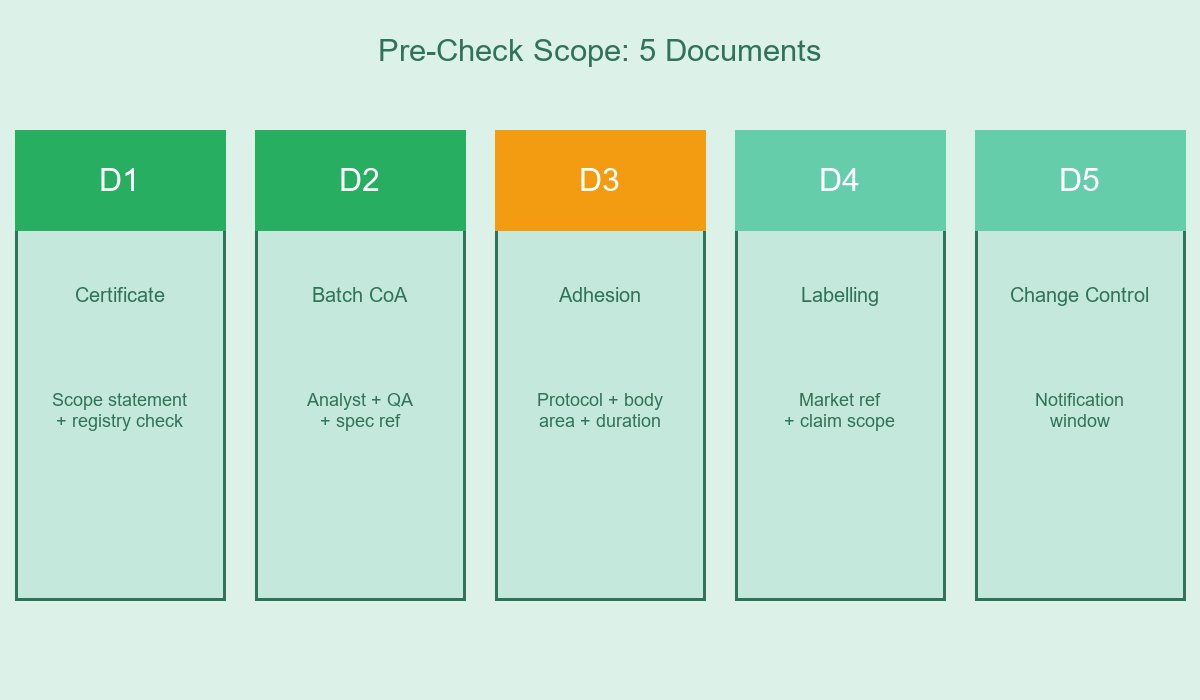
The documentation pre-check is the buyer's defence against all five red flags. The pre-check reviews the five documents before the purchase order and returns a pass or a flagged list, so the buyer can negotiate the gap before the production run rather than after the shipment.
7.1 Pre-Check Scope (KONGDY)
The pre-check scope covers the certificate scope statement, a recent batch CoA, the large-format adhesion validation protocol, the labelling reference sheet, and the change control procedure. KONGDY delivers the pre-check pack before the pilot batch approval gate.
7.2 Pre-Check Verification Steps (KONGDY)
The verification steps match the certificate scope to the product format, confirm both CoA signatures, match the adhesion protocol to the body area, confirm the labelling reference, and read the change control notification window.
7.3 Pre-Check Outcome Documentation (KONGDY)
The pre-check outcome is documented with the pass items and the flagged items. KONGDY's commercial team returns the pre-check outcome with the quotation.
8. What a Clean Documentation Pack Looks Like
A clean documentation pack is not a larger pack; it is a consistent one. The five documents match each other, name the same product format, the same body area, the same destination market, and the same release procedure, and they are delivered as a set rather than assembled per request.
8.1 Consistent Scope Across Documents (KONGDY)
The consistent scope means the certificate, the CoA, the adhesion protocol, the labelling sheet, and the change control procedure all reference the product format being ordered. KONGDY's documentation set references the same product format throughout.
8.2 Consistent Destination Market Reference (KONGDY)
The consistent destination market reference means each document names the market's regulation it satisfies. KONGDY's destination market dossier names the regulation per document.
8.3 Delivery Timing (KONGDY)
The delivery timing means the dossier arrives before the production run and the batch CoA arrives with the shipment. KONGDY's documentation system delivers on both timings.
9. Red Flags as a Negotiation Lever
The red flags are not only a rejection tool; they are a negotiation lever. A buyer who documents the flagged items before the purchase order can trade the gap closure against the unit price, the lead time, or the payment terms, and the supplier who can close the gaps quickly demonstrates the system capability that the buyer needs for the full program.
9.1 Documenting the Flag (KONGDY)
Documenting the flag means writing down which document carries which gap and what the closure requires. KONGDY's pre-check outcome documents each item with the closure requirement.
9.2 Trading Closure Against Terms (KONGDY)
Trading closure against terms means using the gap closure as a condition in the commercial negotiation. KONGDY's commercial team closes the flagged items before the purchase order and documents the closure.
9.3 Escalation When the Gap Persists (KONGDY)
Escalation when the gap persists means moving to an alternate supplier when the same flag appears twice without closure. KONGDY's documentation system closes the flags at the pre-check stage.
10. Conclusion: Documentation Red Flags as an Early Warning System
Back pain patch supplier documentation red flags are an early warning system, not a formality. The buyer who reads the documentation pack before the purchase order catches the scope mismatch, the signature gap, the body area scope gap, the labelling reference gap, and the change control gap while they are still line items rather than shipment delays.
KONGDY runs back pain patch QC programs under ISO 22716 GMP certification with FDA registration, EU CPSR preparation, in-house analytical, microbiological, and stability laboratories, back pain patch-specific large-format adhesion testing rigs, and documented change control. The documentation system maintains a program file per destination market with 7-year retention and electronic batch record indexing.
Request KONGDY's back pain patch documentation pre-check pack within 48 hours — the commercial team will return the ISO 22716 certificate scope statement, a recent batch CoA, the large-format adhesion validation protocol, the labelling reference sheet, and the change control procedure for your destination market.
Book a factory audit or live video tour at KONGDY's ISO 22716 facility to review the analytical laboratory, the large-format adhesion testing rigs, the stability chamber room, and the documentation archive, and request a free sample to validate adhesion duration, skin-contact comfort, and first-impression in your channel. Buyers planning a launch within two quarters can run the documentation pre-check in parallel with the pilot batch schedule.

