Choosing between wholesale and OEM (Original Equipment Manufacturer) pain patch sourcing is one of the most consequential decisions B2B buyers face. The wrong choice can mean 35-50% margin loss, supply chain disruptions, regulatory headaches, and brand damage that takes years to repair. The right choice can accelerate your market entry, protect your margins, and give you full control over your product's quality and reputation.
This guide, written for B2B buyers, distributors, private-label brands, and procurement professionals, breaks down every dimension of the wholesale-vs-OEM decision. KONGDY Health, a leading pain patch manufacturer with 15+ years of OEM/ODM experience and exports to 60+ countries, shares what experienced buyers actually look for, what the real cost differences are, and how to avoid the five most common mistakes.
By the end of this guide, you will understand: (1) the precise cost structure differences between wholesale and OEM, (2) the four-question decision tree that experienced buyers use, (3) the MOQ, lead time, and customization trade-offs, (4) how to evaluate a wholesale supplier vs. an OEM manufacturer, (5) red flags that signal a trading company disguised as a manufacturer, and (6) the negotiation playbook for each model.
Whether you are a first-time buyer testing a new market or an established brand scaling production, this guide will help you choose the right sourcing model for your specific situation.
Before comparing the two models, let's establish clear definitions. The pain patch industry uses these terms loosely, and the difference matters significantly for your business.
Wholesale means you buy finished, ready-to-sell pain patches from a manufacturer or distributor at a per-unit price, then resell them under your own brand or distribute them through your sales channels. The product formula, packaging design, and specifications are pre-set by the manufacturer and shared across many buyers.
Key characteristics of wholesale:
Wholesale works best for: distributors testing new markets, e-commerce sellers building SKU variety, retailers adding pain management categories, and B2B buyers who lack formulation expertise.
OEM means the manufacturer produces pain patches according to your specifications under your brand. You provide the formula (or work with the manufacturer's R&D team to develop one), the packaging design, and the regulatory documentation. The patches are made exclusively for you (or under NDA, with a limited number of co-buyers).
Key characteristics of OEM:
OEM works best for: brands building differentiated product lines, companies entering regulated markets (FDA, CE, TGA), distributors seeking exclusive SKUs, and B2B buyers with margin targets above 40%.
ODM sits between wholesale and OEM. The manufacturer offers pre-developed formulations (often 20-50 stock formulas) that you can customize lightly: brand name, logo, packaging design, minor tweaks to ingredient ratios, and label claims. ODM is often the most efficient path for new brands.
The unit cost of a pain patch varies dramatically based on the sourcing model. Here's a detailed breakdown of where your money goes in each scenario.
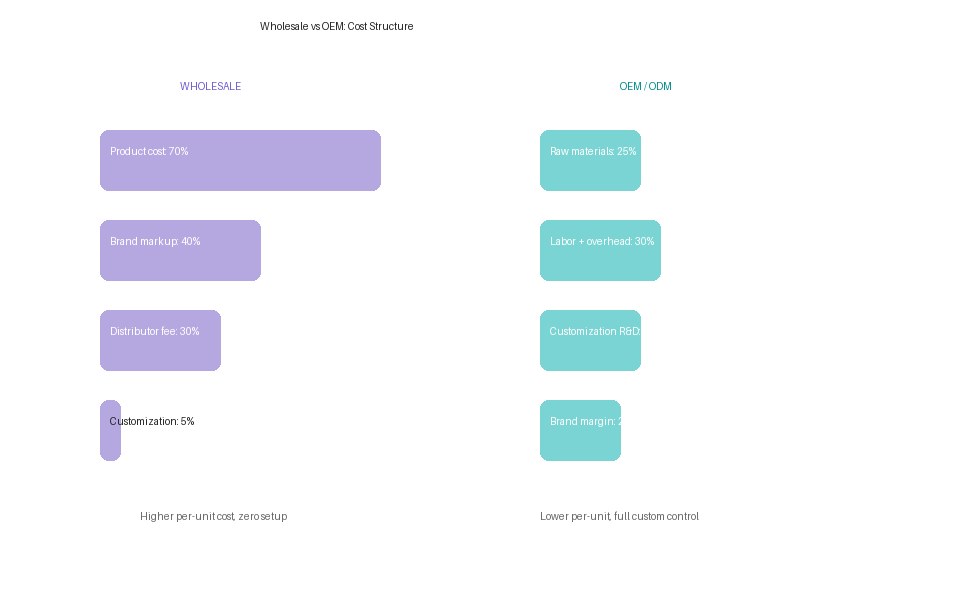
When you buy wholesale, the per-unit price (typically $0.15-$0.75 per patch depending on formulation, size, and quantity) includes:
Wholesale offers predictable per-unit pricing, but you absorb the cost of the manufacturer's R&D, marketing, and brand premium. The factory has already recovered its development costs across hundreds of buyers.
OEM pricing is more complex because the total cost is amortized across fewer units and includes one-time setup fees. A typical OEM cost breakdown:
The per-unit OEM cost is often 20-40% lower than wholesale for equivalent quality, but the upfront investment is higher and the MOQ is 5-10x larger.
Let's compare the same pain patch (10x14cm, menthol 5%, capsicum 0.025%, 8-hour wear) sourced two ways:
| Model | MOQ | Per-unit cost | Setup fee | Total first order |
|---|---|---|---|---|
| Wholesale (catalog) | 1,000 | $0.45 | $0 | $450 |
| Wholesale (bulk) | 20,000 | $0.28 | $0 | $5,600 |
| ODM (private label) | 5,000 | $0.32 | $500 | $2,100 |
| OEM (custom formula) | 20,000 | $0.22 | $5,000 | $9,400 |
Notice: the OEM unit cost is 22% lower than wholesale catalog, but you need $9,400 upfront versus $450. The breakeven on the setup fee comes at approximately 25,000 units for OEM.
Experienced B2B buyers use a simple decision framework. Answer these four questions in order, and the right sourcing model becomes clear.
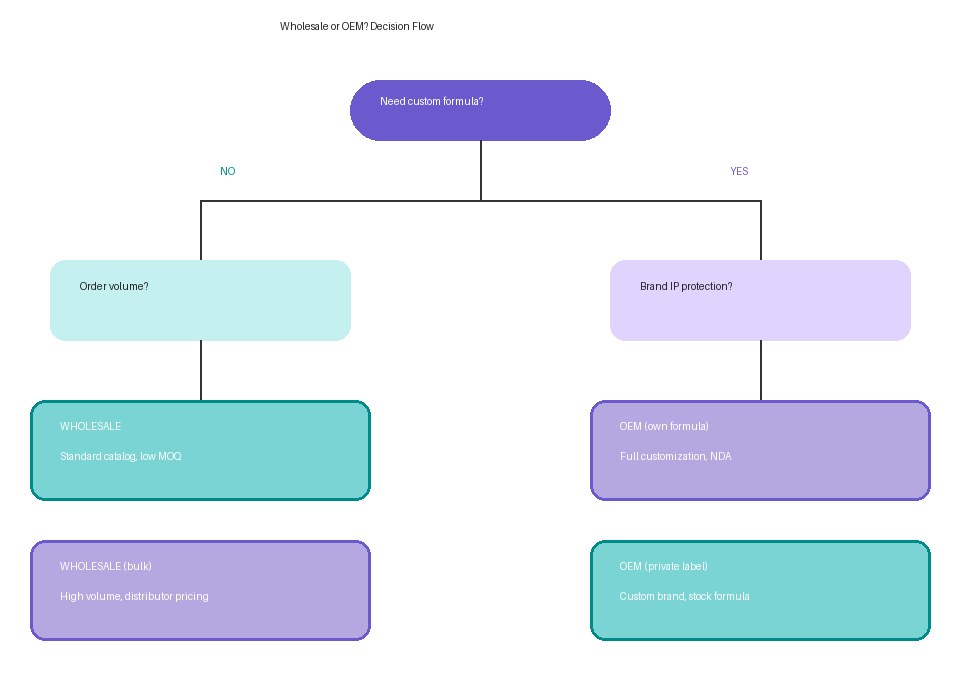
If yes, OEM is your only option. No legitimate manufacturer will produce a custom formulation under a wholesale arrangement because the formula is your IP, not theirs. Custom formulas include: specific active ingredient combinations, unique release profiles, patented delivery systems, or clinical-study-backed formulations.
If no, proceed to Question 2.
Below 20,000 patches per year: Wholesale makes more sense. The setup fees and inventory carrying costs of OEM are difficult to amortize. You can always switch to OEM later once volume grows.
20,000-100,000 patches per year: ODM (private label on a stock formula) is the sweet spot. You get custom branding at near-OEM unit costs, without the R&D investment.
Above 100,000 patches per year: Full OEM pays off. The setup fees are amortized, and the per-unit savings are significant. You also gain supply chain control and brand exclusivity.
If you are selling under your own brand, OEM is strongly recommended. Even with a private-label ODM arrangement, the manufacturer retains the right to sell the same formula to your competitors (sometimes called "open formula" or "shared formula" arrangements).
True OEM with a signed exclusivity clause prevents the manufacturer from selling your formula to anyone else for a defined period (typically 1-3 years) or volume threshold.
Domestic or unregulated markets: Wholesale is fine.
FDA-regulated markets (US, Canada): OEM is essentially required. The FDA 510(k) or OTC monograph process requires you to own the labeling, the formula specifications, and the regulatory file. A wholesale product labeled by the manufacturer for you often does not meet FDA private-label guidelines.
CE-marked markets (EU): OEM with full technical file is required for Class I medical devices. The technical file must be in your name as the legal manufacturer or authorized representative.
Other regulated markets (TGA Australia, PMDA Japan, KFDA Korea, ANVISA Brazil): Local registration typically requires OEM documentation.
| Your situation | Best model |
|---|---|
| First-time buyer, low volume, standard formula, no FDA | Wholesale |
| E-commerce brand, mid volume, want custom look, no FDA | ODM (private label) |
| Established brand, high volume, custom formula, US/EU markets | Full OEM |
| Pharma company entering pain patch category | Full OEM with regulatory support |
| Distributor with 5+ retail accounts | ODM with exclusive territory rights |
Beyond cost, the operational realities of MOQ, lead time, and customization depth differ significantly between models.
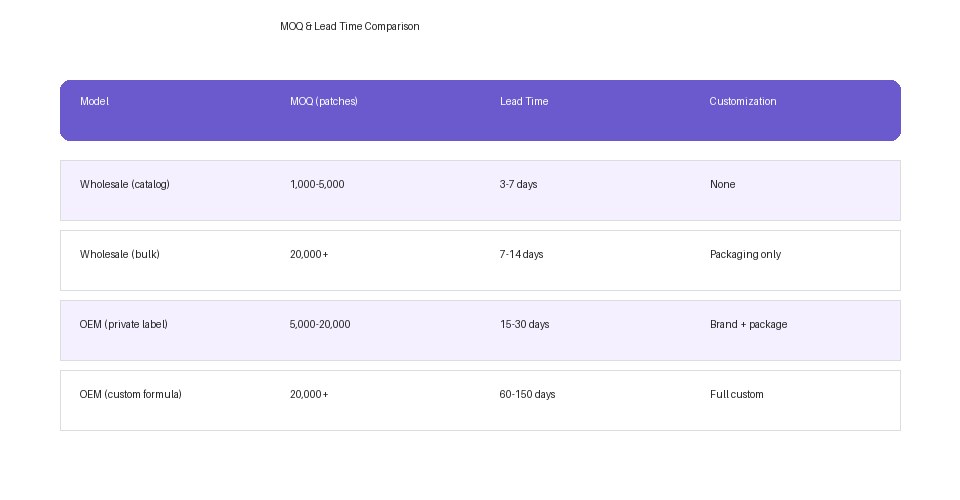
MOQ is the smallest order a manufacturer will accept. It exists because of two economic realities: (1) production changeovers cost money (cleaning, calibration, setup), and (2) the manufacturer needs to recover the cost of holding your specific raw materials, packaging components, and finished goods inventory.
Typical MOQ ranges:
Lead time is the period from purchase order confirmation to delivery at your warehouse. It includes production, quality control, packaging, documentation, and shipping.
Not all customizations are available at all MOQ levels. Here's what each model allows:
| Customization | Wholesale | ODM | OEM |
|---|---|---|---|
| Brand name on packaging | Limited (sometimes not allowed) | Yes | Yes |
| Logo and graphic design | No | Yes | Yes |
| Package size and material | No (fixed by catalog) | Limited (within standard options) | Yes (full custom) |
| Active ingredient selection | No (fixed formulas) | Choose from 20-50 stock formulas | Yes (any combination, any dosage) |
| Release profile / wear time | No (fixed) | Limited (some formulas allow tweaks) | Yes (full control) |
| Scent, color, texture | No | Limited | Yes |
| Label claims (FDA, CE) | No (manufacturer's claims only) | Limited (manufacturer's approved claims) | Yes (your regulatory file) |
| Clinical study data | Manufacturer's data only | Manufacturer's data only | Your own study data |
The evaluation criteria differ subtly but importantly. A wholesale supplier is judged on price, speed, and reliability. An OEM manufacturer is judged on formulation capability, regulatory support, and IP protection.
Look for:
Look for:
This is the most common scam in the pain patch industry. A trading company buys from a real factory, rebrands the products, and resells them as "OEM" or "custom manufacturing." They have no factory, no R&D team, and no quality control. They are simply middlemen.
Red flags that signal a trading company:
Different sourcing models require different negotiation strategies. Here is what experienced buyers focus on in each scenario.
Wholesale negotiations are about volume, payment terms, and exclusivity:
OEM negotiations go deeper than price. Focus on IP, exclusivity, and regulatory support:
Even experienced buyers make these errors. Avoid them at all costs:
KONGDY Health is a leading Chinese pain patch manufacturer with 15+ years of experience, 200+ employees, and exports to 60+ countries. We support all three sourcing models, with full transparency on which is right for your situation.
Over 40 stock formulas across 6 categories:
Catalog MOQ starts at 1,000 patches with 3-7 day lead time. Custom packaging available at 5,000+ MOQ.
Choose from 40+ stock formulas and customize packaging, branding, and label design. Minimum order: 5,000 patches. Lead time: 15-30 days. Includes:
Full custom formulation, regulatory support, and IP protection. Minimum order: 20,000 patches. Lead time: 60-150 days depending on complexity. Includes:
What sets us apart is honesty about which model is right for you. If you need 3,000 patches of a stock formula for a regional launch, we'll recommend wholesale. If you need 100,000 patches of a custom formula for FDA submission, we'll recommend OEM. Our job is to match your business reality to the right sourcing model, not to push you toward the highest-margin option for us.
Contact our B2B team to discuss your specific situation. We provide free consultation, sample evaluation, and a detailed cost analysis comparing all three models for your volume and market.
The wholesale vs. OEM decision is not about which is "better." It's about which is right for your business reality: your volume, your market, your brand strategy, your regulatory environment, and your growth trajectory.
Use the four-question decision tree: custom formula? volume? IP protection? regulatory environment? Let those answers guide you. And remember: the cheapest option is rarely the most profitable. A $0.20 wholesale patch with 5% defects and no FDA documentation is more expensive than a $0.30 OEM patch with zero defects and full regulatory support.
Wholesale, ODM, and OEM are three tools in your sourcing toolkit. The best buyers use all three at different stages of their business: wholesale to test markets, ODM to launch brands, OEM to scale winners. Don't lock yourself into one model before you understand which fits your current stage.
KONGDY Health supports all three models with full transparency, regulatory expertise, and 15+ years of manufacturing excellence. Whether you need 1,000 wholesale patches or 1,000,000 custom OEM patches, we have the capability and the integrity to be your long-term partner.
Ready to discuss your sourcing needs? Browse our wholesale catalog or contact our B2B team for a custom OEM consultation. We respond to inquiries within 24 hours and provide detailed cost analysis within 3 business days.

