Complete comparison of pain patch private label, white label, and full custom OEM for B2B buyers. MOQ, lead time, cost, branding control, and 5-level branding spectrum explained. Used by importers, OEM distributors, and growing brands choosing a pain patch manufacturing model.
White Label Pain Patches: What You Get, What You Don't
White label means the manufacturer produces a generic, ready-to-ship product with no branding. You buy it as-is, sometimes in plain boxes with no label at all. Some white label products have the manufacturer's brand stamped on them; others are completely unbranded.
What white label is good for:
- Market testing: Before investing in branding, you want to validate demand. White label lets you sell 100-500 units and see what sticks.
- Tactical promotions: Short-term campaigns, gift-with-purchase bundles, or one-off promotions where branding isn't critical.
- B2B distribution: Selling to retailers who want to relabel under their own brand anyway.
- Tight cash flow: Minimum order quantities (MOQ) as low as 100-500 units mean lower upfront capital.
What white label isn't good for:
- Building a brand: Every unit you sell disappears into a sea of identical products. No customer remembers where they bought it.
- Repeat customers: Without branding, there's nothing to drive loyalty.
- Premium pricing: Generic products compete on price. Margins shrink to commodity levels.
- Long-term equity: When you exit or sell the business, an unbranded product line has zero goodwill value.
Private Label Pain Patches: The Middle Path Most B2B Buyers Take
Private label sits between white label and full custom OEM. The manufacturer produces a stock formula (capsaicin, menthol, lidocaine — whatever's in their library) and applies YOUR brand identity: logo, color scheme, packaging design, brand name.
This is the most popular model for serious B2B buyers because it balances speed, cost, and brand control. KONGDY Health runs roughly 70% of new buyers through the private label path because it gives them brand differentiation without the 5,000+ unit MOQ of full custom.
What private label gives you:
- Brand control: Your logo, your colors, your tagline. Every unit reinforces your brand.
- Reasonable MOQ: Typically 500-1,000 units per SKU — accessible to growing brands.
- Reasonable lead time: 15-25 days for first production, 10-15 days for reorders.
- Mid-tier pricing: Higher than white label, lower than custom — typically $0.80-1.50 per unit depending on volume.
- Marketing flexibility: You can claim "specially formulated" or "developed by [your brand]" within reason (subject to regulatory limits).
What private label doesn't give you:
- Formula customization: You're working with the manufacturer's existing formulation library. Capsaicin patch with 0.025% active is what you get — you can't request 0.03%.
- Full packaging control: Standard box sizes and structures are usually fixed. Custom packaging requires custom OEM.
- Regulatory ownership: The manufacturer's existing registrations cover the formula. If you want your own FDA establishment registration, that's an extra step.
Full Custom OEM Pain Patches: When You Need Complete Control
Full custom OEM means the manufacturer develops a unique formulation just for you. You specify the active ingredients, concentration, release profile, patch size, adhesive type, and packaging. The manufacturer produces it from scratch under your specifications.
This is the model for established brands with clear market positioning, regulatory capabilities, and the volume to support the investment. KONGDY Health works with 30+ brands on full custom OEM — typically skincare brands expanding into pain relief, sports medicine companies, and pharmaceutical companies with established distribution.
What full custom OEM gives you:
- Unique formulation: Your formula is exclusive to your brand. Competitors can't copy.
- Full packaging control: Custom box design, custom sachet design, custom insert cards.
- Regulatory ownership: Your name appears on the manufacturer's registration documents. You control regulatory strategy.
- Premium positioning: "Specially formulated by [your brand]" gives you premium pricing power.
- Highest brand equity: A unique formulation is a real asset. It builds long-term value.
The trade-offs:
- High MOQ: Typically 5,000+ units per SKU.
- Long lead time: 45-90 days for first production, depending on formula complexity.
- Higher cost: $1.20-2.50 per unit, plus development fees ($2,000-10,000 depending on complexity).
- More regulatory work: New formulations may require new regulatory submissions in each market.
The 3 Models Side-by-Side: Direct Comparison
Here's the practical breakdown for B2B decision-making. Numbers are based on KONGDY Health's typical buyer mix and industry averages:
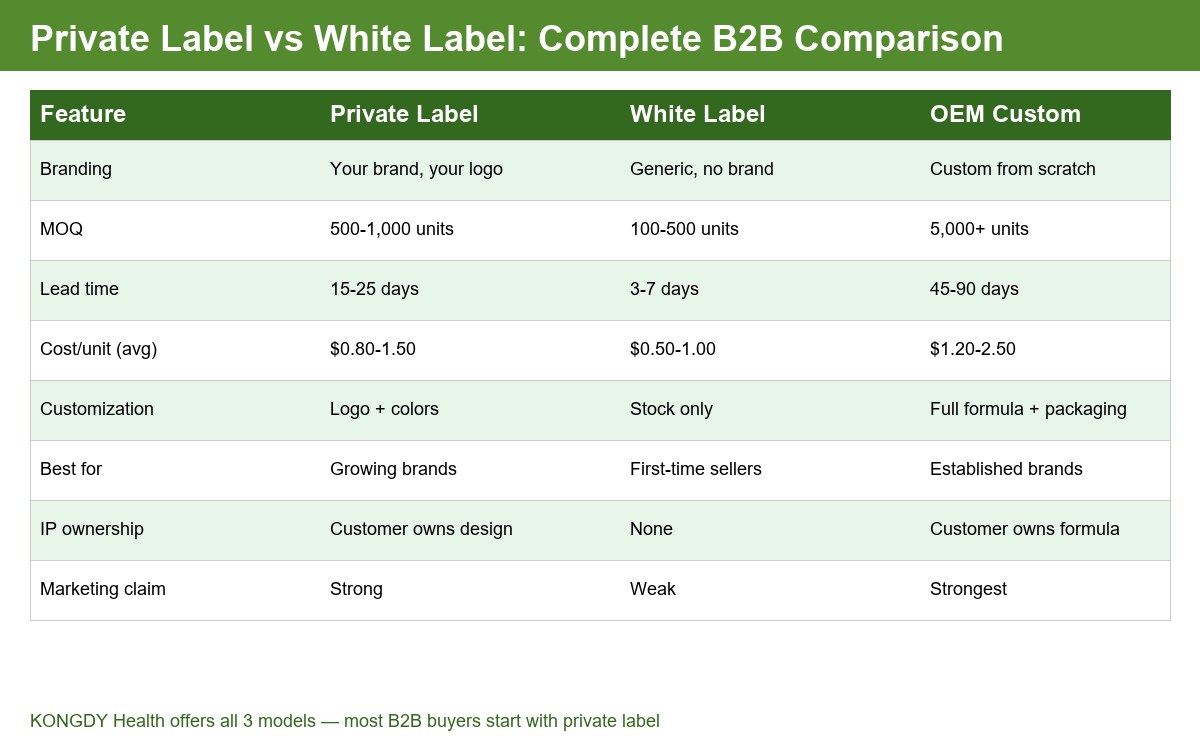
The decision comes down to three factors: your brand stage, your capital available, and your time-to-market pressure. New brand with $20K budget and 30-day deadline? White label. Growing brand with $50K and 60-day window? Private label. Established brand with $100K+ and quarterly planning cycles? Custom OEM.
What Branding Actually Means for Pain Patches
The branding spectrum isn't just logo-on-box. It's a continuum from generic to fully bespoke. Understanding this spectrum helps you communicate your needs to manufacturers and avoid overpaying for features you don't need.
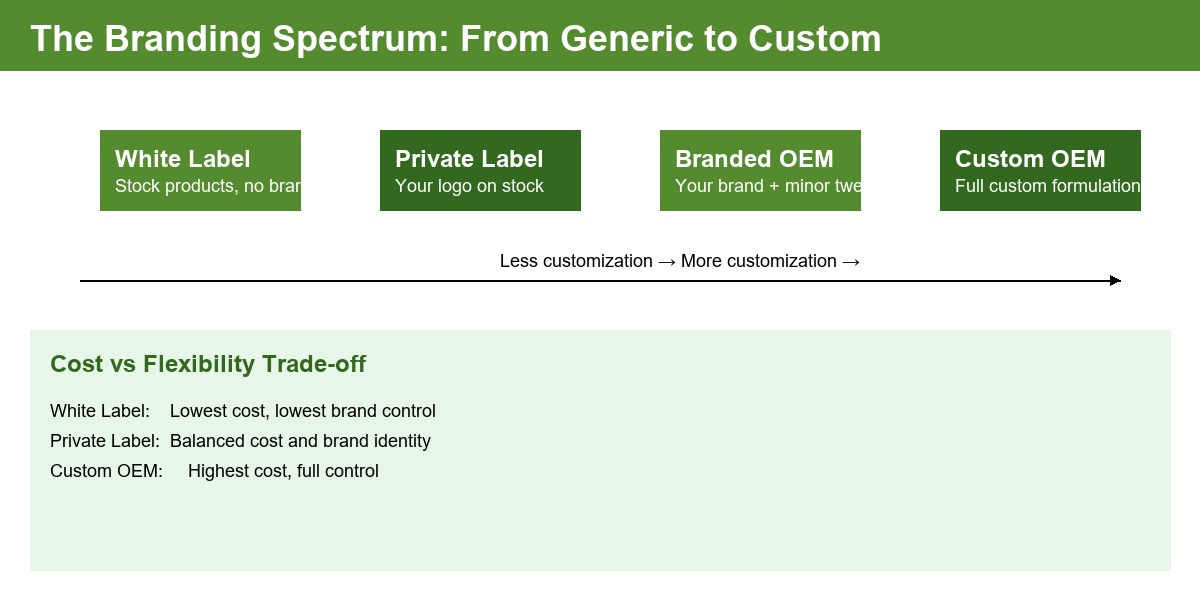
Five levels of branding, from least to most involved:
Level 1: Stock White Label
Manufacturer's brand or no brand. You buy as-is, relabel if needed. No design work required. MOQ 100-500 units. Lead time 3-7 days.
Level 2: Private Label (Basic)
Your logo on stock formula's stock packaging. Standard box sizes, standard colors, standard insert. MOQ 500-1,000 units. Lead time 15-25 days.
Level 3: Private Label (Premium)
Your logo + custom box design + custom insert card + custom sachet design. Still using manufacturer's stock formula. MOQ 1,000-3,000 units. Lead time 25-35 days.
Level 4: Branded OEM
Your formula (developed in collaboration with manufacturer's R&D) + full custom packaging. Formula is exclusive to you. MOQ 3,000-5,000 units. Lead time 45-60 days.
Level 5: Full Custom OEM
Completely custom formula from scratch. Custom packaging. Custom regulatory submission. Your name everywhere. MOQ 5,000+ units. Lead time 60-90 days.
Most B2B buyers settle at Level 2 or Level 3 — and that's usually right. The jump from Level 3 to Level 4 doubles your costs without proportional brand benefit unless you have specific market positioning that demands a unique formula.
Cost Breakdown: What You'll Actually Pay
Beyond per-unit pricing, there are development costs, packaging costs, and tooling costs that vary dramatically by model. Here's the full picture:
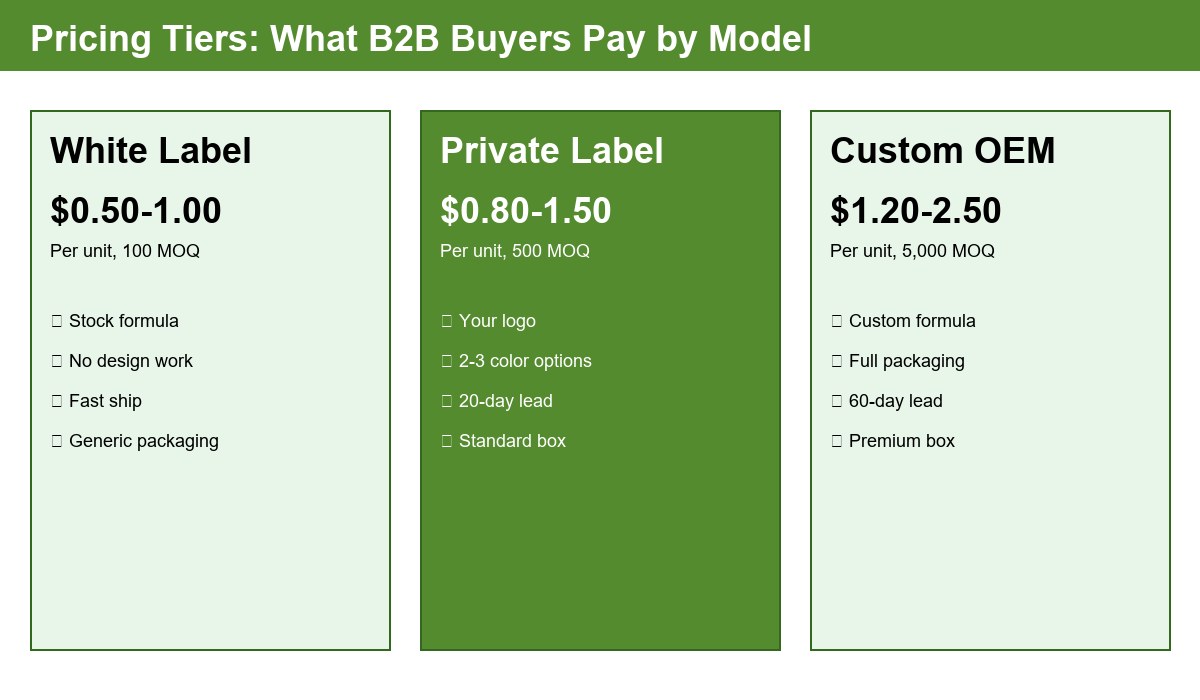
White Label Cost Stack:
- Per-unit: $0.50-1.00
- Setup fees: $0 (no design work)
- Tooling: $0
- Total minimum investment: ~$50-500 for first order
Private Label Cost Stack:
- Per-unit: $0.80-1.50
- Setup fees: $100-500 (logo application, basic design)
- Tooling: $200-2,000 (if custom box design needed)
- Total minimum investment: ~$600-3,500 for first order
Full Custom OEM Cost Stack:
- Per-unit: $1.20-2.50
- Setup fees: $2,000-10,000 (formula development)
- Tooling: $2,000-5,000 (custom packaging tooling)
- Total minimum investment: ~$10,000-30,000 for first order
Speed Comparison: How Fast Can You Get to Market?
Lead times matter. Here's how the three models compare:
- White Label: 3-7 days from order to ship. You can have products in hand within 2 weeks of first contact.
- Private Label: 15-25 days for first production (design approval + production + QC). Reorders: 10-15 days.
- Full Custom OEM: 45-90 days for first production. Includes formula development, stability testing, packaging design, and production. Reorders: 30-45 days.
The speed difference reflects what's actually being done. White label = ship what's on the shelf. Private label = apply your branding to stock. Custom OEM = build from scratch.
How to Choose: A Decision Framework for B2B Buyers
Four questions to ask before selecting a model:
- What's your annual volume forecast? Under 5,000 units/year = white or private label. Over 20,000 units/year = custom OEM makes economic sense.
- What's your brand positioning? Commodity / tactical = white label. Premium / growing = private label. Premium / established = custom OEM.
- What's your regulatory capability? If you don't have regulatory expertise, use the manufacturer's existing registrations (private label). If you have regulatory staff and want control, custom OEM.
- What's your time-to-market pressure? Days = white label. Months = private or custom. Quarters = custom with proper planning.
Recommendation Matrix:
- First-time B2B importer, testing demand: White Label
- Growing brand with established channel: Private Label
- Established brand with clear positioning: Custom OEM
- Pharmaceutical or medical company: Custom OEM
- Promotion / gift / one-off: White Label
Negotiation Tactics for Each Model
Regardless of model, these tactics reduce your total cost by 15-30%:
Tactic 1: Order Across Multiple SKUs
If you need 4 stock-keeping units (SKUs), order them together. Manufacturers prefer fewer large orders over many small ones. KONGDY Health offers 10-15% volume discount when buyers order 5+ SKUs in one batch.
Tactic 2: Lock In Annual Volume
Commit to 12-month volume forecast (with quarterly flexibility). Manufacturers discount heavily for predictability. Typical discount: 8-15% off per-unit price.
Tactic 3: Share Marketing Collateral
If you have established marketing materials (logo files, brand guidelines, product photography), provide them upfront. Saves design time = saves you money.
Tactic 4: Negotiate Packaging, Not Formula
If you're at the private label / custom OEM boundary, negotiate packaging before formula. Custom box design is 50% cheaper than custom formula development.
Tactic 5: Start with Sample Order
Always order samples before committing. KONGDY Health provides 5-10 free samples of stock formulations; private label samples are $50-200 depending on complexity. Sample orders prevent $10K+ mistakes.
Common Mistakes B2B Buyers Make
Across hundreds of buyers, here are the 7 most common mistakes and how to avoid them:
- Choosing white label to save money: Saves $500 upfront, costs $5,000-10,000 in lost brand value over 24 months.
- Skipping sample orders: The product looks great in photos but doesn't match your market's expectations. Always test.
- Underestimating packaging costs: Custom box design + tooling can add 30-50% to first order. Budget accordingly.
- Not understanding MOQ tiers: Manufacturers discount at 500 / 1,000 / 3,000 / 5,000 / 10,000 units. Know the tier pricing before negotiating.
- Forgetting about reorders: First order is the easy part. Reorders have lead time. Plan inventory 60-90 days ahead.
- Ignoring regulatory implications: Custom formulas may need new regulatory submissions in each market. Factor in $5K-30K per market for full custom OEM.
- Not negotiating the first order: First order pricing sets the precedent. Negotiate hard initially — easier to maintain price level than to reduce later.
How KONGDY Health Supports All 3 Models
KONGDY Health runs parallel production lines for all three models. Buyers can start with white label samples (5-10 free), graduate to private label (typical first order $2,000-5,000), and graduate again to custom OEM (typical first order $15,000-30,000) — all with the same supplier relationship.
Benefits of single-supplier multi-model approach:
- Consistent quality: Same QC standards across all models.
- Shared formulations: White label buyers can later upgrade to private label by reusing stock formulas.
- Regulatory continuity: Existing registrations can transfer between models.
- Predictable supply chain: Same factory, same shipping routes, same customs process.
2025 metrics: 99.2% on-time delivery across all models, 0.3% defect rate, 1,200+ active B2B buyers, 60+ destination markets.
Final Recommendation: Start Where You Are, Plan Where You're Going
If you're new to pain patch importing, start with a 200-500 unit white label test order. Validate that your market exists. Then graduate to private label with a 1,000-2,000 unit order. Then, after 6-12 months of validated demand, consider full custom OEM.
This staged approach minimizes risk while preserving optionality. The same supplier relationship grows with you. The same quality standards apply at every stage. KONGDY Health supports all three models and helps buyers transition between them as their business scales.
Ready to start the conversation? Request samples, get quotes for all three models, and choose the path that matches your business stage — not the path that looks cheapest on paper.

