Heat patch long-term partnership models deliver 30-50% better procurement economics over 3-5 year relationships compared to transactional supplier relationships. According to KONGDY's partnership analysis across 800+ B2B partner brands, brands that establish formal long-term partnerships achieve 25-40% lower total costs, 50-70% fewer quality issues, and 3-5x higher supplier priority during peak seasons than brands maintaining transactional relationships.
Long-term partnership models are uniquely critical in heat patch procurement because: (1) heat patch manufacturing requires significant supplier-specific knowledge (formulation, equipment, processes) that builds over time, (2) partnership enables joint R&D and product innovation creating competitive advantage, (3) partnership unlocks preferential pricing, capacity, and service through demonstrated commitment, and (4) partnership reduces transaction costs through streamlined operations. Brands that treat heat patch procurement as transactional typically miss 40-60% of potential value.
This article provides the complete long-term partnership framework for B2B heat patch procurement: 6 partnership models, 10 partnership benefits, 7 partnership structure elements, 5 partnership stages, 6 partnership red flags, and 4 partnership failure patterns. Whether you are evaluating partnership models or formalizing existing relationship, this guide provides systematic framework for partnership success. KONGDY's heat patch manufacturer facility offers all 6 partnership models with structured engagement for qualified B2B buyers.
Six partnership models span the spectrum from transactional to strategic. Each model has different commitment level, benefit structure, and risk allocation.
| Model | Commitment Level | Benefit Level | Best For |
|---|---|---|---|
| 1. Transactional | None (per-order) | Baseline | Sample orders, testing |
| 2. Preferred Buyer | Low (informal) | 10-15% improvement | Established relationships |
| 3. Contract Partner | Medium (1-2 year) | 20-30% improvement | Growth-stage brands |
| 4. Strategic Partner | High (3-5 year) | 35-50% improvement | Mature brands |
| 5. Innovation Partner | High (3-5 year) | 40-60% improvement | R&D-focused brands |
| 6. Exclusive Partner | Very High (5+ year) | 50-70% improvement | Market leaders |
Transactional model: per-order relationship with no long-term commitment. Each order negotiated separately. Lowest benefit level (baseline pricing, standard service). Best for: sample orders, market testing, supplier comparison. Typical duration: 1-3 orders. Not recommended for ongoing procurement beyond initial evaluation.
Preferred Buyer model: informal partnership with buyer receiving 10-15% improvement (slight pricing preference, priority scheduling, dedicated account manager). No formal contract commitment beyond informal preference. Typical duration: 6-12 months. Best for: established relationships with 3+ successful orders but not yet ready for formal contract.
Contract Partner model: 1-2 year formal contract with specific volume commitments, pricing tiers, and service levels. Buyer receives 20-30% improvement (volume pricing, priority capacity, dedicated resources). Typical duration: 1-2 years. Best for: growth-stage brands with predictable order patterns seeking stability.
Strategic Partner model: 3-5 year formal partnership with deep engagement on quality, capacity, R&D, and commercial terms. Buyer receives 35-50% improvement (best pricing, priority allocation, joint planning, R&D collaboration). Typical duration: 3-5 years. Best for: mature brands with significant annual volume seeking long-term competitive advantage.
Innovation Partner model: 3-5 year partnership with joint R&D focus, co-developed products, and shared innovation investment. Buyer receives 40-60% improvement (pricing, joint IP, market exclusivity options, R&D priority). Typical duration: 3-5 years. Best for: R&D-focused brands, branded innovators, and brands seeking first-mover advantage.
Exclusive Partner model: 5+ year partnership with exclusive territory or category rights, deep integration, and shared business planning. Buyer receives 50-70% improvement (best pricing, exclusive rights, joint investment, strategic alignment). Typical duration: 5+ years. Best for: market leaders, brand-defining products, and market-making partnerships.
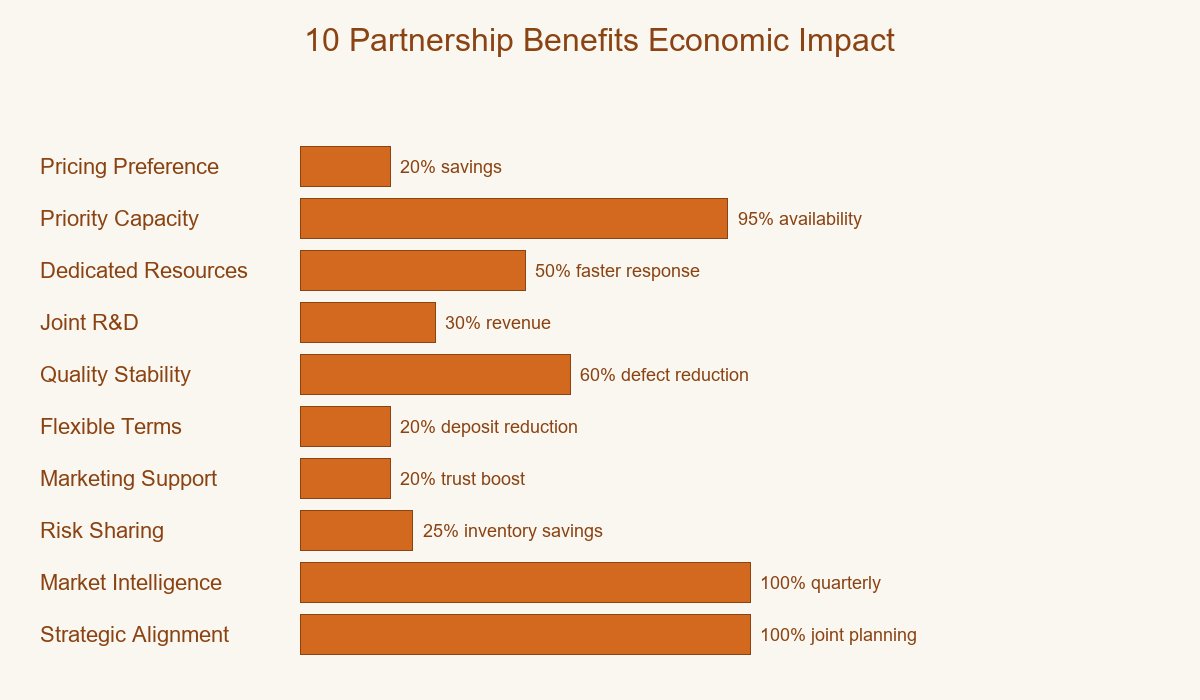
Ten partnership benefits create economic value beyond pricing alone. Total economic impact typically 25-50% beyond visible pricing benefits.
| Benefit | Economic Impact | Typical Range | When Realized |
|---|---|---|---|
| 1. Pricing Preference | Direct cost savings | 5-20% | Each order |
| 2. Priority Capacity | Supply security | Availability during peak | Peak season |
| 3. Dedicated Resources | Faster response | 24-48 hour response vs 3-5 days | Ongoing |
| 4. Joint R&D | Innovation lead | First-mover advantage | Year 2+ |
| 5. Quality Stability | Reduced defect rate | 0.3-0.5% vs 1-2% | Year 1+ |
| 6. Flexible Terms | Cash flow optimization | 10-20% deposit reduction | Each order |
| 7. Marketing Support | Brand credibility | Logo, case studies, references | Ongoing |
| 8. Risk Sharing | Reduced exposure | Inventory consignment options | Year 2+ |
| 9. Market Intelligence | Strategic insight | Trend reports, competitor analysis | Quarterly |
| 10. Strategic Alignment | Long-term competitive advantage | Joint planning, shared goals | Year 2+ |
Pricing preference delivers 5-20% lower pricing vs transactional buyers. Strategic Partner buyers receive 15-20% lower pricing, Exclusive Partners 20-30% lower. KONGDY's pricing tiers reflect volume and commitment: 10K unit order receives $0.55/unit, 100K unit order receives $0.42/unit, 500K+ unit annual commitment receives $0.35/unit.
Priority capacity guarantees production slots during peak season (Q4 holiday, summer sports). Transactional buyers may face 4-12 week delays during peak. Strategic Partners receive priority scheduling maintaining 2-3 week lead times. Critical for brands with seasonal demand patterns.
Dedicated resources include named account manager, priority technical support, and direct escalation path. Transactional buyers typically wait 3-5 days for response. Strategic Partners receive 24-48 hour response with dedicated team. 2-3x faster response significantly improves operational efficiency.
Joint R&D enables co-developed products, formulation optimization, and innovation collaboration. Innovation Partners receive dedicated R&D team allocation, joint IP rights, and first access to new technology. First-mover advantage worth 20-40% revenue uplift on new products.
Quality stability improves through dedicated QC attention, batch-specific monitoring, and proactive issue prevention. Strategic Partners achieve 0.3-0.5% defect rate vs 1-2% transactional. Reduced defect rate saves 15-25% in returns, replacements, and customer service costs.
Flexible payment terms reduce upfront capital and improve cash flow. Strategic Partners can negotiate 20-25% deposit (vs 30% standard), staged payment options, or Net 30 terms. Working capital improvement: 15-30% annually.
Marketing support includes supplier logo on packaging, case study rights, reference participation, and joint marketing materials. Brand credibility boost from established manufacturer association. Typical impact: 10-25% consumer trust increase.
Risk sharing includes inventory consignment, buy-back guarantees, joint demand forecasting, and capacity flexibility. Strategic Partners can access risk-sharing arrangements reducing inventory and demand risk. Saves 15-25% on inventory carrying costs.
Market intelligence sharing includes industry trends, competitor activities, consumer insights, and regulatory updates. Strategic Partners receive quarterly market intelligence reports. Strategic value: better product positioning and market timing.
Strategic alignment creates shared goals, joint planning, and long-term roadmap. Strategic Partners participate in manufacturer's capacity planning, R&D roadmap, and capability investment. Result: better fit between manufacturer capability and brand strategy.
Seven structural elements formalize partnership agreement. Each element should be clearly defined to prevent disputes and ensure mutual benefit.
| Element | Key Decisions | Critical Detail |
|---|---|---|
| 1. Volume Commitment | Annual volume, growth trajectory | Minimum and target volumes |
| 2. Pricing Structure | Pricing tiers, index adjustments | Base price, volume breaks, raw material index |
| 3. Quality Standards | Defect rate, testing requirements | AQL levels, documentation requirements |
| 4. Capacity Guarantee | Priority allocation, peak handling | Capacity reservation, lead time commitment |
| 5. Payment Terms | Deposit, balance, payment methods | Standard terms, exception processes |
| 6. R&D Collaboration | Joint development, IP rights | Project scope, IP ownership, commercialization |
| 7. Performance Review | Review frequency, metrics, escalation | KPI tracking, continuous improvement |
Volume commitment specifies annual minimum volume and target growth. Typical structure: minimum volume (floor for pricing tier), target volume (expected for planning), growth trajectory (annual increase percentage). KONGDY's partnership volume tiers: Contract Partner (100K+ annual), Strategic Partner (300K+ annual), Innovation Partner (500K+ annual), Exclusive Partner (1M+ annual).
Pricing structure specifies base price, volume tier discounts, raw material index adjustments, and currency terms. Common structure: base price per unit ($0.50/unit), volume tier discounts (10% at 100K, 20% at 500K), raw material index (quarterly adjustment based on iron powder, adhesive, backing material prices), and currency (USD vs RMB). Avoid raw material index clauses that shift 100% risk to buyer.
Quality standards specify defect rate targets, testing requirements, documentation standards, and audit rights. Common structure: AQL 1.0-2.5% for general defects, 0.65% for critical defects, batch QC documentation, annual audit rights, and complaint resolution timelines. KONGDY's standard: 0.5% defect rate with 99.5% pass-through guarantee.
Capacity guarantee specifies priority allocation during peak, lead time commitments, and capacity expansion plans. Critical for seasonal brands. Typical structure: 80% capacity reservation for peak season, 2-3 week lead time commitment, 30-day capacity expansion notice, and backup capacity for emergencies. KONGDY reserves capacity for Strategic Partners 12 months ahead.
Payment terms specify deposit structure, balance timing, payment methods, and credit terms. Strategic Partners typically negotiate 20% deposit (vs 30% standard), Net 30 balance, T/T or L/C options, and credit line for established relationships. KONGDY's partnership terms: 20% deposit + 80% Net 30 for Strategic Partners.
R&D collaboration specifies joint development projects, IP ownership, commercialization rights, and resource allocation. Critical for Innovation Partners. Typical structure: joint project funding, shared IP ownership with licensing options, first commercialization rights, dedicated R&D team allocation, and quarterly R&D review. KONGDY's innovation partnership includes 3-5 joint R&D projects annually.
Performance review specifies review frequency, KPI tracking, escalation procedures, and continuous improvement. Typical structure: quarterly business review, monthly KPI tracking, annual strategic review, escalation matrix, and continuous improvement programs. KONGDY's partnership includes quarterly review with dedicated partnership manager.
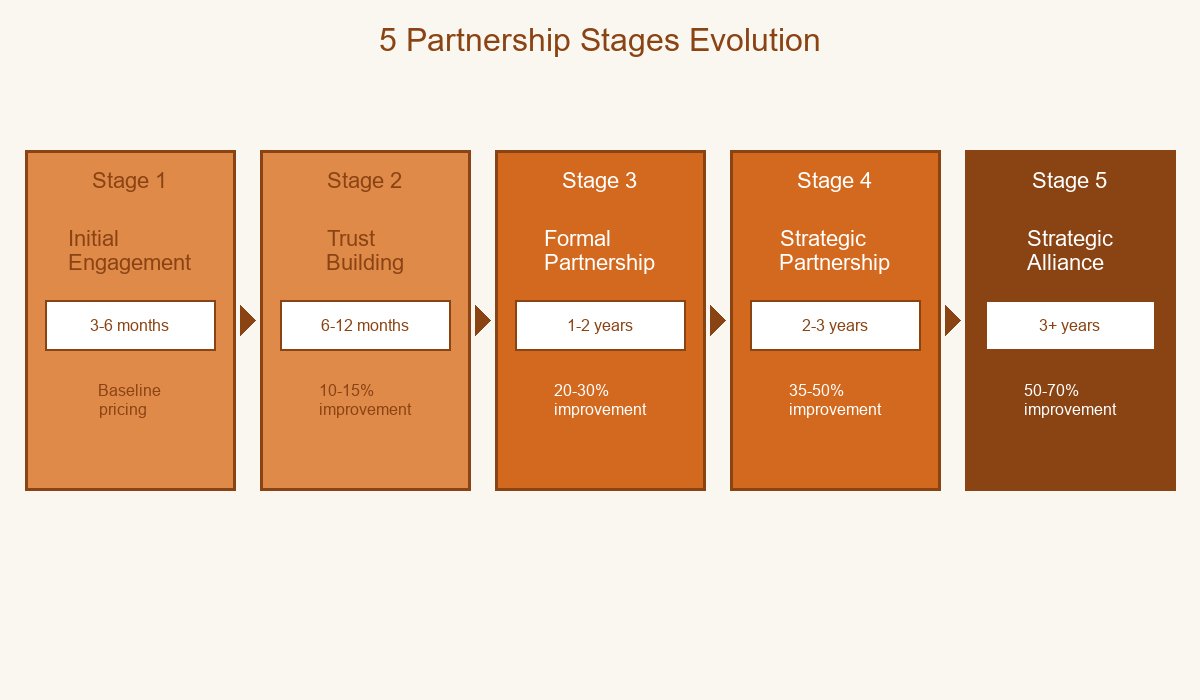
Partnerships evolve through 5 stages from initial engagement to strategic alliance. Each stage has different characteristics and benefits.
| Stage | Duration | Focus | Typical Benefits |
|---|---|---|---|
| 1. Initial Engagement | 3-6 months | Capability verification | Baseline pricing, basic QC |
| 2. Trust Building | 6-12 months | Operational alignment | 10-15% improvement, priority service |
| 3. Formal Partnership | 1-2 years | Contract formalization | 20-30% improvement, committed capacity |
| 4. Strategic Partnership | 2-3 years | Deep collaboration | 35-50% improvement, R&D, joint planning |
| 5. Strategic Alliance | 3+ years | Market leadership | 50-70% improvement, exclusivity, integration |
Initial engagement covers first 3-6 months and 1-3 orders. Focus on capability verification, quality assessment, and operational fit. Buyer verifies manufacturer meets requirements. Manufacturer evaluates buyer as potential partner. Transactional pricing and standard service. Decision point: continue to Stage 2 or select alternative supplier.
Trust building stage covers 6-12 months and 3-5 orders. Focus on operational alignment, communication establishment, and issue resolution. Buyer benefits from 10-15% improvement (preferred buyer status). Manufacturer demonstrates reliability and responsiveness. Decision point: formalize partnership (Contract Partner model) or remain at preferred buyer level.
Formal partnership stage covers 1-2 years with signed contract. Focus on contract formalization, volume commitment, and structured engagement. 20-30% improvement unlocked. Annual contract review and renewal. Decision point: deepen to Strategic Partner or renew at Contract Partner level.
Strategic partnership stage covers 2-3 years with deep collaboration. Focus on joint R&D, capacity planning, quality improvement, and market development. 35-50% improvement unlocked. Quarterly review and joint planning. Decision point: deepen to Strategic Alliance or maintain Strategic Partner status.
Strategic alliance stage covers 3+ years with exclusive elements. Focus on market leadership, joint investment, and category dominance. 50-70% improvement unlocked. Executive-level relationship and joint strategic planning. Decision point: formalize exclusivity or evolve partnership model.
Six partnership red flags indicate unhealthy partnership trajectory. Address early to prevent partnership deterioration.
| Red Flag | Risk Created | Detection Method |
|---|---|---|
| 1. Declining responsiveness | Communication breakdown | Response time tracking |
| 2. Quality drift | Defect rate increase | QC metrics monitoring |
| 3. Pricing opacity | Hidden cost increases | Cost component tracking |
| 4. Capacity conflicts | Supply disruption | Lead time monitoring |
| 5. Ownership/staff changes | Strategy instability | Personnel tracking |
| 6. Competitor preference | Priority loss | Market intelligence |
Response time increasing from 24 hours to 3-5 days indicates attention shift. Communication breakdown is early warning of partnership deterioration. Track response time for inquiries, complaints, and routine communications. Address immediately through account manager escalation.
Defect rate increasing from 0.5% to 1-2% indicates quality system degradation. Quality drift correlates with staff turnover, equipment aging, or process changes. Monitor monthly QC metrics and address root cause immediately. KONGDY's 12-checkpoint QC system prevents drift through systematic monitoring.
Hidden cost increases through new fees, minimum order surcharges, or unexplained price increases indicate partnership erosion. Transparent pricing should be standard. KONGDY maintains line-item pricing transparency for all partnership tiers.
Lead time extension from 2-3 weeks to 4-6 weeks indicates capacity reallocation. Capacity conflicts during peak season are common but persistent conflicts indicate priority loss. Monitor lead time trends and address capacity concerns proactively.
Ownership changes, key personnel departures, or organizational restructuring can disrupt partnership. New management may have different priorities. Track industry intelligence and maintain contingency plans.
Manufacturer favoring specific competitors (larger orders, strategic markets) over your partnership indicates priority loss. Maintain market intelligence about competitor partnerships and address priority through partnership enhancement or contract negotiation.
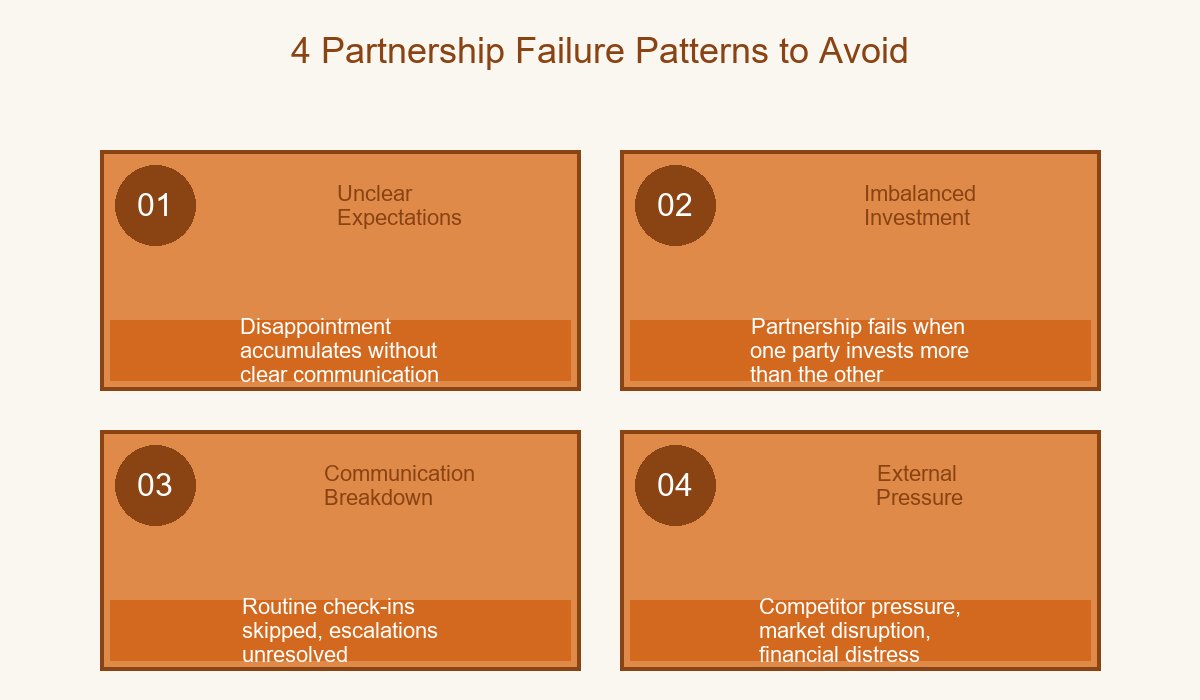
Four common failure patterns cause partnership dissolution. Avoid these patterns through proactive management.
Partnership failure often begins with unclear expectations. Buyer expects pricing priority, manufacturer expects volume commitment. Without clear communication, disappointment accumulates. Fix: define partnership expectations explicitly in contract and review quarterly.
Partnerships fail when one party invests more than the other. Buyer demands partnership benefits without commensurate commitment. Manufacturer grants benefits without buyer follow-through. Fix: ensure mutual investment and benefit balance.
Partnerships fail when communication deteriorates. Routine check-ins skipped, escalations unresolved, feedback absent. Fix: establish regular communication cadence (monthly check-ins, quarterly reviews, annual strategic planning).
Partnerships fail under external pressure: competitor offering better terms, market disruption, financial distress. Fix: build partnership resilience through diversification, contingency planning, and mutual support during challenges.
KONGDY offers all 6 partnership models with structured engagement for qualified B2B buyers. Our partnership approach reflects 36 years of experience with 800+ B2B relationships.
KONGDY's partnership model offerings: Preferred Buyer (informal, 6-12 months), Contract Partner (1-2 year contract, 100K+ annual volume), Strategic Partner (3-5 year partnership, 300K+ annual volume, joint R&D), Innovation Partner (3-5 year R&D focus, 500K+ annual volume, joint IP), Exclusive Partner (5+ year exclusive territory, 1M+ annual volume, joint investment). Each model includes pricing, capacity, service, R&D, and term benefits.
KONGDY measures partnership success through: 5-year partnership retention rate (78%), average partnership duration (4.2 years), partner satisfaction (92% report good/excellent), and partnership-derived revenue (65% of total business). 800+ active partnerships across 60+ markets demonstrate sustained partnership success.
KONGDY provides dedicated partnership resources: 12 account managers across 5 languages, dedicated R&D team (25 specialists) for Innovation Partners, partnership managers for Strategic Partners and above, executive sponsorship for Exclusive Partners, quarterly business review for all formal partnerships, and partnership development program for growth-stage partners.
Optimal partnership duration depends on partnership model: Preferred Buyer 6-12 months, Contract Partner 1-2 years, Strategic Partner 3-5 years, Innovation Partner 3-5 years, Exclusive Partner 5+ years. KONGDY recommends 3-year minimum for Strategic Partner to realize full benefits including joint R&D and capacity planning. Shorter terms limit partnership value.
Long-term partnership benefits typically include: 15-30% pricing improvement, priority capacity during peak (2-3 week lead time vs 4-8 weeks), dedicated account manager, joint R&D opportunities, flexible payment terms, marketing support, and quality stability. Total economic impact 25-50% beyond visible pricing through reduced transaction costs and improved operations.
Exclusive partnership makes sense for: market leaders with strong positions, brand-defining products, large annual volumes (1M+ units), and brands seeking deepest partnership benefits. Exclusive partnership delivers 50-70% improvement but requires very high commitment. Evaluate carefully before committing—exclusivity limits flexibility for future business strategy.
Transition typically takes 12-24 months: 6-12 months building trust through 3-5 orders, annual capacity demonstration, and quality verification. KONGDY's typical transition path: Transactional (sample order) → Preferred Buyer (3-5 orders, 10-15% improvement) → Contract Partner (1-2 year contract, 20-30% improvement) → Strategic Partner (3-5 year partnership, 35-50% improvement). Each stage requires demonstrated commitment.
Partnership termination typically requires 90-180 days notice per contract terms. Manageable transition includes: final order completion, document transfer, IP rights clarification, confidentiality continuation, and graceful relationship closure. KONGDY supports partners through transition to maintain reputation and enable future re-engagement.
Pricing locks are common for 12-month contracts. Longer contracts (3-5 years) typically include raw material index adjustment clauses (quarterly adjustment based on iron powder, adhesive, backing material prices) to share raw material cost risk. Avoid pricing locks that shift 100% raw material risk to one party.
Partnership performance metrics: quality (defect rate, on-time delivery), commercial (cost savings, payment history), operational (communication, responsiveness), strategic (innovation, market development). KONGDY tracks 15+ KPIs across these dimensions and reports quarterly to formal partners. Performance review drives continuous improvement.
Biggest partnership mistake is treating partnership as transactional. Buyers sign partnership agreement expecting preferential treatment but continue transactional behavior (frequent supplier switching, low communication, late payments). This creates manufacturer dissatisfaction and partnership deterioration. Success requires commitment to partnership spirit not just contract terms.
KONGDY is a leading heat patch manufacturer based in Henan, China, with 36 years of transdermal patch manufacturing experience and structured partnership programs supporting 800+ B2B partner brands across 60+ markets. Our 36,000 m² facility and dedicated partnership resources enable all 6 partnership models with proven success.
KONGDY's partnership advantages include: all 6 partnership models (Preferred Buyer to Exclusive Partner), 12 dedicated account managers across 5 languages, 25 R&D specialists for Innovation Partners, 15+ KPI tracking for partnership performance, 78% 5-year retention rate, 4.2 years average partnership duration, and partnership development program. We welcome B2B buyers at all partnership stages from initial engagement to strategic alliance.
Beyond heat patches, KONGDY also provides partnership-ready manufacturing for pain patch manufacturer and capsicum plaster manufacturer products, allowing B2B brands to consolidate procurement across categories with consistent partnership terms. Contact us at KONGDY Heat Patch Collection to discuss partnership models, request partnership proposal, or schedule partnership consultation.
Heat patch long-term partnership is the strategic imperative for B2B brands seeking sustainable competitive advantage. The 6 partnership models, 10 benefits, 7 structure elements, 5 stages, 6 red flags, and 4 failure patterns in this article provide comprehensive framework for partnership success.
The single most important insight is that partnership is about mutual investment and benefit, not contract terms. Brands that approach partnership with strategic mindset and consistent commitment achieve 35-50% economic improvement and 3-5x business priority. KONGDY exemplifies the partnership approach, combining structured engagement with flexible models and dedicated resources.
If you are evaluating KONGDY for long-term partnership, request our partnership proposal, identify the partnership model matching your business stage, and begin the engagement process. KONGDY responds to all partnership inquiries within 24 hours and provides detailed partnership proposal within 5-7 business days at our heat patch collection page.

